
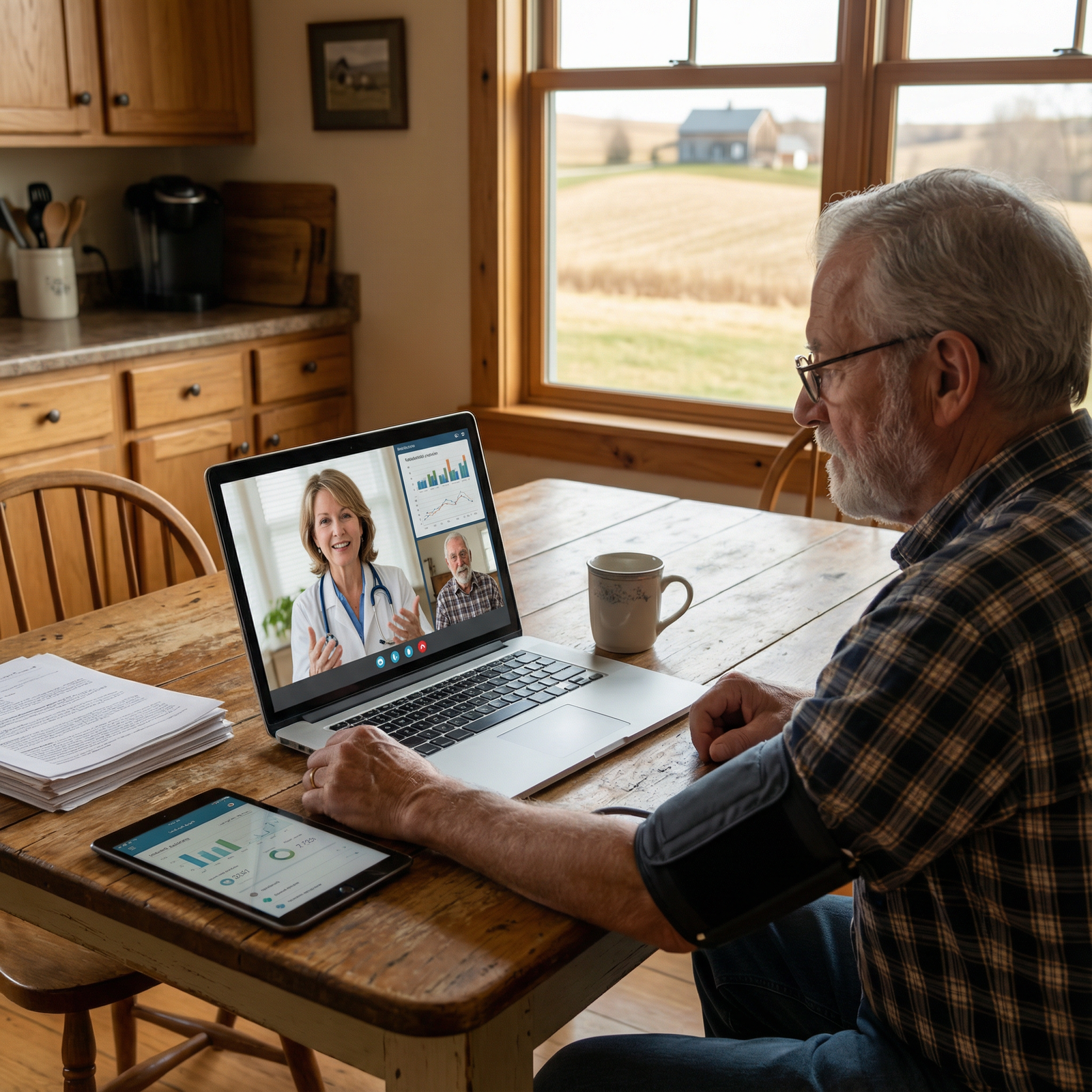
AI is not coming for your stethoscope. Not in the way the headlines keep promising, anyway.
The loudest voices are either breathless evangelists promising “doctorless clinics” or anxious residents whispering that “radiology is dead” and “primary care will be replaced by chatbots.” Both sides are mostly wrong. When you look at what’s actually happening in real clinics, with real patients and real liability, the story is very different.
Let’s walk through what the data shows instead of what the hype machine keeps recycling.
The Myth: “AI Will Replace Clinicians”
You’ve heard the script:
- “Radiologists are going to be obsolete in 5–10 years.”
- “AI will handle triage, diagnosis, and treatment planning for most conditions.”
- “Patients will just use symptom checkers and telehealth bots.”
This narrative rests on three assumptions that fall apart under scrutiny:
- That AI performs consistently as well as top clinicians in the wild, not just in carefully curated test sets.
- That health systems, regulators, and payers will happily accept “doctorless” workflows.
- That patients will trust and adopt those systems when anything important is on the line.
None of those are actually true right now. And there’s no good evidence they’ll be true in the near term.
What the Hard Data Actually Shows
Strip away the press releases and look at published studies and real-world deployments. A pattern emerges: AI is much better at augmenting clinicians than replacing them, and it often underperforms when left alone.
1. Diagnostic Performance: Great in Slides, Messy in Clinics
Those famous “AI performs as well as specialists” papers? Read the fine print.
Many are:
- Single-center datasets
- Retrospective
- Narrow inclusion criteria
- Sometimes comparing the model to individual clinicians, not teams or consensus
And when these systems get pushed into real clinical environments, performance drops.
Take deep learning for medical imaging:
- Algorithms trained on clean, labeled datasets often show AUCs in the 0.9+ range.
- But when tested on external data with different scanners, populations, or disease prevalence, performance lags. There are multiple studies showing 5–15 point drops in AUROC when you move outside the development site.
That’s not replacement territory. That’s “useful tool when a human is watching.”
2. Radiology: The “First to Die” That Actually Got Busier
Radiology has been the poster child of the “AI will replace you” narrative for a decade. Yet actual adoption looks more like this:
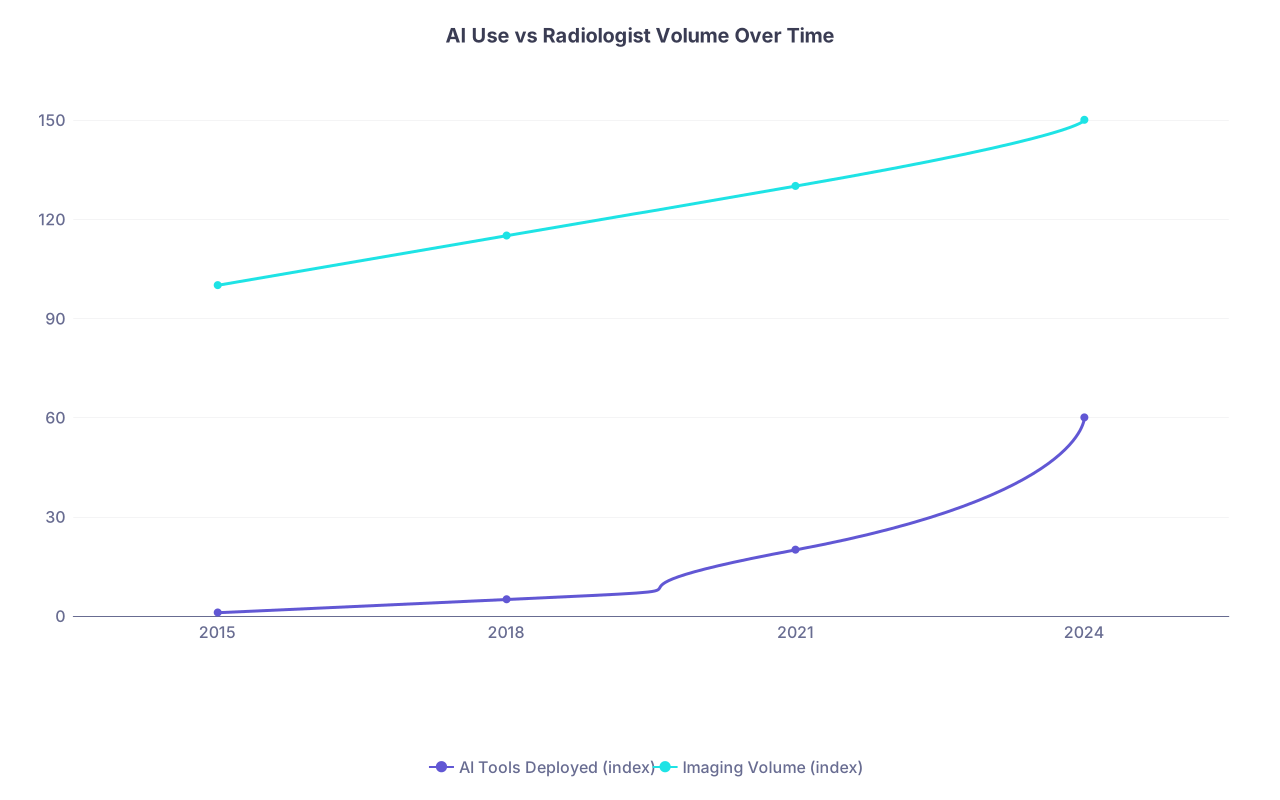
| Category | AI Tools Deployed (index) | Imaging Volume (index) |
|---|---|---|
| 2015 | 1 | 100 |
| 2018 | 5 | 115 |
| 2021 | 20 | 130 |
| 2024 | 60 | 150 |
While AI tools (for CT stroke detection, lung nodule flagging, mammography triage, etc.) have multiplied, imaging volume and radiologist workload haven’t magically vanished. If anything, they’ve increased.
In many large systems, AI is used to:
- Triage which scans need fastest review (e.g., suspected intracranial hemorrhage)
- Flag incidental findings that humans might miss under pressure
- Double-check measurements or segment structures
But the final read? Still a human name, human liability, human signature.
I’ve seen the reality on the ground: radiologists occasionally curse the false positives, appreciate the extra set of eyes on high-risk studies, and then get back to their 100+ study day. No one’s packing their office in anticipation of being replaced.
3. Chatbots and Triage Systems: Impressive… Until They Aren’t
Clinical chatbots and symptom checkers are a similar story. On demo day, they look fantastic. In uncontrolled patient use, they do less well:
- Independent evaluations of symptom checkers repeatedly show them underperforming experienced clinicians for both triage accuracy and diagnostic suggestions.
- Even where they’re decent, health systems treat them as front doors or previsit organizers, not decision makers. Someone still has to own the call.
When large language models entered the game, you saw papers showing they could pass licensing exams, write notes, or explain complex conditions at a layperson level. Fine. But none of that addresses the core questions ethicists and risk officers care about:
- Will it hallucinate contraindicated medications?
- Will it miss rare-but-deadly diagnoses?
- Who gets sued when it does?
Those questions keep real-world deployment cautious and human-in-the-loop.
The Real Shifts: What AI Is Actually Changing in Clinics
AI is changing clinical work. Just not in the simplistic “robot doctor” direction. It’s quietly rewriting the distribution of tasks—and the value of certain human skills.
1. Documentation and Bureaucracy: The First True Automation Win
If AI is going to “replace” anything in medicine soon, it’ll be your dictation system and a good chunk of your documentation misery.
Ambient scribe tools that listen in on visits and auto-generate notes are no longer vaporware. In multiple pilots:
- Clinicians save several minutes per encounter.
- Burnout scores—especially related to after-hours charting—improve.
- Note quality often improves because the system can structure information consistently, pull in meds/allergies, and auto-populate elements you’d usually copy-paste.
Does that eliminate you? No. It eliminates a piece of your cognitive load and your clerical overload.
The subtle shift: the clinicians who get good at “talking in a structured way” and quickly fixing AI-generated notes will be faster, less burned out, and more productive. That’s a skill.
2. Pattern Recognition and Triage: Safety Net, Not Reaper
In ERs and inpatient settings, AI tools now:
- Flag early signs of sepsis from streaming vitals and labs
- Alert when imaging suggests a stroke or PE
- Predict which admitted patients are at high risk of deterioration
The performance varies wildly across vendors and institutions, but the intended use is consistent: AI as a second set of eyes, not your replacement.
You’re still responsible for:
- Interpreting whether the alert makes sense for this specific patient in this specific context
- Prioritizing conflicting signals
- Deciding when to ignore the machine
The better you are at adjudicating competing inputs—including AI—the more valuable you become.
3. Personalized Risk and Treatment: Decision Support, Not Dictator
Risk calculators and prediction models predate the current AI craze. ASCVD risk, Wells score, CHADS-VASc—these are all structured attempts to make decision-making more data-driven.
Modern ML-based tools just push that a bit further:
- Predicting 30-day readmission risk
- Estimating which cancer patients benefit most from specific regimens
- Flagging patients likely to drop out of care so case managers can intervene
Again, no one serious is suggesting you blindly follow model output. The clinicians who thrive here:
- Understand what the model is—and is not—trained on
- Know where it generalizes poorly
- Can explain the tool to patients in plain language (“This is a calculator based on people like you. It’s not a guarantee, but it helps us weigh options.”)
That requires judgment, communication skills, and a basic grasp of statistics. Those don’t go out of style.
The Parts of Your Job AI Can’t Touch (And a Few It Will)
Let’s dissect your job like a coder dissecting a problem: into discrete sub-tasks. Then you can see what’s actually vulnerable.
Roughly, your clinical work consists of:
- Information gathering (history, exam, records, social context)
- Pattern recognition and hypothesis generation
- Synthesis and decision-making under uncertainty
- Communication and negotiation (with patients, families, teams)
- Procedural/technical skills (from venipuncture to neurosurgery)
- Administrative tasks (notes, orders, billing, inbox, prior auth hell)
Here’s the uncomfortable but useful truth:
| Task Category | AI Replacement Risk (Next 10–15 yrs) |
|---|---|
| Administrative tasks | High (automation likely) |
| Narrow pattern recognition | Moderate (augmented, not solo) |
| Information gathering | Low–Moderate (shared, limited) |
| Decision-making under uncertainty | Low |
| Communication/relationship | Very low |
| Procedural skills | Very low |
The threat isn’t “AI will be your attending.” It’s “if most of what you do is low-complexity pattern matching plus rote documentation, AI will steadily eat that.” And a lot of early-career work is that.
The opportunity is obvious: move up the value chain. The more your day involves uncertainty, nuance, tradeoffs, and human interaction, the harder you are to replace.
What This Means for Your Training and Career Choices
If you’re a student or resident, the smart move isn’t to fight AI or ignore it. It’s to weaponize it.
1. Stop Optimizing for What Machines Are Good At
Memorizing rare eponyms and obscure syndrome lists so you can impress on rounds? That’s not a durable advantage. Your phone can do that.
You should instead:
- Get very good at framing problems: “Here’s what I’m worried about, here’s what would change management.”
- Practice making decisions with incomplete and conflicting information.
- Learn how to weigh risk, cost, and patient preferences, not just “what’s the right answer.”
Machines excel at narrow pattern recognition. Humans excel at deciding what problem to solve in the first place.
2. Build Skills in “AI Literacy,” Not AI Worship
You do not need to become a machine learning engineer. You do need enough literacy to:
- Ask basic questions about validation: internal vs external; prospective vs retrospective
- Recognize obvious failure modes: dataset shift, biased training data, overfitting
- Spot when an AI recommendation conflicts with clinical reality and know you’re allowed to override it
This is ethics and professionalism in 2026 and beyond: understanding the tools you use well enough to own the decisions they influence.
3. Lean Into the Human Stuff You’ve Been Taught to Undervalue
Breaking bad news. Negotiating with a family that disagrees. Managing a patient with medically unexplained symptoms without dismissing or over-testing them. These are not soft skills; they’re core job security.
AI can generate empathetic-sounding responses. It cannot sit with a family’s anger, manage the room, and walk them from denial to acceptance over 45 minutes in the ICU. That’s you.
The specialties where relationship, continuity, and multi-problem complexity are central—geriatrics, palliative, complex primary care, many inpatient roles—are substantially safer from replacement than fear-mongers suggest. They may end up with more AI help than average, but not less employment.
The Ethics: You’re Not Competing With AI, You’re Responsible For It
The ethical question is not “Will AI replace us?” It’s “Are we going to abdicate responsibility to it when things get hard?”
In practice, that means a few things:
- You cannot hide behind “the algorithm said so” when an outcome is bad. Courts and boards will hold people responsible.
- You’ll need to get familiar with bias and fairness issues. Models trained on majority populations can underperform badly in marginalized groups. If you deploy them blindly, you’re not being “innovative”; you’re being negligent.
- You’ll have to advocate for transparency. If your hospital buys a black-box system without decent validation data, you have every right—and arguably a duty—to question using it on your patients.
Clinician involvement is the difference between ethical AI and unsafe AI. If you check out of that conversation because “tech isn’t my thing,” you’re letting administrators and vendors make clinical and moral decisions for you.
The Real Threat: Not Replacement, But De-skilling
I’ll be blunt: the biggest danger is not that AI takes your job. It’s that you get so used to auto-complete medicine that your skills quietly atrophy.
I’ve seen versions of this already:
- Overreliance on auto-interpretation of EKGs in the ED
- Blind trust in automated differential lists from decision support tools
- Point-and-click order sets being used without thinking about why each item is there
Now, amplify that with stronger AI. Generative systems that write your note, propose your assessment and plan, and suggest your orders. Tempting, when you’re exhausted. Dangerous, when used uncritically.
If you want to stay valuable, you have to use AI like a colleague you respect but do not worship. You ask it for input. You question it. You sometimes ignore it. And you keep your own muscles strong.
If You Remember Nothing Else
Three takeaways, and then you can go back to your notes:
- The evidence from real clinics points to AI as an augmenting tool, not a clinician replacement. Performance drops in the wild, liability remains human, and workflows still center on people.
- The tasks at highest risk are administrative drudgery and narrow, repetitive pattern recognition. The more your work involves uncertainty, judgment, and human connection, the safer—and more valuable—you are.
- Your job over the next decade is not to out-compete AI, but to learn to wield it responsibly, maintain your own skills, and insist on ethical, validated tools for your patients.
AI is not your replacement. It’s your new intern: fast, sometimes brilliant, occasionally dangerous, and absolutely in need of supervision.


