

The scariest part of genomics isn’t the technology. It’s the thought that you might get it wrong and hurt someone forever.
That’s the thing that sits in the back of my mind: not just “What if I don’t know enough about variants?” but “What if I misinterpret a critical variant, give the wrong advice, and the patient pays for it?” And honestly, the more I read about genomics, the more I toggle between fascination and full‑on panic.
If you’re anything like me, this is the mental spiral:
- What if I miss a pathogenic variant and a patient doesn’t get a life‑saving intervention?
- What if I overcall something and push someone into prophylactic surgery they never needed?
- What if I trust a lab report too much?
- Or not enough?
So let’s actually talk about this. Not in the polished, “genomics is the future of medicine” way. In the “I’m terrified of screwing this up ethically and clinically” way.
The Nightmare Scenario: Misinterpreting a Variant
Here’s the horror movie I keep replaying in my head.
A 35‑year‑old woman comes in. Strong family history of breast and ovarian cancer. She gets genetic testing. There’s a BRCA1 variant on the report.
And now it’s your job to help interpret what that means.
What if:
- You assume “variant in BRCA1 = high risk” and she chooses prophylactic mastectomy and oophorectomy…
- Then later it turns out that variant is actually benign or a VUS (variant of uncertain significance)? Or the flip side:
- You reassure her because the lab classifies it as “likely benign,” you gloss over nuance…
- And five years later she develops aggressive cancer that might have been preventable?
That’s the kind of thing that keeps me up.
The scary truth: genomics isn’t like reading a potassium level. It’s messy, evolving, and full of gray zones. Terms like “likely pathogenic,” “VUS,” “penetrance,” and “reclassification” sound technical in lectures, but in practice they translate into real‑world decisions with real‑world regrets.
And the ethical weight of that? Heavy.
You’re Not Actually Supposed to Do This Alone
Here’s the part I keep having to remind myself: if I’m sitting alone in a room trying to make sense of a complicated variant, something has already gone wrong.
Genomic medicine is built on teams, not lone heroes. That’s not just a nice ideal; it’s a safety feature.
| Role | Primary Responsibility |
|---|---|
| Ordering Clinician | Clinical context, pre/post-test counseling |
| Genetic Counselor | Risk assessment, patient communication |
| Molecular Geneticist | Variant classification, technical details |
| Lab Director | Oversight of report accuracy and standards |
| Ethicist (when needed) | Complex ethical dilemmas and edge cases |
If you’re imagining yourself as the single point of failure—reading a raw sequencing file and inventing an interpretation—you’re imagining the wrong scenario. The actual danger is not “What if I misinterpret a variant?” It’s “What if I act alone and don’t ask for help when I’m out of my depth?”
Because that’s the line ethically:
- Acting confidently when you’re not qualified or uncertain.
- Not looping in genetics professionals.
- Not admitting “I don’t know.”
Saying “I’m not sure; we need a genetics consult” isn’t weakness. It’s literally the ethical thing to do.
The Variant Classification System Is Built to Prevent Your Worst Fear
One thing that helped me panic slightly less was realizing: variant classification is systematic. It’s not a vibe. There are actual standards, like the ACMG/AMP guidelines, that labs use to classify variants.
You’ve probably seen these categories:
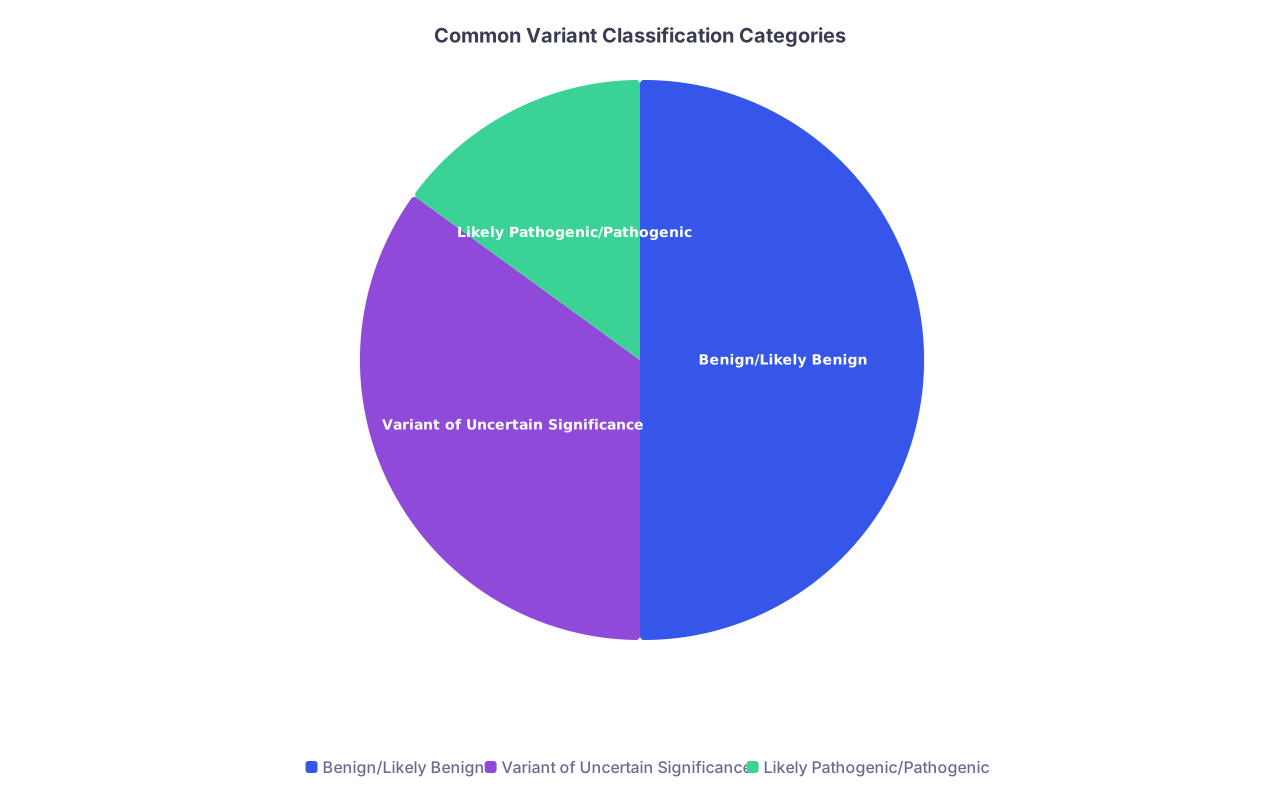
| Category | Value |
|---|---|
| Benign/Likely Benign | 50 |
| Variant of Uncertain Significance | 35 |
| Likely Pathogenic/Pathogenic | 15 |
And there’s a reason those words matter:
- Pathogenic / Likely Pathogenic: Strong evidence this variant is disease‑causing.
- Benign / Likely Benign: Strong evidence it’s not disease‑causing.
- VUS: Translation: “We genuinely don’t know yet.”
Where people (and by “people” I mean anxious future‑me) get into ethical trouble is when they treat a VUS like it’s pathogenic. Or ignore important qualifiers like “likely” and act as if something is 100% definite.
The system is built to encode uncertainty:
- Population databases (gnomAD, etc.)
- Functional studies
- Segregation data
- Computational predictions
- Clinical case reports
Labs synthesize all this. Your ethical job isn’t to independently re‑classify the variant. It’s to:
- Understand what the classification means.
- Stay within the limits of that meaning.
- Communicate that uncertainty honestly to the patient.
If you start “upgrading” or “downgrading” variants in your head without genetics backing, that’s where the real danger lives.
The Real Ethical Risks (It’s Not Just About Being Wrong)
My internal monologue used to be: “I’m scared of being wrong.” But that’s too simplistic. There are different ways of being wrong, and some are way more ethically problematic than others.
Here’s what I worry about most:
Overcalling risk
- Treating “likely pathogenic” or a VUS as a guaranteed outcome.
- Pressuring a patient toward drastic interventions because you’re anxious.
- Presenting options like there’s only one “smart” choice.
Undercalling risk
- Minimizing a truly pathogenic variant because you’re afraid of scaring someone.
- Over‑reassuring when you don’t fully understand penetrance or expression.
False certainty
- Speaking in absolutes: “This means you will get X” or “You’re totally safe.”
- Hiding your uncertainty because you think patients “can’t handle it.”
Not acknowledging reclassification
- Acting like the report is frozen forever.
- Not warning patients that some variants may be reclassified with time.
The ethical core isn’t “never be wrong.” That’s impossible. The core is:
- Don’t pretend you’re sure when you aren’t.
- Don’t act outside your training without backup.
- Don’t let your own anxiety push the patient into irreversible decisions.
How People Actually Get Burned by Misinterpretation
I’ve seen a few patterns in case discussions and conferences that keep coming up. These are the stories that haunt me a bit.
The prophylactic surgery case
- VUS in BRCA.
- Non‑genetics clinician says, “Given your family history plus this gene change, you should seriously consider surgery.”
- Patient later learns that VUS shouldn’t guide major management decisions.
- Years of regret, body image issues, trust broken.
The “You’re cancer‑free forever” reassurance
- Patient with a strong family history does a panel.
- No clearly pathogenic variants found.
- Clinician treats that as a clean bill of genetic health.
- Patient stops screening or is less vigilant.
- Later develops cancer that was probably multifactorial or from genes not tested.
The family ripple effect
- One family member gets tested.
- Result is misinterpreted as clearly hereditary.
- Multiple relatives act on incomplete or misinterpreted information.
- The harm spreads beyond one patient.
In all of those, the problem wasn’t the existence of the variant. It was:
- Overconfidence,
- Poor communication,
- Acting like genomics gives black‑and‑white answers when it doesn’t.
Which… I can see myself accidentally doing if I’m rushed, stressed, or trying too hard to sound competent.
Practical “Rules of Self-Defense” Against Misinterpreting Variants
Because my brain likes rules when I’m panicking, here’s what I’ve started treating as non‑negotiables for future‑me.
Never manage a VUS like it’s pathogenic.
- Screening and surgeries shouldn’t be based on a VUS alone.
- Use family history and clinical context for decisions, not just the variant label.
Never interpret a genomics report in a vacuum.
- Always tie it back to:
- The patient’s phenotype,
- Family history,
- Known gene–disease relationships.
- “Variant = disease” is not how this works.
- Always tie it back to:
Always involve genetics when:
- There’s a VUS that actually impacts decisions.
- There’s a pathogenic/likely pathogenic variant in a gene you don’t fully understand.
- The patient is making a big, irreversible choice based on the report.
Say the actual uncertainty out loud.
- “This variant is associated with increased risk, but it doesn’t guarantee disease.”
- “This is a variant of uncertain significance; we don’t have enough evidence yet to say if it’s harmful or not.”
- “There’s a chance this classification changes as we learn more.”
Document your thought process.
- What did the report say?
- What did genetics recommend?
- What did you explain to the patient?
- If things go wrong, the ethical difference between “careful with uncertainty” and “reckless” is often in the notes.
Your Fear Actually Has a Purpose (If You Let It)
I’m not going to pretend the fear goes away. Mine hasn’t. But it’s shifted.
The fear of misinterpreting a critical variant can either:
- Paralyze you into avoiding genomics altogether (which is its own kind of harm), or
- Push you into being meticulous, collaborative, and humble.
That second option is where the ethics live.
Think about it:
- Would you trust the clinician who says, “Genomics is easy, I’ve got this” with no consult?
- Or the one who says, “This is complex, I’ve reviewed it, but I’d like to confirm with a genetic counselor before we decide on surgery”?
I know who I’d want as my doctor.
Your anxiety can be a built‑in safety alarm:
- It reminds you to check guidelines.
- It nudges you to call genetics.
- It stops you from bulldozing over uncertainty.
As long as you don’t let it turn into avoidance or dishonesty, it’s not your enemy.
Building Actual Competence So You’re Not Just Scared
Fear without skills is miserable. Fear with skills is caution.
If you’re in med school, residency, or early practice, here’s what I’ve seen actually help people feel less like they’re about to ruin someone’s life with a misread variant:
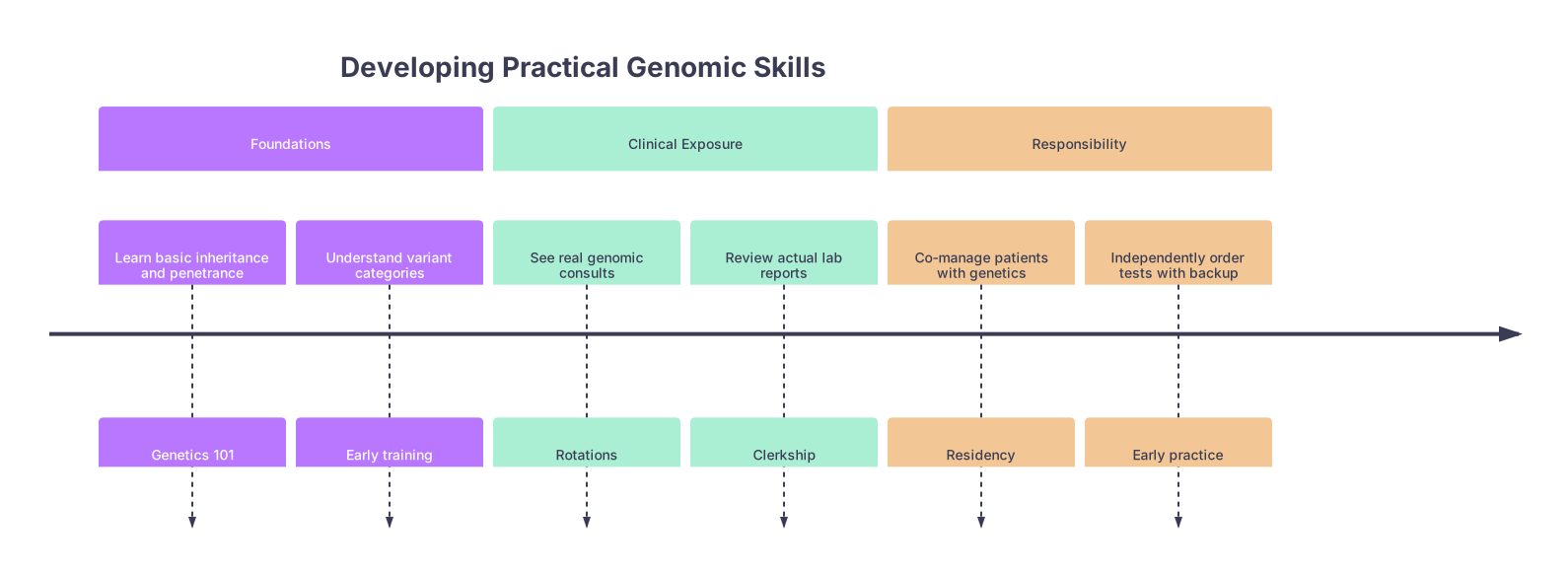
| Period | Event |
|---|---|
| Foundations - Learn basic inheritance and penetrance | Genetics 101 |
| Foundations - Understand variant categories | Early training |
| Clinical Exposure - See real genomic consults | Rotations |
| Clinical Exposure - Review actual lab reports | Clerkship |
| Responsibility - Co-manage patients with genetics | Residency |
| Responsibility - Independently order tests with backup | Early practice |
Things that actually build confidence:
- Reading actual lab reports regularly, not just textbook examples.
- Sitting in on genetic counseling sessions and watching how they phrase risk.
- Learning what you are and are not supposed to do with VUSs.
- Understanding a handful of key genes deeply (BRCA1/2, Lynch syndrome genes, etc.), instead of pretending you know all of them.
You don’t need to be a human ClinVar database. You need to:
- Recognize when something is beyond your depth.
- Know who to call.
- Understand the ethical stakes enough to not wing it.
What If I Still Make a Mistake?
Here’s the part my brain hates: there is no world where you will never misinterpret something. Medicine doesn’t offer that guarantee anywhere, least of all in genomics.
But not all mistakes are equal.
There’s a difference between:
- A reasonable, well‑documented decision made with the best available evidence and appropriate consultation…
- Versus a solo, overconfident call made outside your expertise with no acknowledgment of uncertainty.
Ethically, the line is:
- Were you honest about what you knew and didn’t know?
- Did you use available resources (genetic counselors, guidelines, databases)?
- Did you communicate risk and uncertainty transparently to the patient?
- Did you avoid pressuring the patient into irreversible decisions?
If the answer to those is yes, and things still go wrong—that’s tragic, but it’s not unethical. It’s the reality of practicing in a field that’s evolving faster than our comfort.
The Short Version (for When Your Brain Starts Spiraling at 2 a.m.)
If you remember nothing else when your mind starts replaying the “What if I misinterpret a critical variant and ruin someone’s life?” loop, keep these:
- You’re not supposed to interpret genomics alone. Ethics in genomics = teamwork, consultation, and humility.
- The biggest danger isn’t being uncertain. It’s pretending certainty you don’t have—especially with VUSs and “likely” labels.
- Your anxiety can be useful if it pushes you to ask for help, respect uncertainty, and document your reasoning instead of faking confidence.
You will never feel 100% safe with genomics. But if you keep those three anchors, you’re a lot less likely to be the horror story you’re currently afraid of becoming.


