
What happens when a “cutting‑edge” therapy you’re excited about ends up in front of the ethics committee—because your consent process was sloppy, rushed, or half‑baked?
If you’re working around cell therapies, AI‑guided interventions, off‑label biologics, or any “first in human” innovations, you’re sitting on a minefield. Not because innovation is bad. Because consent with novel therapies is where good intentions get shredded by ethics reviews, complaints, or—worse—harm that the patient never really understood they were signing up for.
Let me walk you through the mistakes I’ve seen derail smart clinicians and trainees.
1. Treating a Novel Therapy Like “Just Another Option”
The first big mistake: pretending a novel therapy is just another line on the menu and using your usual consent script.
You know the script:
- “These are the risks, these are the benefits, here’s the alternative.”
- A quick handout.
- A signature at the bottom.
- Done.
With novel therapies—new CAR‑T indications, unproven AI‑driven dosing algorithms, experimental implants—that approach is lazy and dangerous. Ethics committees pounce on this.
Why? Because novelty changes the entire consent landscape:
- Uncertain risk profile — You don’t actually know all the risks yet.
- Limited evidence — You can’t lean on strong RCTs or long‑term data.
- Hype distortion — Media, industry, and even your colleagues inflate expectations.
- Regulatory gray zones — The line between care and research blurs fast.
I’ve watched people get grilled in ethics review meetings because their notes and forms treated a first‑in‑clinic device like a standard implant, with the same boilerplate consent sections.
Don’t make this mistake.
With novel therapies, you must:
- Explicitly flag that this is new and not yet part of standard of care.
- Spell out that unknown risks exist, not just the known ones.
- Avoid making outcome predictions sound more certain than they are.
If your documentation reads like an ordinary consent for an ordinary treatment, you’re already in trouble.
2. Failing to Separate Clinical Care from Research
This one triggers ethics committees faster than almost anything else: mixing research and clinical care in one muddled “consent” discussion.
The patient thinks: “My doctor is recommending this treatment for me.”
You think: “We’re offering an innovative therapy with data collection and protocolized follow‑up.”
The ethics committee thinks: “You just ran human subjects research without a clear, IRB‑approved consent process.”
Here’s where people screw up:
- The “new” therapy is tied to a structured protocol, data capture, extra visits.
- Outcomes will be analyzed, maybe even published.
- But the discussion with the patient is framed purely as “treatment,” not “research involvement.”
- No separate research consent. No clear explanation that they can say no to the study and still receive standard care.
That’s textbook therapeutic misconception—patients believing everything offered is purely for their individualized benefit, rather than partially for generating generalizable knowledge.
Ethics committees love that phrase. They hate seeing it in practice.
If any of these are true, you likely need IRB oversight and a proper research consent:
- You’re systematically collecting outcomes beyond routine documentation.
- There’s a defined protocol, inclusion/exclusion criteria, or control group.
- The primary goal is to test efficacy/safety, not just deliver best available care.
- You’re planning to publish or present aggregated results.
And then you need something like this, in plain language:
- “You can say no to this study and still receive the best standard treatment we can offer.”
- “This is a research protocol, not a standard approved treatment for your condition.”
- “We do not yet know if this works better, the same, or worse than current standard options.”
If that language is missing, ethics review will not be kind.
3. Under‑disclosing Uncertainty and Over‑selling Hope
The fastest way to lose ethics committee trust? Turn into a salesperson the moment something “innovative” is involved.
I’ve seen clinicians say things like:
- “This could really be a game‑changer for you.”
- “You’re the perfect candidate for this cutting‑edge approach.”
- “We’ve had promising results so far.”
But then you read the data: tiny phase I trial, no long‑term follow‑up, high cost, serious potential complications.
This is where people confuse possibility with probability.
You must not:
- Present speculative benefits as likely outcomes.
- Use success stories from 2–3 patients as if they’re representative.
- Soft‑pedal serious adverse event rates with vague phrases like “some risk.”
Ethics committees get very tense when they see:
- “This offers you the best chance.”
- “We expect this to help.”
- “So far we’ve had excellent results,” with no numbers.
Be concrete instead. And not just in your head—in the consent discussion and in the documentation.
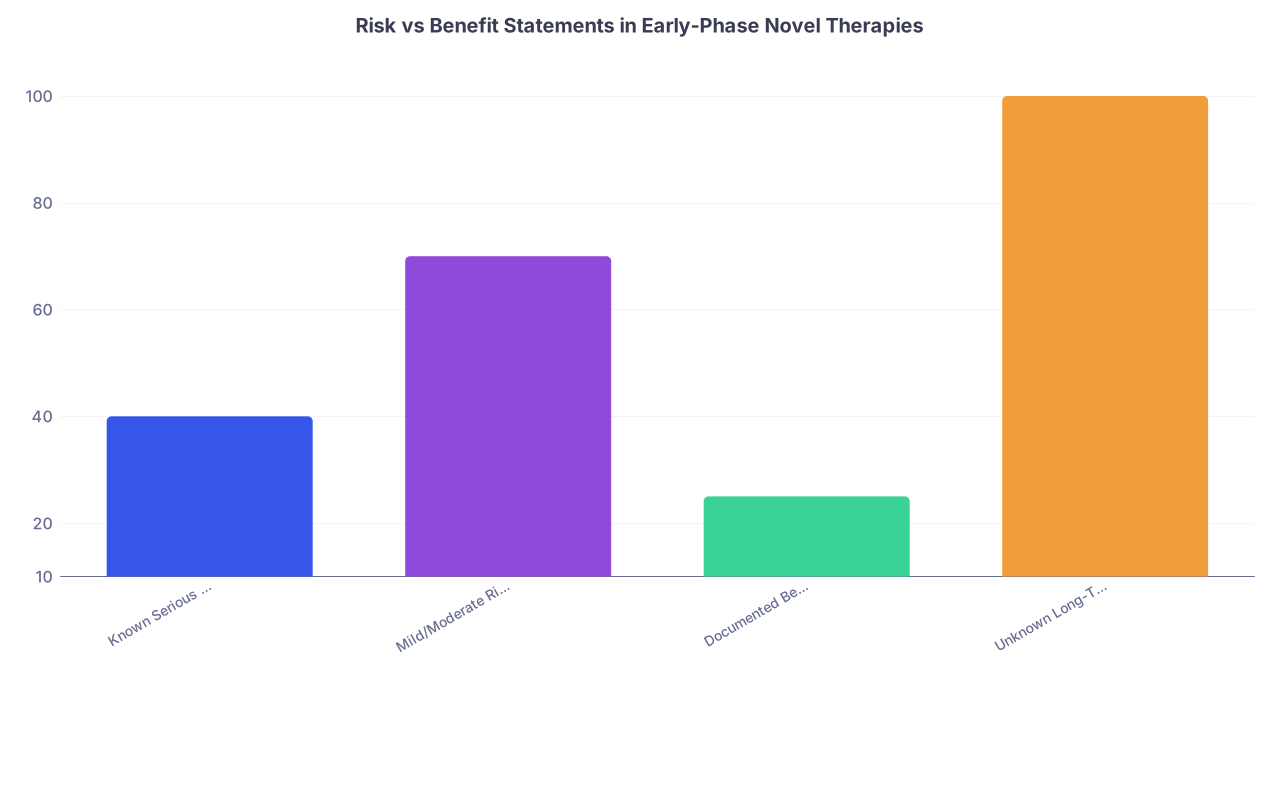
| Category | Value |
|---|---|
| Known Serious Risk | 40 |
| Mild/Moderate Risk | 70 |
| Documented Benefit | 25 |
| Unknown Long-Term Effects | 100 |
Here’s the trap: early‑phase or novel interventions typically have:
- High or uncertain risk,
- Modest or unclear benefit,
- Almost no long‑term safety data.
If the way you talk about the therapy doesn’t reflect that asymmetry, your consent process is misleading. That’s enough to trigger ethics complaints even if nothing “goes wrong” clinically.
Hard rule: if you find yourself getting excited describing the therapy, stop and re‑center on what you actually know—not what you hope.
4. Ignoring the Power Imbalance and Subtle Coercion
You might think: “I never coerce anyone.” Good for you. But consent can be undermined without obvious threats, especially with novel therapies that sound like “last chances.”
Watch for these red flags that ethics committees look for:
- The therapy is presented “at the bedside” when the patient is in crisis, in pain, or barely processing.
- Family members say, “Doctor, if you think this is best, we’ll do it,” and you don’t slow down to explore whether they actually understand.
- The patient hears, “If you decline, we basically have nothing else,” even if palliative or alternative routes exist.
Subtle coercion often comes from:
- Time pressure: “We need a decision now, or you’ll miss the window.”
- Authority pressure: “Our team recommends this as the best option.”
- Scarcity framing: “Few people are offered this; you’re lucky to qualify.”
I’ve seen consent forms that look fine, but the context is awful: rushed ICU conversations, heavily emotional framing, no documented follow‑up discussion. When a complication hits, families say, “We didn’t realize this was experimental.” Ethics committees generally believe them more than they believe your two‑line note.
To avoid that:
- Build in a cooling‑off period whenever possible, especially with high‑risk innovation.
- Document more than “risks/benefits discussed.” Write what the patient said back to you.
- Offer a neutral phrase like: “Some patients prefer not to be among the first to try new treatments. Others are comfortable with that. Both choices are reasonable.”
If your notes or your behavior suggest that “reasonable decline” wasn’t really on the table, ethics trouble is coming.
5. Sloppy or Misleading Documentation
Ethics committees don’t attend your consent conversations. They read your chart.
If your documentation looks like this:
- “Informed consent obtained. Patient agrees.”
- “Risks and benefits discussed.”
- “Patient understands this is experimental.”
…that’s weak, borderline useless, especially for novel therapies.
You want something closer to:
- What you called the therapy (novel, off‑label, early‑phase).
- How you explained its status (not standard of care; limited data).
- What alternatives you presented, including doing nothing or supportive care.
- The key risks you highlighted and how the patient responded.
- Any time pressure or clinical urgency that limited extended discussion.
Ethics review gets especially hostile if your written explanation and your billing or protocol behavior don’t align. For example:
- You document this as “standard care” but treat patients per a funded protocol.
- You call it “well established” in your note while the IRB application says “high uncertainty.”
- Your patient handout uses marketing language the IRB never approved.
When there’s a serious adverse event, the chart is your only defense. If the consent note is superficial, the assumption will be that the conversation was, too.
6. Hiding the Financial and Institutional Interests
Another trap: not disclosing who benefits from the therapy beyond the patient.
Novel therapies are often financially and professionally loaded:
- Industry‑sponsored access programs.
- Device or drug company relationships.
- Investigator‑initiated trials where your promotion depends on results.
- Institutional prestige tied to “first to offer X.”
If patients are never told:
- That this therapy is part of a study generating data for a sponsor,
- That you or your institution receive funding or support for using it,
- That there may be cheaper or non‑proprietary alternatives elsewhere,
you’ve got a conflict‑of‑interest problem.
Ethics committees are very sensitive to situations where:
- The consent feels like marketing copy.
- The promotional aspect creeps into clinical language.
- The more patients enrolled, the more the institution benefits—not just medically, but reputationally or financially.
You don’t need to torture the patient with every internal detail of funding, but you absolutely must say, in plain language, things like:
- “This therapy is provided through a sponsored program.”
- “The results will be shared with the company that makes the product.”
- “I do not receive personal payment for enrolling you, but the study is funded.”
If any of those are untrue but could be inferred from your behavior, tighten it up now before ethics does it for you.
7. Misjudging When Innovation Crosses the Line into “Human Subjects Research”
Clinicians love to say: “We’re just trying something new for this patient individually.” Ethics boards hear that and think: “You mean you’re experimenting without oversight.”
The mistake? Assuming that as long as your intent is “helping the patient,” nothing you do counts as research.
Wrong. Intent is not the only factor.
Look at what you’re actually doing:

| Step | Description |
|---|---|
| Step 1 | Offer New Therapy |
| Step 2 | Multiple similar patients |
| Step 3 | Likely research - IRB needed |
| Step 4 | Innovative care but monitor closely |
| Step 5 | Single patient only? |
| Step 6 | Systematic data collection planned? |
| Step 7 | Protocol or criteria used? |
Red flags that you’ve crossed into research territory:
- Repeated use of the novel intervention under the same criteria.
- Predefined endpoints (e.g., survival at 6 months, tumor response rates).
- Intention to publish outcomes “to inform future care.”
- Structured follow‑up beyond what you would normally do clinically.
If those are present and you don’t have IRB approval and a research consent form, expect:
- Retrospective ethics headaches.
- Questions about every single consent you obtained.
- Possible rejection of your data from journals for ethics noncompliance.
The safest mindset: if you’re using a novel therapy in a way that looks like you’re testing it, not just applying it, treat it as research. Get proper oversight.
8. Overlooking Vulnerable Populations in Novel Therapy Consent
Innovation loves desperate spaces: late‑stage cancer, rare genetic disorders, neurodegeneration, pediatrics, ICU. Places where patients and families are emotionally wrecked and ready to “try anything.”
Ethics committees know this. They’re brutal when they see innovation piled onto vulnerability without safeguards.
Common failures:
- Using dense, technical language with patients who have limited health literacy.
- Getting a rushed verbal “yes” from a stressed surrogate without separate follow‑up.
- Offering novel therapies to children or cognitively impaired adults with ambiguous documentation about assent or dissent.
- Not explaining to families that refusing the novel option doesn’t mean “giving up.”
That last point is huge. I’ve sat with families who were haunted by the sense that if they declined the new therapy, they were abandoning their loved one. No one stopped to say:
- “Choosing comfort‑focused care is not choosing less care. It’s choosing a different goal.”
If you’re introducing a high‑risk, uncertain therapy to someone already on the edge—developmentally, cognitively, emotionally—you need more consent protection, not less.
That can mean:
- Extra time and multiple conversations.
- Visual aids or plain‑language summaries.
- Explicit offers to involve another trusted clinician for a second opinion.
- Pausing when families parrot back your language instead of using their own.
If the ethics committee reviews the case and sees nothing tailored to the vulnerability of the patient, just a generic form, expect criticism.
9. Letting Technology or AI Hide Behind the Consent
Here’s a newer problem: AI‑driven, algorithm‑guided, or software‑dependent therapies.
Examples:
- AI systems that drive radiation planning.
- Machine‑learning tools that pick chemo regimens.
- Closed‑loop insulin systems or neurostimulators adapting in real time.
The mistake: treating the technology as a neutral “tool” that doesn’t require specific consent attention.
But if:
- The algorithm’s decisions are not transparent,
- The training data doesn’t reflect your patient population,
- The system is still being updated, iterated, or “validated” as you go,
then you’re again in the research/innovation gray zone.
Quick comparison to keep in your head:
| Aspect | Standard Tool (e.g., calculator) | Novel Algorithm (e.g., AI dosing) |
|---|---|---|
| Transparency | Fully understood | Often opaque |
| Evidence base | Established | Limited / evolving |
| Data source | Not patient-specific learning | Learned from past patient data |
| Need special disclosure | Usually no | Usually yes |
Ethics committees will ask:
- Did the patient know an AI or adaptive system was materially influencing their care?
- Were they told about uncertainty, limitations, or bias in the system?
- Could they have reasonably opted for a more standard, clinician‑driven approach?
If your consent acts like the tech is just “in the background,” you’re erasing a key risk dimension. And yes, that’s a consent pitfall that can absolutely send your practice under ethics review.
10. Forgetting That Consent Is a Process, Not a Signature
The last mistake is the most boring but also the most common: reducing consent for novel therapies to a single conversation and a single signature.
Novel therapies evolve as you go.
- New data emerges mid‑treatment.
- Side effects appear that weren’t expected.
- Protocols or dosing schemes change.
- Access programs open and close.
If you got consent once, six months ago, and never revisited it when the situation changed, your “ongoing” use of the therapy may now be ethically exposed.
Think of consent for novel therapies like this:
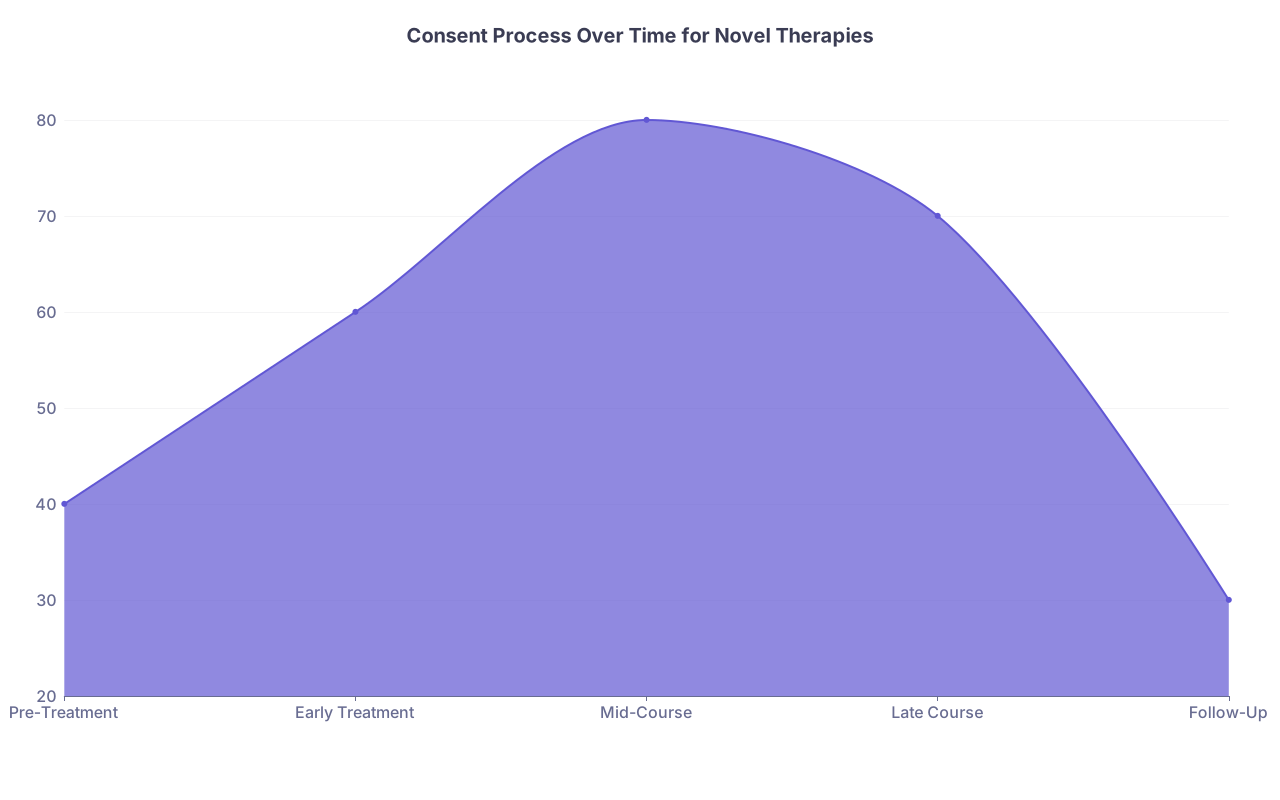
| Category | Value |
|---|---|
| Pre-Treatment | 40 |
| Early Treatment | 60 |
| Mid-Course | 80 |
| Late Course | 70 |
| Follow-Up | 30 |
The stakes and information change across phases. Yet I constantly see charts where:
- Initial consent is documented.
- Major plan changes are made months later.
- No refreshed consent. No updated risk–benefit discussion. Nothing.
When ethics committees see that, they question not just your process, but your respect for autonomy.
You avoid this by:
- Re‑opening the consent dialogue when key new data arrives.
- Documenting re‑discussions: “Reviewed updated evidence with patient; they wish to continue.”
- Treating withdrawal of consent as a real, respectable option, not a problem to “solve.”
If your attitude is “they signed once, we’re covered,” you’ve entirely missed the point of consent in the context of medical innovation.
Final Thoughts: The Three Things You Can’t Afford to Get Wrong
Keep it simple in your mind. With any novel therapy that might drag you before an ethics review, you absolutely cannot afford to:
- Blur treatment and research. If you’re testing, collecting, or publishing, you’re in research territory. Get oversight. Get proper research consent.
- Soft‑pedal uncertainty. Admit what you don’t know. Make unknowns and potential harms explicit. Don’t sell hope you can’t back with data.
- Reduce consent to a checkbox. Novel therapies demand richer, ongoing, contextual consent—especially for vulnerable patients, early‑phase interventions, and anything tied to financial or institutional interests.
If you respect those three, you’ll still make judgment calls, but you’re far less likely to meet the ethics committee because of preventable, sloppy consent mistakes.