

When is it appropriate to suggest expanded access to a new drug?
What do you do when a patient has exhausted every approved option, the clinical trial slot is gone (or never existed), and you know there’s a promising new drug sitting behind regulatory glass?
That’s exactly where expanded access (compassionate use) lives. And it’s where a lot of well‑meaning clinicians either overstep or stay silent because they are unsure of the rules.
Let me lay it out clearly.
First: What expanded access actually is (and is not)
Expanded access (EA) = a regulatory pathway that lets patients get an investigational drug outside a clinical trial when no comparable or satisfactory alternatives exist.
It is not:
- A shortcut around clinical trials
- A “right” the patient automatically has
- A way to offer speculative, last‑minute miracle cures because everyone feels desperate
The usual players:
- Patient with serious or life‑threatening disease
- Treating clinician (you)
- Drug sponsor (pharma/biotech)
- Regulator (e.g., FDA in the US; EMA/national authority in EU)
- Often: IRB/ethics committee and institutional leadership
The core ethical tension: You’re trying to help one patient now without causing disproportionate risk to that patient or undermining the generation of evidence that could help many future patients.
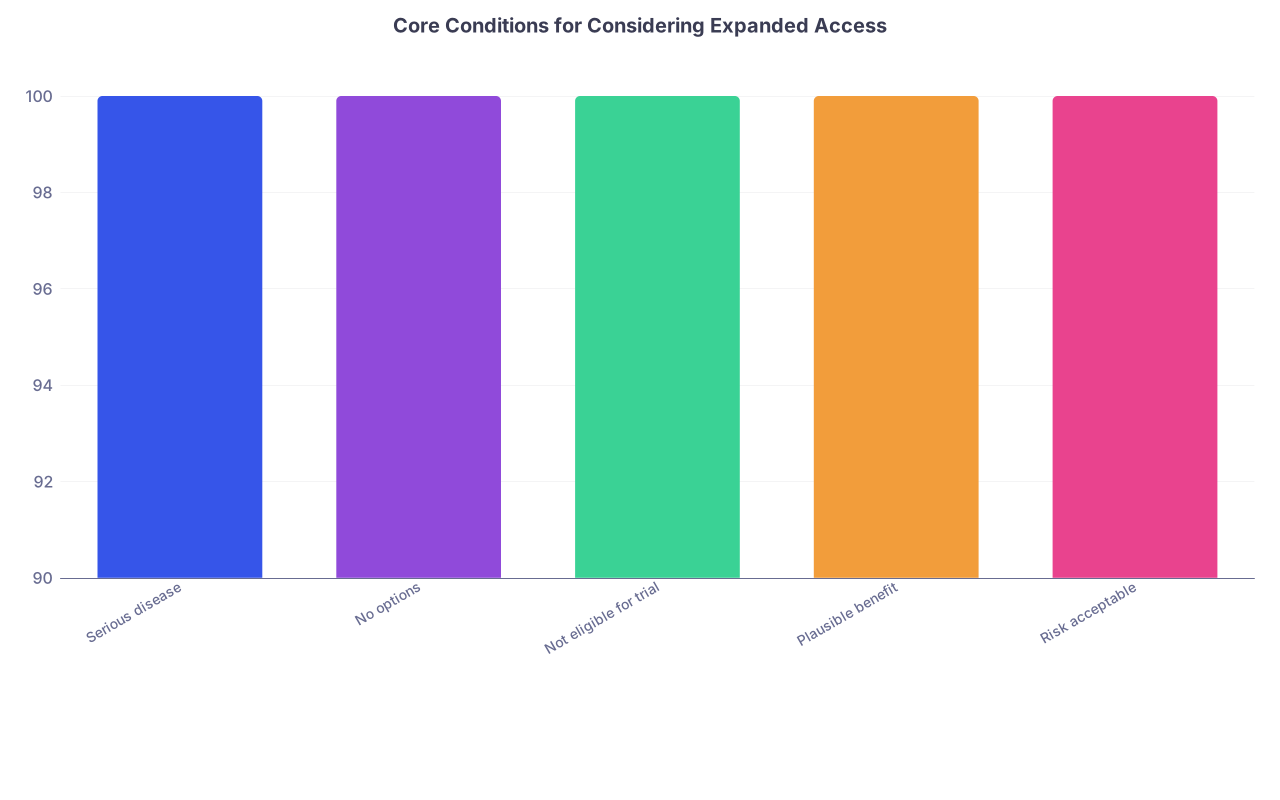
The 5 conditions that must be met before you even consider suggesting expanded access
If these are not all present, you should not be suggesting EA. Full stop.
| Category | Value |
|---|---|
| Serious disease | 100 |
| No options | 100 |
| Not eligible for trial | 100 |
| Plausible benefit | 100 |
| Risk acceptable | 100 |
1. The patient has a serious or life‑threatening condition
Not chronic annoyance. Not “would be nice to try something new.”
Appropriate scenarios:
- Metastatic cancer failing standard lines of therapy
- Advanced heart failure not a candidate for transplant/LVAD, exhausting guideline therapy
- Progressive neuromuscular disease with substantial disability and clear trajectory
Question you should be able to answer clearly:
“Is this condition serious enough that a reasonable clinician would accept higher‑than‑usual treatment risk?”
If you hesitate, EA probably isn’t the right path.
2. No satisfactory approved alternatives remain
This is where people get lazy or biased.
You should not jump to EA when:
- There are still guideline‑supported regimens untried because they are inconvenient or unpopular
- Patient or clinician simply “dislikes” standard options without good reason
- An approved therapy exists but is hard to access and you have not seriously attempted to obtain it (financially or logistically)
Appropriate to consider EA only when:
- Approved therapies have been tried and failed
- Approved therapies are contraindicated (e.g., severe allergy, co‑morbidities)
- Approved options are genuinely expected to be futile (e.g., response probability near zero in a well‑defined setting, not just “low-ish”)
Your ethical duty here: do a real, documented review of options. Not just “we’ve kind of tried a lot.”
3. Clinical trial participation is not possible
This part is routinely ignored or glossed over, and that’s ethically dangerous.
Expanded access should never be your first pathway if a feasible trial exists, because:
- Trials generate knowledge and protect patients with protocolized monitoring
- EA does not give the same evidentiary or safety structure
You should suggest EA only after:
You have checked for:
- Trials of the drug in question
- Reasonably similar agents in the same class
- Different trial sites that might accept the patient
And then confirmed at least one of the following:
- Patient is ineligible based on inclusion/exclusion criteria (e.g., organ dysfunction, performance status, prior therapy)
- No trial site is logistically feasible (geography, finances, functional status) despite serious efforts to explore options
- The relevant trial has closed to accrual or the relevant arm is full
If you have not opened ClinicalTrials.gov (or your country’s registry) and seriously looked, you’re not ready to talk about EA.
4. There’s a reasonable expectation of potential benefit
Not “it was in a press release” or “Twitter is excited.”
You should have:
- Early‑phase data (Phase I/II) suggesting activity in this disease or a very closely related one
- A biologically coherent rationale that goes beyond vague mechanistic hope
Reasonable:
- EGFR‑mutant NSCLC patient who has blown through first‑ and second‑line TKIs, with a new agent showing strong early‑phase activity in patients with the same resistance mutation.
Much less reasonable:
- Late‑stage Alzheimer’s patient and a drug tested only in mild cognitive impairment with no meaningful data in advanced disease; mechanism hand‑wavy.
Be honest: is this therapeutic optimism or fantasy with paperwork?
5. The risk profile is acceptable for this patient
You’re not giving this to a healthy volunteer. These are often very sick people. Risk tolerance is different, but not infinite.
You need:
- At least some human safety data at doses you’d use
- No red‑flag toxicity that would be catastrophic in this specific patient (e.g., drug causes nephrotoxicity in a patient with marginal renal function who cannot survive dialysis)
And you need to ask:
- Are we risking a miserable final month of life for a 1–2% theoretical benefit?
- Will this require burdensome monitoring or hospitalization that the patient clearly does not want?
If the realistic upside is tiny and the downside is significantly worse suffering, it may be unethical to even bring this up as a “treatment option” rather than as an extraordinary, high‑risk experiment.
When you personally should suggest expanded access (not just “allow it”)
So those 5 boxes are checked. Now the personal, ethical question: when should you be the one to raise it?
Appropriate times to actively suggest EA
You should bring it up — proactively — when:
The drug is reasonably promising and relevant to their exact situation.
You know this molecule, you’ve seen the data, maybe you run trials in the area. You’re not guessing from headlines.The patient still has a “therapeutic mindset,” not purely palliative priorities.
They want more treatment, understand it may not work, and are still oriented toward potential disease control rather than only comfort.You can realistically get it done.
- Sponsor has an EA policy and is known to consider requests
- Institution has done EA before or has regulatory support
- Timelines are compatible with the patient’s prognosis
You can present it without coercion or false hope.
The way you phrase it matters.
Wrong: “There’s a new drug that might save you.”
Better: “There is an experimental drug that might help a small proportion of people like you; it also might do nothing or cause harm. I can explore access if you’re interested in that sort of last‑option approach.”You’re not trying to solve your own distress.
A lot of EA suggestions are about clinician discomfort with stopping treatment. That’s not a good reason. If you’re thinking, “I just can’t stand doing nothing,” pause. That’s your emotion, not their best interest.
When it is not appropriate to suggest expanded access
This is where ethics and self‑discipline come in.
You should not suggest EA when:
- There are still guideline‑supported, evidence‑based options you have not seriously explored or offered.
- The request is driven by media hype, social media, or political pressure more than data.
- You know the sponsor has repeatedly declined EA for this drug because the evidence base is too fragile, and your patient’s case isn’t meaningfully different.
- The patient is clearly in the last days–weeks of life with a predominant focus on comfort, family time, or dying at home. Initiating EA at this point is usually harmful.
- Comorbidities make severe toxicity almost certain, and you can’t reasonably mitigate it.
- Your institution doesn’t have the infrastructure, and you’d be “winging it” on safety monitoring or regulatory compliance.
Put bluntly: if offering EA mainly serves your need to “do something” or your interest in the drug/company, don’t suggest it.
How to structure the conversation when you do suggest it
This is where your communication skills matter more than your regulatory knowledge.

| Step | Description |
|---|---|
| Step 1 | Assess disease seriousness |
| Step 2 | Confirm no standard options |
| Step 3 | Check trial eligibility |
| Step 4 | Recommend trial |
| Step 5 | Review investigational data |
| Step 6 | Discuss with patient |
| Step 7 | Recommend against EA |
| Step 8 | Contact sponsor and start EA process |
| Step 9 | Focus on palliative/supportive care |
| Step 10 | Patient interested? |
When you decide it is appropriate to suggest EA, hit these elements clearly:
Contextualize it.
“We’re at a point where standard treatments have been exhausted or aren’t appropriate. There is an experimental option; I want to explain what that really means.”Explain “investigational” in plain language.
“This drug is not approved yet. We’re still learning how well it works and what the risks are. Some things we know; some we don’t.”Give your best honest estimate of benefit and risk.
Prefer numbers or concrete qualifiers over vague optimism.
“In early studies, maybe 10–20% of patients with similar disease saw their tumors shrink. Many did not respond. Some had serious side effects like X and Y.”Spell out burdens and logistics.
- Extra visits, bloodwork, imaging
- Possible hospitalization
- Costs: who pays for the drug vs. standard care vs. monitoring
Clarify alternatives, including “no more disease‑directed therapy.”
And say explicitly that choosing not to pursue EA is a valid, reasonable decision.Address the emotional layer.
You will hear: “So you’re saying this is the last chance?”
Your answer: “It is an option we can explore, but it isn’t a guaranteed chance. It may not help, and it might make you feel worse. We’d decide together if it fits with what matters most to you right now.”
Real‑world examples: When I would vs would not suggest EA

Example 1: I would suggest it
- 48‑year‑old with metastatic ALK‑positive NSCLC
- Has failed 3 lines of ALK inhibitors and platinum chemo
- ECOG 1, still working part‑time, motivated for more treatment
- New ALK inhibitor in Phase II with meaningful response rate in patients resistant to same drugs he’s had
- No open trial slot within 500 miles; he cannot relocate
- Sponsor has an established EA program
Here, I’d bring up EA, explain the realities, and offer to pursue it if it aligns with his goals.
Example 2: I would not suggest it
- 82‑year‑old with end‑stage heart failure, multiple hospitalizations this year
- Now bed‑to‑chair, severe frailty, clearly weeks from death
- Family brings in news of a “new heart drug” in Phase II, asking if she can get it on compassionate use
- The drug has significant risk of arrhythmias and hypotension
- She has repeatedly expressed desire to die at home, not “hooked up to machines”
Here, I’d acknowledge the family’s hope but explain that pursuing EA would almost certainly mean more hospital time, more suffering, and is very unlikely to give her meaningful extra life or quality. I would not recommend it and would not proactively pursue it.
Institutional and systems realities you can’t ignore
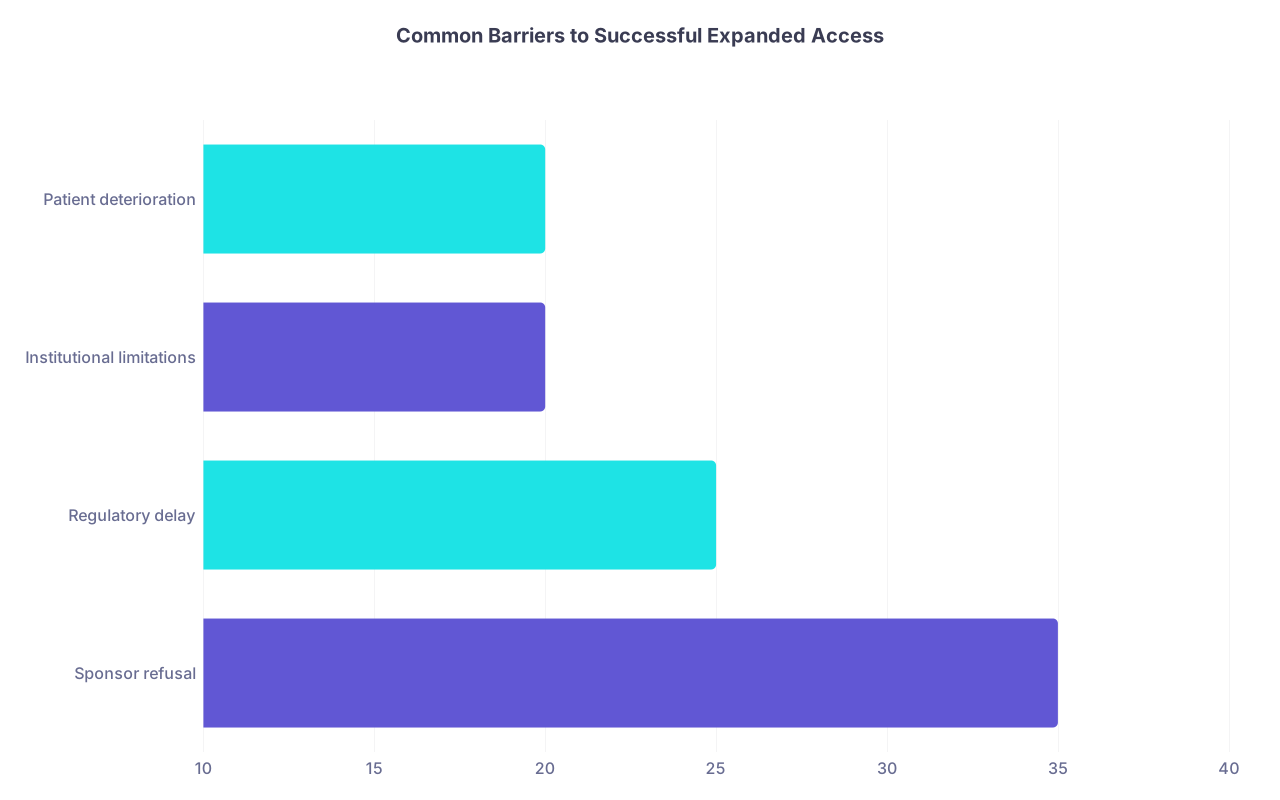
Even when it’s ethically appropriate to suggest EA, reality may block you:
| Constraint | Why It Matters |
|---|---|
| Sponsor willingness | They can simply say no |
| Drug supply | Limited production or allocation |
| Regulatory timelines | May exceed patient’s life expectancy |
| Institutional support | IRB, legal, pharmacy, billing capacity |
| Cost coverage | Monitoring and hospitalization expenses |
| Category | Value |
|---|---|
| Sponsor refusal | 35 |
| Regulatory delay | 25 |
| Institutional limitations | 20 |
| Patient deterioration | 20 |
You’re allowed to say: “I think clinically you’d be a reasonable candidate for this kind of program, but in practice the sponsor hasn’t been offering it,” or “by the time approvals go through, I worry we won’t have time to even try one cycle.”
Ethical transparency beats pretending you have more power than you do.
How this fits your own professional development and ethics
If you’re a trainee or early‑career clinician, EA is one of those areas where your ethical muscles either grow or atrophy.
Here’s what I’d want you to internalize:
- Your job is not to chase every experimental molecule. Your job is to match the right patient, at the right time, to the right level of risk and uncertainty.
- Courage sometimes means suggesting EA; just as often, it means not suggesting it, and being honest that treatment goals should shift.
- Learn the mechanics at your institution: who handles EA paperwork, who talks to sponsors, what your IRB expects. Competence reduces chaos and bad decisions.
You’ll remember the cases where you fought for access and it helped. You’ll also remember the one where everyone pushed for the “last shot” and the patient died in the ICU on a drug that never had a real chance. Try hard to learn on the earlier, not the latter.

FAQ: Expanded access to new drugs
1. Do patients have a “right” to compassionate use of any investigational drug?
No. There’s no automatic right. Expanded access requires agreement from the sponsor, the regulator (like the FDA), and usually your institution/IRB. Patients have a right to ask and to be taken seriously, but not to compel provision.
2. Is it unethical to refuse to pursue expanded access when a patient asks?
Not necessarily. It’s unethical to refuse without thoughtful consideration and explanation. But if there’s no plausible benefit, unacceptable risk, or no realistic path (sponsor refusal, impossible timelines), you can ethically decline — as long as you explain why and offer alternative support.
3. Should I ever bring up expanded access if I’m not experienced with it?
Yes, if the clinical and ethical criteria are clearly met. But be honest about your inexperience, and immediately loop in people who know the regulatory and logistical side at your institution (research office, IRB, pharmacy, or an attending with EA experience).
4. How do I avoid giving false hope when I suggest expanded access?
Use specific language. Give approximate response rates or realistic benefit ranges when possible. Explicitly say: “This may not work at all,” and “it might make you feel worse.” Then ask the patient to reflect on what they’re hoping for and whether those hopes are compatible with the real odds.
5. What if a sponsor refuses an expanded access request for a drug I believe could help?
You explain that the sponsor controls the drug and that they’ve declined. You can ask for their reasoning, advocate once if there’s a strong case, but you cannot force them. Ethically, you owe the patient transparency and support, not a guarantee.
6. Can expanded access data be used to get a drug approved?
Usually only in a limited way. EA is primarily about treatment, not evidence generation. Data from these cases can sometimes support safety assessments, but it’s rarely high‑quality efficacy evidence. That’s why trials remain the primary route for approval.
7. Is it appropriate to bill patients for costs related to expanded access?
Often the drug itself is provided free, but standard care costs (labs, imaging, hospitalization) are usually billed as usual. Charging patients for the investigational drug is tightly regulated and often not allowed or heavily restricted. Before suggesting EA, find out what the patient may be billed for and discuss it openly.
Key points to remember:
- Suggest expanded access only when all five conditions are met: serious disease, no real standard options, no feasible trial, plausible benefit, and acceptable risk.
- Your ethical duty is to offer it when it genuinely aligns with patient goals and evidence — and to withhold it when it does not, even if everyone is desperate.
- The way you discuss it matters as much as the decision itself: clear, honest, and grounded in realistic expectations, not wishful thinking.


