

The word “innovative” on a protocol means nothing by itself. You have to treat it like a drug: demand data, scrutinize the trial, and decide if you’d actually “prescribe” it to your patients.
Here’s how to evaluate the evidence behind a hospital’s new “innovative” protocol like a serious clinician, not a marketing target.
1. Start With One Blunt Question: “What Patient-Important Outcome Does This Improve?”
Everything else hangs on this.
If a new protocol can’t clearly state which patient-important outcome it improves, you’re already on shaky ground. And I don’t mean:
- “Improves workflow”
- “Reduces documentation burden”
- “Standardizes care”
Those may be nice. They’re not the main thing.
You’re looking for outcomes that matter to patients and families, like:
- Lower mortality
- Fewer major complications
- Less time on a ventilator
- Reduced readmissions
- Better functional status at discharge
- Lower pain, delirium, or distress
If all you hear is “better compliance with X” or “improves process Y” with no connection to outcomes, treat it as a red flag. Process measures are not automatically bad, but they’re secondary. You first ask: did this change make anyone healthier or safer?
I’ve sat in too many meetings where a shiny new protocol was justified almost entirely on “everyone else is doing this” and “it aligns with national priorities.” Translation: weak direct evidence.
So your first move when someone presents the protocol:
“Show me the primary outcome this is designed to improve, and the evidence that it actually does.”
If they can’t answer that in one or two clear sentences, you’re not dealing with serious evidence-based change. You’re dealing with fashion.
2. Demand the Source: “Is This Based on Trials, Guidelines, or Opinion?”
You don’t need to be a full-time researcher to sort this out. You just need to categorize what’s in front of you.
Ask these questions immediately:
- Is there at least one randomized controlled trial (RCT) behind this?
- Were those trials done in patients like ours?
- Is this recommended in recent high-quality guidelines?
- Or is this mostly expert opinion / “local best practice”?
Use a simple mental hierarchy like this:
| Level | Type of Evidence |
|---|---|
| 1 | Multiple RCTs or meta-analyses |
| 2 | Single good RCT or strong cohort study |
| 3 | Observational data / before–after study |
| 4 | Expert consensus / local experience |
| 5 | Theory / extrapolation / “seems logical” |
Level 1–2: Reasonable to standardize, especially if safety data is solid.
Level 3: Maybe, but should be labeled as “promising” and ideally piloted, not mandated system-wide.
Level 4–5: Should not be enforced as a rigid requirement. At best, “consider using” with clinical judgment.
You should not be shamed for questioning a level 4 protocol being implemented like gospel.
If the committee doesn’t even know what evidence level they’re working from, that’s a cultural problem.
3. Look Under the Hood: What Were the Actual Studies?
Once you know there is “evidence,” you check how good, how applicable, and how honest that evidence is.
Ask for:
- The primary trial(s) or meta-analysis that triggered the change
- The population studied
- The setting (academic ICU vs community ward, etc.)
- The key outcomes (and how big the effect was)
Some specific things to scan for (quick and dirty, not a full journal club):
Population match
Did they study patients like yours?- Age, comorbidities, severity of illness
- Specialty (med vs surg vs ICU vs ED)
- Country and level of resources
If the study was done in a hyper-resourced academic center with dedicated research nurses and your hospital is understaffed and chaotic, expect weaker real-world performance.
Design quality
Was it randomized? Controlled? Cluster-randomized at least? Or just a before–after study where 100 other things changed in the meantime?Before–after designs are notorious for exaggerating benefits of protocols. You clean up the process, pay extra attention, track things more carefully—of course outcomes improve. That doesn’t mean the specific “innovation” is the magic ingredient.
Effect size and precision
Don’t just ask “did it work?” Ask:- How big was the benefit?
- What’s the confidence interval?
- Is this clinically meaningful, or just statistically significant?
A protocol that reduces length of stay by 0.2 days in a carefully selected population is not necessarily worth massive disruption.
Harms and trade-offs
A lot of protocol rollouts focus only on benefits. Ask bluntly:- Any increase in adverse events or specific complications?
- Any signals of harm in subgroups?
- Greater burden on nursing, pharmacy, or RT that might indirectly increase other risks?
Example: Aggressive sepsis bundles that push fluids and broad-spectrum antibiotics early. Benefit for some. Clear risk for others (heart failure, renal disease, antimicrobial resistance). Protocols that ignore nuance often hide harm in the averages.
4. Check Applicability: “Does This Belong in Our Patients, Here?”
Even a good RCT can be a bad fit for your environment.
Run through four simple fit tests:
Clinical match
- Are your patients similar or much sicker/older/comorbid?
- Is the protocol meant for ICU but being forced onto med-surg?
- Is it ED-specific but extended beyond its evidence base?
Resource match
- Does this require staffing you don’t have?
- Special monitoring, lab turnaround times, or pharmacy capacity?
- A step-down unit that barely exists on nights and weekends?
If the evidence assumes capabilities you don’t have, the risk-benefit ratio changes. Dramatically.
Workflow reality
On paper: great.
On night shift with 1:7 nursing ratio and two new admits: maybe not.Ask nurses, RTs, and residents: “Can this actually be done the way the trial did it?” If the answer is no, expected outcomes are unlikely.
Patient values
Some protocols prioritize survival at any cost. But your frail, dementia patient may value comfort and minimal interventions. A protocol that’s “evidence-based” may still contradict patient goals.
5. Separate True Innovation From Rebranding and Compliance
Not every “innovative” protocol is actually new. Some are:
- Old ideas with a new name
- Regulatory mandates dressed up as innovation
- Vendor-driven tools integrated into the EHR
You need to know which you’re dealing with, because the bar is different.
Types of “innovative” protocols you’ll see:
Evidence-backed, guideline-aligned
Example: Early extubation protocols in cardiac surgery with actual RCTs and meta-analyses behind them.Good candidates for standardized adoption, with local adaptation.
Local improvement projects with promising data
Example: One unit’s nurse-driven diuretic protocol dropping HF readmissions by 10% in a before–after analysis.Worth piloting. Not ready for rigid, hospital-wide mandates without further testing.
Compliance/metric-driven bundles
Example: Sepsis or VTE bundles timed and structured to meet external metrics rather than optimal individual care.Here, you have to balance regulatory realities with patient-specific harm/benefit. Compliance matters, but blind obedience is lazy medicine.
Tech or vendor-driven “solutions”
Example: AI-based alert systems, EHR pathways, algorithm-based order sets with minimal independent evidence.These need more skepticism and often create new failure modes (alarm fatigue, overtesting).
The question you keep in your back pocket:
“Is this change coming from strong clinical evidence, or from billing, metrics, and vendor influence that may or may not align with patient best interest?”
6. Ask About Monitoring, Feedback, and Exit Plans
A truly ethical and scientific implementation doesn’t just “flip the switch” and disappear. It builds in monitoring.
You want clear answers to:
- How will you track whether this protocol is helping or hurting?
- What specific metrics will be watched?
- What’s the plan if those metrics don’t move, or worsen?
- Is there a defined review date or will this live forever once activated?
If you hear something like “we’ll just add it and see” with no formal evaluation, that’s lazy. For genuinely new protocols—especially those without strong RCTs—you should be thinking in terms of pilot studies or quality improvement cycles:
Plan → Do → Study → Act
Not: Approve → Enforce → Forget
If your hospital culture resists the idea of scaling back or killing a protocol that doesn’t work, you have an ethical problem. Because at that point, patients are essentially in an uncontrolled experiment without follow-up.
7. Your Ethical Obligations as a Clinician
You’re not just allowed to question the evidence behind a new protocol. You’re obligated to.
Here’s what that looks like in real life:
- You support evidence-based, beneficial change, even if it’s inconvenient.
- You push back on poorly justified or harmful protocols, even if they’re popular.
- You advocate for patient-centered exceptions when a protocol clashes with goals of care.
- You document your reasoning when you deviate thoughtfully from a protocol.
Remember: the protocol is a tool. You are responsible for your clinical decisions. Hiding behind “the hospital policy said so” is not an ethical shield if harm occurs.
Phrase your resistance professionally but firmly:
- “I’m concerned the evidence is weak for this population. Can we review the primary data together?”
- “This trial excluded patients like the one in front of me; I’m going to deviate and here’s why.”
- “If we’re going to call this innovative, we should be collecting outcome data and be prepared to stop if the benefit isn’t replicated.”
If your institution punishes thoughtful, well-documented disagreement with low-quality protocols, that’s a systemic ethical failure, not your personal one.
8. Practical Checklist You Can Use in Real Time
When you’re confronted with a new “innovative” protocol, run this in your head (or on paper):
- What patient-important outcome is this supposed to improve?
- What level of evidence is behind it (RCT, observational, expert opinion)?
- Are the study patients and setting similar to ours?
- What is the actual size of benefit? Are harms/downsides reported?
- Can our environment realistically reproduce the conditions of the study?
- How will its impact be monitored locally, and can it be revised or withdrawn?
If the answers are vague, defensive, or heavily reliant on “everyone else is doing this,” treat the protocol as experimental at best.
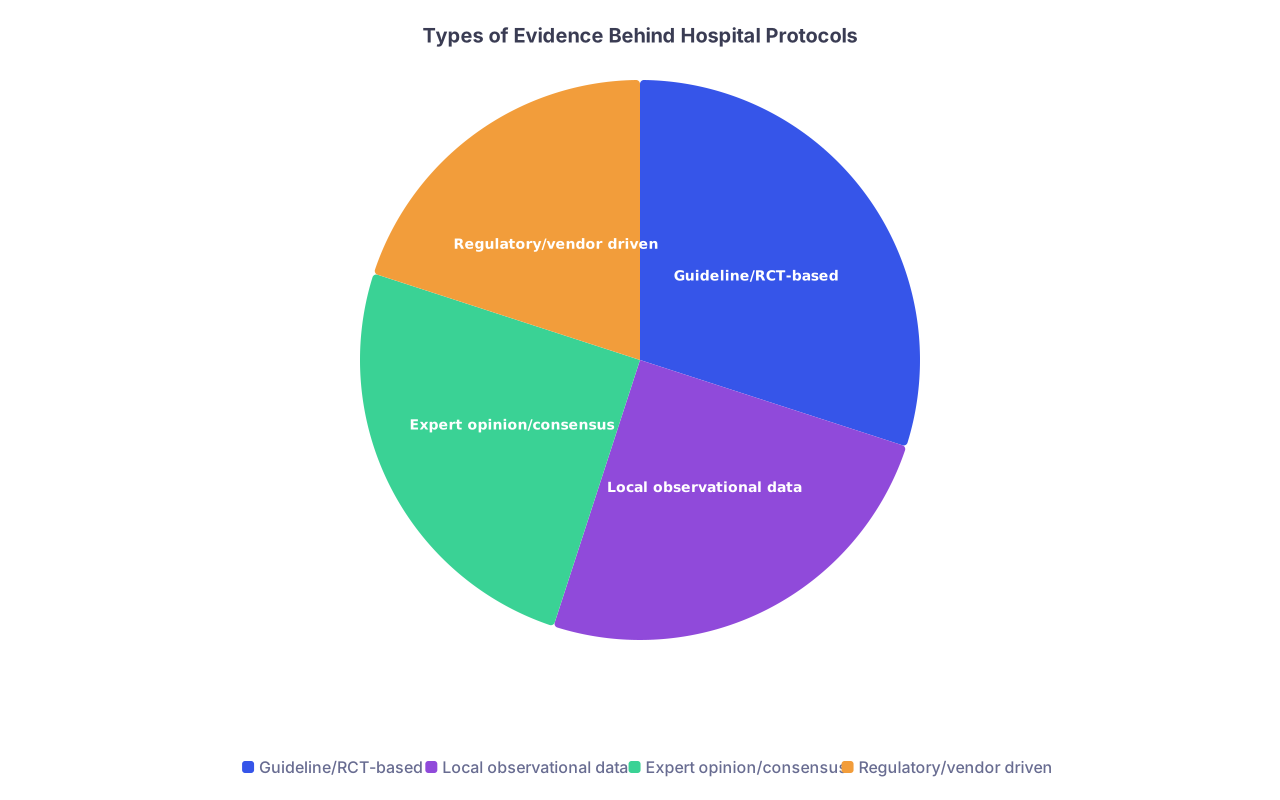
| Category | Value |
|---|---|
| Guideline/RCT-based | 30 |
| Local observational data | 25 |
| Expert opinion/consensus | 25 |
| Regulatory/vendor driven | 20 |

| Step | Description |
|---|---|
| Step 1 | New protocol proposed |
| Step 2 | Ask for clarification or oppose |
| Step 3 | Assess local fit and resources |
| Step 4 | Classify as weak or experimental |
| Step 5 | Support with monitoring |
| Step 6 | Modify or limit scope |
| Step 7 | Suggest pilot with evaluation |
| Step 8 | Clear patient outcome? |
| Step 9 | Strong RCT/guideline? |
| Step 10 | Feasible and safe here? |
FAQ: Evaluating “Innovative” Hospital Protocols
1. What should I do if there’s no published evidence, just “internal data”?
Treat it as experimental. Ask for the methodology: how they collected data, what outcomes they measured, how they controlled for other changes. Support cautious pilots with monitoring, not full hospital-wide mandates. And push for external peer review or presentation at conferences if it’s genuinely promising.
2. How do I push back without being labeled “resistant to change”?
Anchor yourself in patient outcomes and evidence. Use phrases like, “I’m absolutely for improving care; I just want to see the data behind this,” or “Can we align this more tightly with the trials/guidelines?” That frames you as pro-quality, not anti-innovation.
3. Is it ever acceptable to ignore a protocol?
Yes—if applying it would clearly harm the specific patient in front of you, and you can articulate and document why. Protocols are guides, not shackles. The key is to make it a thoughtful, explicit decision, not a lazy habit.
4. How do I quickly spot low-quality “innovation”?
Watch for buzzwords with no numbers, “transformative” change without actual patient outcomes, reliance on surrogate markers only, and heavy vendor or regulatory language. If there’s no concrete trial, no clear benefit size, and no monitoring plan, your skepticism is warranted.
5. Do I have to read all the primary studies myself?
Ideally sometimes, yes—but not always. At minimum, skim abstracts and look for: study design, population, primary outcome, and effect size. Where possible, lean on journal clubs, EBM-trained colleagues, or your hospital librarian to help. But don’t blindly trust slide decks summarizing “the literature” without citations.
6. What if my hospital never tracks outcomes after implementing protocols?
That’s a serious quality and ethics gap. Raise it at quality or safety committees: “We’re changing care without checking if we’re better or worse off.” Suggest simple, focused metrics and review timelines. If they still refuse, recognize the limits of the system you’re in—and be extra careful about uncritically embracing each new “innovation.”
Key points: don’t be impressed by the word “innovative.” Ask what patient-important outcome it changes, what real evidence backs it, and whether that evidence actually fits your patients and your hospital. Then insist on monitoring and the ability to change course if reality does not match the sales pitch.


