

How Much Should I Trust AI Risk Scores in My Treatment Decisions?
What do you do when an AI tool says your patient’s “30-day mortality risk is 27%” and your gut says, “That seems off”? Which one wins?
Let me be blunt: if you’re outsourcing your judgment to an AI risk score, you’re doing it wrong. But if you’re ignoring those scores completely, you’re also leaving useful information on the table.
The job isn’t to “trust” or “distrust” AI. The job is to know exactly how to use it, where it helps, and where it can absolutely burn you.
Here’s how to think about AI risk scores in real clinical decisions without losing your clinical brain or your ethical footing.
First: What AI Risk Scores Are Actually Good For
Most AI risk tools aren’t magic. They’re just pattern-recognition engines trained on large datasets: EHR data, imaging, labs, vitals, sometimes even free text.
They’re usually good at:
- Finding subtle patterns across huge data sets
- Updating probabilities quickly as new data comes in
- Being consistent (they don’t get tired at 3 a.m.)
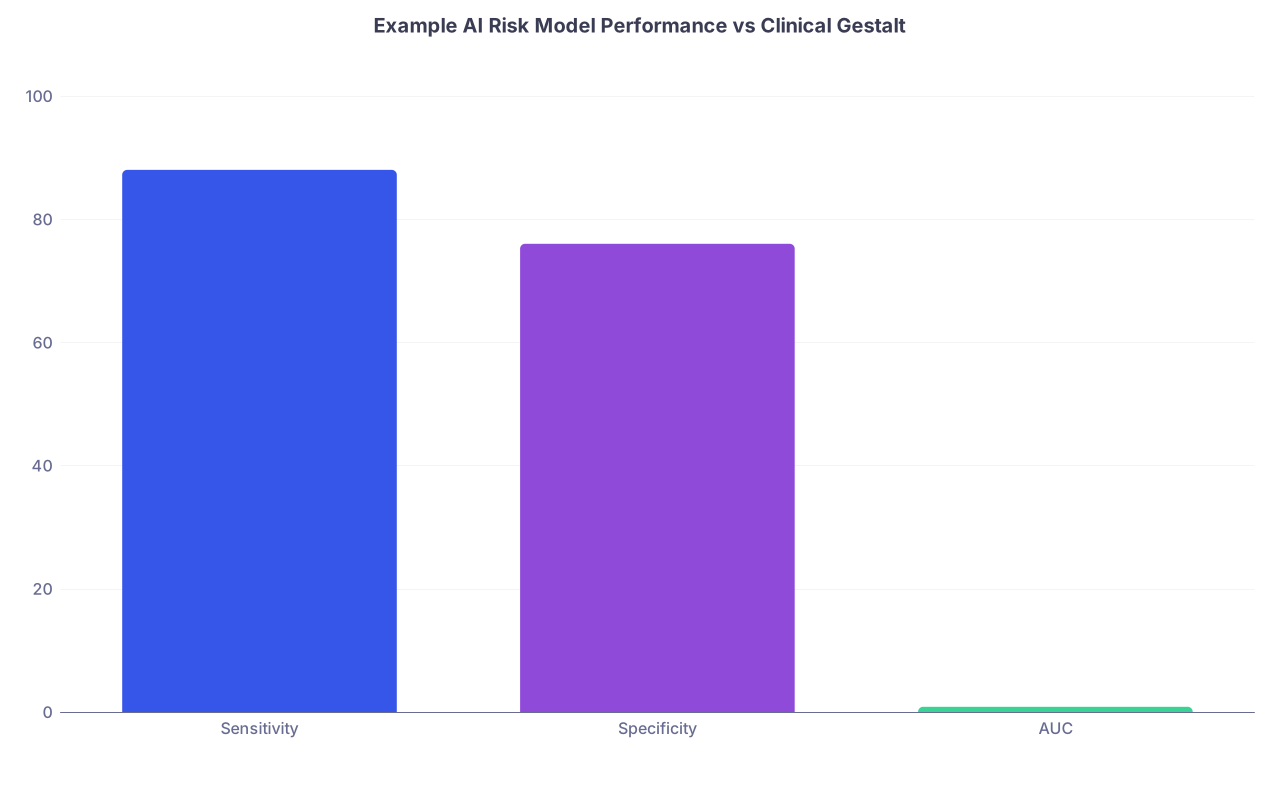
| Category | Value |
|---|---|
| Sensitivity | 88 |
| Specificity | 76 |
| AUC | 0.85 |
That’s why you see them in:
- Sepsis prediction models
- Readmission risk tools
- Cardiology risk calculators on steroids
- Imaging triage (flagging likely PE, stroke, fractures)
But here’s the key: they’re probability adjusters, not decision-makers.
The right mental model:
AI gives you, “Given patients like this in the past, here’s how often bad thing X happened.”
You decide, “Given this patient, and my goals with them, does that change what I do?”
If the tool doesn’t help you answer a real clinical question—“Admit vs discharge?” “PCI vs meds?” “CT now vs observe?”—it’s noise.
How Much Should You Trust the Number?
Here’s the answer you probably want: roughly as much as you trust any unfamiliar subspecialist’s curbside opinion… once you understand its track record and blind spots.
You need three pieces of data before you give an AI risk score real weight:
- How accurate is it really?
- Does it work in your kind of patients?
- What are the consequences of being wrong?
1. Accuracy: Beyond “This Model Has an AUC of 0.87”
If the only thing you know about a tool is “AUC = 0.87”, that’s marketing, not medicine.
At a minimum, you want:
- Sensitivity and specificity at the thresholds you actually use
- Positive and negative predictive values in a population like yours
- How it compares to your current standard (existing score + clinical gestalt)
| Question | Why It Matters |
|---|---|
| What population was it trained/validated on? | Tells you if your patients look anything like the model's patients |
| How does it perform vs clinicians or existing scores? | If it's not better, it's not worth the cognitive overhead |
| Do I know the sensitivity/specificity at the given cutoffs? | Determines how often it's wrong in each direction |
| Is performance stable across subgroups (age, race, sex)? | Flags potential bias and harm to specific groups |
| How often is it updated or recalibrated? | Out-of-date models degrade and quietly get worse |
If your hospital or vendor can’t answer these in plain English? I’d treat the output as low-confidence, curiosity-level data. Not decision-grade.
2. Does It Work On Your Patients?
A sepsis model trained on ICU patients in a U.S. academic center may fall apart in your safety-net ED, your rural clinic, or your high-end private cardiology practice.
Ask:
- Was it validated externally, or only in the development site?
- Were your patient types (ethnic groups, comorbidity profiles, socioeconomic realities) actually present in the data?
- Is performance reported by subgroup, or just averaged over everybody?
If it wasn’t tested in anything that looks like your environment, ethically you should treat early use as experimental. That means: more skepticism, more documentation, more transparency with patients.
3. What Happens If It’s Wrong?
You don’t treat a “maybe” about a CT scan the same way you treat a “maybe” about tPA.
Same with AI outputs. Ask: If I follow this risk score and it’s wrong, what’s the damage?
- High cost but low direct harm (extra labs, extra observation hours)? You can tolerate more false positives.
- High irreversible harm (unnecessary surgery, missing early cancer, denying lifesaving treatment)? You require much stronger evidence before letting a black box push you in that direction.
Ethically, your tolerance for trusting AI should scale with the reversibility and magnitude of potential harm. That’s not philosophy, that’s basic clinical responsibility.
A Simple Framework: How To Actually Use AI Risk Scores
You don’t need a 20-page ethics treatise. Use this three-step mental flow in real time.
Step 1: Ask, “What decision am I actually making?”
Don’t start with the model. Start with the decision.
- Admit vs discharge
- Watchful waiting vs aggressive intervention
- Start anticoagulation vs not
- Order additional imaging vs not
Then ask: does this risk score help resolve this decision, or is it just background noise?
If the number doesn’t clearly map onto an action threshold—“above X, we do Y”—be careful. Hand-wavy “elevated risk” language is how bad tools sneak into practice.
Step 2: Ask, “Would I do something different because of this score?”
If your initial plan and your post-score plan are identical, then you’re not “using” the AI; you’re just observing it.
Examples:
- Your gestalt: patient is low risk for PE → AI also says low risk → fine, documented alignment, but no real effect.
- Your gestalt: low risk → AI says sky-high risk → now we’re in territory where it might change care.
Only when the model pushes you to change something—order a test, escalate care, withhold something—do you need to scrutinize it.
Step 3: Adjust Trust Level Based on Stakes + Evidence
Low-stakes, reversible decisions (like extending observation) can afford more reliance on imperfect tools.
High-stakes, irreversible or high-harm decisions demand corroboration:
- Second human opinion
- Additional testing if feasible
- Slower, more deliberate discussion with the patient or family
That’s your ethical floor. AI can shift probabilities, but it doesn’t get to unilaterally decide who gets surgery, who gets chemo, who gets labeled “palliative only.”
Ethics: Where You Get in Trouble if You Over-Trust
Here’s where things go sideways—fast.
1. Hidden Bias That You “Didn’t Know About”
If a model systematically underestimates risk in Black patients or overestimates risk in older adults, and you blindly follow it, you are participating in discrimination. Whether you intend to or not.
Real example: Some widely used “clinical risk tools” (not even fancy AI) gave lower priority for certain advanced therapies to patients who historically had less access to care, due to the way “utilization” was built into the score. AI can replicate and amplify that nonsense quietly.
You’re ethically responsible to at least ask: How does this perform across race, sex, age, language, disability? And if no one knows, use it cautiously, especially in vulnerable groups.
2. The “Computer Said So” Excuse
I’ve heard versions of this in chart reviews: “The model showed low risk, so we discharged.” That’s not justification. That’s abdication.
Your duty isn’t to obey the tool. It’s to integrate the tool with:
- Patient’s values and goals
- Clinical context
- Unstructured information (family dynamics, reliability, support at home) the model doesn’t see
Legally and ethically, the decision is still yours. The AI doesn’t share malpractice liability. You do.
3. Consent and Transparency
No, you don’t need a five-page consent form every time you look at a risk score. But if the AI output is a major driver of a big decision, patients deserve to know that a machine-learned model was part of the reasoning.
At minimum:
- Explain that a computer model estimated their risk using prior patients’ data.
- Be honest about uncertainty: “This isn’t perfect; it helps us estimate odds, but it can be wrong.”
- Make clear that you are recommending the plan, not “the algorithm.”
Patients already assume you’re using computers. They don’t assume you’re deferring to them.
How to Build a Healthy Relationship With AI as a Clinician
You want a practical strategy, not AI-phobia or AI-worship.
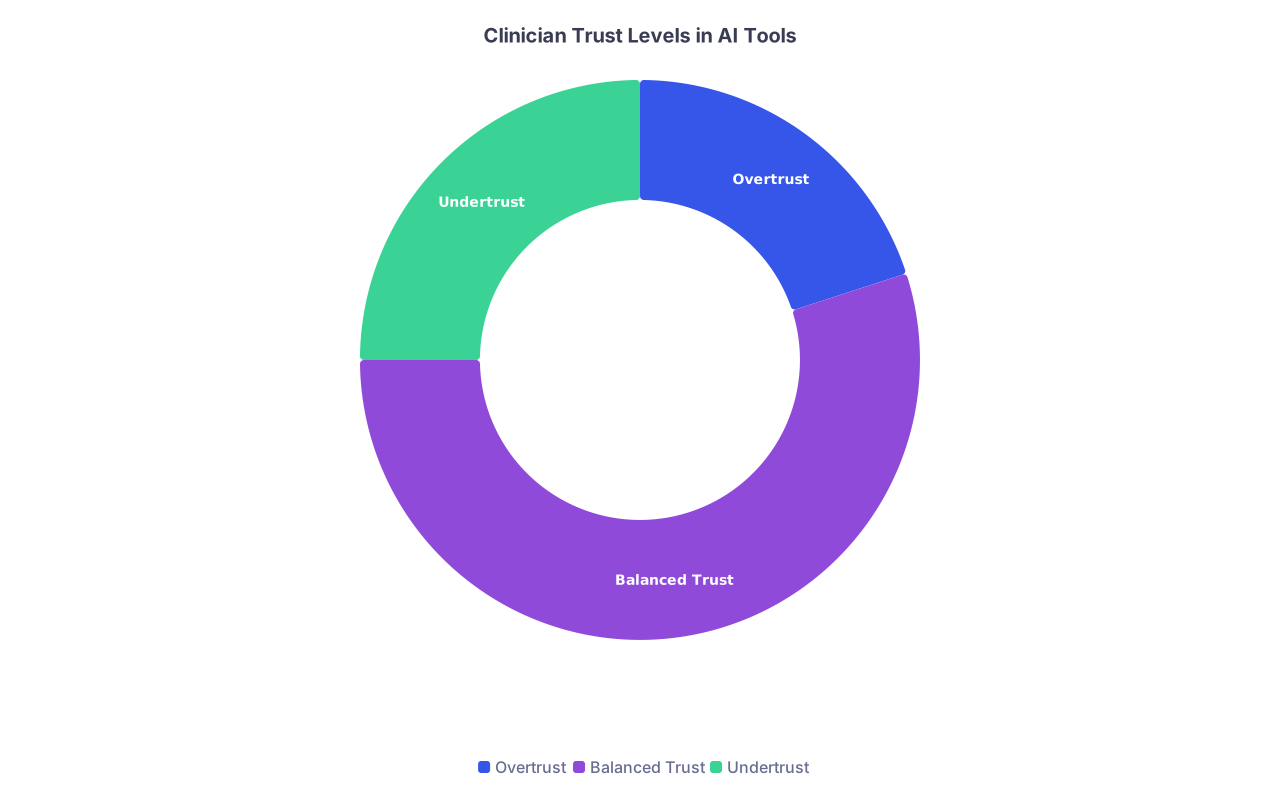
| Category | Value |
|---|---|
| Overtrust | 20 |
| Balanced Trust | 55 |
| Undertrust | 25 |
1. Decide Where You’ll Trust It More
AI tools tend to be more trustworthy when:
- The endpoint is clear and objective (death, ICU transfer, MI)
- The data feeding it is accurate and routinely collected (labs, vitals, imaging)
- It’s been externally validated multiple times
- It consistently outperforms clinicians in blinded comparisons
Those are places where you can let it “nudge” you more strongly—still with judgment, but with more weight.
2. Decide Where You’ll Trust It Less
Be extra skeptical when:
- The endpoint is mushy (pain improvement, “stability,” quality of life)
- The input data is messy or incomplete (social history, fragmented records, free text only)
- You’re dealing with under-represented populations or rare conditions
- There’s strong financial or operational pressure behind it (e.g., readmission reduction tools tied to hospital penalties)
If it’s clearly designed more for billing, throughput, or metrics than for patient outcomes, dial your trust down.
3. Document Your Reasoning
You shouldn’t write a treatise, but a brief sentence or two can protect you ethically and legally:
- “AI sepsis score elevated; clinical exam and labs not consistent with sepsis at this time. Will monitor and repeat labs.”
- “Readmission risk tool identifies high risk; discussed social support and arranged follow-up within 3 days.”
- “Model suggests moderate perioperative risk; decision aligned with patient goals after shared decision making.”
This shows you used the tool as input, not as an autopilot.
What to Do When Your Judgment and the AI Disagree
This is the scenario that actually matters.
The AI says high risk. You say low. Or vice versa. Now what?
Use a quick 4-question check:
Could the model know something I don’t?
Maybe it’s integrating long-term trends in creatinine, BP patterns, or subtle combinations that I haven’t mentally tracked.Could I know something the model doesn’t?
Nonadherence, language barriers, recent outside-hospital care not in the record, family support, patient preferences—models are terrible at this.What’s the cost of acting as if the model is right vs as if I’m right?
Extra test? Extra night in hospital? Or major procedure?Can I get a quick second opinion or extra test to break the tie?
Another clinician, a quick bedside ultrasound, a lab recheck—anything to move beyond the binary “AI vs me” frame.
If after all that, you still disagree, and the stakes are high, you err on the side of patient safety and values. Not algorithmic neatness.
The Bottom Line: How Much Should You Trust AI Risk Scores?
Keep it simple.
- Treat AI risk scores as strong decision inputs, never decision owners.
- Match your level of trust to three things: model evidence, patient similarity to training data, and the stakes if it’s wrong.
- Don’t hide behind the algorithm. You’re still the one responsible to your patient—and you should be able to explain your decision without saying, “Because the computer told me so.”


