

How Do I Ethically Present ‘Breakthrough’ Therapies to Vulnerable Patients?
What do you do when the new “miracle drug” hits the headlines, your hospital signs on to the trial, and your next patient is exactly the sort of vulnerable person everyone thinks should get it—except you’re not sure they really understand what they’d be signing up for?
That’s the tension you’re feeling: medicine sprinting forward, ethics trying to keep up.
Let me cut straight to it: the ethical challenge isn’t whether breakthrough therapies are good or bad. It’s whether you can present them to vulnerable patients in a way that’s honest, balanced, and free of subtle coercion—while still giving them a real chance to say “yes” if it actually aligns with their values.
Here’s how you do that, step by step, without lying to yourself or to them.
Step 1: Know What Makes a Patient “Vulnerable” in This Context
You can’t adjust your approach if you don’t first admit: some patients are easier to sway than others. And “vulnerable” doesn’t just mean poor or elderly.
Common vulnerability factors when you’re talking about breakthrough therapies:
- Limited health literacy
- Language barriers
- Cognitive impairment (even mild)
- High emotional distress (new cancer diagnosis, ICU setting, terminal disease)
- Strong dependency on you (“You’re the only doctor I trust”)
- Power imbalances (prisoners, undocumented patients, children, intellectually disabled adults)
- Financial or insurance desperation (“This is my only shot”)
If you recognize any of these—and you will—you’re not in a normal “informed consent” conversation. You’re in the danger zone for therapeutic misconception and subtle coercion.
So mentally flag it. “This patient is at higher risk of saying yes for the wrong reasons.” That one thought alone should slow you down and change your approach.
Step 2: Separate “Standard Care” From “Experimental” Clearly
If you blur this line, you’re already off the rails ethically.
Breakthrough therapies generally fall into one of three broad categories:
| Category | Typical Setting | Evidence Level | Main Ethical Risk |
|---|---|---|---|
| Standard of Care | Routine clinical use | Strong, established | Overselling marginal benefits |
| Off-Label Use | Individual clinician | Variable | Thin data, biased expectation |
| Trial/Experimental | Research protocols | Early or evolving | Therapeutic misconception |
Your first ethical duty is to say—out loud—which category you’re talking about.
Bad:
“We have a new therapy we can try that’s been very promising…”
Better:
“There are two kinds of options here. First, standard treatments that are part of usual medical care. Second, an experimental option that’s part of a research study. Let me explain both clearly, and how they’re different.”
If it’s research, you explicitly say:
- “This is a research study, not standard treatment.”
- “We don’t know yet if it’s better, worse, or the same as usual care.”
- “You can say no and still receive the best standard treatment available.”
If you can’t say those sentences comfortably and clearly, you shouldn’t be recruiting that patient.
Step 3: Translate Uncertainty Into Normal Human Language
Breakthrough therapies come with a mess of numbers, p-values, and early-phase optimism. Vulnerable patients hear: “Hope.”
You need to convert hype into reality. Simple, grounded reality.
Use concrete anchors:
- Absolute, not just relative, benefit.
- Realistic timeframes.
- What “we don’t know yet” actually means.
Example with a new oncology drug:
“We have a new medication that some early studies show might help people live a bit longer. In the study so far, people on this drug lived on average about 2–3 months longer than those who didn’t get it. That’s an average—some more, some less, some not at all.”
And then you add the part people skip:
“We don’t yet know how well this will work for people exactly like you. It’s new. That means there are also side effects we’re still learning about.”
If it’s a phase I/II–type situation, be brutally clear: the primary purpose may be safety and dosing, not cure.
“This study is mainly to find the safest dose and understand side effects. Sometimes people do get benefit, but that’s not something we can promise or predict.”
When people nod and say, “I understand,” I’ll often ask them to repeat in their own words:
“Just so I know I explained it clearly—how do you see the main difference between this trial option and standard treatment?”
If they say, “This is the one that’s going to cure me, right?”—you know you’re not done.
Step 4: Actively Fight Your Own Conflicts of Interest
You’re not neutral. Nobody is.
You might:
- Be excited by the science.
- Be part of the study team.
- Want to help your department recruit.
- Get subtle pressure from your PI or chair.
- Want one “win” for this patient after a long run of bad news.
None of that makes you evil. It just means you’re human. Ethically, your job is to build friction between those motives and the patient’s decision.
Practical ways to do that:
Explicitly name your role.
“I’m one of the doctors involved in this study, so I’m invested in its success. My first responsibility is still to you. A separate research coordinator will also talk you through the trial, and you don’t have to decide anything today.”Give them an independent voice.
A different clinician (not on the trial) can review options with them if they want. Even just offering that option changes the power dynamic.Use a script guardrail.
Before you walk in, mentally commit:
“I won’t promise benefit. I won’t minimize risk. I won’t let my need for enrollment shape how I present this.”
If your institution has an ethics consult service, this is precisely the kind of case you can run by them early, before you start pushing enrollment on that one emotionally fragile patient.
Step 5: Present Options in a Way That Doesn’t Steer the Answer
The most common ethical failure I see isn’t outright lying. It’s framing.
You know how this sounds:
“Option A is the usual treatment, but honestly it hasn’t worked very well for most patients. Option B is this exciting new therapy we’re offering here as part of a cutting-edge study.”
Now look at the same content, presented ethically:
“Option A is the standard treatment. We’ve used it for years, and we understand its benefits and side effects pretty well. It’s not a cure, but it can help with [X].
Option B is an experimental treatment. We hope it might be better, but we don’t know that yet. We’re still learning about how well it works and what side effects it causes.”
Two big rules here:
Equal time, equal structure.
Describe each option—including palliative/supportive care—with the same pattern: what it involves, potential benefits, potential risks/burdens, uncertainties.Put “doing nothing” and comfort-focused care on the table.
For severely ill, vulnerable patients, the true alternative might be:
“We can also focus only on comfort and symptom control and not add new treatments. That’s a valid choice, and it doesn’t mean we’re giving up on you. It means we’d be choosing quality of life over experimental options.”
If you can’t say that last sentence without choking on it, you’re not ready to present a phase I trial to a dying patient.

Step 6: Match Your Communication to Their Actual Capacity
You’re not talking to a statistics seminar. You’re talking to real people in distress.
For vulnerable patients, communication isn’t just “simplify.” It’s tailor.
Do this:
- Use short, concrete sentences.
- Avoid jargon like “response rate,” “surrogate endpoint,” “disease-free survival” without translating.
- Use numbers carefully: “Out of 100 people like you, about X…” instead of raw percentages.
- Use written or visual aids: simple charts, one-page summaries.
If there’s cognitive impairment, mental illness, or advanced age with questionable capacity:
- Do a simple, direct capacity check. Can they:
- State the decision?
- Explain the basic risks/benefits in their own words?
- Understand alternatives?
- Reason how this fits their values?
If not, you don’t just “slide it by” because the study needs numbers. You escalate: involve legally authorized representatives, ethics, maybe don’t enroll them at all if the risk–benefit ratio is close.
Step 7: Slow. Down.
Vulnerable patients are often also time-pressured patients.
“Chemo starts tomorrow.”
“ICU bed is waiting.”
“The trial window closes this week.”
Sometimes that’s real. Sometimes it’s institutional urgency masquerading as clinical urgency.
Ethically, you push back on the rush as much as you safely can:
- Build in a pause: “You don’t have to decide this right now. Let’s talk again tomorrow/after you speak with your family.”
- Encourage a second conversation: “Do you want a family member or friend on speakerphone for our next talk?”
- Normalize taking time: “People often need a night to think about this. That’s normal. Saying ‘I need time’ is completely okay.”
If enrollment or treatment timing truly is tight, say that—but make the trade-off explicit:
“We have a few days to decide. Waiting longer than that could mean this option isn’t available. I don’t want you to feel rushed, but I also don’t want to hide that timing matters here.”
Your job is to manage urgency, not manufacture it.
Step 8: Keep Hope, Kill Hype
You’re not a dream crusher. You’re a reality translator.
You can respect hope without selling fantasy.
A good formula here:
Acknowledge hope.
“It’s normal to want anything that might help. Most people in your situation feel that way.”Add reality with honesty.
“This treatment might help, but it also might not change the outcome—and it can cause side effects and more time in the hospital.”Turn back to values.
“When you think about the time you have, what matters more to you—trying more active treatments even if it means more hospital time and side effects, or focusing more on comfort and time at home?”
That last question is the ethical compass. Many vulnerable patients have never been asked it directly. Once you know their answer, the rest of the conversation on breakthrough therapies falls into place.
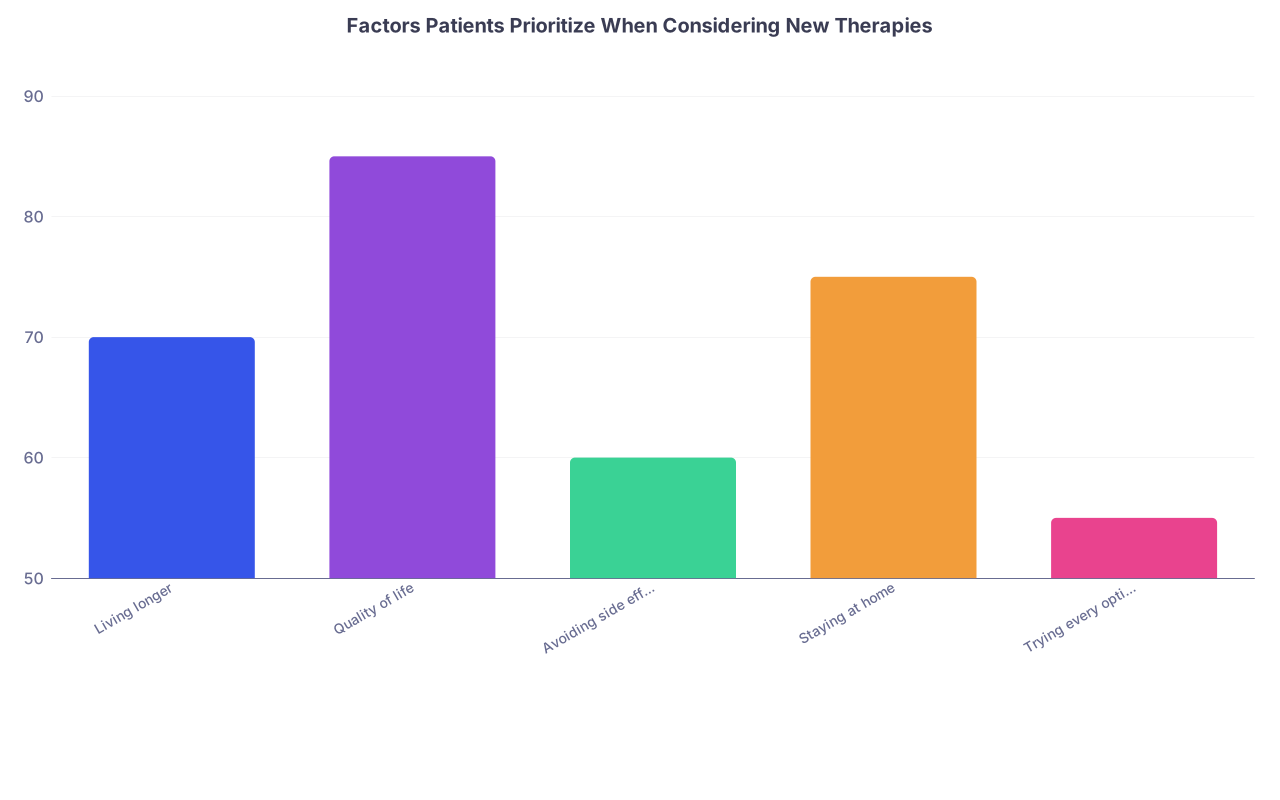
| Category | Value |
|---|---|
| Living longer | 70 |
| Quality of life | 85 |
| Avoiding side effects | 60 |
| Staying at home | 75 |
| Trying every option | 55 |
Step 9: Document Like Someone Will Read It in Court
Blunt but true: if it goes badly, people will ask what the patient was told.
Good documentation isn’t just legal cover; it forces you to be honest with yourself about what you actually said.
Include:
- That you distinguished clearly between standard and experimental options.
- Specific risks, burdens, and uncertainties you covered.
- That you explicitly said they could refuse and still get good care.
- Any signs of vulnerability (language, cognition) and what you did to address them.
- That they explained back their understanding, not just “patient verbalizes understanding.”
If your note reads, “Discussed risks and benefits, patient agrees,” you know that wouldn’t stand up to any serious ethical scrutiny. And deep down, you know it.
Step 10: Use Discomfort as a Signal, Not Something to Ignore
If you walk out of the room feeling uneasy—“Did they really understand?” “Did I just sell this too hard?”—don’t bury it.
That discomfort is often your best ethical tool.
You can:
- Go back in and clarify.
- Call an ethics consult.
- Ask a colleague to talk with the patient or family separately.
- Reconsider whether they should be enrolled at all.
I’ve seen more regret from clinicians who pushed people into trials at the edge of death than from those who held back and focused on comfort. Not once have I heard, “I wish I’d enrolled that delirious, terrified patient in that first-in-human trial.”
Use your discomfort as data. It usually points in the right direction.
Key Takeaways
- Name the category of therapy (standard, off-label, experimental) clearly and repeatedly, and kill therapeutic misconception by speaking plainly about uncertainty.
- Protect vulnerable patients by slowing down, matching communication to their capacity, separating your research/enthusiasm role from your clinical duty, and presenting all options—especially comfort-focused care—on equal footing.
- Keep hope honest: align treatment choices with the patient’s values, not your excitement or institutional pressure, and let your own discomfort be a trigger to pause, clarify, and, if needed, step back.


