
The worst way to introduce a novel therapy is to “just start using it and see how it goes.” You need structure, or you’re gambling with ethics, safety, and your own credibility.
Here’s a 12-week, step‑by‑step schedule to design and launch a small but real quality project around a new therapy—something you can defend to your ethics committee, present at a conference, and actually use to improve care.
I’ll walk you week by week. At each point: what you should have done, what to do now, and what’s non‑negotiable ethically.
Big Picture: 12 Weeks at a Glance
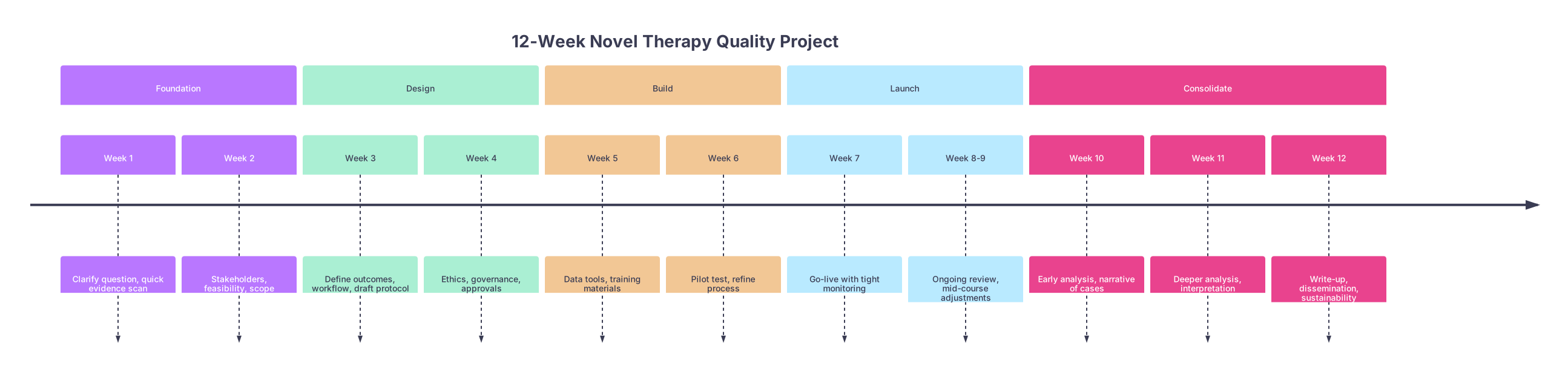
| Period | Event |
|---|---|
| Foundation - Week 1 | Clarify question, quick evidence scan |
| Foundation - Week 2 | Stakeholders, feasibility, scope |
| Design - Week 3 | Define outcomes, workflow, draft protocol |
| Design - Week 4 | Ethics, governance, approvals |
| Build - Week 5 | Data tools, training materials |
| Build - Week 6 | Pilot test, refine process |
| Launch - Week 7 | Go-live with tight monitoring |
| Launch - Week 8-9 | Ongoing review, mid-course adjustments |
| Consolidate - Week 10 | Early analysis, narrative of cases |
| Consolidate - Week 11 | Deeper analysis, interpretation |
| Consolidate - Week 12 | Write-up, dissemination, sustainability |
You’re not building a randomized trial. You’re building a lean, ethically sound quality project that tests how a novel therapy performs in your real-world setting.
Week 1 – Nail the Question and the Rationale
By the end of Week 1, you should know exactly what you’re trying to improve and why this new therapy is justified even as an experiment in routine practice.
This week you should:
- Define the clinical problem. Precisely.
Not “patients do poorly.” Try:
- “High 30‑day readmission rates for heart failure patients with reduced ejection fraction despite guideline-directed therapy.”
- “Delays in adequate pain control for sickle cell vaso-occlusive crises in the ED.”
Write one sentence: “We want to improve X in Y population using Z novel therapy.”
If you can’t fill those blanks in plain language, you’re not ready.
- Do a focused evidence scan (not a PhD thesis).
Limit yourself to 2–3 hours:
- PubMed search with key terms: therapy name, indication, “real world”, “implementation”, “quality improvement”
- Look for:
- At least 2–3 decent peer-reviewed studies
- Known risks/adverse effects
- Any professional society statements or cautions
If you discover the therapy is basically unsupported or strongly discouraged outside trials, stop. This shouldn’t be a QI project; this is research territory and you need IRB plus a completely different infrastructure.
- Clarify: QI project vs research.
You’re in the gray zone. That’s fine, but be honest about it.
Quick mental check:
- QI‑leaning: using a therapy already in guidelines or local formulary, but optimizing how it’s used, who gets it, when they get it.
- Research‑leaning: therapy not standard of care, not widely available, safety profile still emerging.
You can still do a small project in the gray area, but you will probably need ethics input and possibly IRB oversight (we’ll handle that in Week 4).
- Draft a 3‑line project aim.
Classic format:
- Population: adults with X condition on service Y.
- Intervention: introduce novel therapy Q under defined criteria.
- Outcome & timeframe: we aim to improve [measurable outcome] by [X% or descriptive] over [period].
Example:
“We aim to implement inhaled nitric oxide as a rescue therapy in high‑risk post‑cardiac surgery patients to reduce immediate post‑op right ventricular failure episodes over a 3‑month pilot period.”
By Friday of Week 1, you should have:
- A one-sentence problem
- A one-sentence aim
- Brief notes on existing evidence + key risks
If you don’t, you’re already behind.
Week 2 – Stakeholders, Scope, and Feasibility
This is where many junior clinicians blow it: they design on paper, forget the humans who have to carry it.
Early in Week 2 you should:
- Identify key stakeholders.
At minimum:
- 1–2 clinicians who will actually order/use the therapy
- Nursing rep from the unit(s) involved
- Pharmacy rep
- Data/IT contact (who can pull outcomes, build order sets, etc.)
- Someone with QI or patient safety experience
- If controversial or high‑risk: risk management / ethics liaison
Make a simple grid:
| Role | Name / Placeholder | Involvement Focus |
|---|---|---|
| Lead Clinician | Clinical decisions | |
| Nursing Lead | Workflow & safety checks | |
| Pharmacist | Dosing, supply, checks | |
| Data/IT | Measurement, dashboards | |
| QI Mentor | Methodology & ethics |
- Hold a 30–45 minute kickoff huddle.
Agenda:
- Present problem + aim in 5 minutes. No slides if you can help it.
- Ask: “What worries you about this? Where will this break in real life?”
- List:
- Potential failure points (ordering, documentation, monitoring)
- Ethical hot spots (equity, consent, bias in who gets therapy)
- Logistical bottlenecks (stocking, monitoring, cost)
You’re not solving everything yet. You’re mapping reality.
- Right-size the project.
You need small and tight:
- One unit / one clinic / one ED pod
- One primary outcome
- 2–3 secondary outcomes at most
If your current plan touches 5 services and 4 outcomes, cut it in half. Then cut it again.
By the end of Week 2, you should have:
- A clear, single-site scope
- Named stakeholders who’ve agreed the idea is at least possible
- An updated aim statement that reflects their feedback
Week 3 – Outcomes, Workflow, and Proto‑Protocol
Now we move from idea to plan. This is where it starts looking like a real project.
By mid‑Week 3 you should:
- Define inclusion/exclusion criteria.
Make them simple enough to remember on a busy day.
Example (good):
- Inclusion: adults ≥18, admitted to ICU with septic shock on norepinephrine ≥0.1 mcg/kg/min despite 30 mL/kg fluid.
- Exclusion: pregnancy, known allergy to therapy, comfort‑care only status.
Bad: 9 lines of nuanced physiology that require a calculator.
- Choose your primary outcome and how you’ll measure it.
Examples:
- Process: “Percentage of eligible patients who receive therapy within 2 hours of eligibility.”
- Clinical (for early signal): “Change in mean MAP within 6 hours,” “Rate of rescue intubation,” etc.
Specify:
- Data source: EHR fields, flowsheets, pharmacy logs
- Time frame: baseline vs post‑implementation
- Sample size goal: realistically how many patients in 8–12 weeks?
- Map the workflow in plain language.
From trigger → decision → ordering → administration → monitoring → documentation.
Write it as steps. Example:
- Patient meets inclusion criteria (nurse/clinician identifies).
- Clinician confirms eligibility, checks exclusions.
- Clinician discusses therapy with patient/family (scripted language).
- Order set “Novel Therapy Pilot” placed in EHR.
- Pharmacy verifies dose and safety checks.
- Nurse administers therapy, records vitals at specified intervals.
- Clinician reevaluates at 2 hours, decides to continue/stop per protocol.
Turn this into a one‑page “How it works” diagram for colleagues.
- Draft a short protocol (3–5 pages max).
Sections:
- Background (1–2 paragraphs)
- Aim and setting
- Inclusion/exclusion
- Intervention details (dose, timing, duration)
- Safety monitoring (vitals, labs, thresholds to stop)
- Data collection plan
- Ethics and patient information approach
This is what you’ll give ethics/IRB and your department chief.
By end of Week 3, you should have:
- Clear criteria
- A sketched workflow
- A written draft protocol ready for review
If your protocol is 20 pages, you’ve built a research trial, not a nimble QI project.
Week 4 – Ethics, Governance, and Approvals
This is the week you deal with the adults in the room: IRB, ethics, leadership. Do not skip this because “it’s just QI.”
Early Week 4 you should:
- Classify the project with your IRB or equivalent.
Send them:
- Your 3–5 page protocol
- Statement explaining:
- Therapy status (standard of care vs emerging)
- Intent (local quality vs generalizable research)
- Risk profile vs current standard
Very common outcomes:
- “Not human subjects research – QI, no IRB required, but maintain oversight.”
- “QI but requires ethics committee notification.”
- “Requires expedited IRB review.”
Any answer is fine. What’s not fine is guessing and hoping no one notices.
- Address ethical touchpoints explicitly.
You should have written answers to:
- Is this therapy “standard care” here yet, or experimental?
- Will patients be given additional written information?
- Is specific consent needed? If not, why is usual clinical consent sufficient?
- How will you protect against inequitable access or clinician bias? (e.g., only offering to “good” patients or those who speak your language)
- How will adverse events be handled and reported?
Draft a one‑page “Ethical Considerations” memo. It’ll save you headaches later.
- Get operational sign‑off.
That usually means:
- Department chair / service chief
- Unit/ward/clinic manager
- Sometimes pharmacy & therapeutics committee if formulary changes are needed
You don’t need a three‑month approvals saga. You need email confirmation or a brief committee note saying: “Yes, this small pilot is allowed under these conditions.”
By the end of Week 4, you should have:
- IRB/ethics determination in writing
- Operational leaders aware and on board
- Agreement on whether and how you’ll inform patients
If ethics or IRB say “no,” you pivot. You don’t sneak around.
Week 5 – Data Tools and Training Materials
Now we move from paper to tools people can actually use on a night shift.
This week you should:
- Build simple data collection tools.
Minimum viable approach:
- A brief REDCap form or secure spreadsheet with:
- Patient ID (coded)
- Inclusion criteria met (yes/no, date/time)
- Key intervention details (dose, timing)
- Primary outcome fields
- Adverse events tick-boxes
Also coordinate with IT for:
- A basic report pulling:
- List of patients who received the therapy
- Baseline and follow-up vitals or labs
- Create quick‑use clinical materials.
One‑pagers, not novels:
- Prescriber guide: when to consider therapy, how to order, when NOT to use.
- Nursing guide: administration steps, monitoring intervals, when to call.
- Patient script: 5–7 sentences clinicians can use to explain: what the therapy is, why you’re using it, what’s uncertain, and that you’re tracking outcomes to improve care.
- Decide your monitoring cadence.
For a novel therapy you’re ethically obliged to watch it closely, especially early.
For example:
- For every patient: a brief safety review within 24 hours.
- For the project: weekly huddle reviewing all cases, outcomes, and any red flags.
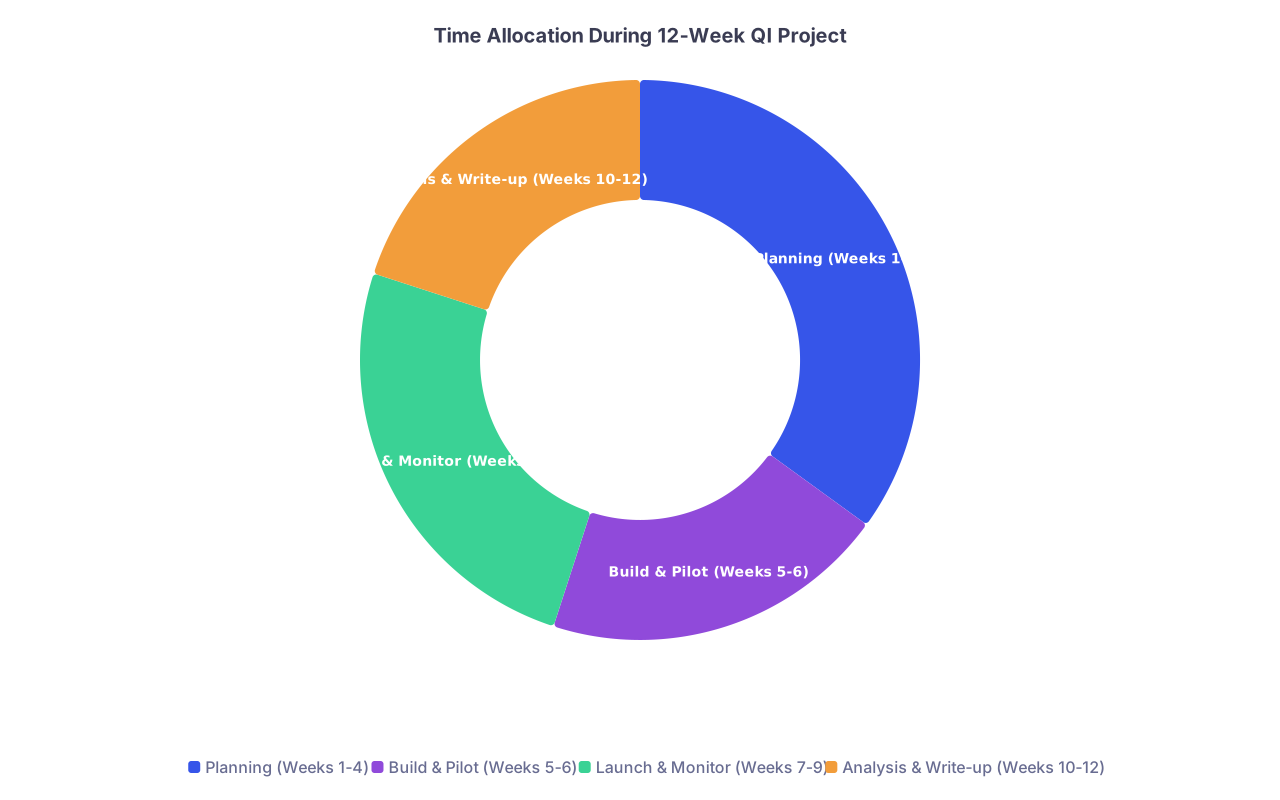
| Category | Value |
|---|---|
| Planning (Weeks 1-4) | 35 |
| Build & Pilot (Weeks 5-6) | 20 |
| Launch & Monitor (Weeks 7-9) | 25 |
| Analysis & Write-up (Weeks 10-12) | 20 |
By end of Week 5, you should:
- Have working data tools (tested with fake patients)
- Have 1–2 page guides ready to share
- Be ready to start a tiny pilot next week
Week 6 – Micro‑Pilot and Process Fixes
Before full launch, you run a very small pilot. Think of this as a dress rehearsal, not opening night.
This week you should:
- Treat the first 2–3 patients as pilot cases.
You’re testing:
- Can clinicians identify eligible patients?
- Do orders go through correctly?
- Do nurses know what to do without panicking?
- Does the data capture actually work?
- Debrief each case within 48 hours.
Gather the directly involved team for 15 minutes:
- What worked?
- What was confusing or dangerous?
- Did the patient/family understand what was happening?
- Did we miss any safety steps?
Adjust:
- Order set wording
- Checklists
- Patient script
- Data fields
- Reassess your risk profile.
If the first 2–3 patients show:
- Major workflow chaos
- Unexpected safety issues
- Team discomfort bordering on resistance
You may need to pause and revise the protocol before expanding. That’s not failure. That’s ethical behavior.
By end of Week 6, you should:
- Have evidence that the process basically works
- Have fixed obvious issues
- Feel confident you can scale to all eligible patients in your limited scope
Week 7 – Formal Launch with Tight Monitoring
This is go‑live week. No more “pilot of a pilot.” Now any eligible patient in your defined setting should be considered for the therapy according to your criteria.
Early Week 7 you should:
- Announce launch clearly.
Short email or brief at a team meeting:
- Dates of pilot period (e.g., Weeks 7–12)
- Inclusion criteria
- Who to contact with issues
- Assurance that safety is being closely monitored and that this has ethics/leadership backing
- Start log of all eligible patients.
Not just those who received the therapy. Track:
- Eligible + received therapy
- Eligible + did not receive (and why: team declined, patient refused, unavailable, etc.)
This is crucial ethically. You want to know if there’s systematic bias in who gets it.
- Run your first weekly safety huddle.
Invite stakeholders. Review:
- Number of eligible patients
- Number treated
- Any adverse events
- Any protocol deviations
Decide if any immediate changes are needed.
By end of Week 7, you’re fully operational. Every eligible patient shows up in your log, one way or another.
Weeks 8–9 – Ongoing Use, Early Signals, and Mid‑Course Corrections
Now you’re in the grind: real patients, real data, real time pressure.
During Weeks 8–9 you should:
- Maintain weekly review rhythm. Non‑negotiable.
Agenda:
- Count of eligible vs treated patients
- Safety summary: “Any adverse events? Any near misses?”
- Process feedback: Are clinicians still actually willing to use this?
- Equity: Are certain groups being excluded in practice?
If serious safety issues appear, you scale back or pause. That’s the ethical line.
- Watch for early patterns.
You’re not doing final analysis yet, but:
- Are outcomes trending in a direction that makes continued use ethically justifiable?
- Are there obvious harms without much benefit?
- Are there subgroups where it really seems to shine or clearly fails?
You’re not making policy out of 10 patients. You’re just avoiding harm.
- Refine small things, not the fundamentals.
You can tweak:
- Documentation fields
- Education materials
- The timing of monitoring
You should not constantly rewrite inclusion criteria or primary outcomes. Changing your main question mid‑project is how you lose credibility.
By end of Week 9, you should:
- Have a reasonable sample (even if small)
- Know your process is stable
- Have a feel for whether this therapy has legs in your context
Week 10 – Early Analysis and Case Narratives
Now you pivot from pure implementation to understanding.
This week you should:
- Pull interim data.
Basic descriptive stats:
- Number of eligible patients
- Number treated
- Demographics
- Primary outcome distribution (even just medians, proportions)
Use this to ask:
- Does this look enough like a real signal to justify ongoing use or expansion?
- Are any harms clustering?
- Build 2–3 brief patient stories.
Not for drama—for insight. For each:
- Baseline status
- Why they were offered the therapy
- What happened clinically
- How they experienced it (if you have notes or feedback)
Narratives are gold in ethics discussions and for departmental buy‑in.
- Check back in with ethics/leadership if needed.
If your early data suggest:
- Benefit clearly outweighs risk → you start talking about sustainability.
- Harm or no benefit → you start talking about stopping or radically restricting use.
You don’t wait 6 more months “to be sure” if harms are stacking up.
Week 11 – Deeper Analysis and Interpretation
Now you make sense of what you’ve done.
This week you should:
- Finalize your dataset for the 12‑week window.
Clean it:
- Resolve missing data where possible
- Verify that all treated patients are included
- Confirm classification of adverse events
- Run basic comparisons.
Depending on your design:
- Before vs after metric in your unit
- Treated vs untreated eligible patients (with huge caveats about bias)
Keep it simple:
- Means/medians
- Proportions
- Maybe a crude odds ratio if you have enough numbers
You’re not doing a JAMA paper. You’re generating local, honest insight.
- Interpret through three lenses:
- Clinical: Does this look helpful or not?
- Operational: Was this feasible without burning everyone out?
- Ethical: Is ongoing use justifiable? Under what constraints?
Draft bullet‑point answers to those three. This will become the heart of your summary.
Week 12 – Write‑Up, Feedback, and Next Steps
Finish the cycle. Do not ghost your own project.
By end of Week 12 you should:
- Write a 2–4 page summary.
Sections:
- Background & aim
- Methods (who, where, how)
- Results (key numbers + at least one graph or table)
- Safety and ethical reflections
- Recommendations:
- Continue as is
- Continue with modifications
- Restrict to narrower group
- Stop outside research settings
- Present it to your team.
Short, focused session:
- 10 minutes: what you did
- 10 minutes: what you found
- 10 minutes: what you recommend
Ask directly: “Given what we know now, are we comfortable continuing this therapy in our unit, and under what conditions?”
- Plan sustainability or exit.
If continuing:
- Who owns the process once you step back?
- How will periodic safety review happen?
- Do you need formal policy or guideline updates?
If stopping or restricting:
- How will you communicate this to clinicians who got used to ordering it?
- How will you prevent untracked “off‑protocol” use?
- Decide on external dissemination.
Abstracts, posters, local QI day—fine.
But be honest in how you frame it: this is a local quality project with limited sample, not definitive evidence.
Final Takeaways
- A 12‑week schedule is enough to design, launch, and ethically evaluate a small novel therapy project—if you stay tight on scope and ruthless about safety.
- The non‑negotiables are clear: early ethics input, visible stakeholder ownership, and regular safety reviews that you actually act on.
- If at Week 12 you can clearly say what you tried, what happened, and what you’ll do differently, you’ve done more than most “let’s just try this” innovators ever manage—and your patients are safer for it.