
The stories you hear about industry-sponsored trials are sanitized. The reality is messier, more conflicted, and—if you’re not careful—shaping the kind of physician you become without you even noticing.
Let me tell you what really happens.
How Industry-Sponsored Trials Actually Get Chosen
Residents are usually told something vague like, “We’re participating in a multicenter phase III trial of a promising new agent.” That’s the public-facing line. Inside the conference room, the conversation looks very different.
I’ve sat in those meetings with division chiefs and industry “medical science liaisons” (MSLs). The questions on the table are not just scientific. They’re strategic, financial, and political.
There’s a quiet checklist running in the background:
- Will this trial bring indirect money or prestige to the department?
- Does it strengthen our relationship with the company that already funds our fellowships, devices, or CME?
- Does it help a rising faculty member build an academic career on someone else’s data and infrastructure?
- Can we get enough patients to make the sponsor happy without wrecking clinic flow?
You’ll hear phrases like:
- “This aligns with our strategic priorities.”
- “Good visibility for the institution.”
- “Low lift, high yield.”
- “Our volume makes us very attractive to them.”
Translation: This trial is partly a business deal. The sponsor is not just buying data; they’re buying the institution’s credibility, the PI’s name on the manuscript, and access to your patients.
As a resident, you’re rarely told that the trial your attending pushes hard has already come with a behind-closed-doors agreement about authorship slots, subcontracts, or future grants. But that’s exactly what happens in many places.
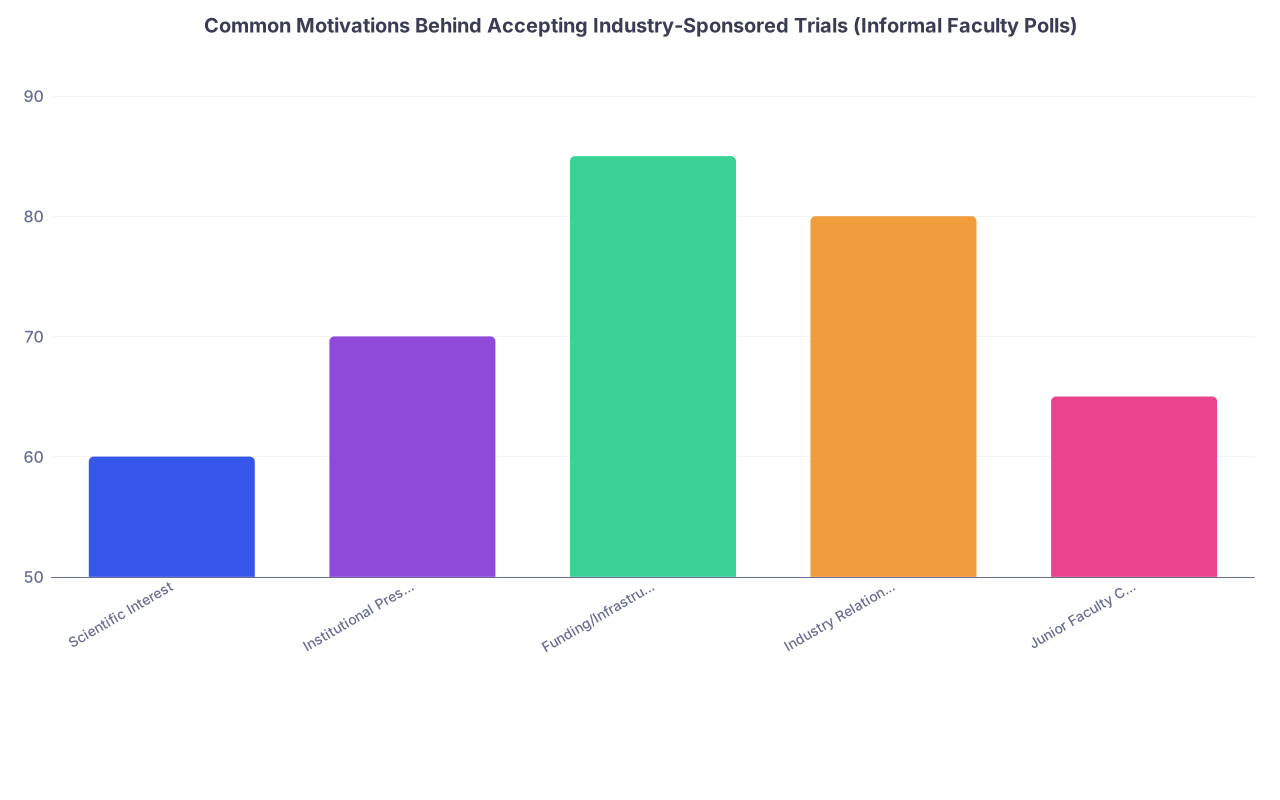
| Category | Value |
|---|---|
| Scientific Interest | 60 |
| Institutional Prestige | 70 |
| Funding/Infrastructure | 85 |
| Industry Relationship | 80 |
| Junior Faculty Career Boost | 65 |
Those numbers aren’t from a journal. They look like the frank answers I’ve heard when senior faculty talk to each other, not to residents.
How Residents Get Subtly Enlisted
Nobody walks up and says, “We’re going to use you as cheap labor to help fulfill enrollment targets and keep the sponsor happy.” That would be too honest.
Instead, it sounds like this:
“Hey, can you mention this trial to any eligible patients in your clinic?”
“We’re really trying to hit our enrollment numbers this quarter.”
“This is a great way to get research experience; you can be a sub-investigator.”
So you start:
- flagging charts
- reading inclusion/exclusion criteria in the hallway
- giving the pre-scripted “this is a research opportunity” speech
- nudging the attending when a potentially eligible patient walks in
And eventually, you stop questioning the premise. The trial becomes normal background noise. Part of workflow. A box to check: H&P, assessment, plan, trial pitch.
Here’s the ethical trap: if nobody has carefully sat you down and walked through the conflicts, you start to see enrollment as a performance metric. A sign that you’re a “good” resident. A team player. The kind who “helps the department.”
That’s how ethical creep happens. Not by villains. By good people slowly shifting their reference points.

| Step | Description |
|---|---|
| Step 1 | Trial approved by PI |
| Step 2 | Coordinator screens clinic lists |
| Step 3 | Resident alerted to eligible patient |
| Step 4 | Resident introduces trial to patient |
| Step 5 | Coordinator explains consent packet |
| Step 6 | Attending signs orders |
| Step 7 | Data collection by resident and coordinator |
Notice who never appears as a true decision-maker: you. You’re involved. But you’re not at the table where the conflicts are discussed.
Why These Trials Look Cleaner on Paper Than in Reality
If you only read NEJM or JAMA, you’d think industry-sponsored trials are pristine machines:
- protocolized
- monitored
- IRB-approved
- carefully consented
All technically true. But let me show you where the sausage is actually made.
1. Inclusion/Exclusion Criteria as Business Strategy
Those criteria aren’t just “science.” They’re also marketing.
I remember a device trial where the sponsor insisted on excluding patients with several very common comorbidities. Why? Not because the device wouldn’t work. Because they wanted a low complication rate for FDA documents and conference slides.
Your attending might say, “Protocol excludes them.” The sponsor’s internal email (I’ve seen these) says, “We need cleaner data for regulatory and messaging.”
You, as the resident, are then taught that these patients are “not appropriate for the trial,” when the truth is: they’re not appropriate for the company’s planned story.
2. The Subtle Pressure to “Pre-Sell” the Study
A lot of so-called “informed consent” is framed by how you set it up.
I’ve watched residents walk into rooms and say, “We’re part of a cutting-edge study of a new therapy that might be better than standard treatment.”
Better. Not “we don’t actually know if it’s better, that’s what this study is trying to find out.”
That one word is the difference between honest equipoise and unconscious marketing.
Where does it come from? Slide decks from the sponsor. Pitches at faculty dinners. Reps who “educate” the team. You hear the phrase “novel therapy” and “promising results” 20 times and it seeps into your language.
3. Data That Does Not Match the Patients You Actually See
Ever notice how the published trial population looks younger, cleaner, less complicated than your clinic?
You think, “This drug worked great in the study,” then realize:
- fewer comorbidities
- better social support
- stricter follow-up
- exclusion of people you see every day: unstable housing, language barriers, limited literacy
But those details get one line in the limitations section, and nobody revisits the ethics of pushing that same therapy on your real-world patients once it’s on the market.
Residents are rarely trained to connect these dots. You should be.
The Real Conflicts of Interest (Not Just What’s on the Disclosure Slide)
Programs act like the only conflict is the attending getting a consulting fee or speaking honorarium. That’s the tip of the iceberg.
Here’s what’s under the waterline.
Career Currency
You want to know what really sells a junior faculty candidate?
- “PI or sub-I on multiple multicenter trials”
- “High-enrolling site lead on phase III study”
- “First or senior author on industry-supported publications”
That stuff matters. So when a trial comes with the explicit promise that “high recruiting centers will be prioritized for authorship,” do you think that has zero influence on how strongly leaders push residents to “consider the study” with patients?
Of course it does. It’s just rarely said out loud.
Institutional Dependencies
A cardiology department relying heavily on one device company for:
- cath lab equipment
- fellowship grants
- conference sponsorships
- registries
- “unrestricted educational funds”
is not in a neutral position when that same company wants to run a trial of its new stent or valve.
I’ve seen chiefs say, offhand, “We should support this; they’ve been good to us.” That phrase alone should make your ethical radar light up. It implies reciprocity. Loyalty. Debt.
Your patient doesn’t know any of this when you walk into the room with a glossy consent form.
Emotional and Identity Conflicts
There’s another layer: personal identity.
Some attendings build their entire professional persona on being “innovators,” “early adopters,” “on the cutting edge.” Industry-sponsored trials are how they feed that identity.
They’re biased before the first patient is enrolled—not because they’re evil, but because they’re human.
And their enthusiasm is contagious. Residents absorb that energy and it shapes your default stance:
New = good. Industry trial = exciting. Being “in the trial” = being special.
That’s charisma, not evidence.
What You Almost Never Hear in Resident Teaching
Here’s the part that really bothers me: most programs do a laughable job of teaching residents how to think ethically about industry-sponsored research.
You’ll maybe get a one-hour session on “conflicts of interest” with a PowerPoint:
- disclosure slides
- pharma pens
- “don’t accept lavish gifts”
- mention of Sunshine Act
Then nothing concrete about how to navigate:
- partial equipoise
- power dynamics with mentors who live on industry trials
- saying “I’m not comfortable” when pressed to push enrollment
- documenting conversations where you disagree
Instead, the hidden curriculum teaches you:
- trials = academic points
- industry = resources, devices, tech
- enrollment = being helpful
- skepticism = being “difficult” or “not a team player”
You’re not just learning medicine. You’re being socialized into a system where it’s easy to slide into “research as business tool” without ever saying those words.

Practical Red Flags You Should Learn to Spot
Let’s talk concrete. These are patterns that, when I see them, make me slow down and look hard at the ethics.
1. The Trial That “Just Happens” to Favor Workflow
If the trial arm that uses the sponsor’s product:
- shortens your visit
- aligns perfectly with clinic templates
- gets prioritized in scheduling
- or has the path of least resistance
while the control arm is inconvenient or more work, your system is biased long before the first outcome is measured.
Example I watched: a biologic infusion trial where trial patients got priority infusion slots and enhanced nursing support “because it’s research.” Standard care patients waited longer and had more chaotic scheduling. Guess which option felt smoother to offer?
2. Attending Brags About Enrollment at Meetings
When you hear in division meetings:
- “We’re the top enrolling site in the country.”
- “Sponsor is really happy with us.”
- “We beat [nearby university] on recruitment.”
that’s a signal. The department has internalized enrollment as a competition. Which almost always leaks into clinical conversations, even if everyone swears they’re neutral.
3. Patients Described as “Great Trial Candidates” for Non-Scientific Reasons
Watch the language.
When someone says, “She’d be a great candidate because she’s reliable and trusts us,” what they sometimes mean is: she won’t push back. She’ll sign what we put in front of her. She won’t ask hard questions.
That’s not “great candidate.” That’s low resistance.
Patients who ask a lot of questions or hesitate? I’ve heard them labeled “not a good fit” even when they were medically perfect for the protocol.
That is not ethics. That’s sales.
| Category | Green Flag Example | Red Flag Example |
|---|---|---|
| Consent Framing | Neutral, balanced risks/benefits | Emphasis on “cutting edge” and “better care” |
| Team Language | “We truly do not know which is better” | “We’re excited about this new therapy” |
| Workflow Impact | Arms equally convenient | Trial arm is much easier than standard care |
| Metrics | Focus on data quality and safety | Public praise for enrollment numbers |
| Autonomy | Resident can decline participation | Pressure to “help us meet recruitment goals” |
How to Protect Your Ethics Without Torching Your Career
You’re not powerless here. You do have to be strategic.
Ask the Questions Nobody Asks Out Loud
When a new trial is introduced at conference, you can (and should) ask:
- “What are the primary financial and career incentives for our institution in participating?”
- “How are we protecting against subtle enrollment pressure?”
- “How is the consent process audited for quality, not just completion?”
- “What happens if a resident is uncomfortable enrolling a given patient?”
You’ll see who in the room is actually thinking and who’s on autopilot.

Control Your Own Language With Patients
Even in an ethically gray system, your mouth is yours.
Instead of, “This is a new, promising treatment,” say:
“This is a research study comparing a new treatment to what we already use. We truly do not know which is better. The reason for doing the study is to find that out. If we knew, it would be standard care, not a study.”
Spell it out. If your attending doesn’t like that, that’s a separate discussion you should be having.
Draw Personal Lines in Advance
Decide now:
- You will not exaggerate benefits.
- You will not downplay risks.
- You will not mislead about equipoise.
- You will not let “enrollment goals” dictate whether you bring up a trial.
Say those commitments out loud to yourself. Because in the moment, with clinic running behind and an attending hovering, you will default to the path of least resistance unless you’ve thought this through.

| Step | Description |
|---|---|
| Step 1 | Attending asks to introduce trial |
| Step 2 | Explain study with true equipoise |
| Step 3 | Privately discuss concerns with attending |
| Step 4 | Opt out of enrolling this patient |
| Step 5 | Resident comfortable with trial ethics |
| Step 6 | Concerns addressed? |
Is that always easy? No. But I’ve seen residents quietly carve out that ethical space and still match into competitive fellowships. It’s possible.
Learn the Game, Don’t Become It
You should absolutely learn:
- how trials are designed
- how protocols are negotiated
- how publications happen
- how industry partnerships can be harnessed for good (and sometimes they can)
But there’s a difference between understanding the machinery and letting it rewire your moral reflexes. The residents who come out intact are the ones who keep a mental firewall:
“This is how the business side works. I will use that knowledge to protect my patients, not to rationalize anything that feels wrong.”

Why This Matters for Who You Become
Industry-sponsored trials are not going away. If anything, you’ll see more of them, in more subtle forms—real-world registries, “quality projects” with hidden marketing agendas, post-marketing studies that look like care but exist to drive use.
The question is not, “Are these trials good or bad?” The real question is, “What are they doing to you?”
If you go through residency absorbing the message that:
- enrollment equals success
- skepticism is ungrateful
- financial and career incentives are background noise
- “cutting edge” justifies a little sloppiness in consent
then 10 years from now you’ll be the attending giving the same soft-sell speech and calling it “education.”
Or you can choose a different path: understand the machinery, call conflicts what they are, and still participate—selectively, consciously, transparently.
Let me leave you with this.
You don’t need to reject every industry trial to be ethical. You need to:
- See the full set of incentives and name them honestly.
- Guard how you talk to patients—your language is where ethics live or die.
- Decide your red lines now, before the system quietly decides them for you.