
The way program directors assess your “interest in medical innovation” is almost never how you think it is.
They’re not impressed that you wrote “passionate about innovation” in your personal statement. They don’t care that you sprinkled the word “AI” into three interview answers. And that hacky line about “disrupting healthcare”? Half the room rolls their eyes when they hear it.
Let me tell you what really happens behind the scenes when faculty and program directors try to figure out whether you actually care about medical innovation—or you’re just chasing buzzwords because you read that “innovation is hot right now.”
What “Medical Innovation” Means To Program Directors (Not To You)
First, we need to translate.
When applicants say “medical innovation,” they mean anything from AI, apps, and startups, to 3D printing, to “I once used a new EMR feature and liked it.”
When program directors say “innovation,” they almost always mean some combination of three things:
- Can this person help us improve how we deliver care?
- Will they generate academic output (posters, QI projects, grants, publications) that makes the program look good?
- Are they going to be a massive time sink with half-baked ideas that never get finished?
They are not grading you on your originality. They’re grading you on execution, follow‑through, and whether your “innovation interest” is compatible with their culture and infrastructure.
They slot people mentally into buckets. I’ve heard this exact kind of hallway talk after interviews:
“Yeah, he’s ‘super into innovation’ but nothing actually finished.”
“She’s done two complete QI projects, solid EMR optimization stuff, she’ll be productive.”
“Another AI brochure reader. Pass.”
That’s the real categorization.
The Hidden Framework: How They Actually Score Your “Innovation Interest”
Most programs don’t have a formal “innovation score,” but they all use the same rough mental checklist. It’s surprisingly consistent across big academic centers.
| Category | What PDs See |
|---|---|
| Tourist | Buzzwords, no finished work |
| Dabbler | Small projects, limited impact |
| Executor | Completed, measurable improvements |
| Builder | Systems-level or multi-year work |
| Risk | Chaotic ideas, no follow-through |
Here’s how that plays out.
1. The Tourist
This is 60–70% of applicants who talk about “innovation.”
They say they’re interested in:
- AI in radiology
- Digital health
- Telemedicine
- “Reimagining workflows”
But when you push:
“What did you actually build, change, or measure?”
It all collapses.
Tourists:
- List hackathons where they didn’t win or finish anything
- Have “projects” that never got past the brainstorming phase
- Attended innovation conferences but didn’t produce anything tangible afterwards
- Toss out slogans like “leveraging technology to improve outcomes” with zero specifics
On the PD side, these people get mentally tagged: “Likes the idea of innovation, may or may not ever be useful. Probably fine, but not a selling point.”
2. The Dabbler
Dabblers have done at least one concrete thing, but small.
Examples:
- Helped implement a new patient education handout and tracked some basic metrics
- Worked on an app prototype for a class, but it never got used clinically
- Took part in a QI project where they were clearly the junior helper, not the driver
Dabblers get credit. At least they’ve started. But PDs know these are still “light lift” efforts. They’re not going to fight other PDs for you just because of this.
3. The Executor
Executors are the people PDs actually get excited about.
They’ve:
- Taken a QI or innovation idea from start to finish
- Measured effects—time saved, error reduction, revenue captured, patient satisfaction change
- Gotten something adopted by a clinic, service, or department
- Presented or published the work at least locally, often regionally or nationally
Example that plays incredibly well:
“On my medicine rotation, I noticed discharge summaries were routinely delayed. I led a small team that redesigned the discharge template, cut redundant fields, and added must-fill elements. Our completion time improved by 35%, and we reduced pharmacy callback errors by 20%. We presented it at our hospital QI day, and two other services adopted the template with minor changes.”
That’s catnip for PDs. Not because the project is flashy. Because it screams: sees problems, drives change, finishes.
Executors are the ones PDs imagine:
- Leading residency QI projects
- Co-authoring grants
- Grinding through the annoying middle phase of projects when everyone else loses interest
4. The Builder
Builders are rare. These are your serious innovation candidates.
They’ve done things like:
- Created a validated clinical tool that’s actually used in a system
- Been part of a funded innovation center, digital health lab, or startup with real users
- Built a data pipeline, registry, or dashboard that changed how a service operates
- Co-authored implementation papers, not just case reports
These are the people that get brought up in selection meetings with, “This person could become faculty here if we play it right.”
Do you need to be a Builder? No. But understanding this spectrum tells you how PDs rank your “innovation interest” relative to others.
5. The Risk
There’s one more category nobody talks about: the Risk.
This is the person who:
- Constantly talks about “disrupting” and “breaking the system” without understanding regulation, patient safety, or workflow realities
- Bad-mouths current practices without showing any understanding of why they exist
- Has a long wake of half-started projects
- Exudes a vibe of “I’m too good for clinical work; I’m here to be a visionary”
Attendings pick this up fast. I’ve sat in meetings where someone said:
“Smart, sure. But I don’t want to be cleaning up their unfinished bright ideas for three years.”
If you sound like a Risk, your “innovation interest” actively hurts you.
Where Program Directors Look For Evidence (That You Don’t Realize They’re Scanning)
They don’t just look at the “Research” section and call it a day. PDs and selection committee members scan multiple parts of your file for a consistent signal.
1. Your CV: Structure, Not Just Content
On paper, they’re asking:
“Does this look like someone who can start and finish something in our environment?”
They look at:
- Project timelines: do you stick with things > 6 months, or jump constantly?
- Your role: leader vs “member” vs “assistant”
- Outcomes: poster, publication, implementation, award, adoption, policy change
If your CV says:
“Quality Improvement Project – Optimization of Sepsis Alerts – Team Member”
with no outcome, date, or result, that’s weak.
If instead it says:
“Lead Resident, Sepsis Alert Optimization – Reduced EMR alert burden by 28% without loss of sensitivity; project adopted system-wide; presented at regional quality forum (2024)”
completely different story. Same basic topic. Different signal.
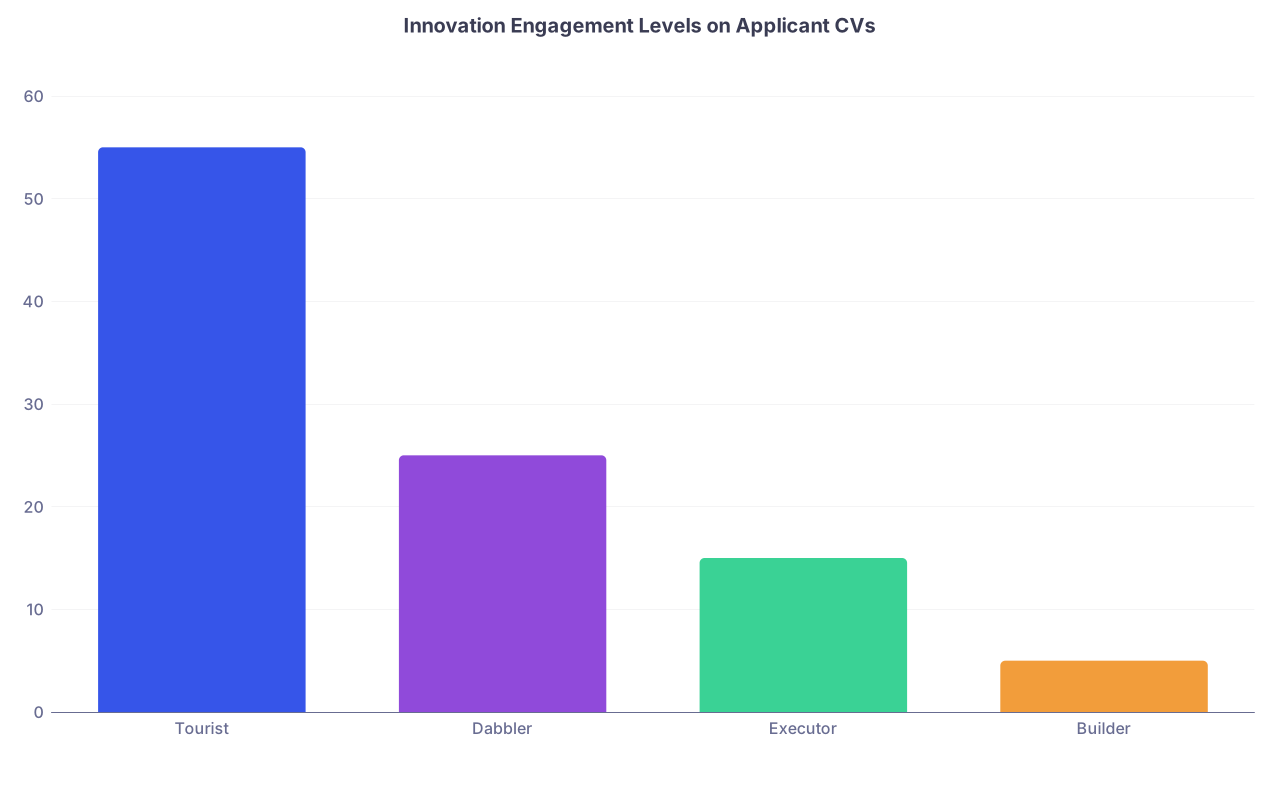
| Category | Value |
|---|---|
| Tourist | 55 |
| Dabbler | 25 |
| Executor | 15 |
| Builder | 5 |
Those rough proportions? Pretty close to what I’ve seen in multiple applicant pools over the years.
2. Your Personal Statement: Tone Over Buzzwords
Most “innovation” personal statements are unreadable. Grandiose, cliché, and shallow.
PDs are looking for:
- Specific problems you’ve confronted: “I saw X, and it was broken in this particular way.”
- Concrete steps you took: “We tried A and B, then pivoted to C when A failed.”
- A realistic view of system constraints: regulation, IT, culture, money
They are not impressed by:
- “I want to transform healthcare” with no concrete path
- Long digressions on AI ethics with no hint you’ve ever worked with real data
- Vague “I’m passionate about digital health” lines that could be copy-pasted between applicants
The unspoken question as they read:
“Would this person survive a meeting with our CMIO, QI chief, and IT? Or would they get eaten alive in 10 minutes?”
If your statement shows humility about what you don’t know yet and specificity about what you’ve actually done, you pass that test.
3. Letters of Recommendation: The Real Innovation Signal
You want to know what really moves the needle? It’s not what you say about your innovation interest. It’s what your letter writers say.
The gold-standard sentence that makes people on the committee pay attention looks like this:
“Unlike many students who are interested in innovation conceptually, [Name] actually carried a complex project to completion, navigating IRB, IT, and frontline staff, and left us with a tool we still use today.”
Variations of that sentence are worth more than three pages of personal statement prose.
What kills you is this pattern:
- You loudly brand yourself as “innovation-focused”
- Your letters talk about you as a decent student, solid clinically, but say nothing about innovation
The dissonance tells PDs: brand exceeds reality.
4. Your Interview: How You Talk About Failure and Friction
On the interview trail, programs do something very predictable: if you flag yourself as “interested in medical innovation,” someone will test it.
Questions you’ll hear versions of:
- “Tell me about a system problem you actually tried to solve.”
- “Walk me through a project you started—what was the hardest part?”
- “What’s something you tried that didn’t work?”
- “How do you balance innovation with resident workload and duty hours?”
What they’re listening for:
- Do you understand that innovation is mostly politics, process, and iteration—not just tech?
- Do you sound bitter or entitled when you hit resistance?
- Do you blame “the system” or do you show that you learned to work within constraints?
I watched one applicant sink themselves in ten minutes at a big-name academic program. They were asked:
“What barriers did you encounter trying to implement your idea?”
Their answer?
“Honestly, most of the problems were people just being closed-minded and lazy. Physicians need to get out of the way.”
You could feel the room go cold. Two faculty literally wrote something down at the same time. That applicant never recovered.
The Ethical Layer: How PDs Judge Your Moral Compass Around Innovation
Since you asked in the context of “Personal Development and Medical Ethics,” let’s talk about the part applicants chronically underestimate: the ethical lens.
Innovation without ethics is a red flag. Directors have seen enough ugly situations to be suspicious.
1. Data, Privacy, and Shortcut Culture
They’re asking:
“If this person is excited about data and AI, do they respect guardrails, or are they the type to email PHI to themselves and say they didn’t realize?”
Examples of what reassures them:
- You mention IRB when applicable
- You talk about anonymization, de-identification, access control
- You acknowledge bias and inequity in tools, not just accuracy
If you talk about “scraping hospital data for a startup idea” or gloss over consent, red alerts go off in their head.
2. Patient vs Product
Directors have seen residents get seduced by shiny tech and forget the patient in the bed.
They pay attention when you:
- Center patient outcomes and safety, not just tech coolness
- Mention how you gathered feedback from nurses, MA’s, patients
- Show you understand burden—extra clicks, new workflows, cognitive load
The mental filter is simple:
“Will this person push tools that make clinicians’ lives worse so they can publish or impress a VC?”
If the answer might be yes, you’re a liability.
3. Integrity Under Pressure
They will test how you think when your innovation goals clash with ethical obligations.
You might get something like:
“Let’s say you’re running a pilot of a new triage algorithm and you realize midway through that it might be under-triaging a certain population. What do you do?”
The “wrong” answers sound like:
- “I’d probably keep collecting data to make sure before saying anything.”
- “I’d see if I could adjust it quietly in the background.”
The right path is:
- Stop or pause
- Investigate
- Escalate
- Own your responsibility
Program directors do not want another headline: “Resident-led innovation project harms patients.” They’re screening for that.
How To Present Yourself As Genuinely Innovation-Oriented (Without Overplaying It)
Now the practical part—the positioning.
You don’t need a startup. You don’t need an app. You need coherence.
1. Tell One Or Two Deep Stories, Not Ten Shallow Ones
On your application and in interviews, you’re better off doing a deep, honest dive into:
- One meaningful QI project
- One data/EMR/operations project
- Or one innovation fellowship / lab experience
Walk through:
- The problem
- The stakeholders
- The failure points
- The pivot
- The measurable outcome
That’s how you come across as an Executor or emerging Builder.
2. Use Language That Signals You Live In Reality
Faculty immediately recognize people who’ve actually worked inside systems. They use words like:
- IRB
- Compliance
- IT ticket
- Governance committee
- Buy-in
- Pilot vs full implementation
- Workflow mapping
- Front-line staff
Sprinkle those accurately—don’t fake them—and you sound like someone who’s been in the room.
3. Don’t Oversell. Ever.
One of the fastest ways to lose respect:
Claim credit for something that, when probed, was minimal.
If your role was data collection and cleaning, say that. Then talk about what you learned seeing the PI handle politics and design.
Honest “junior but hungry” beats fake “lead innovator” every time with serious faculty.
How Programs Differ In What They Want From “Innovation People”
Not all programs evaluate your innovation interest the same way. Some want you exactly as you are. Others want to ignore that side of you completely.
| Program Type | Innovation Expectation |
|---|---|
| Classic community program | Minimal, focus on efficiency |
| Academic, no innovation hub | Basic QI, maybe small projects |
| Academic with QI focus | Executors prized |
| Innovation center / lab site | Builders strongly preferred |
| Startup-heavy urban programs | High tolerance for experimentation |
If you walk into a small community IM program talking nonstop about AI triage tools and digital transformation, half the time they’re thinking:
“Are you going to be happy actually seeing patients here, or just frustrated we don’t have an innovation lab?”
Meanwhile, a program like Stanford, Penn, Mount Sinai, or the big systems with digital innovation centers will dig into every line of your CV that smells like future faculty material.
So yes—your “innovation identity” needs to be selectively emphasized depending on the program.
What PDs Say In The Closed-Door Meeting
Let me give you a sense of the actual language when they discuss innovation-focused candidates in ranking meetings.
You’ll hear:
- “This one has done real QI, would be great for our patient safety track.”
- “He talks a lot about innovation, but I don’t see any completed work.”
- “She’s already done EMR work—our CMIO would love her.”
- “Seems a little more into startups than actual residency. I’m not convinced she’ll be present clinically.”
- “Good innovation background, but I don’t want to lose him to an MBA in the middle of residency.”
That’s the level you’re being judged on: not just “are you innovative?” but “will this help or hurt our program in the real world over the next 3–7 years?”
If You’re Early: How To Build Real Innovation Cred (Not Just Hype)
If you’re still in med school or early in training and reading this thinking, “I’m a Tourist right now,” that’s fine. You can move up at least one level before you apply.
Do this:
Pick one small, annoying, real problem somewhere in your training environment. Not global healthcare inequity. Something like:
- Discharge instructions for heart failure are inconsistent
- Clinic referrals are getting lost
- Follow-up calls after ED visits are chaotic
- A form everyone hates takes 5 extra minutes a patient
Then:
- Find the person who already cares about this
- Join them, make yourself useful, and help push one project to completion
- Track something measurable
- Present it somewhere (hospital QI day, regional meeting)
Congratulations. You’re now at least a Dabbler, likely on the cusp of Executor if you do it well.
That one finished project, told properly, will do more for your “innovation” credibility than five half-done app ideas and a Medium blog about “the future of digital health.”
The Bottom Line: What Program Directors Actually Care About
Boil all this down, and the evaluation comes to three blunt questions in their heads:
- Do you finish what you start, and does it actually help patients, staff, or the system?
- Can you pursue innovation without trampling ethics, safety, or professionalism?
- Will your innovation interest make our program stronger—or just make more work for us?
If your application, your stories, and your letters all point in the same direction—yes, yes, and yes—you’re not just “interested in medical innovation.”
You’re the kind of resident they quietly hope will stick around as faculty.