
It’s 7:15 a.m. You’re in pre-op, glancing at the schedule, still half-thinking about your progress note from last night. Your attending flips through the chart, then casually says: “By the way, the rep’s bringing a new device we’re going to try for this case. It’ll be good for you to see something cutting edge.”
You nod. Because that’s what you do.
But inside, you’re thinking: What device? What evidence? What are the complications? What’s my role? And a quieter question: If this goes sideways, where do I stand ethically and legally?
This is where a lot of trainees freeze. They either blindly follow along (“I guess this is what people do”) or they get quietly anxious and say nothing. Both are bad strategies.
Here’s how to handle this situation like a competent, ethically grounded physician-in-training.
1. First: Identify What Kind of “New” This Actually Is
Not all “new” is the same. Before you react, you need to know what bucket this device falls into.
There are a few main scenarios:
Truly new to you, but standard in the field
Common example: You’re an intern, and your attending wants to use a device that’s been on the market for 10 years but you just never saw it in med school.New to the hospital/department, but widely used elsewhere
Example: New vascular closure device that’s used at big academic centers, but your community hospital just got it.New to the market, recently approved
Example: Device got FDA 510(k) clearance last year; early adopters are starting to use it.New and investigational/experimental
Example: It’s under an IDE, in a clinical trial, or used off-label in a way that’s pretty far from standard of care.
Your response changes a lot depending on which one you’re dealing with.
So your first job: get that information.
Straightforward, low-drama way to ask, in front of the attending only (not in front of the patient, not in front of the rep):
“Just so I’m up to speed — is this something that’s already pretty standard, or is this still considered relatively new/early experience?”
Then shut up and listen to the answer. The phrasing doesn’t attack their judgment; it signals you’re trying to understand context.
2. Get Oriented Fast: What You Must Know Before the Case
You’re not going to do a full systematic review before the 8:00 a.m. start. But you absolutely can get 5–10 minutes of targeted intel.
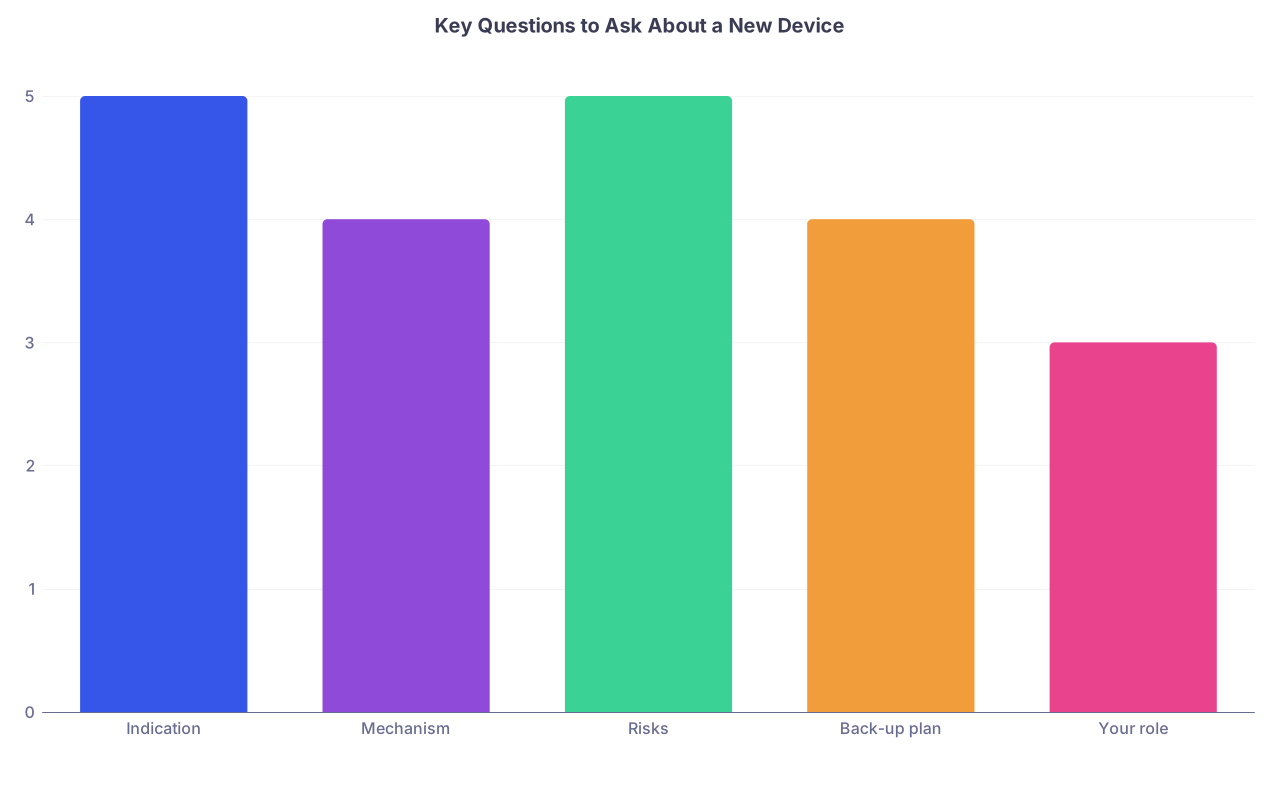
Focus on five things:
- Indication – Who is this device actually for?
- Mechanism – What does it do, functionally?
- Risks/complications – What’s different from standard options?
- Back-up plan – What happens if it doesn’t work or fails?
- Your role – What are you expected to do with it?
Concrete way to get this without sounding like a pest:
“Can you walk me through the basics of this device — main indication, what it adds over what we usually use, and any complications I should be watching for during the case?”
That’s a very reasonable trainee question. A good attending will actually like that question, because it shows you’re thinking in systems, not just “which button do I press.”
Then, if you have a few minutes and access to a computer or your phone:
- Pull up the FDA device summary if it’s new-ish.
- Quickly search “[device name] complication” or “[device name] randomized trial” and scan the abstract.
- If you’re in a specialty that lives in devices (cardiology, IR, ortho, etc.), you probably have a go-to journal or recent guideline that might reference it.
You’re not trying to become the world expert. You’re just trying to not be blind.
| Category | Value |
|---|---|
| Indication | 5 |
| Mechanism | 4 |
| Risks | 5 |
| Back-up plan | 4 |
| Your role | 3 |
(Think of those numbers loosely as priority: risks and indication are non-negotiable.)
3. The Ethical Core: Patient Consent and Your Responsibility
Here’s the piece people dance around: once you put on the white coat and take part in that procedure, you’re not a bystander. You are part of the team delivering that intervention.
You are not “just the resident.” Legally and ethically, you can’t pretend you had nothing to do with it if things go wrong.
Two key questions you need answered in your own head:
- Has the patient been appropriately informed about the use of this device?
- Am I comfortable participating, given what I know (or don’t know)?
About consent
You don’t need to deliver a treatise on regulatory pathways. But a few basic lines matter:
If this is standard of care or a common alternative: it usually falls under the broad procedural consent, assuming the procedure is being done in an accepted way.
If this is new to market, off-label, or significantly different from usual practice:
The patient should know they’re getting something different than what’s traditionally used. That it’s relatively new. And what that means in terms of risks/uncertainty.
If you see the attending get consent and it sounds like:
“We’re going to fix your blockage with a stent, sign here”
…but they never mentioned that this is a brand-new stent with limited data?
You should at least raise it privately:
“Just checking — did we specifically mention that we’re using the new [device name] rather than the usual one? I want to document it correctly in the note.”
That’s a non-accusatory way to force the question into the open.
If the answer is essentially “No, but it’s fine,” and your gut is screaming this is not fine, that’s your ethical red flag.
4. Dealing with the Industry Rep in the Room
You walk into the OR or lab, and there’s a person in business attire with a badge that says “Clinical Specialist” or “Field Engineer.” Translation: industry rep.
They’re not the enemy. They’re also not your attending. And definitely not your teacher of record.
I’ve watched this play out badly when reps start instructing residents directly, especially in desperate, “we’re stuck” moments. That’s how bad decisions get made.
Your guardrails:
- It’s OK to let the rep explain mechanics of the device (“this rotates this way,” “this part locks here”) as long as the attending is okay with it.
- It’s not OK for a rep to be the de facto operator through you. If you find yourself doing something just because a rep said so and your attending is not actively supervising that step, you’re out of bounds.
If the rep turns to you and says something like, “Why don’t you try advancing it a little more, then deploy,” and your attending is across the room:
You say, firmly but calm:
“I’ll wait for Dr. [Attending] to walk me through that step.”
That’s it. No drama.
If your attending is clearly over-relying on the rep (“What do you think we should do now?”), that’s not your mess to fix in the moment, but file that away mentally. This is not a safe learning environment.
5. When You’re Truly Uncomfortable: How to Push Back Without Getting Nuked
You’re a trainee. You don’t have the power to stop the show in most places. But you’re not powerless either.
Here’s the line that separates professionals from passengers:
If you believe something is clearly unsafe or clearly unethical, you have to act. Even if it’s uncomfortable.
So how do you actually do that without turning it into a nuclear event?
Before the case starts
This is your best window. Pull the attending aside, away from patients and reps.
“Can I be honest? I haven’t worked with this type of device before, and I’m a little uncomfortable being primary operator on something I don’t understand well yet. I’d be much more comfortable observing you first.”
You’re not saying “don’t use the device.” You’re setting a boundary around your role.
If they push back:
“You’ll be fine, it’s easy, just follow the rep.”
You respond:
“I’ll absolutely help and want to learn, but I need you to walk me through each step. I’m not comfortable just following rep instructions without direct supervision.”
You’ve now documented — verbally, in front of them — that you’re not okay being left to improvise with a rep as your guide.
In the middle of the case
If things are going sideways and you’re being pushed to do something that feels unsafe:
Use safety language, not ego language.
“Dr. [Name], I’m not comfortable with this step. Can you please take over?”
Hard stop. If they insist and it’s still clearly unsafe, you can persist once:
“I really think it’s safer for you to do this part.”
You’ve drawn a clear boundary and flagged the risk.
Later, you document your involvement accurately in the note and debrief with someone you trust (PD, chief, or risk management if it was truly wild).
6. After the Case: What You Should Do Every Single Time
Do not just walk out, shrug, and move on.
Any time you see a new device, you should do three things later that day or week:
Look up actual data
At minimum:- FDA documents (if applicable)
- One or two key trials or case series
- Any professional society position statements or guidelines
Debrief yourself
Ask:- Was the patient clearly appropriate for this device?
- Did this feel like a thoughtful choice or a toy being tried out?
- Was consent adequate?
- Were there steps where I felt out of my depth? Why?
Decide how you feel about repeating this scenario
If you felt it was well-handled and safe: great. You just learned something and saw innovation in action.
If not, you need a strategy for next time:Talk to your program director or advisor:
“We’re starting to use [device] a lot. I don’t feel like I understand the data well enough. Is there any structured teaching about it?”If there were serious safety concerns, you may need a confidential channel (GME, risk management, ombudsperson).

7. Watch for These Red Flags
There are certain phrases that should instantly put you on high alert. I’ve heard all of these in real ORs and cath labs:
- “The rep says this will work”
- “We’re one of the first sites to use this in the region” (said with more pride than caution)
- “Let’s just try it and see what happens”
- “We don’t really have long-term data yet, but it makes sense”
- “The company is supporting us to get experience with it”
None of these automatically mean what’s happening is wrong. But if you hear two or three of them stacked together, combined with rushed consent and a marginal indication, you’re in sketchy territory.
What you should do in that moment:
- Internally: switch to high-scrutiny mode.
- Externally: tighten your documentation and your questions.
After the case, you might write in your own reflections or debrief:
- Was this primarily patient-centered, or innovation/marketing-centered?
- Did the patient’s specific situation demand this device, or could standard approaches reasonably have been used?
If the honest answer keeps coming back “We could have done this safely without the shiny toy,” that’s a culture problem.
8. Practical Communication Scripts You Can Actually Use
Let’s keep this extremely concrete. Here are scripts you can more or less steal.
When you first hear about the device
“Nice, I haven’t seen that one before. How new is it? Is it already pretty standard, or still in the early adoption phase?”
Asking about evidence
“I want to read up on it later — is there a particular trial or paper you think is the key one for this device?”
Clarifying consent (privately, before going in)
“Just so I’m clear for my note: did we specifically talk with the patient about using [device name] versus the usual approach?”
Setting boundaries about your role
“I definitely want to learn this, but since I haven’t used it before, I’d be more comfortable if you did the deployment this first time and I assist/observe.”
Intra-procedure when uncomfortable
“I’m not comfortable advancing/deploying this without you right here. Can you walk me through the step or take over this part?”

9. How to Turn This Into a Growth Opportunity Instead of Just Stress
You’re in the personal development and medical ethics phase whether you like it or not. Devices will keep getting “new.” Industry will keep finding ways to get them in front of you.
Your job is to become the kind of physician who:
- Learns new technology quickly
- Protects patients from being experimental objects without consent
- Isn’t easily manipulated by marketing
- Can say “I don’t know this well enough yet” without crumbling
A few long-term habits that help:
Keep a running list (in your notes app) of:
- New devices you see
- One-line summary of what they do
- Your attending’s take on them
- One paper or trial to look up
Ask at conference or journal club: “We’re using [device X] more — could we do a focused session reviewing the data and indications?”
Watch patterns in attendings:
- Some are disciplined early adopters: they pick carefully, consent clearly, document well. Learn from them.
- Others are magpies chasing shiny things. Learn from them too — as examples of what not to mimic.
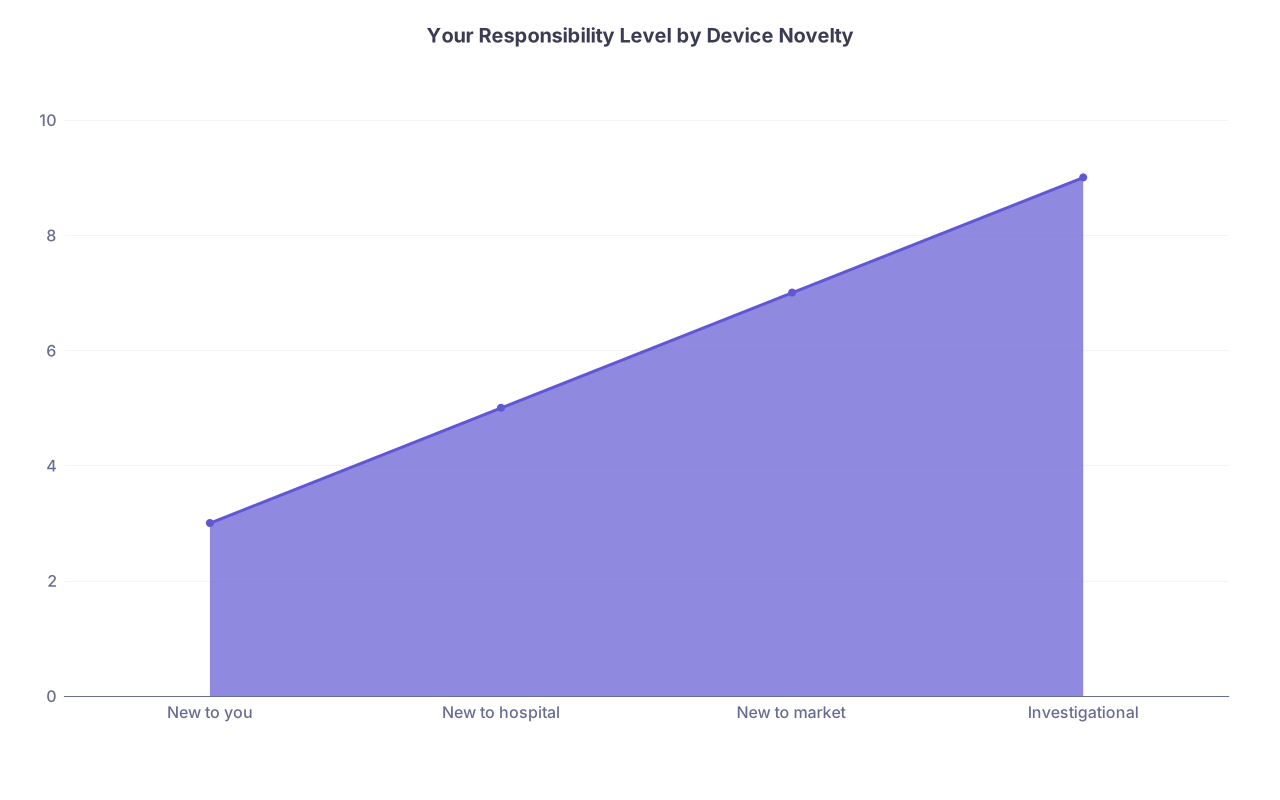
| Type of "New" | Example | Your Minimum Response |
|---|---|---|
| New to you | Common closure device | Quick review, ask attending basics |
| New to hospital | Device used at major centers | Ask about others' experience, key data |
| New to market | Recently FDA cleared | Look up trials, check consent clarity |
| Investigational | IDE / clinical trial device | Confirm protocol and explicit consent |
| Category | Value |
|---|---|
| New to you | 3 |
| New to hospital | 5 |
| New to market | 7 |
| Investigational | 9 |
Higher number here = more you need to actively think about ethics, consent, and your comfort level.

| Step | Description |
|---|---|
| Step 1 | Attending proposes new device |
| Step 2 | Ask how new it is |
| Step 3 | Clarify your role and basic risks |
| Step 4 | Check consent and evidence |
| Step 5 | Proceed with clear supervision |
| Step 6 | Ask attending to take lead or adjust role |
| Step 7 | Debrief and seek guidance after |
| Step 8 | Standard or widely used? |
| Step 9 | You comfortable participating? |

FAQ (Exactly 4 Questions)
1. What if I only realize after the case that the device was experimental or poorly studied?
You’re not the first person that’s happened to. Start by educating yourself: read the device’s regulatory status and key studies. Then debrief with someone you trust — chief resident, program director, or a faculty member known for being ethically solid. You’re not necessarily obligated to file a formal report every time something feels off, but if what you saw crosses into clearly unethical territory (no proper consent, wildly inappropriate indication, clear pressure from industry), then you should consider using your institution’s safety or ethics channels. At minimum, make sure you aren’t blindly complicit next time.
2. Am I required to challenge my attending in front of the patient if they don’t mention the device is new?
No. Publicly undermining your attending in front of the patient usually creates more confusion than protection. Your move is to pull the attending aside before the consent is finalized and ask clarifying questions. If they blow you off and the situation is egregiously wrong, then you have a bigger problem that extends beyond that single patient. But routine disagreements should be handled privately and respectfully.
3. Can I refuse to participate in a case using a device I’m not comfortable with?
You can refuse to perform specific tasks that you believe are unsafe for you to do, and you can voice clear discomfort about the device and your role. Completely refusing to scrub or be present is rare and usually escalates fast. A more realistic move is: “I’m not comfortable deploying this since I’ve never done it; I’d like to assist while you perform it.” If the case itself seems unethical (no valid consent, wildly inappropriate indication), that’s when you talk to your program leadership or ethics/risk channels, ideally before or immediately after, depending on timing.
4. How do I balance learning new technology with not becoming a marketing target for device companies?
You stay curious but skeptical. When a new device shows up, you ask: What problem does this actually solve better than existing options? Where’s the data? What do independent guidelines say? You listen more carefully to attendings who can answer those questions fluently and less to ones who mainly say, “The rep says it’s great.” Attend live cases and in-services, but always pair them with your own reading. If your enthusiasm for a device is mostly based on how “cool” it looks rather than patient-centered outcomes, you’re drifting into sales territory. Pull yourself back.
Key takeaways:
- Don’t be passive. When a “new” device shows up, quickly find out how new it actually is, what the evidence says, and what your role should be.
- Protect the patient and yourself: pay attention to consent, be honest about your comfort level, and never let a rep substitute for direct attending supervision.
- Turn every exposure to a new device into a learning rep: read the data, debrief honestly, and decide the kind of physician you want to be in a world where innovation and marketing are often tangled together.