
The worst ethical problems in medicine rarely look like movie villains. They look like “that’s probably fine… right?” moments. Questionable consent in a trial is one of those—and you cannot shrug it off.
If you’ve just realized a study you’re involved with might have shaky consent practices, you’re not overreacting. You’re probably the only safeguard the participants actually have.
Let’s walk through exactly what to do, step by step, depending on where you are and how bad it is.
1. First 24–48 Hours: Stabilize and Document Reality
You don’t start by blowing a whistle. You start by getting your facts straight and quietly reducing harm.
A. Pause your own involvement in consent (if you can)
If you’re personally obtaining consent in this trial and you now suspect the process is flawed:
- Stop enrolling new participants yourself, if you have that discretion.
- If pausing completely isn’t possible (e.g., your attending is watching), slow things down:
- Ask more clarifying questions.
- Give patients more time.
- Explicitly restate risks and voluntariness.
- Avoid rushing signatures.
You’re not fixing the whole trial yet. You’re making sure you personally are not worsening the damage while you figure out the next steps.
B. Write down what you’re actually seeing
You think the consent is “questionable.” That’s too vague. Turn it into concrete, observable facts.
Examples of what to record (privately, de-identified):
- “Consent forms are given after premedication with midazolam started.”
- “PI tells patients: ‘This is all standard of care; nothing experimental here’ even when protocol includes experimental device.”
- “Family members not invited into room despite patient asking, despite no cognitive impairment.”
- “Forms are in English only; many patients clearly speak only Spanish. PI says, ‘Just sign here; I’ll explain.’ No interpreter involved.”
- “One patient asked, ‘Will I still get care if I say no?’ Research coordinator hesitated and PI quickly jumped in: ‘You’re already here; this is part of the process.’”
Do this in a secure personal file (not on a shared drive, not in the EMR). No names, no MRNs, no identifying details. Just dates, roles, and what happened:
- Date/time
- Where (ICU, clinic, OR holding area)
- Who in general terms (e.g., “Attending surgeon,” “Research coordinator,” “Post-op patient awaiting transfer”)
- Exact words or actions you observed, as specifically as you can remember
This log serves two purposes:
- It forces you to separate facts from vibes.
- It’s proof, later, that this wasn’t one bad conversation you misheard.
2. Diagnose the Problem: Is This Sloppy or Dangerous?
Not all consent problems are equal. Some require quiet correction; others require emergency braking.
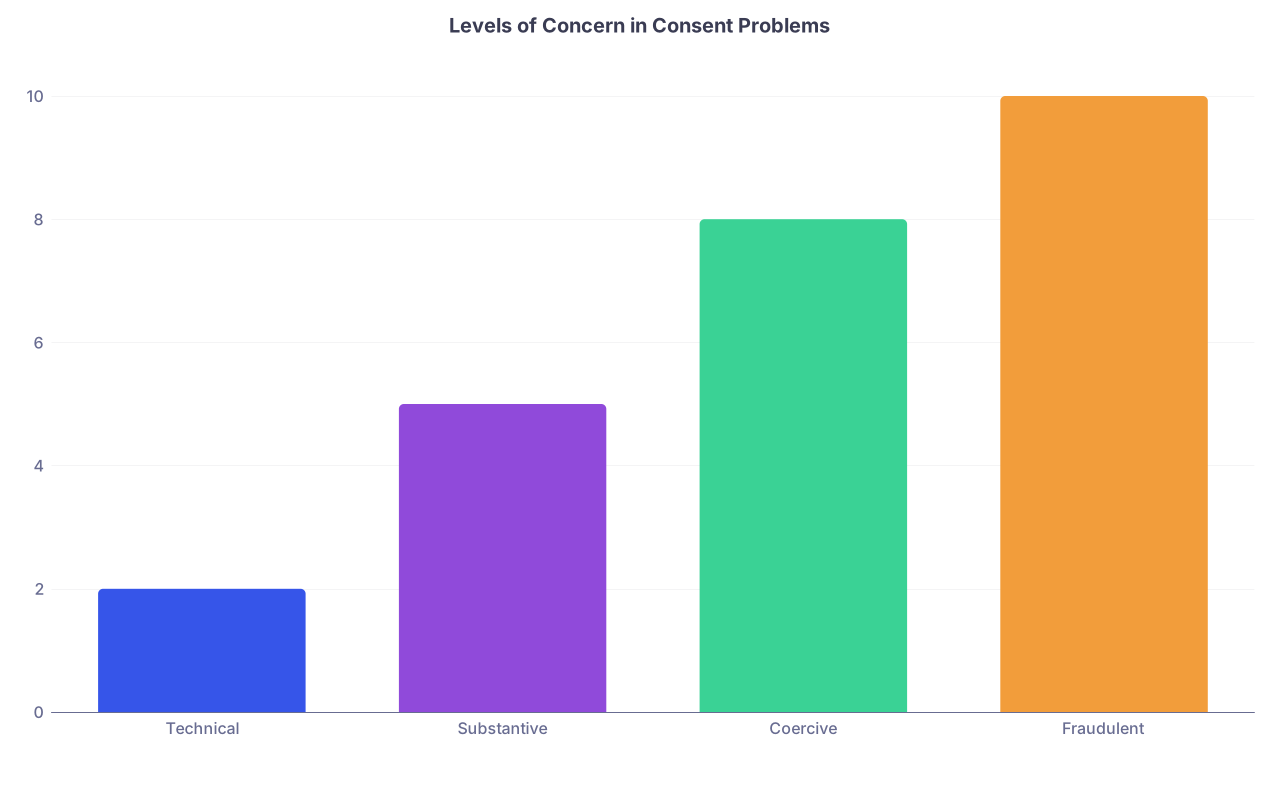
| Category | Value |
|---|---|
| Technical | 2 |
| Substantive | 5 |
| Coercive | 8 |
| Fraudulent | 10 |
Here’s how I mentally triage:
Level 1 – Technical / Administrative Issues
Examples:
- Outdated IRB stamp date on the consent form.
- Wrong version number of the consent being used.
- Missing signature or missing date fields.
- Witness lines left blank when protocol requires a witness.
These are problems, but they’re usually correctable without stopping the study, as long as the actual conversation with the patient has been honest and complete.
Action: Internal correction and quick notification to PI / research office. You don’t need to go nuclear—yet.
Level 2 – Substantive but Non-Coercive Problems
Examples:
- Risks under-emphasized or glossed over.
- Benefits overstated (“this will probably help your condition”) where evidence is weak.
- Alternatives not clearly discussed.
- Consent obtained too quickly (5 minutes total, no chance for questions).
- Patients not given a copy of the signed consent.
Patients might still be making voluntary decisions, but they’re not fully informed. Ethically unacceptable, but not necessarily criminal.
Action: Raise with PI or responsible person soon, document response, then escalate if dismissed.
Level 3 – Coercive / Manipulative Consent
Red flag examples:
- Implying or stating that medical care will suffer if they refuse.
- Obtaining consent while someone is in obvious distress, heavy sedation, or altered mental status.
- Legitimate fear tactics: “If you don’t do this, you’ll die,” when that is not established fact.
- Pressuring families in crisis (“You want to do everything you can for them, right?”) to sign research interventions.
- Insisting on immediate decision: “We don’t have time for you to think this over or talk to others” when in fact the protocol allows time.
Now we are in serious territory. This is not just bad form, it’s a violation of basic research ethics and potentially human subjects regulations.
Action: You are now thinking in terms of halting enrollment and external reporting if internal correction fails.
Level 4 – Fraudulent / Deceptive Practices
This is the really dark stuff:
- Telling participants a procedure or drug is standard of care when it is experimental.
- Enrolling patients without consent at all when the protocol requires it.
- Forging signatures or backdating consents.
- Using non-approved consent forms with different language from the IRB-approved version.
- Enrolling ineligible patients and “fixing” the records to make them fit criteria.
Here, you’re not dealing with misunderstanding. You’re dealing with misconduct.
Action: Treat this like discovering falsified data or patient harm. You’ll likely need to involve institutional compliance, IRB, or external agencies if internal channels fail.
3. Quiet Internal Check: Does This Match the Approved Protocol?
Before you accuse anyone of misconduct, confirm what the protocol actually allows.
You want three things:
- The IRB-approved protocol
- The IRB-approved consent form (latest version)
- Any institutional SOPs (standard operating procedures) for that unit or research office
If you don’t already have these, you can ask:
- The research coordinator: “Can I get the most recent IRB-approved consent and protocol? I want to make sure I’m doing this correctly.”
- The study PI (emailed): “For my own learning, could you share the approved consent form and protocol version we’re currently using?”
Then, compare what’s written to what you’re seeing.
Key questions to ask yourself:
- Is consent supposed to happen before, during, or after any clinical procedures?
- Is there a requirement for a translator / interpreter when English fluency is limited?
- Are there any exclusion criteria being ignored?
- Does the consent form clearly list the experimental nature, risks, and alternatives?
- Is there any language about emergency/exception from informed consent? (Some trials in emergencies legally allow this but only with strict conditions and community notification.)
If what you’re seeing clearly contradicts the written protocol or consent form, that strengthens your case significantly.
4. Who to Talk To First (and How to Say It)
You don’t blast an email to the FDA from your phone in the hallway. You escalate in a controlled, strategic way.
Step 1: Direct but low-drama conversation with someone close to the trial
Start with the person whose job it is to manage the study day-to-day. Often:
- Research coordinator
- Sub-investigator you trust
- Fellow heavily involved in the trial
- Unit research nurse
You might say something like:
“I’ve been involved with the consent process for [Study Name], and I’m worried that the way we’re doing consent doesn’t match the approved form or ethical standards. For example, [describe 1–2 concrete instances]. Can you help me understand if this is actually what the protocol allows?”
You’re not accusing; you’re asking for clarification. Sometimes you’ll learn there’s a nuance you missed. But pay close attention to the reaction:
- Healthy response: “That’s concerning. Let’s look at the protocol and maybe loop in the PI / IRB.”
- Unhealthy response: “We’ve always done it this way. If you make trouble you’ll ruin this study.”
That second one is a big red siren.
Step 2: The PI or attending in charge
If the problem clearly persists or is being minimized, you go to the person who officially owns the trial: the principal investigator (PI).
Script it simply:
“I need to raise an ethical concern about how consent is being obtained in [Study Name]. I’ve seen [specific examples], and I’m worried participants are not truly giving informed, voluntary consent. I’ve reviewed the IRB-approved consent/protocol, and I don’t think this matches. What’s your understanding, and how do you see addressing this?”
Then stop talking. Let them react.
If they:
- Take it seriously
- Agree to review
- Consider pausing enrollment or consulting IRB
…good. Document that conversation for yourself (date, time, what they said they would do).
If they:
- Dismiss it
- Tell you you’re “too sensitive”
- Suggest you’ll hurt your career if you keep asking
…you move on to formal channels.
5. Formal Channels: IRB, Compliance, and External Reporting
When internal conversations fail or the behavior is severe/coercive/fraudulent, you escalate beyond the research team.
Your main internal options (most institutions):
| Office / Person | Best For |
|---|---|
| IRB Office | Consent violations, protocol issues |
| Research Compliance | Systemic or repeated violations |
| Office of Integrity | Fraud, fabrication, serious abuse |
| Program Director | Residents/trainees under pressure |
| Ombudsperson | Confidential advice, fear of reprisal |
You do not need proof beyond all doubt to contact them. You need:
- Good-faith concern
- Specific observations
- Willingness to describe what you’ve seen
Typical email to the IRB (keep it crisp):
“Dear [IRB contact],
I am [role] involved in [Study Name, IRB # if you have it]. I have observed multiple instances that make me concerned participants are not providing truly informed, voluntary consent.
Examples include:
- [Short description of 1–2 key events]
- [If relevant] These practices seem inconsistent with the IRB-approved consent form/protocol (version X, date Y).
I’m requesting guidance on appropriate next steps and whether this warrants a review of the study’s consent process. I’m available to discuss by phone if easier.
Sincerely, [Name, role, contact]”
If your institution has anonymous hotlines for research integrity or compliance, you can use those if you fear retaliation. But anonymous reports are easier to ignore; named concerns carry more weight.
When to consider external reporting
If:
- The institution ignores clear, serious violations.
- Participants are being actively harmed or clearly deceived.
- You’ve exhausted internal channels or they are compromised.
Possible external routes (depending on country and oversight):
- National regulatory agency (e.g., FDA Office of Good Clinical Practice in the U.S. for drug/device trials).
- Office for Human Research Protections (OHRP) if federally funded research.
- Journal editors if data from this problematic trial is being published with misrepresented methods.
This is the highest level of escalation. You do not jump here first unless the situation is truly extreme and urgent.
6. Protecting Yourself While Doing the Right Thing
You’re not paranoid for thinking about retaliation. It happens.
Here’s how to be smart about self-protection:
- Keep your own contemporaneous notes of:
- What you saw
- Whom you informed
- What they said they would do
- Use institutional channels, not ad hoc gossip, for reporting.
- Avoid making public accusations (social media, group emails) without official backing.
- If you’re a trainee:
- Loop in your program director or a trusted faculty mentor not involved in the trial.
- Ask directly: “I’m worried about retaliation if I report this. What protections exist for me?”
Most institutions have explicit non-retaliation policies for good-faith reports involving patient safety and research ethics. They don’t always work perfectly, but they exist for a reason. Reference them if anyone threatens your position.
7. Handling It in Real Time With Patients
Sometimes the ethical problem lands right in front of you. You’re in the room while shaky consent is happening.
Two simultaneous duties: protect the patient, and avoid a chaotic showdown in front of them if you can help it.
If the patient is about to sign under clear misinformation
If safe, you can interject gently:
“Before you sign, I want to make sure you’ve heard a couple of key points about risks and alternatives, just so your decision is really informed.”
Or:
“Just to clarify, participation in this study is completely voluntary. Your medical care here will be the same whether you join the study or not.”
If the PI or coordinator glares at you, that glare is not legally binding. An honest clarification to a patient is hard to punish formally.
If things are really off the rails
Example: Heavily sedated patient, research consent being pushed, family not present.
You can say:
“I’m not comfortable proceeding with consent right now given their level of sedation. I think we should wait until they’re more awake, or include family if appropriate.”
If they bulldoze through anyway, you:
- Step back from participating.
- Document what happened for your records.
- Escalate soon after.
8. Learning From This Without Becoming Numb or Cynical
Finding out a trial has sketchy consent is a gut punch. It can make you question the whole research enterprise.
Do not let this turn you into the person who shrugs and says, “Everyone cuts corners.” That’s how bad cultures perpetuate.
Instead, use it as a blueprint:
- In your own future research:
- Write consent processes that are realistic and patient-friendly.
- Demand training of everyone obtaining consent.
- Insist on genuine time for questions, interpreters when needed, and patient autonomy.
- In your clinical practice:
- Watch for when “quality improvement” or “innovative care” quietly becomes research without clear consent.
- In your mentorship:
- Talk to students and residents honestly about consent shortcuts you’ve seen.
- Normalize speaking up EARLY, not after years of complicity.
You’re not just dealing with one bad trial. You’re building your own ethical spine.
9. Quick Decision Flow: What To Do Next

| Step | Description |
|---|---|
| Step 1 | Notice questionable consent |
| Step 2 | Document specific events |
| Step 3 | Review protocol and consent form |
| Step 4 | Talk to coordinator or PI |
| Step 5 | Discuss with PI, request changes |
| Step 6 | Contact IRB or Compliance |
| Step 7 | Escalate to higher institutional or external body |
| Step 8 | Monitor future consents and debrief |
| Step 9 | Severity level |
| Step 10 | Resolved? |
10. Common Scenarios and How I’d Handle Them
Scenario 1: Language barrier ignored
You’re on a cardiology service. The PI obtains “consent” from a Spanish-speaking patient using an English-only form and no interpreter.
What I’d do:
- In the room: “I think we should get a certified interpreter so the patient can review this in their primary language. I can help arrange that.”
- Afterward: Email the coordinator and CC PI: “I’m concerned we enrolled a Spanish-speaking patient without a translated consent or interpreter. How does the protocol address non-English speakers?”
- If brushed off: Contact IRB with that specific example.
Scenario 2: Residents pressured to enroll quickly in the OR
Consent being taken in pre-op as the patient is literally being wheeled to the OR. Attending says, “Just get the consent and we’ll talk risks inside.”
What I’d do:
- In the moment: “I don’t think this timing allows meaningful consent. Can we discuss this with them earlier in pre-op next time?”
- If pattern continues: Bring to program director and IRB: “Residents are routinely asked to obtain consent immediately pre-op under time pressure, which does not allow adequate discussion.”
Scenario 3: You discover retrospectively that consents were forged
You compare EMR signatures and trial documents. Some “patient signatures” look obviously inconsistent. One patient denies ever being in a study.
This is serious.
What I’d do:
- Immediately stop any role in enrolling subjects.
- Write a detailed log of what you’ve seen.
- Go straight to research compliance / integrity office and IRB. This is beyond just the PI; it’s potential fraud.
- If the institution drags its feet and the trial involves significant risk, consider external reporting after legal/ethics consultation.
11. Your Bottom Line
You’re not “being difficult” for caring about consent. You’re doing the core job of a clinician and scientist: protecting people who don’t know the system like you do.
When you discover questionable consent practices:
- Get concrete: Write down exactly what you’re seeing, not just how you feel about it.
- Escalate smartly: Start locally, then move to IRB/compliance if dismissed, and go external only when necessary.
- Protect both the patient and yourself: Clarify in the moment when you can, and use official channels for reporting.
FAQ (Exactly 5 Questions)
1. What if I’m just a medical student—do I really have standing to raise this?
Yes. Your formal authority is limited, but your ethical obligation is not. Students often see things others overlook because you’re not yet desensitized. Use the same steps: document, clarify with the team, then go to the IRB or a trusted faculty mentor if concerns persist. Precede formal reports with “I may be misunderstanding, but…” if that helps you feel more comfortable; it doesn’t weaken the substance of your concern.
2. Could I get in trouble for pausing my own participation in the study?
You might get social pushback, but ethically you’re on solid ground declining to personally participate in conduct you believe is unethical. Phrase it as: “I’m not comfortable obtaining consent under these conditions; I need clarification from the IRB/ethics before I continue.” If someone tries to formally discipline you for that, it actually strengthens your case with compliance and IRB.
3. How do I know when it’s bad enough to contact the IRB directly?
Use this rule: if participants may be making decisions based on incomplete, coerced, or false information, and you’ve tried to address it with the team without meaningful change, it’s IRB time. You do not need proof of intent. IRBs are there to investigate exactly this kind of concern.
4. What if the IRB seems to minimize the issue too?
Document that interaction as well. Then consider: research compliance office, office of professional integrity, or an ombudsperson. If the trial is regulated (FDA, federal funding) and involves serious risk, you can seek guidance from national bodies (e.g., OHRP, FDA) or professional organizations. Before going external, it’s wise to speak confidentially with an institutional ethics lawyer or senior mentor you trust.
5. Do I have to tell the participants that their consent was mishandled?
You personally usually do not have the authority to unilaterally re-contact participants outside the study structure. But you can and should raise the question explicitly with the IRB: “Given these consent problems, do participants need to be re-contacted and re-consented?” The IRB can mandate corrective actions, including re-consent or withdrawal from the study, if warranted.
Key points: Questionable consent in a trial is not a small administrative glitch; it’s a core ethical failure you’re obligated to address. Start by documenting specific behaviors and comparing them to the approved protocol, then escalate in a deliberate way—from local team to IRB to higher bodies if needed. And while you do all that, remember your first duty: protect the participant in front of you, even if that means slowing things down or stepping out of a flawed process.