
The loudest voices in an ICU family meeting are often the least realistic about “trying anything experimental.”
If you’re the clinician in the room, you’re not just dealing with grief. You’re dealing with misinformation, magical thinking, and sometimes raw fear disguised as “we just want cutting-edge options.” You need a plan before you walk into that conversation, not while you’re drowning in it.
This is that plan.
1. Know What “Experimental” Actually Means Before You Open Your Mouth
You cannot handle family pressure for “anything experimental” if you yourself are fuzzy on the categories. Families sense hesitation and will push through any gap in your understanding.
Break it up in your head first:
| Category | Typical Example | Oversight |
|---|---|---|
| Standard of care | Evidence-based sepsis bundle | Guidelines |
| Reasonable off-label | Drug approved, new context | Attending review |
| Compassionate use | Not approved, special access | IRB/FDA or nation |
| Clinical trial | Research protocol | IRB + sponsor |
Families say:
“Isn’t there some trial?”
“Can you use that new drug they talked about on TV?”
“Can’t you try stem cells? AI treatment? Something advanced?”
You need quick mental buckets:
Standard or near-standard care.
You can offer this now if it’s clinically indicated. It’s not “experimental” just because it’s new to them.Off‑label but reasonable.
For example: using a vasopressor in a slightly different context but within common practice. This is still clinical medicine, not research.Research trial available at your institution.
This requires inclusion criteria, consent, IRB approval, and often randomization. Families usually do not understand that last part.Expanded access / compassionate use.
For the drug/device that’s not approved for anything yet. One patient at a time. Bureaucratically heavy, time-sensitive, and rarely realistic in a crashing ICU patient.
If you do not differentiate these in your mind, you’ll either overpromise, under-explain, or fold when someone waves a news article in your face.
2. Decode What the Family Is Really Asking For
Most families aren’t actually requesting a specific monoclonal antibody. They’re asking for one of three things:
- “Please don’t give up on them.”
- “Show us you’re not missing something.”
- “We need to feel like we did everything.”
You respond to those underlying needs, not just the literal words.
Say you’re in a room, patient on max pressors, multi-organ failure. Daughter says:
“My friend’s dad got some ‘experimental thing’ at a big center and he walked out. Can we get that here?”
If you take that literally and start talking trial registries, you’ll lose them. You respond to the emotional content first, then the science.
Example script:
“I hear that you’re worried there might be something we are not doing. My job is to make sure your dad gets every treatment that has a real chance of helping and doesn’t get things that would only cause more suffering without benefit. Let me walk you through what we’re already doing, and then we can talk about which kinds of ‘experimental’ options are or are not realistic.”
You’re telling them:
- I’m not missing things.
- I’m not lazy.
- I’m not giving up.
You are also quietly setting a boundary: this will be a rational discussion, not a fishing expedition through the internet.
3. The Step‑By‑Step Conversation Strategy (Use This Structure)
When the family says “anything experimental,” here’s the practical sequence that actually works in an ICU room.

| Step | Description |
|---|---|
| Step 1 | Family asks for experimental treatments |
| Step 2 | Clarify goals and fears |
| Step 3 | Explain current standard care |
| Step 4 | Define what experimental means |
| Step 5 | Discuss clinical trials or off label |
| Step 6 | Explain limits and focus on comfort/realistic care |
| Step 7 | Address risks and consent |
| Step 8 | Confirm understanding and document |
| Step 9 | Any realistic options? |
Step 1: Reflect and clarify
You do not jump straight to “no.” You buy clarity.
Examples:
- “When you say ‘experimental,’ can you tell me what you’re picturing?”
- “Are you thinking about a specific drug or trial you read about, or more that you don’t want us to stop trying?”
Let them talk for a full minute. Do not interrupt. You’ll often uncover:
- A specific center: “Mayo,” “MD Anderson,” “Cleveland Clinic”
- A TV story
- A vague belief that “big hospitals have secret treatments”
Then summarize in plain words:
“So you’re worried that if we don’t go after something new or advanced, we’re failing him. That makes sense given how fast this all happened.”
You’re aligning, not agreeing.
Step 2: State what is being done
Families demand experimental stuff when they have no mental model of what’s already happening.
Concrete approach:
“Let me give you a quick map of what we’re doing now. Right now, we’re supporting his lungs with the ventilator at the strongest settings that are safe. We’re supporting his blood pressure with three different medications. He’s getting the strongest antibiotics we have for this infection, based on his cultures. His kidneys have failed, so we are doing continuous dialysis. This is the maximum level of life support that modern ICU care can provide.”
Say it calmly. Don’t rush. Make it sound like you know the ceiling of current medicine.
Step 3: Define “experimental” in this specific case
Now you drop the categories in simple language.
“When people say ‘experimental,’ it can mean a few things.
One is a research study, where a patient is randomly assigned to a new treatment or to usual care.
Another is using a drug in a way it was not originally approved for, but that doctors sometimes try when evidence is limited.
And then there are drugs that are not approved for any use yet; those require special emergency permission and are rarely possible in someone as sick as your mom is now.”
Pause. Let that land.
Then you connect it to this patient:
“For your mom’s exact situation — [condition] with [complication] at this advanced stage — there are, unfortunately, no research studies or special-access drugs that have been shown to reverse this once it’s this far along.”
You are specific. You are owning the limits of medicine.
4. Handling Common Variants of the Demand
Let’s walk through the greatest hits and what you actually say.
Scenario A: “Can we transfer them to a bigger hospital for trials?”
You’re in a community ICU. Patient is maxed on vents, pressors, dialysis. Family says:
“We want them at [famous academic center] where they have research trials and better options.”
Your move:
- Address transfer feasibility.
- Address actual benefit.
Example:
“Right now, your brother is on the highest level of life support and very unstable. Moving him, even across town, would very likely cause his blood pressure and oxygen levels to crash. There’s a strong chance he would die in the ambulance or helicopter.
I have also checked our usual transfer partners. At this stage of his illness, there are no trials they can offer that would change this picture. They have the same ventilators, the same dialysis machines, and the same medications. So we would be taking on real risk for transfer, without a realistic chance of benefit.”
If transfer actually is medically reasonable and there is a relevant trial, say so:
“He is stable enough that a transfer is medically possible. I’ve spoken with [receiving center] and there is a trial for patients like him, but trial enrollment means he might or might not get the experimental treatment. I want to be clear: it’s not a guaranteed new therapy, and we do not know yet if it helps.”
Scenario B: “We’ll sign anything. We accept all risks.”
You’ll hear:
“We’ll take the risk, just try it.”
“We don’t care about side effects.”
That’s not how ethics or law works. Your duty is not to be a vending machine for dangerous interventions.
You respond by re-centering on benefit, not just risk.
“The problem isn’t only the risk. The main issue is that, based on everything we know, these kinds of interventions have no realistic chance of helping at this stage. Doing something that has almost no chance of benefit and a high chance of suffering is not fair to your dad, even if you’re willing to accept the risk on his behalf. My responsibility is to recommend treatments that can actually help.”
If they push:
“There is a line where doing more becomes doing harm. I will not cross that line, even with good intentions.”
You are allowed to say that. You should say that.
Scenario C: “Our relative would want ‘anything’ done”
The myth of the “anything” patient. People almost always mean “anything that could reasonably help.”
You can reframe:
“Many people say ‘do everything’ when they’re healthy. What we try to do, in ICU, is translate that into what they would want when ‘everything’ means more machines, more needles, and more time in a state we know they would not recover from.
If a treatment had a meaningful chance of getting her back to the kind of life she valued, I would absolutely recommend it. At this point, the things being asked — certain experimental or heroic options — cannot change the outcome, only how much she suffers on the way.”
That’s the ethical core: benefit, not box‑checking.
5. When There Is Something Experimental: How Not to Screw It Up
Sometimes there really is a relevant trial or off-label idea. This is where people get sloppy and drift into coercive consent.
You need a clean structure in your head.
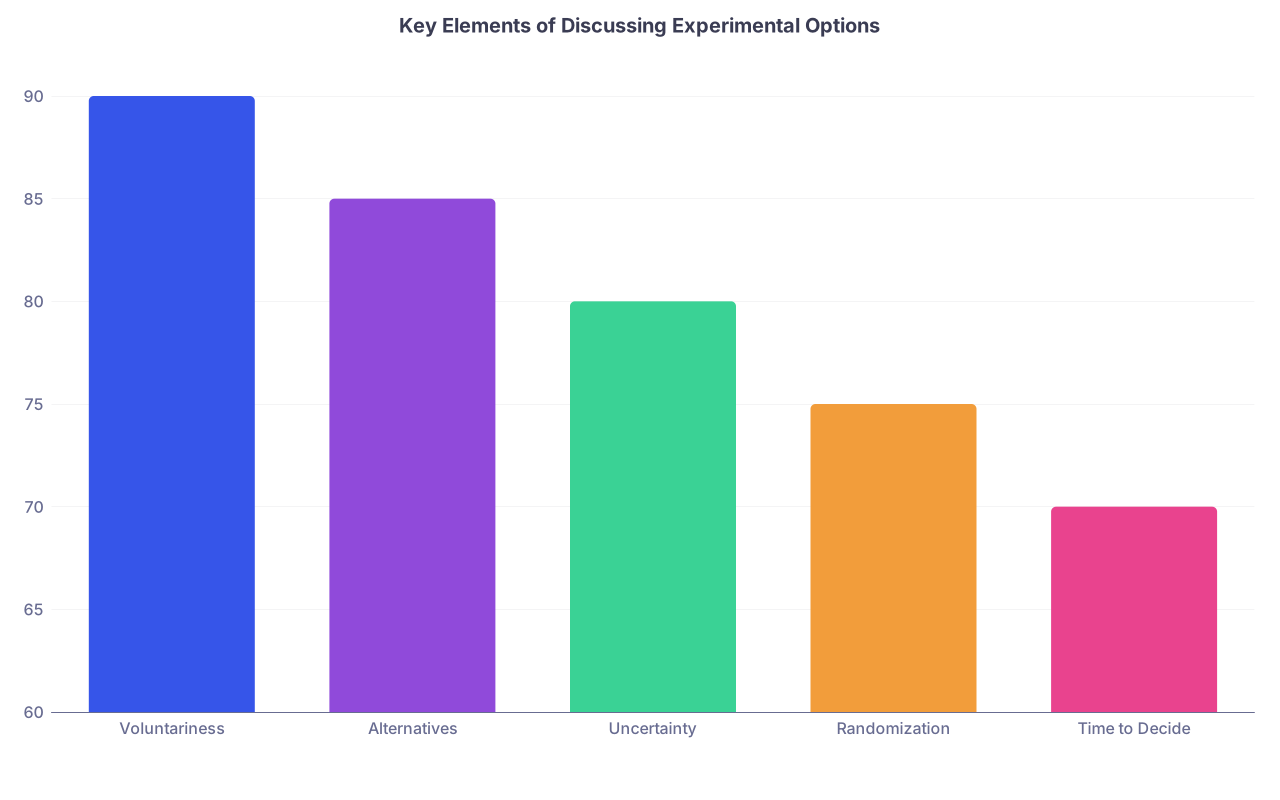
| Category | Value |
|---|---|
| Voluntariness | 90 |
| Alternatives | 85 |
| Uncertainty | 80 |
| Randomization | 75 |
| Time to Decide | 70 |
Make the distinction: care vs research
Use explicit language:
“What we’ve talked about so far is standard medical care — treatments we use because we have strong evidence they help.
There is also a research study we can consider. That’s different. The goal of research is to learn, not just to treat the individual in front of us. That means there are unknowns.”
Then hit the critical points in plain English:
- It may not work.
- It may have risks we do not fully know.
- They may not actually get the experimental arm (if randomized).
- Saying no will not reduce the quality of usual care.
Example script:
“If you choose not to take part in this study, we will still do everything appropriate for your mom. Saying no does not change the care she gets from our team.”
If off‑label but within reason:
“There’s a medication we sometimes use in situations like this, though it’s not officially approved for this exact use. The evidence is limited — some small studies suggest it might help, others are inconclusive. Risks include [x, y, z]. If we try it, I want everyone to understand we’re in a grey zone of medicine, not a proven cure.”
Document that conversation. In writing. In the chart.
6. Managing Your Own Moral Distress While Families Push
Let me be blunt: these cases eat residents and attendings alive. You get yelled at for “doing nothing” when you’re doing the absolute limit of what evidence supports. Or you feel complicit when your group tends to “throw everything” at patients long past the point of benefit.
You need internal guardrails.

Practical moves:
Decide in advance what you will not offer
As a team, set boundaries. For example: “We do not offer ECMO for X condition at this stage,” or “We do not pursue compassionate use for actively dying, unstable patients.” Having these lines pre-negotiated reduces bedside improvisation.Use the team
You do not need to solo every hard meeting. Loop in:- ICU attending
- Ethics consult
- Palliative care
- Social work / chaplain
A palliative care doc who calmly says, “We are at the end of what medicine can offer” can sometimes get through when you cannot.
Name your distress explicitly (to yourself and colleagues)
Afterward, say it out loud in debrief:
“I hated that conversation. I felt like the bad guy not offering more.”
Otherwise this stuff metastasizes into burnout.
7. Documentation and Legal Reality: Protect Yourself and the Patient
Anytime “experimental,” “trial,” “transfer,” or “lawsuit” enter the conversation, you assume the notes may be read later. Act accordingly.
Things you document clearly:
The family’s concerns and exact phrases.
“Family requested ‘anything experimental,’ including transfer to large academic centers.”Your explanation of current care.
“Explained patient is receiving maximal ventilatory support, vasopressors, RRT, broad-spectrum antibiotics.”Your explanation of experimental options and their (un)availability.
“Reviewed lack of active interventional trials or compassionate-use agents applicable to this stage of [condition].”Their understanding and your recommendation.
“Family verbalized understanding that no additional experimental options are available that would change prognosis. Recommended continued current support vs transition to comfort-focused care.”
If there is a trial:
- Reference consent form.
- Note that you clarified voluntariness and alternatives.
- Record family questions and your answers.
This isn’t just self-protection. It’s good medicine. Clear documentation signals to the next shift what ground has already been covered so they don’t accidentally re-open false hope.
8. Building Your Own Script Library (So You’re Not Ad‑Libbing at 2 a.m.)
You should have a few lines almost memorized. Not to sound robotic, but so your brain doesn’t blank when emotions are high.
Here are field-tested sentences that work:
To set boundaries gently:
“My job is not only to keep trying things, but to make sure what we do has a real chance of helping and doesn’t just add suffering.”To separate medicine from miracles:
“Right now, a recovery would require something beyond what medical science can do. We are at the edge of what medicine can offer.”To respond to “we’ll accept all risk”:
“The issue here is not just risk; it’s that even if we take that risk, this treatment does not have a realistic chance of changing the outcome.”To validate and redirect:
“Wanting more options means you love them. What I can do is make sure their last days reflect that love without putting them through treatments that cannot help.”To close the loop at the end of a meeting:
“Let me say this clearly: there are no experimental treatments we are holding back that have a real chance of helping in this situation. We are giving the best care current medicine can provide.”
Practice these. Out loud. In the call room or car. It feels dumb until the first time you need them and they come out steady instead of shaky.

9. Personal Growth: Using These Encounters To Become a Better Physician
If you’re still in training, these cases will shape who you become. They can harden you into someone who resents families. Or they can sharpen your ethics and language so you’re rock-solid under pressure.
Use them deliberately:
After each “anything experimental” encounter, ask yourself:
- Did I state the limits of medicine clearly?
- Did I separate care from research in understandable terms?
- Did I say “no” where I should have said “no”?
- Did I let my own discomfort push me to offer something futile?
Pick one small skill to improve each time:
- Next time, I’ll define “experimental” better.
- Next time, I’ll involve palliative care earlier.
- Next time, I’ll document the emotional content more precisely.
You will not be perfect. You will occasionally over-treat out of fear or cave to pressure. Learn from it instead of pretending it did not happen.
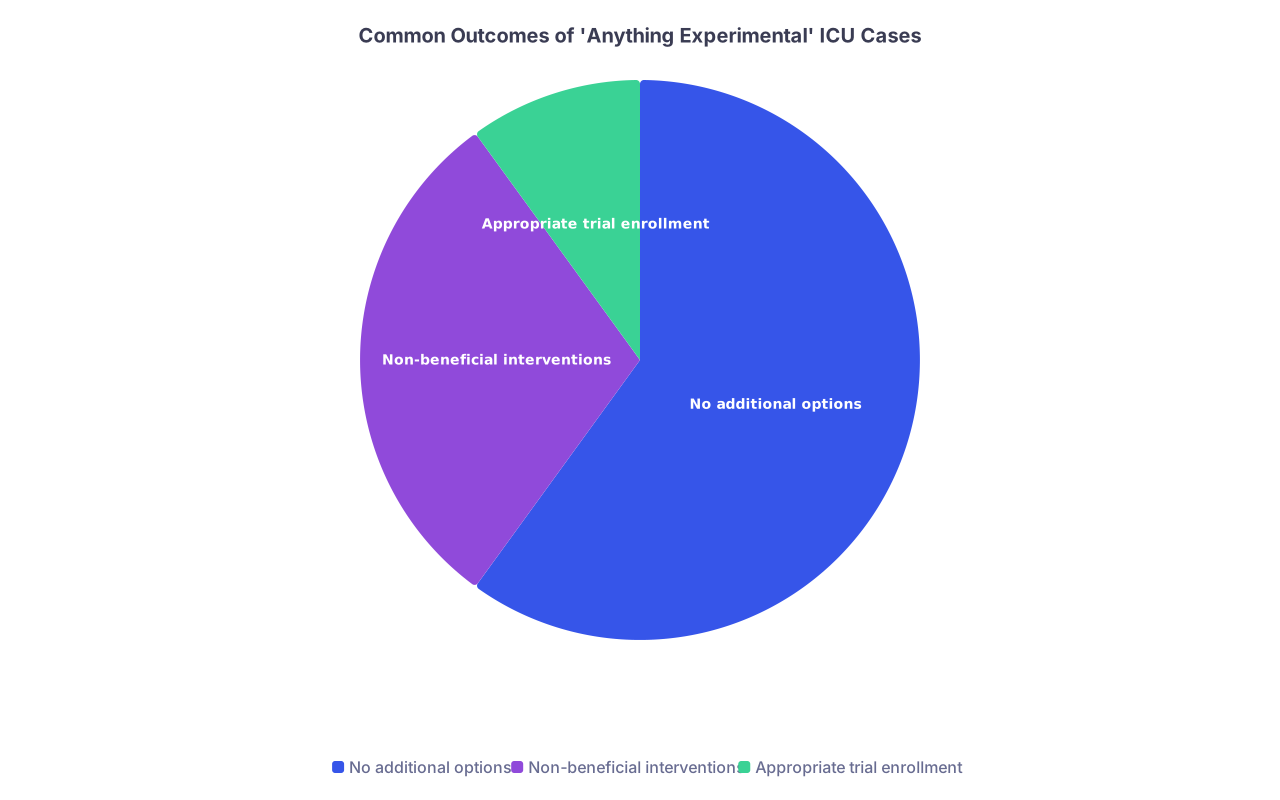
| Category | Value |
|---|---|
| No additional options | 60 |
| Non-beneficial interventions | 30 |
| Appropriate trial enrollment | 10 |
Most of the time, there truly is no meaningful “experimental” option left. A smaller chunk of cases end up with additional interventions that don’t change the outcome. Only a minority represent genuinely appropriate enrollment in a useful study.
Your job is to move more cases into the honest first category and the justified third, and fewer into the futile middle.
FAQs
1. Should I ever offer to “look into” experimental options just to calm the family?
Only if you actually intend to look and to report back honestly. Saying “I’ll look into it” as a stall tactic is how mistrust is born. Better: “I can check our current trials list and with our research office today. If there is something appropriate, I’ll tell you. If there is not, I’ll be clear about that too.”
2. What if another clinician on the team is more willing to “try anything” and undermines my message?
You address it directly with your colleague, not in front of the family. “I’m worried we’re offering things that won’t benefit this patient and are confusing the family about what’s realistic.” If needed, escalate to the attending, ICU director, or ethics. At the bedside, avoid contradicting in real time; instead, re-ground in facts: “Even with [additional treatment], the overall prognosis and likelihood of recovery remain extremely poor.”
3. How do I handle a family that threatens legal action if we do not pursue experimental care?
You stay calm and stick to clinical and ethical reality. “I hear that you are very distressed and worried we might be denying helpful treatment. We are not. We are recommending against treatments that have no realistic chance of benefit and could cause harm. You are always free to request a second opinion or speak with patient relations, and we can help you connect with them. Meanwhile, we will continue to provide the best appropriate care we can.”
4. Is it ever appropriate to raise research trial options proactively in the ICU?
Yes, if there is a well-designed trial that clearly applies to the patient’s condition and stage, and enrollment is ethically sound. You must clearly separate research from standard care and avoid presenting participation as the only “good” or “responsible” choice. “There is a research study we can consider. It might or might not help, and saying no will not change the quality of care we provide.”
Key points:
You’re not a wish‑fulfillment machine for desperate families. You’re a professional whose job is to push right up to the edge of what medicine can help with, and no further. When “anything experimental” comes up, you clarify what’s really being asked, explain the ceiling of current care in plain language, and hold the line against futile or harmful interventions while staying relentlessly honest and humane.