
If you wing this kind of conversation, you will either lose the patient’s trust or practice unsafe medicine. Sometimes both.
You’re in clinic. Busy day. A follow-up cancer visit that’s supposed to be routine. You walk in and the patient pulls out their phone: “Doctor, I read about this new experimental drug that cures my type of cancer. I want this one. Why haven’t you given it to me?”
Your stomach drops a little. You recognize the drug name—it’s in an early phase I/II trial. Mouse data. Maybe a handful of humans. Definitely not standard of care. But the patient is scared, desperate, and convinced.
Here’s how you handle this without panicking, overpromising, or becoming the cold, paternalistic doctor they rant about on Facebook later.
1. First 5 Minutes: Do Not Educate. Defuse.
Your instinct will be to start explaining trial phases, FDA approval, and safety data. Do not start there. If you lead with “Well actually…” you’ve already lost them.
First job: understand and de-escalate.
Script it. Literally if you need to.
- Pause and validate the emotion before the content.
You can say something like:
- “I can see you’ve really been digging into this and it clearly matters a lot to you.”
- “Of course you’re looking for every possible option. I would be too in your position.”
Notice: you are not agreeing that the drug is good. You’re acknowledging that their search is reasonable.
- Ask for their version of the story before you tell yours.
“Can you walk me through what you saw and what stood out to you?”
Then shut up and listen.
You want to know:
- Where they saw it (TikTok? Patient forum? Company press release? PubMed?)
- What exact claims they’re repeating (“90% cure rate,” “no side effects,” “works for all stages”)
- What they think the current plan is missing (“You said my current chemo ‘controls’ the cancer—this says it cures it.”)
- Mirror and summarize.
“I’m hearing a few things. You’re worried our current plan might not be enough, you’re scared we’re running out of time, and this drug sounds like a miracle because of what you read. Is that right?”
If they correct you—good. Keep clarifying until they say “Yes, that’s what I mean.” Only then move on.
This first 5 minutes isn’t wasted. It’s buying you permission to say “no” or “not yet” later without an explosion.
2. Figure Out What You’re Actually Dealing With
Not every “experimental drug” scenario is the same. You need to classify it quickly.
There are 4 common buckets:
| Type | Status | Typical Risk Level |
|---|---|---|
| Preclinical (animal/lab only) | Not in humans | Unknown, potentially high |
| Phase I trial | First in humans | Safety focus, unknown benefit |
| Phase II/III trial | Clinical trials | Some benefit data, still experimental |
| Approved for other indication | Off-label use | Known risks, unknown benefit in this cancer |
If you know the drug, you can usually classify it in your head. If you do not, say so plainly:
“That drug name isn’t one I know well enough to give you a safe answer on the spot. Let me pull it up right now and see what stage it’s at.”
Then actually look it up in front of them:
- ClinicalTrials.gov
- NCCN or your local cancer guidelines
- A quick PubMed search for phase I/II studies
Doing this live does two things:
- Shows you’re not dismissing them out of hand
- Models how you evaluate evidence, instead of just saying “trust me”
If they resist you looking it up (“I already did the research”), be calm but firm:
“Your research is important, and mine is too. My responsibility is to make sure what we choose together is safe and grounded in the best evidence we have. Let me take 2 minutes to check the data behind this.”
Take the 2 minutes.
3. Draw the Line Between Hope and Hype
Once you’ve classified the drug, you need to explain the difference between:
- “Exists in a news headline”
- “Is realistically available to you”
- “Is medically appropriate for you”
This is where most clinicians botch it. They either:
- Crush hope completely (“That’s nonsense, forget it”) or
- Become overly vague (“Maybe someday, we’ll see”) and leave the patient clinging to fantasy
You need a clear, structured explanation they can understand. Think like this:
- Clarify what “experimental” actually means.
I often use plain language like:
“‘Experimental’ here means:
- It hasn’t been proven to help people live longer or feel better yet.
- We’re still figuring out what the right dose is.
- We might not even know all the major side effects.”
Keep it concrete. Not abstract.
- Anchor to their specific case.
“You have stage IV colorectal cancer with KRAS mutation. The current evidence-based options we know can help people in your exact situation are A, B, and C. This new drug, from what I’m seeing, has only been tested in 20–30 people with a different tumor type and we don’t yet know how well it works, or if it applies to your type at all.”
People tolerate “not yet” better than “never,” but only if they understand the why.
- Name the ethical boundary clearly.
You’re not just a vending machine for whatever drug they saw. Say that directly but respectfully:
“I have an ethical and legal responsibility not to prescribe drugs that are unproven and potentially dangerous outside of proper trials. That isn’t me blocking you—it’s me doing my job to keep you safe.”
Do not mumble this. Patients actually respect a line in the sand more than hedging.
4. Build a Real Response Plan: 4 Structured Paths
Now here’s the part the patient actually cares about: “So what can we do?”
You need a menu of paths, not a single yes/no.
Path 1: Clinical Trial Enrollment (Best-Case for True Experimental Drugs)
If the drug is in a legitimate clinical trial:
- Check trial eligibility criteria quickly.
- See if it’s offered at your institution or a nearby center.
- If there’s any realistic shot, say:
“There is a valid clinical trial of this drug. That’s the only safe way to get it right now. If you’re open to it, I can:
- See if you might fit the criteria
- Reach out to our research team
- Or refer you to [Nearest Academic Center] to explore this.”
You’re giving them a path, not a wall.
If they’re clearly ineligible:
“I did look at the criteria. It’s designed for patients with earlier stage disease / different mutation / no prior chemotherapy. So the trial team wouldn’t be able to enroll you. I’m not allowed to prescribe this outside the trial because then we’d bypass the safety protections built into that system.”
Some patients will push: “Can’t you just get it anyway?” This is where you stay calm:
“If I bypass that system and something goes wrong, I’ve exposed you to risk without any data to justify it and outside of the monitoring built into the study. That’s not ethical, and I won’t do it. But we can talk about other trials that do fit your situation.”
Path 2: Off-Label Use (Approved for Other Indications)
If the drug is actually FDA-approved for something else and has at least some plausible rationale for their cancer:
Now you’re in gray-zone land. Here you must balance:
- Mechanistic plausibility
- Early human data (even small)
- Toxicity profile
- Cost and access
Be explicit:
“This drug is approved—but not for your cancer. We have:
- Very limited data in your situation
- Some theoretical reasons it might help
- A real risk of side effects
- And likely high out-of-pocket cost because insurance may not cover off-label use here.”
Then ask a key question:
“What matters most to you right now: maximizing chance of benefit based on evidence we already have, or being open to a more uncertain option that’s riskier and might not be covered?”
If they’re leaning experimental and your risk-benefit calculus says it might be reasonable in a late-line, no-standard-options-left scenario, you can ethically consider it. But document your reasoning and the conversation. In detail.
If you think it’s a bad idea:
“My judgment is that, for you right now, the likely harms and costs of this drug outweigh what we know or even suspect it might do. I would not be comfortable prescribing it. What I can do instead is…”
And then you must have a real “instead.”
Path 3: Compassionate Use / Expanded Access
This comes up less often but it’s the big one patients hear about online: “My cousin’s friend got a special letter and the company gave them the drug!”
Reality: Expanded access is possible but bureaucratic and slow. And not always wise.

| Stage | Activity | Score |
|---|---|---|
| Early Training | Observe attendings | 3 |
| Early Training | Practice scripts | 2 |
| Independent Practice | Lead difficult talks | 4 |
| Independent Practice | Coordinate with trials team | 3 |
| Mastery | Teach juniors | 5 |
| Mastery | Shape institutional policy | 4 |
Basic steps if you seriously consider this route:
- Confirm the company is even offering expanded access.
- Confirm the patient’s prognosis and timing—this process can take weeks to months.
- Onc pharmacist + institutional review board + FDA paperwork.
When do I actually recommend trying this?
- The patient has exhausted standard options.
- There’s a biologically strong rationale.
- Toxicity profile is known from early trials.
- Patient understands it may never arrive in time.
Say something like:
“There is a mechanism called expanded access where we can ask the company and the FDA to allow use outside a trial. It’s complex, time-consuming, and not guaranteed. If this is something you want to pursue, I’m willing to look into whether it’s even possible for this drug and then we can decide together if it’s worth it.”
Never promise: “We’ll get it.” You might not.
Path 4: Reaffirming and Adjusting the Current Plan
Sometimes, after 10–15 minutes of honest discussion, the patient will say some version of:
“So you’re telling me this drug is mostly headlines and mouse studies right now.”
That’s your opening to redirect:
“Yes. And I do not want you to feel like we’re doing ‘just the standard’ and ignoring innovation. Here’s what I would do to make sure you have every serious, evidence-based option:
- Make sure we’ve used the full range of standard-of-care regimens.
- Re-review your tumor profiling to see if you qualify for any targeted trials.
- Check our institutional / regional trial list again.
- Prioritize symptom control and quality of life aggressively while we search.”
This is where trust is either restored or lost. Be specific about actions, not vague “we’ll keep looking.”
5. Communication Landmines to Avoid
There are some lines that will blow up the conversation. Don’t use them.
- “Don’t believe everything you read on the internet.”
Translation in their head: “You’re stupid.”
Try instead: “There’s a lot of information out there, and it’s hard to sort marketing from real data. Let’s look at this together and see what’s actually known.”
- “If this worked, we’d already be using it.”
Not always true. Patients know medicine moves slowly.
Try: “Sometimes promising ideas take years to prove and become available. Right now, with this drug, we’re still in the very early stages of figuring out if it truly helps.”
- “I know what’s best.”
You’re killing shared decision-making in one sentence.
Better: “My job is to be brutally honest about what we know, what we do not know, and what the risks are. Then we decide together what’s worth trying.”
6. Your Ethical Backbone: Autonomy vs. Nonmaleficence
You’re not just juggling feelings. You’re juggling ethics.
The tension is simple:
- Patient autonomy: They have the right to seek treatments, even risky ones.
- Nonmaleficence: You have the duty not to cause harm with unproven interventions.
The line I use with trainees:
“You are not obligated to offer or provide treatment that you believe is more likely to harm than help, even if the patient demands it. You are absolutely obligated to explain your reasoning, explore alternatives, and not abandon them.”
If they say, “So you’re refusing to help me?” you answer:
“I am refusing to offer a drug I believe is unsafe or not appropriate for you. I am not refusing to help you. I will keep working with you to find every reasonable option—including trials—that could help.”
If they threaten to transfer care, get a second opinion, or “go somewhere that will give it”:
“Getting another opinion is completely reasonable, and I’ll share your records to help that process. I want you to feel confident in your care, whether it’s with me or someone else. My recommendations will stay the same because they’re based on the best evidence and my responsibility to your safety.”
Firm. Respectful. Not defensive.
7. Documentation and Team Coordination (Do Not Skip This)
After a conversation like this, you need to protect two things:
- The patient’s understanding
- Your future self
Chart more than “discussed experimental drug, declined.” That’s lazy.
Document:
- The specific drug they asked about
- What stage of development it’s in based on your review
- Key points you explained about evidence and risks
- Any options you offered (trials, expanded access, off-label, second opinion)
- The patient’s reaction and preferences
This prevents:
- Misunderstandings later (“You never told me there was a trial.”)
- Colleagues getting blindsided when they see the patient next
- Complaints that you “refused lifesaving therapy” without explanation
Loop in:
- Your nurse or navigator: so when the patient calls back about “that experimental drug,” they’re not confused
- Pharmacy / research office if you’re pursuing trials or access
- Primary care or outside oncologist, if relevant
You want a consistent message from everyone, not mixed signals.
8. Your Own Emotional Management: This Stuff Wears You Down
Let’s be honest: these encounters are draining. You’re:
- Fighting misinformation
- Holding someone’s fear
- Being cast as either the gatekeeper or the savior
If you’re early in training, it’s even worse. You feel underprepared and overexposed.
Two practical habits:
- Debrief one case a week with a colleague or mentor.
Not in a generic way. Walk through:
- What the patient asked for
- What you said
- Where you felt you lost them or got defensive
Then ask, “What would you have done differently?” and steal their best lines.
- Build a go-to micro-script library.
Literally write down 5–10 phrases that you know work for you. Keep them in your notes app. You’ll adapt them over time. But you won’t be inventing language in the middle of a high-stakes conversation.
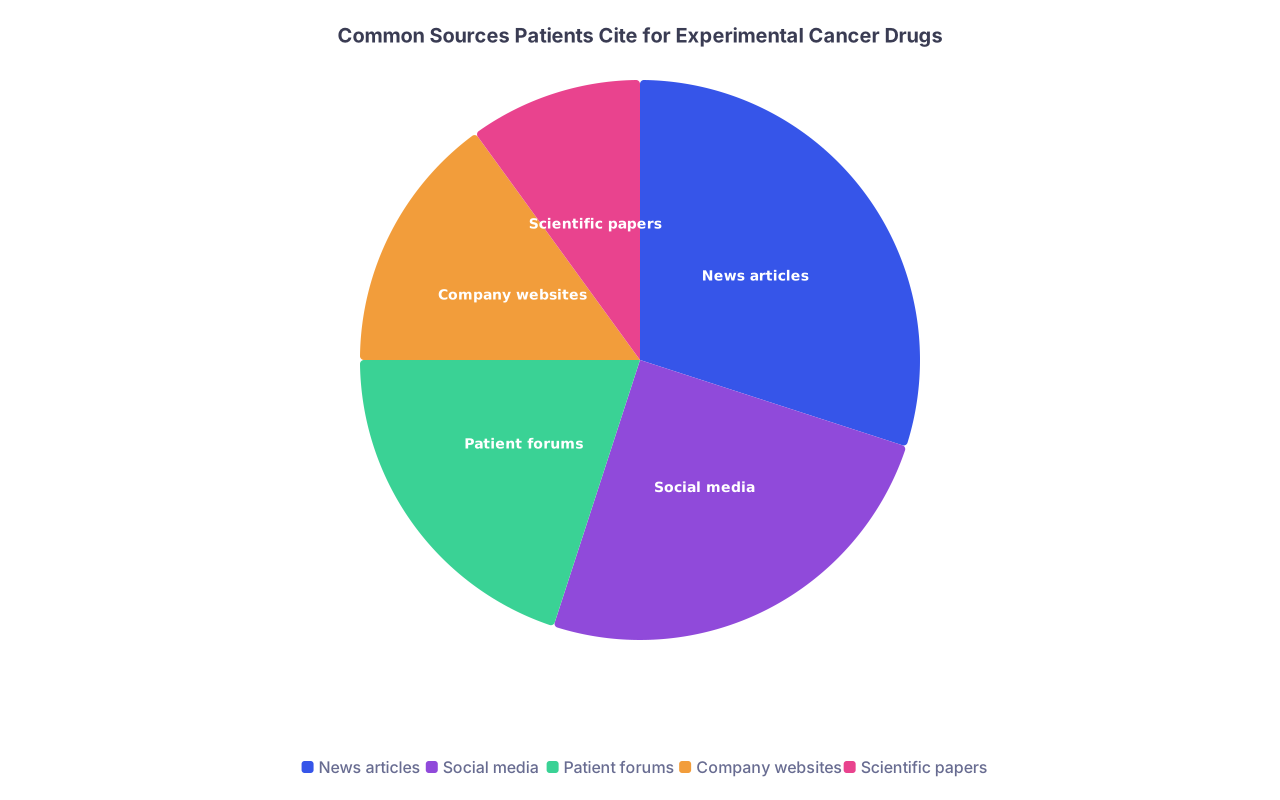
| Category | Value |
|---|---|
| News articles | 30 |
| Social media | 25 |
| Patient forums | 20 |
| Company websites | 15 |
| Scientific papers | 10 |
9. Quick Reference: Stepwise Response Plan
Here’s your short version, if you like checklists.
| Step | Focus |
|---|---|
| 1 | Validate emotion and listen |
| 2 | Clarify what they read/believe |
| 3 | Classify the drug’s status |
| 4 | Explain evidence and ethics |
| 5 | Offer real paths (trial, off-label, expanded access, optimize current care) |
| 6 | Set clear boundaries |
| 7 | Document and loop in team |
Print that if you want. Stick it in your workroom.

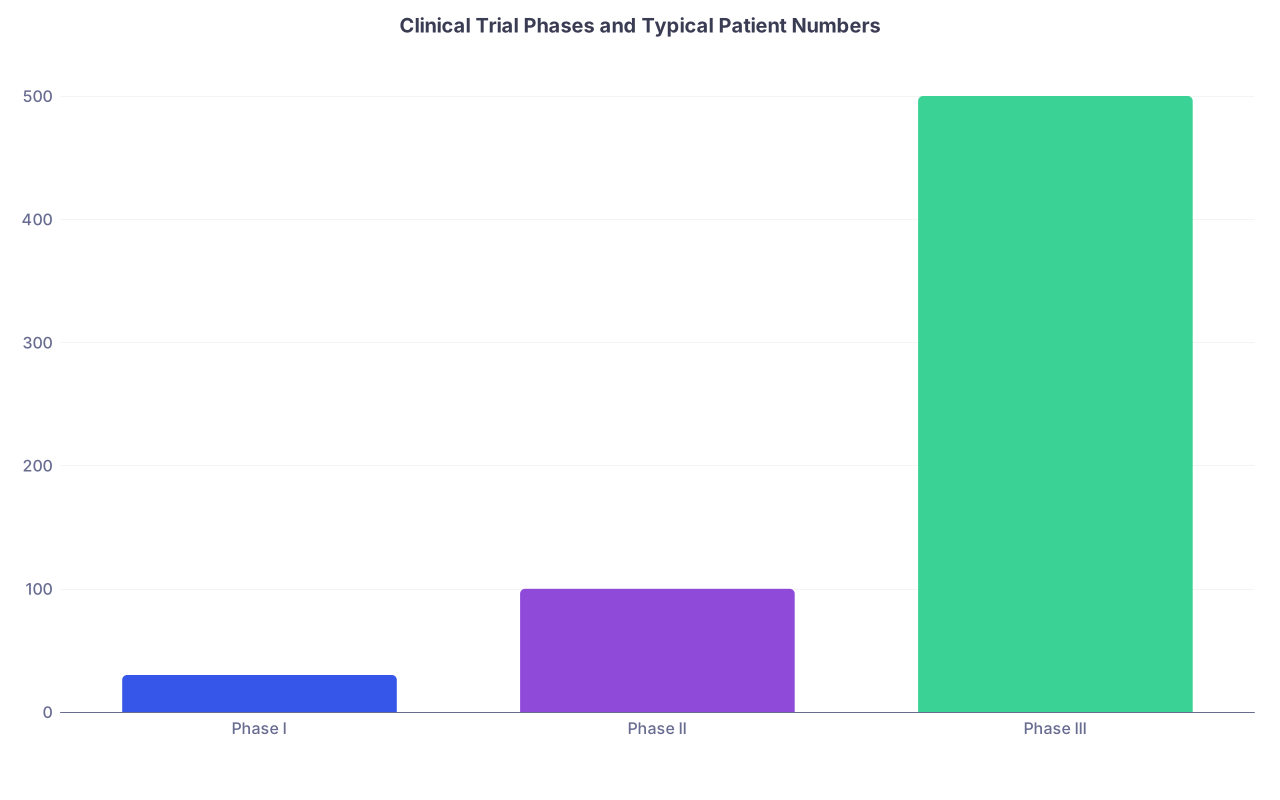
| Category | Value |
|---|---|
| Phase I | 30 |
| Phase II | 100 |
| Phase III | 500 |

| Stage | Activity | Score |
|---|---|---|
| Early Training | Observe attendings | 3 |
| Early Training | Practice scripts | 2 |
| Independent Practice | Lead difficult talks | 4 |
| Independent Practice | Coordinate with trials team | 3 |
| Mastery | Teach juniors | 5 |
| Mastery | Shape institutional policy | 4 |
FAQ (Exactly 4 Questions)
1. What if I genuinely think the experimental drug might help, but the data is thin?
Then you slow down, not speed up. Ask yourself:
- Is there a plausible mechanism for this patient’s tumor?
- Are there any human data at all, even from small cohorts?
- What are the known serious toxicities?
- Is the patient out of standard options, or are there proven therapies left?
If they’ve exhausted standard treatments and you’re considering off-label or expanded access, involve:
- A colleague for a second internal opinion
- Tumor board if possible
- Pharmacy / ethics if there’s major risk or cost
You can ethically offer something with thin data at late-line, but only with savage transparency: “We do not know if this helps people like you. There is a real chance it does nothing or harms you. Here are the reasons we’re still considering it…”
2. How do I respond when patients say, “If you were in my position, you’d want this too”?
I usually say: “If I were in your position, I’d absolutely be hunting for every possibility, just like you are. But if I were in my position, as your physician, with access to the full data and my experience of how these things go, I would not recommend this drug at this stage for you. My job here is to act in that second role, not the first.”
If they push, do not role-play your own hypothetical treatment preferences in detail. It muddies the water. Bring it back to evidence and your professional duty.
3. What if they demand I write a prescription ‘just so we can see if insurance covers it’?
Be very careful with this. That’s not a harmless administrative step. Writing a prescription implies clinical endorsement. If you don’t believe it’s appropriate, say:
“I’m not comfortable writing a prescription for this because that signals that I think it’s an appropriate treatment for you. At this point, I don’t. If another oncologist evaluates you and reaches a different conclusion, they can write for it and discuss the risks with you.”
You’re not an insurance test tool. You’re the gatekeeper of what you consider safe and justified.
4. How do I handle my own frustration with misinformation without sounding condescending?
Name the problem, not the person. For example:
“There’s a lot of marketing language around new cancer drugs that makes them sound like guaranteed cures long before we have solid proof. That frustrates me too, because it sets patients up for disappointment. My commitment is to walk you through what’s really known about this one, even if the answer isn’t as hopeful as those headlines.”
Then use curiosity instead of contempt: “Show me exactly what you saw,” instead of “Where’d you get that idea?” Redirect your anger toward the system, not the patient.
Open one of your recent oncology notes where a patient mentioned something they “read online.” Rewrite just the first three sentences you used in that conversation, using the validation–clarify–classify structure from above. If those first three lines change, the rest of the encounter usually does too.