
If you’re asking whether you need formal training before using a new robotic platform, the honest answer is simple: yes – and if your system doesn’t require it, that’s a red flag.
Let me be blunt. Walking up to a new robotic system with only a PDF manual and some YouTube videos is not “being efficient.” It’s unsafe, it’s medicolegally vulnerable, and in some cases it’s flat-out unethical. Hospitals, credentialing committees, and malpractice lawyers all know this. You should too.
This isn’t about protecting industry or gatekeeping cool tech. It’s about protecting your patients, your license, and your sanity.
Let’s break it down.
1. The Short Answer: Yes, You Need Training – And It Must Be Documented
If you’re going to touch a new robotic platform clinically, you need three things, in this order:
- Structured training
- Documented competency
- Institutional credentialing or privileging
Notice what’s not on that list: “I’ve used a different robot before, so I’m fine.”
Robotic platforms are not generic. They differ in:
- Console ergonomics
- Control mappings (hand movements, clutching, scaling)
- Energy delivery and safety interlocks
- Docking/undocking workflows
- Emergency stop procedures and failure modes
- Instrument limitations, arm range, and collision risks
You wouldn’t say, “I know how to fly a Cessna, so I’ll just hop into this new jet without a type rating.” Same energy here.
If you cause a complication while using a system you were never formally trained or credentialed on, the medicolegal conversation gets ugly. Very fast.
2. What “Formal Training” Actually Means (Not Just a Sales Demo)
Let’s be precise, because this is where people get sloppy.
“Formal training” on a new robotic platform should include at least:
- Industry or vendor education: Online modules, device-specific learning, safety features, contraindications.
- Simulation or lab-based practice: Dry lab, VR sim, animal lab, or cadaver lab – somewhere you can fail and fumble without hurting a human.
- Proctored or supervised initial cases: Your first X cases (number depends on specialty and institution) overseen by someone credentialed and experienced on that specific system.
- Competency assessment: Signed documentation that you can safely set up, operate, troubleshoot, and respond to emergencies.
A 30-minute “here are the buttons” talk from a rep before the case is not formal training. That’s product orientation.
If you want a mental checklist, ask yourself:
- Is this structured?
- Is it reproducible?
- Is it documented?
- Is someone signing off on my competence?
If the answer to any of those is no, it’s not adequate.
3. Why Training on One Robot Does NOT Automatically Transfer to Another
“I’m already credentialed on the da Vinci; I don’t need to start over.”
I hear this sentence constantly. It’s wrong.
Yes, prior robotic experience helps. You’ll pick up the new system faster. Your spatial awareness, instrument feel, and team communication skills all carry over. But the risk isn’t your basic surgical skill. The risk is hidden, system-specific behavior that you don’t know you don’t know.
Examples I’ve seen cause real problems:
- Different emergency stop logic: On one robot, tapping a pedal may pause energy. On another, you must hit a hard EMERGENCY STOP. People assume. Patients pay.
- Different collision avoidance: Some systems have active collision detection, others rely more on user awareness. An experienced surgeon from another platform can cause internal arm collisions simply because they’re trusting the wrong habits.
- Energy and insulation differences: A surgeon used to a particular bipolar or advanced energy system made assumptions about safe activation near metal trocars on a different platform. Result? Thermal injury.
- Docking workflow changes: One platform expects you to fully position the patient before docking. Another allows repositioning. If you mix those workflows, you waste time or create dangerous tension on ports.
So yes, your prior experience matters. But it doesn’t exempt you from system-specific training. In a serious case review, “But I’ve used another robot before” is not a defense.
4. Ethical Obligations: Competence Isn’t Optional
Let’s tie this to medical ethics, not just logistics.
Four core principles apply here:
Non-maleficence (do no harm)
You can’t justify exposing a patient to extra, avoidable risk because you wanted to “figure out” a new platform live in the OR.Beneficence (act in the patient’s best interest)
Using technology you’re not properly trained to use is self-serving. It’s about your learning, your CV, your early adoption bragging rights. That’s not beneficence.Autonomy (honest informed consent)
If it’s your first case on this specific platform, and you don’t disclose that to the patient, you’re walking into ethically shaky territory. They have a right to know material facts that may influence their decision.Justice (fair and safe care)
Patients shouldn’t receive lower-quality care just because they happen to be at a hospital that just purchased a new toy and wants to use it immediately.
If you wouldn’t be comfortable saying this, out loud, in court:
“I used this platform on this patient without formal training, without proctoring, and without institutional privileging.”
…then you already know the ethical answer.
5. Credentialing, Privileges, and What Hospitals Actually Care About
Hospitals and credentialing committees don’t care that you “feel comfortable” with the tech. They care about:
- Liability and risk
- Regulatory expectations
- Payer and malpractice coverage
- Patient safety metrics and complications
Most institutions that take robotics seriously have:
- A robotic surgery committee or technology committee
- Written credentialing pathways for each platform (or at least each platform family)
- Proctors approved by the department or committee
- Requirements for case logs and ongoing volume
If your hospital doesn’t? Then you need to protect yourself.
Here’s the minimum you should push for before using a new platform clinically:
| Step | Description |
|---|---|
| Vendor Training | Formal modules + in-person session |
| Simulation/Lab Session | Hands-on practice off live patients |
| Proctored First Cases | Experienced user at your side |
| Documented Competency | Signed log or evaluation form |
| Privileging/Approval | Institutional sign-off |
If admin pushes you to “just start using it” for marketing or volume reasons, that’s your signal to slow things down, not speed them up.
6. Practical Path: How to Get Properly Trained (Without Wasting Time)
You’re busy. You don’t want a 6-month certification circus. Fair.
Here’s a realistic path that I’ve seen work well:
Start with vendor resources
Take the required online modules. Yes, they can be painfully basic. Do them anyway. Those logs matter down the line.Schedule a focused lab session
Ask for a 2–4 hour dry lab or VR session with:- Docking and undocking
- Camera control
- Instrument exchange
- Energy use and safety steps
- Simulated faults: “Show me what happens when X fails.”
Use a checklist for readiness
Before your first live case, you should be able to answer, without hesitation:- How do I do an emergency stop?
- How do I undock rapidly in a crisis?
- What’s the backup plan if the system fails mid-case?
- Who in the room (nurse, tech) is also trained on this system?
Proctor your first several cases
Not a rep. A clinically experienced surgeon on this platform. Ideally:- First 3–5 cases fully proctored
- Next 5 cases available but not necessarily scrubbed
- Direct feedback on ergonomics, efficiency, safety
Document everything
Keep:- Certificates from vendor training
- Lab session attendance
- Proctor evaluations and case logs
- E-mails or forms granting privileges
You hope you’ll never need it. But if a complication gets reviewed and the question of competency comes up, that paper trail can save you.
7. What About Residents, Fellows, and Early-career Docs?
If you’re still in training, you’re in a weird in-between space: you want to learn every platform you can, but everything you do is technically under supervision.
Here’s the rule: your attending’s privileges and training don’t automatically cover your independent use.
What you should push for:
- Clear resident/fellow curricula for each robotic platform at your institution
- Simulator access with tracked performance metrics
- A graduated responsibility model: observation → camera driving → simple portions → full cases under close supervision
- Proficiency-based, not just time-based, sign-offs
If a fellow tells me, “I did 100 robotic cases but I’m not sure exactly what training I had on each platform,” I worry. Program leadership should be able to show, in writing, what you were allowed to do and on which systems.
When you apply for privileges after training, hospitals will ask:
- How many robotic cases?
- On which systems?
- What was your role in those cases?
- Who supervised you?
You’ll wish you had kept track.
8. Legal and Risk Reality: How This Plays Out When Things Go Wrong
Let me be absolutely clear about how this looks in a lawsuit or root-cause analysis:
- “Doctor, were you formally trained on this specific robotic platform?”
- “Were you credentialed by this hospital to use it?”
- “How many supervised cases had you completed before operating independently?”
- “Did the informed consent mention that this was your first case on this system?”
If the answers are vague, inconsistent, or clearly “no,” it doesn’t matter how skilled you are. The narrative becomes: you used a complex, high-risk technology without proper preparation.
And that’s very hard to defend.
Malpractice carriers are paying more attention to device-related claims. Some are already asking institutions about training and credentialing processes around robotics and other high-tech systems. You don’t want to be the test case.
9. Ethics of Early Adoption and Industry Pressure
One more uncomfortable truth: companies and hospitals sometimes want to move faster than is safe.
- New robot in town? Marketing wants cases on social media next week.
- Admin just justified a multi-million-dollar system? They want “utilization” now.
- Industry rep eager to support a launch? They’ll downplay how ready you really are.
Your job is to be the adult in the room.
Reasonable boundaries you should insist on:
- No live human case as your very first hands-on exposure
- A minimum baseline of simulation or dry-lab work before you operate
- Proctored and scheduled “first-in-human” cases, not thrown into a full OR day
- Transparent consent language when you’re early in your learning curve
Formal training isn’t bureaucracy. It’s the buffer between clinical enthusiasm and preventable harm.
10. Bottom Line: What You Should Actually Do
Here’s the direct, no-spin answer to the core question.
Do you need formal training before using new robotic platforms?
Yes. Every time. For every new platform or major generation change.
At minimum, you should:
- Complete vendor-approved education specific to that platform
- Practice in simulations or lab environments first
- Have your first set of cases proctored by an experienced user
- Obtain written institutional privileges on that platform
- Be prepared to disclose your experience level to patients when ethically appropriate
Skipping these steps isn’t “efficient.” It’s reckless.
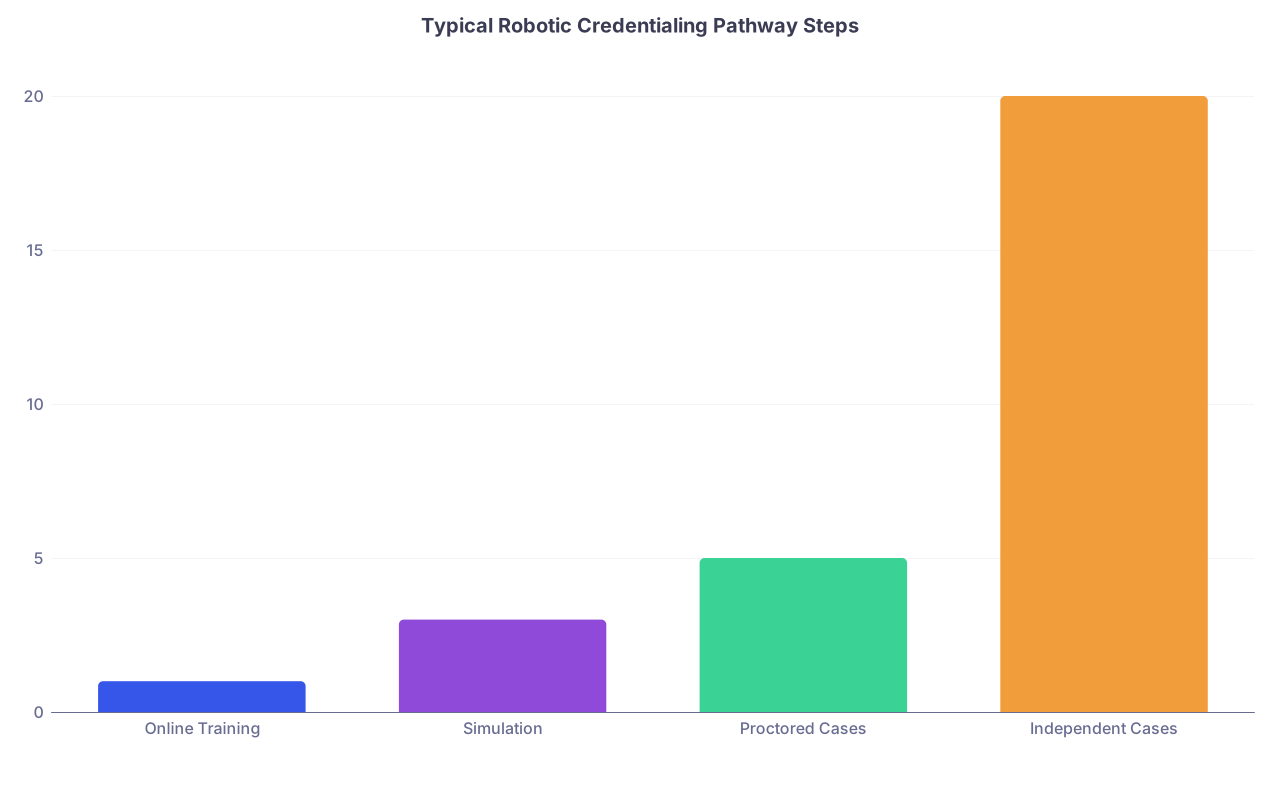
| Category | Value |
|---|---|
| Online Training | 1 |
| Simulation | 3 |
| Proctored Cases | 5 |
| Independent Cases | 20 |

| Step | Description |
|---|---|
| Step 1 | New Robotic Platform Available |
| Step 2 | Complete vendor modules |
| Step 3 | Do sim or lab session |
| Step 4 | Arrange proctored cases |
| Step 5 | Request institutional privileges |
| Step 6 | Use clinically |
| Step 7 | Have you had formal training? |
| Step 8 | Are you privileged on this system? |
FAQ (5 Questions)
1. I’m already credentialed on another robot. Do I really need full training again?
Yes. You don’t need to repeat basic surgery training, but you do need system-specific training: controls, docking, safety features, and failure modes. Most hospitals treat each platform as a separate competency. Your prior experience should shorten the learning curve, not eliminate it.
2. Can a company rep “sign me off” as trained?
No, not in any way that matters legally or ethically. Vendor sign-offs show you completed their education, but they don’t replace hospital credentialing or peer-reviewed proctoring. Reps are not your credentialing authority; your institution is.
3. Are simulators and dry labs actually necessary if I’ve done tons of robotic cases?
Yes, for a new platform they are. Sim time is where you learn the weird quirks and failure behaviors without a patient on the table. It doesn’t have to be weeks of practice, but skipping it is hard to justify when something goes wrong.
4. How many proctored cases do I need before I’m “independent”?
There’s no universal number, but a common pattern is 3–10 proctored cases depending on complexity and your prior experience. The key is competency, not just count: your proctor should be willing to write, “This surgeon can safely and independently operate this platform.”
5. Do I have to tell patients it’s my first case on this platform?
Legally, it depends on your jurisdiction; ethically, you’re safer leaning toward transparency. A reasonable standard is to ensure patients know if you’re early in your learning curve with a new technology, especially if alternatives exist. If you’d be uncomfortable seeing your consent discussion quoted in court, rewrite it.
Key points:
- Yes, you absolutely need formal, documented training and privileges before using any new robotic platform clinically.
- Prior robotic experience helps but does not replace system-specific education, simulation, and proctored cases.
- Skipping formal training isn’t just risky; it’s ethically weak and very hard to defend if complications occur.


