
The worst place to learn how to “innovate” is on real patients without a plan.
You can build a small, genuinely useful innovation project during residency without risking safety, violating policy, or getting yourself called into the PD’s office. But you have to treat it like a clinical intervention: scoped, consented, monitored, and reversible.
Here is how to do it step by step.
1. Get Your Reality Check First: What “Safe” Actually Means
Most residents underestimate the risk of “just a tiny change.” Hospital lawyers do not.
“Safe” for an innovation project during residency means four things:
No unapproved changes to direct clinical care
- You do not change medication doses, order sets, triage rules, or workflow that affects time‑sensitive care unless:
- it goes through appropriate committees (P&T, Quality, IT, etc.), and
- your attending and program director are explicitly on board.
- You do not change medication doses, order sets, triage rules, or workflow that affects time‑sensitive care unless:
No PHI leakage
- No screenshots on your personal laptop.
- No uploading CSVs with MRNs into some cloud analytics site.
- No “de‑identified” data that you de‑identify yourself without institutional sign‑off.
No conflict with duty hours or patient care
- Your project is explicitly secondary to patient care.
- If your project starts making your notes late or rounds slower, it is too big.
Traceable oversight
- One identified supervising attending.
- Written description of scope.
- Clear “stop” criteria.
If your idea breaks any of those, you either:
- Shrink the idea. Or
- Move it to a simulation / sandbox environment. Or
- Park it until you have IRB, IT, and leadership behind you.
2. Pick a Project That Is Small, Boring, and Actually Doable
Ambitious residents kill good projects by making them too big. You do not need an AI triage tool. You need something that:
- Can be built in 4–8 weeks of scattered resident time
- Has zero or near-zero risk to patients
- Improves something specific for people you work with daily
- Can be measured with simple before/after data
Think in these categories:
- Workflow clarity (checklists, handoff templates, cognitive aids)
- Education (micro-learning tools, structured teaching guides)
- Communication (standard message templates, clearer sign-outs)
- Safety nudges (reminders, visual cues, checklists that do not auto‑change orders)
Here are examples that are both realistic and safe for a resident:
| Project Type | Example Scope |
|---|---|
| Checklist | Intubation cart checklist for nights |
| Handoff Template | Standard cross-cover note format |
| Education Tool | 10 case-based cards for common pages |
| Communication Aid | Standard SBAR script for ICU transfers |
| Simulation Tool | Mock code scenarios with debrief guide |
If your idea cannot be explained in one sentence that a PGY-1 understands in 10 seconds, it is not small enough.
Test yourself:
“Over four weeks, we will pilot a standardized cross‑cover handoff template on the night float team and measure pages requiring clarification.”
If you need more than that sentence, keep trimming.
3. Build a One-Page “Mini-Protocol” Before You Touch Anything
You would not start a new antibiotic without thinking about dose, monitoring, and side effects. Treat your project the same way.
Write a one‑page protocol with these headings:
Problem – one paragraph
- “Night float cross‑cover pages are unclear, leading to repeated clarification calls and delayed care.”
Goal – one clear metric, not a fantasy
- “Reduce clarification pages by 25% over 4 weeks on one medicine team.”
Intervention – exactly what you will do
- “Introduce a one‑page standardized handoff template to be used by the three residents on Med A during night float, with no changes to existing sign‑out locations or required notes.”
Scope & limits
- Teams: which service(s)
- Time: clear start and stop date
- Patients: if applicable (e.g., “adult medicine patients on Med A only”)
- Boundaries: “No change to orders or care pathways; only format of written handoff.”
Risks & safeguards
- Potential: “Handoffs may be incomplete if template is confusing.”
- Safeguards: “All residents receive 10‑minute training; first three nights we double‑document with old and new format; any safety concern reverts to standard handoff immediately.”
Data – what you will count and how
- “Night float will log number of pages that require clarification about clinical background or plan, for 2 weeks before and 4 weeks after implementation, using a simple tally sheet.”
Oversight & approvals
- Name the supervising attending
- Confirm whether this is:
- QI (may be IRB‑exempt),
- Research (likely needs IRB),
- Or just operational improvement (still needs local approval).
Done correctly, that is a 1‑page document. Bring this to your supervising attending and PD. It signals you are serious and safe.
4. Get the Right Approvals in the Right Order
Residents usually do this backwards: they build the tool, start using it, then “loop in” leadership. That is how projects die.
Stepwise approval order
Your supervising attending
- Sanity check your idea and one‑page protocol.
- Ask directly: “Do you see any patient safety red flags or political landmines here?”
Program Director (PD)
- You need your PD to know this exists.
- Frame it as: “This is small, bounded, and will not interfere with duty hours. Here is the protocol.”
- Ask for specific constraints:
- Max time per week.
- Any services or rotations where you must not pilot this.
Unit / Service leadership (if applicable)
- For example, Med A service director or ICU director.
- They care about workflow disruption; show them your start/stop dates and your minimal scope.
QI office or IRB (depending on your institution)
- Many hospitals have a simple pathway to classify something as QI, not research.
- You want a short email or document that says: “This is QI / exempt.”
- If it is research or uses identifiable data, you stop and go through the real IRB process. No shortcuts.
IT / EMR only if you touch the system
- If your project requires changing order sets, building EPIC SmartPhrases, altering workflows, or using third‑party apps with patient data—this is no longer a tiny project.
- For a first project, stay off the core EMR. Use:
- Printed tools
- Offline checklists
- Local templates that do not change institutional content
You want at least two people who can say in a meeting: “Yes, I reviewed this project and it is safe and appropriate.”
5. Design for Safety Like an Anesthesiologist: Layers, Reversibility, Defaults
You want your project to fail gracefully if it fails.
Good safeguards for a resident‑run innovation project:
Reversible by default
- Any resident or attending can abandon the tool instantly without breaking care.
- Example: a paper checklist that can be ignored vs. an EMR hard stop that blocks orders.
No single point of failure
- If your project involves critical information, it must be in addition to standard communication, not a replacement.
- Example: New sign‑out template + usual in‑person checkout.
Double coverage early on
- Run old and new in parallel for a short time:
- Two forms of handoff
- Both old and new note templates
- Yes, it is annoying. That is how you prove safety.
- Run old and new in parallel for a short time:
Opt‑out for frontline staff
- You cannot coerce nurses, RTs, or other residents into using your tool.
- State clearly: “This is voluntary; if it causes problems, we revert.”
Clear red‑flag rules
- “If anyone reports a near miss that seems related to this tool, we stop the pilot and review.”
When I have seen projects implode, it is usually because someone forced a fragile new process into a critical workflow with no off‑ramp.
6. Keep Your Data Simple and Clean
You are not running a randomized controlled trial. You are trying to prove: “This helped and did not hurt.”
Use low‑friction metrics:
Countable events:
- Number of clarification pages
- Number of incomplete handoffs
- Number of pages resolved without calling an attending
Time‑based:
- Average time to complete a sign‑out
- Average time from consult request to first MD note (if your tool addresses this)
Perception:
- 3‑question micro‑survey for residents / nurses on a 1–5 scale
Avoid anything that requires complex chart review unless:
- You have protected time, and
- You have institutional support.
A very functional approach:
- 2 weeks of baseline tallies (no intervention)
- 4 weeks of pilot
- Same person(s) logging data both times
If you are smart, you will pre‑design your data sheet:
- One page, checkbox/fill‑in
- Stored in a secure institutional platform (or physical locked location if on paper)
- No names or MRNs required unless IRB‑approved
Here is how tracking something like clarification pages could look:
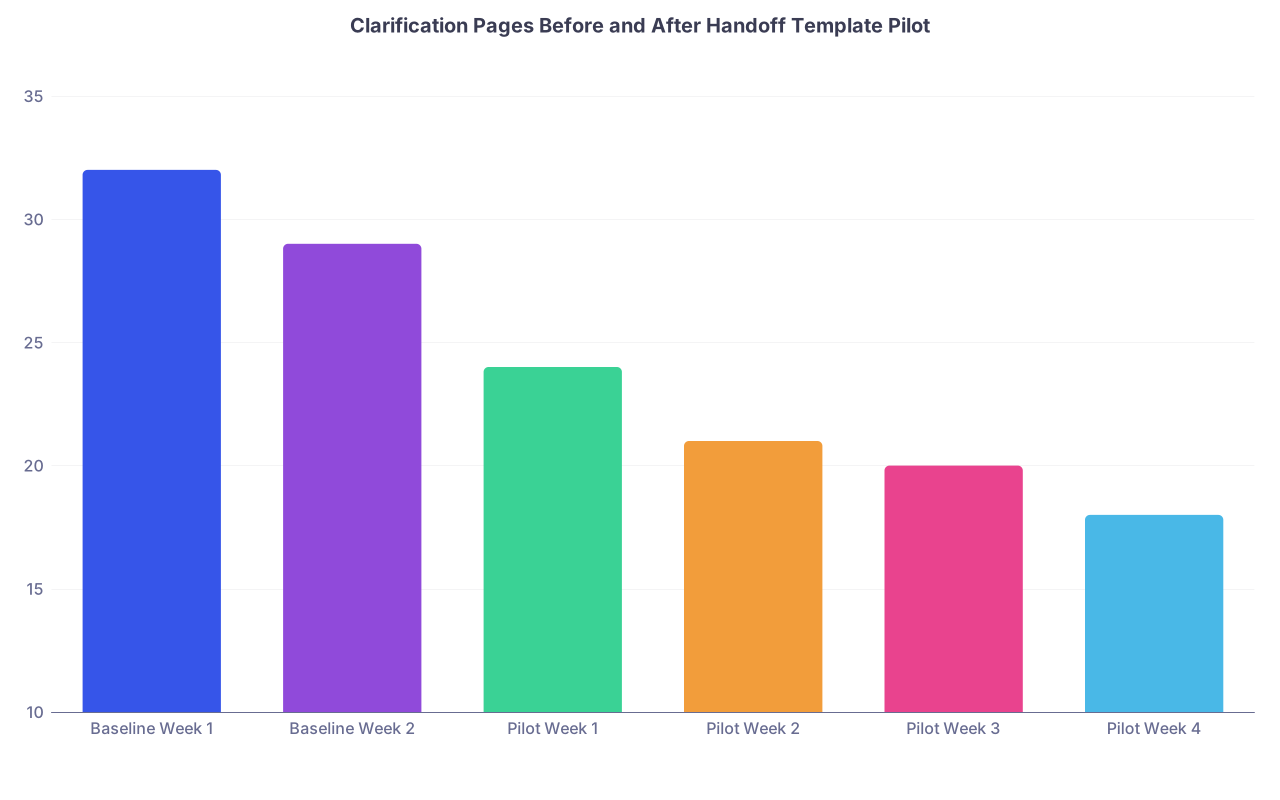
| Category | Value |
|---|---|
| Baseline Week 1 | 32 |
| Baseline Week 2 | 29 |
| Pilot Week 1 | 24 |
| Pilot Week 2 | 21 |
| Pilot Week 3 | 20 |
| Pilot Week 4 | 18 |
You do not need p‑values to say: “We saw a consistent drop in clarification pages, with no reported safety events.”
7. Keep Ethics Front and Center (So You Never Have To Defend Yourself Later)
Innovation during residency is sexy. Ethical disasters are not.
Ask yourself these specific questions up front:
Are patients being experimented on without consent?
- If your change alters how they receive care (timing, content, who sees them), you may be in research territory.
- Safe zone: tools that support clinicians’ existing judgment without changing options or constraints.
Are you trading safety for efficiency?
- If your primary outcome is “time saved” and you have no concrete safety measures, you are doing it wrong.
- For every “efficiency” metric, pair at least one “safety” or “reliability” metric.
Could this disadvantage any group of patients or staff?
- Language barriers
- Tech‑illiterate staff
- New interns
- Night shift vs day shift
Are you honest about your dual role?
- You are not just a researcher; you are also their colleague or doctor.
- No subtle pressure: “We are doing this for my project, can you just…?” is not acceptable if it makes someone uncomfortable.
If you are unsure: ask the ethics committee or an experienced QI faculty member before you launch. A 20‑minute conversation can save your career.
8. Execute Like a Pilot Study, Not a Side Hobby
Your project dies when residency gets busy unless you build it into your actual clinical life.
Here is a realistic execution plan for a PGY‑2 on wards.
Phase 1 – Prep (2 weeks)
- Finalize protocol and get approvals.
- Build the tool (template, checklist, card deck). Keep it ugly but functional.
- Run the design past 2–3 colleagues who actually do the work:
- “Does this make your life easier or harder?”
- “What would make you ignore this?”
Phase 2 – Baseline Data (2 weeks)
- Collect your pre‑intervention metrics quietly.
- Do not talk up your project as “coming soon” yet; just get clean baseline numbers.
Phase 3 – Pilot Launch (4 weeks)
Short kickoff huddle with users (5–10 minutes max).
Clear instructions:
- What this is
- How to use it
- When to stop using it
Make the tool physically or digitally hard to miss:
- Laminated cards attached to the code cart
- Printed template stapled to the usual sign‑out packet
- .RESIDENTSIGNOUT SmartPhrase you add manually (not forced)
Daily micro‑check:
- “Did people actually use it yesterday?”
- “Any complaints or safety concerns?”
Weekly 10‑minute debrief with supervising attending:
- Data so far
- Any incidents
- Any tweaks allowed within your original safety boundaries
Phase 4 – Stop, Analyze, Decide (2 weeks)
- Stop the pilot on the promised date. Do not let it drag.
- Clean your data (no heroics; just accurate counts).
- Compare before vs after on your core metric(s).
- Summarize:
- What worked
- What did not
- Any safety signals (even minor ones)
Then decide explicitly with your supervising attending and PD:
- Option A: Adopt locally (keep it as a standard but voluntary tool)
- Option B: Revise and re‑test
- Option C: Kill it and record why
9. Document Like You Plan To Present (Because You Probably Should)
A “small, safe” project is gold on your CV if and only if you can prove it existed.
Keep a simple project folder (securely, compliant with your institution):
- Your original one‑page protocol
- Approval emails (PD, supervising attending, QI/IRB)
- Final version of the tool
- Cleaned data file
- A 1–2 page summary with:
- Problem
- Intervention
- Outcome data
- Lessons learned
- Safety events: “none observed” or what actually occurred
From that, you can generate:
- A poster for your hospital QI day or local society meeting
- A short QI paper (if you went through the right PI/IRB channels)
- A clear bullet on your residency application or fellowship CV:
- “Led a 6‑week pilot of a standardized cross‑cover handoff template on a medicine service, reducing clarification pages by 35% without reported safety events.”
And yes, this is absolutely enough to talk intelligently about “innovation” in interviews.
10. Two Concrete Example Projects You Could Start Next Month
So you are not staring at a blank page, here are two fully scoped project ideas.
Example 1: Night Float Cross‑Cover Handoff Template
Problem:
Night float wastes time figuring out background and plans from chaotic handoffs, leading to delays and unsafe assumptions.
Intervention (tiny version):
- Build a one‑page paper or text template with fixed headings:
- Patient ID (room only, no name if possible)
- Primary issue
- Active concerns tonight
- If X happens, do Y
- Absolute “call attending” triggers
Scope:
- One medicine team
- 2 weeks baseline, 4 weeks pilot
- Voluntary use by day team creating sign‑out
Safety design:
- Night float still has access to full chart and existing sign‑out.
- Template supplements, never replaces, routine verbal checkout.
Outcome metrics:
- Number of pages requiring call back to day team for clarification
- Night float subjective rating 1–5: “How clear were tonight’s sign‑outs?”
Example 2: Standard “First Response” Algorithm for Common Pages

Problem:
Interns paged overnight for common issues (fever, chest pain, hypoxia) handle them inconsistently, sometimes with unnecessary tests or delayed escalation.
Intervention:
Create 5–7 pocket card algorithms for:
- Fever
- Chest pain
- New hypoxia
- Abnormal labs (K, Na, Hb)
- Agitation / delirium
Each algorithm:
- Fits on half a page
- Encourages structured assessment and does not prescribe specific orders—just “Assess vitals, check prior baseline, consider these options, call senior/attending for X.”
Scope:
- Used by night float interns on a single team
- 4‑week pilot
Safety design:
- Explicitly states: “This card does not replace clinical judgment or attending input.”
- Every card has a big “Call senior/attending if:” section.
- Encourages earlier escalation, not less.
Outcome metrics:
- Intern self‑reported comfort before vs after (1–5 scale)
- Frequency of “late escalation” events where the attending felt they should have been called earlier (as judged by attending review)
Neither of these changes the content of care directly. They structure thinking and communication. That is the safest playground for a resident innovator.
11. Build Yourself a Simple Innovation Habit
One project done well beats five half‑finished ideas.
Here is a lightweight “innovation practice” you can run through every rotation:

| Step | Description |
|---|---|
| Step 1 | Notice Annoying Problem |
| Step 2 | Ask - Is This Safety Critical |
| Step 3 | Talk to Attending PD |
| Step 4 | Write One Page Plan |
| Step 5 | Get Approval |
| Step 6 | Pilot Small Change |
| Step 7 | Collect Simple Data |
| Step 8 | Stop and Review |
| Step 9 | Adopt Revise Kill |
| Step 10 | Document for CV |
You are training a skill here:
- See reality as it is
- Design within constraints
- Protect patients and colleagues
- Make small things better in a traceable way
That is exactly what serious innovators do. They just have bigger budgets.
12. Common Pitfalls to Avoid (I Have Seen All of These)
Let me be blunt. Do not do these:
The solo hero move
- You build a Google Sheet or app, everyone uses it, and leadership finds out six months later. Massive IT and privacy headaches. Do not.
The EMR cowboy
- You convince a friendly analyst to push a change straight into production without governance. When it breaks one workflow in another department, you are the scapegoat.
The unbounded pilot
- “We will just try it and see how it goes” with no end date and no data plan. That is not a pilot; that is drift.
The glossy but empty project
- Beautiful brochure, nice logo, zero measurable change, no safety thought. People see through this quickly.
The bully innovator
- “This is better, so everyone should just get on board” attitude. Nurses and other residents will quietly kill your project.
You avoid all of this by sticking to the protocol mindset: small, scoped, measured, reversible, supervised.
13. Where To Go Next After Your First Project
After you complete one small, safe project:
Debrief with a real QI/Innovation mentor
- Ask: “What would a more advanced version of this look like?”
- Get connected to the hospital’s innovation office or data group.
Formalize your learning
- IHI Open School modules
- Local QI workshop
- If you are serious: a certificate or elective in health systems / informatics.
Plan a slightly larger but still ethical project
- Maybe this time involve:
- One additional team
- A small EMR component via proper channels
- More rigorous data (with IRB, if needed)
- Maybe this time involve:
The key: do not jump from a pocket card project to “AI sepsis prediction” in one leap. Climb steadily.
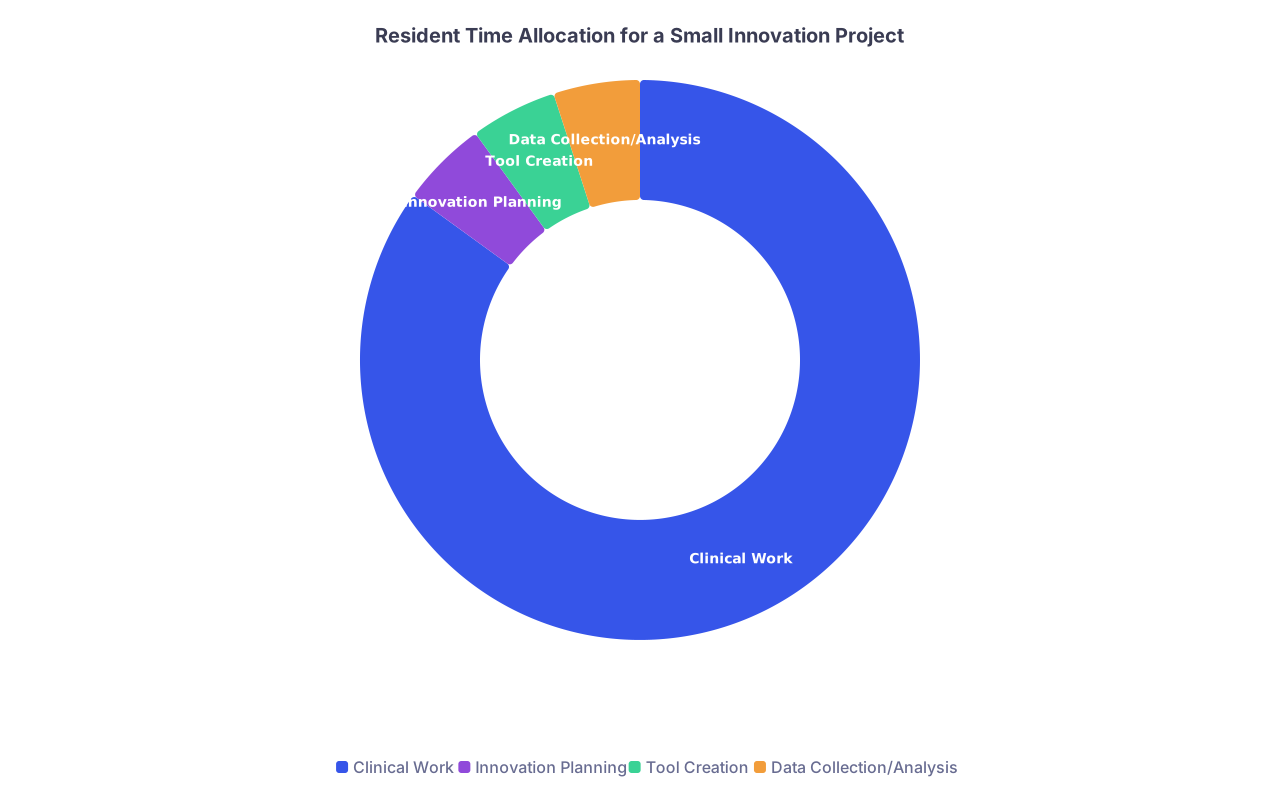
| Category | Value |
|---|---|
| Clinical Work | 85 |
| Innovation Planning | 5 |
| Tool Creation | 5 |
| Data Collection/Analysis | 5 |


Two Core Things To Remember
- A resident innovation project is “safe” only if it is small, reversible, supervised, and ethically boring. That is not a bug. That is the feature that lets you actually do it.
- Treat each project like a mini clinical trial: clear protocol, limited scope, measurable outcomes, honest review. Do that once or twice, and you are already far ahead of the average “idea person.”