
The most dangerous thing about early exposure to gene editing research isn’t the technology. It’s how quickly bright, ambitious people learn to ignore their ethical alarm bells.
If you’re a premed, medical student, or early trainee getting close to CRISPR labs, genomic startups, or “cutting‑edge” translational projects, you’re at high risk for a specific kind of ethical blindness: you’ll be so grateful to be there that you’ll stop asking the questions you should be asking.
Let me walk you through the traps I’ve seen people fall into—and how to not be one of them.
1. Confusing “IRB‑Approved” With “Ethically Sound”
The first big mistake: treating IRB approval like a moral off‑switch.
You join a lab working on CRISPR-based somatic therapies. Someone reassures you, “Don’t worry, the IRB already approved this study.” You breathe out. Box checked. Ethics done.
Wrong.
IRBs are a minimum standard, not a seal of deep ethical wisdom. They can miss things. They can be rushed. They can be misled by overly rosy protocols. And they’re often reviewing piles of studies with limited time.
The ethical traps here:
- You assume risks are fully understood just because they’re summarized in a PDF.
- You assume participants fully “get it” because a consent form exists.
- You assume long‑term implications of gene editing have been seriously considered when often they’ve been hand‑waved.
The red flags you must not ignore:
- Consent forms with dense jargon about off‑target effects that even you struggle to explain clearly.
- Protocols that treat uncertain long‑term genomic risks as “minimal” or “acceptable” just because they’re statistically “unlikely.”
- A PI who says things like, “The IRB was picky, but we got it through,” with a smirk.
Your job isn’t to become the IRB police. But do not let “approved” stop your thinking.
A safer mindset:
“IRB approval means the study crossed a low bar. My ethical responsibility starts there, not ends there.”
If you can’t explain the risks, in plain language, to a non‑scientist friend, you should not be reassuring yourself that the consent process is adequate. Go back. Ask questions. Push.
2. Getting Seduced by Hype and “World‑Saving” Narratives
Gene editing is catnip for ego and ambition. “We’re curing incurable diseases.” “We might eradicate sickle cell.” “We could eliminate certain cancers.”
Those sentences make people switch off scrutiny. Fast.
Here’s the trap: once you believe your project is obviously “for the greater good,” you’ll start accepting sloppy shortcuts in the name of urgency.
You’ll hear:
- “If we slow down, people will die waiting.”
- “Regulators don’t understand the science like we do.”
- “Ethical debates are fine in seminars, but patients in the ICU don’t have time.”
This kind of rhetoric is emotionally powerful—and ethically dangerous.
Let me be blunt: almost every historic biotech disaster was justified with some version of “we’re trying to help people faster.”
If you find yourself thinking:
- “This feels rushed, but the outcome will be so beneficial,” or
- “We can clean up the ethical details later, once we prove this works,”
that’s your warning siren.
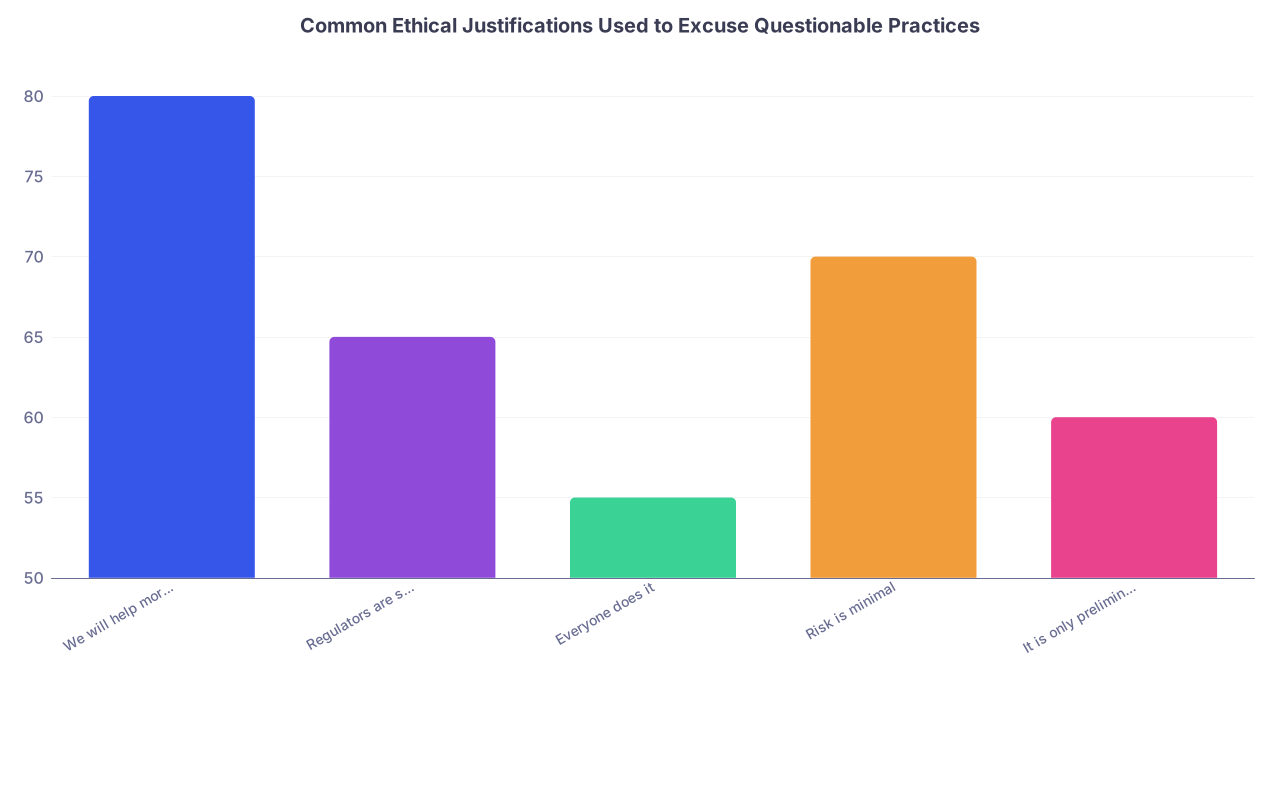
| Category | Value |
|---|---|
| We will help more patients | 80 |
| Regulators are slow | 65 |
| Everyone does it | 55 |
| Risk is minimal | 70 |
| It is only preliminary | 60 |
What to do instead:
- Force yourself to articulate the worst‑case scenario—not just for the participant, but for public trust in gene editing if something goes wrong.
- Ask: “If this protocol showed up in a scandal story 5 years from now, how would it be described?”
- Watch how your PI reacts when someone raises an ethical concern. Dismissive? Mocking? That’s not “visionary”; that’s a liability.
Do not let the story of “we’re saving lives” become a license for ethical laziness.
3. Participating in Sham “Informed Consent”
Here’s a harsh reality: in many early‑stage gene editing projects, “informed consent” is a performance, not a process.
You’ll see:
- Vulnerable patients desperate for options, clinging to experimental hope.
- Consent visits where the risks are technically stated but practically minimized.
- Investigators who rely on hope, gratitude, and fear to secure signatures.
Sham consent tends to look like this:
- Time pressure: forms handed over right before a procedure, “We just need your signature here.”
- One‑sided framing: “This may help you and future patients” with very little emphasis on unknowns.
- Hidden complexity: genome‑wide risks reduced to a single vague line in the form.
What you must not tell yourself:
“They signed. So they know what they’re getting into.”
No. You’ve seen enough to know that people sign things they don’t understand all the time—especially in white‑coat environments.
Your internal checklist:
- Could the patient explain to a family member what gene editing is, what we know, what we don’t know, and what might go wrong in 5–10 years?
- Did anyone clearly state, “This might not help you personally at all, and could make things worse”?
- Was the word “experimental” used clearly, not buried in euphemisms like “novel therapy” or “advanced approach”?
If your honest answer is no, and you’re present for these encounters, you are participating in something ethically fragile.
You don’t have to blow up the study. But you do have to stop lying to yourself about what “informed” means. You can ask your PI privately:
“Can we slow those visits down?”
“Can we add a plain‑language handout?”
“Can we schedule a second visit for consent after they’ve had time to think?”
If that’s treated as annoying rather than reasonable, you’ve learned something important about that environment.
4. Ignoring Power Imbalances—Including Your Own
Another big trap: pretending hierarchy doesn’t affect ethics.
Gene editing research usually sits in prestige spaces: cutting-edge labs, big‑name hospitals, flashy startups. Everyone wants in. That means power is skewed from the start.
The people with the least power:
- Patients with rare or fatal diseases.
- Families without scientific literacy or resources.
- Students, interns, and junior researchers terrified of losing a letter or a line on their CV.
You’re in one of those last two categories. So don’t make the mistake of thinking, “I’m just a student—I have no ethical responsibility.” That’s how people sleepwalk into complicity.
Here’s what power imbalance looks like in real life:
- A PI “suggesting” a particular way to document side effects that clearly downplays severity.
- A coordinator venting, “If we report every small reaction, this trial will never get off the ground.”
- A junior fellow quietly telling you, “Just don’t make a big deal out of it. This is how research gets done.”

You might not be able to stop those dynamics. But you absolutely can control whether you:
- Alter data under subtle pressure (“Just call it ‘mild’ so it doesn’t trigger reporting.”)
- Keep silent about clear protocol deviations.
- Help recruit participants with language that feels more like sales than explanation.
The mistake isn’t being junior. The mistake is pretending that makes you ethically weightless.
Document what you see. Ask careful questions. If something crosses a hard line—data falsification, coercion, concealed adverse events—go outside the immediate chain of command if you have to (ombudsperson, institutional ethics office, trusted faculty).
5. Blurring Somatic vs Germline Boundaries Without Realizing It
Here’s a subtler trap I’ve watched trainees walk into: treating all gene editing as the same thing.
It’s not. Somatic vs germline is a line you do not want to casually erase in your own mind.
Somatic editing: changes only the treated individual’s cells (e.g., CRISPR for sickle cell disease in adults).
Germline editing: changes reproductive cells or embryos in ways that are heritable.
Globally, there is far stronger ethical and regulatory resistance to germline editing. For good reason: you’re making permanent, inheritable changes without the consent of the future people affected.
Yet in some labs and biotech circles, people start using slippery language:
- “Pre‑implantation genome optimization”
- “Genetic enhancement platform”
- “Embryo health editing”
If you’re not careful, you start treating germline editing as merely “the next step” in the curve of innovation.
| Feature | Somatic Editing | Germline Editing |
|---|---|---|
| Affects future generations | No | Yes |
| Current clinical use | Early, limited | Largely prohibited |
| Ethical consensus | Cautious acceptance | Broadly high concern |
| Regulatory scrutiny | High | Intense / restrictive |
If a project you’re around is even near the line of germline implications—embryo manipulation, reproductive tissue editing, heritable modifications—you cannot afford to treat it like “just another CRISPR study.”
Your questions should get sharper:
- Has this been reviewed by specialized ethics bodies, not just a generic IRB?
- How are we preventing these tools from drifting into enhancement or non‑therapeutic use?
- Are we contributing to normalization of germline editing, even if we claim we’re not doing it yet?
Don’t let casual lab culture train you to treat germline editing as inevitable or ethically trivial.
6. Playing Fast and Loose With Privacy and Genetic Data
If you underestimate any risk in early gene editing work, it will probably be this one.
You will be surrounded by genomic data: sequences, variants, family pedigrees, rare disease markers, sometimes linked with identifiable clinical information. The temptation is to treat all of it like “research material,” not deeply personal data that can follow people for life.
Common sloppy behaviors:
- Screens with identifiable genomic info left visible in shared spaces.
- Cloud storage with weak protections “because we need easy access.”
- Sharing “interesting cases” over email or messaging apps with way more detail than needed.
And the worst excuse of all: “It’s de‑identified.”
In practice, so‑called de‑identification in genomics is often fragile. Re‑identification is not science fiction. Combine enough data points (sequence + rare disease + region + age) and the “anonymous participant” isn’t anonymous anymore.
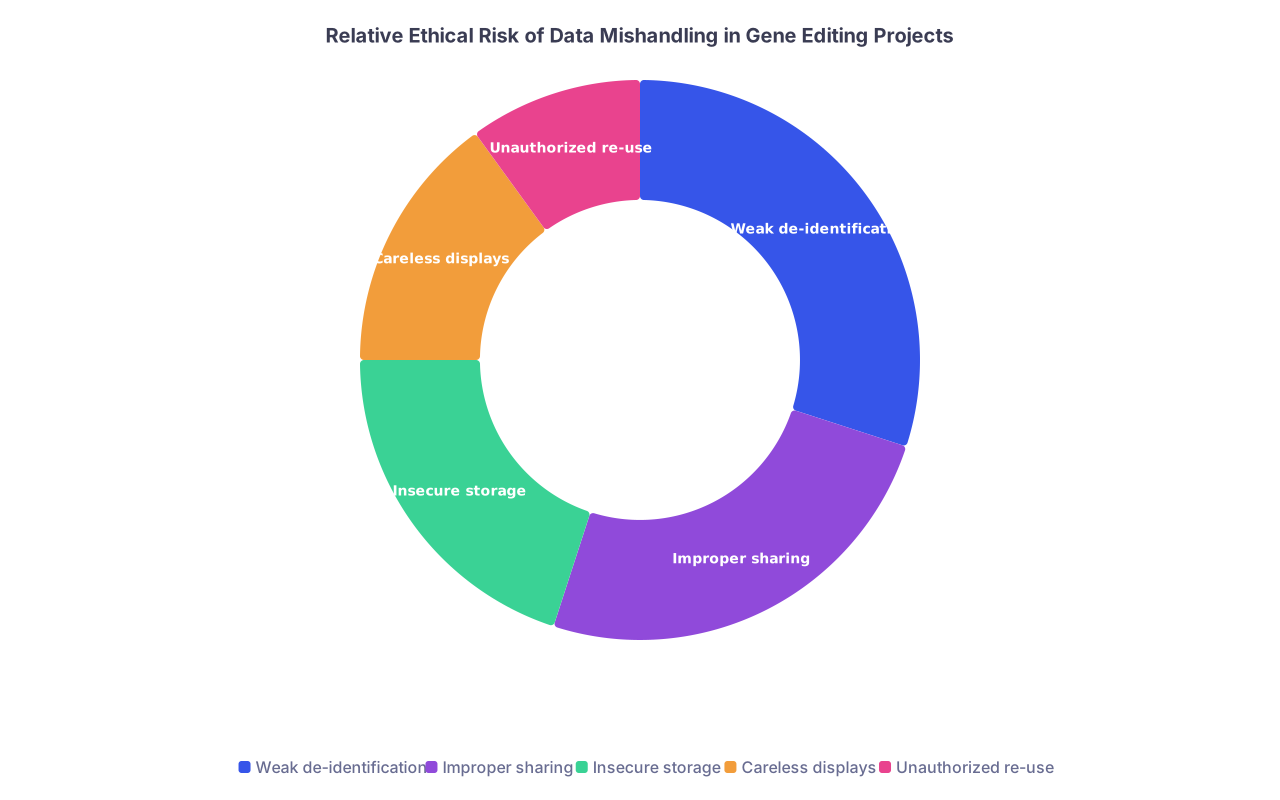
| Category | Value |
|---|---|
| Weak de-identification | 30 |
| Improper sharing | 25 |
| Insecure storage | 20 |
| Careless displays | 15 |
| Unauthorized re-use | 10 |
The mistake students make is assuming privacy is “an IT problem.” It’s not. It’s an ethical problem that shows up in every casual screenshot, Dropbox folder, and hallway conversation.
Basic protections you should insist on:
- No identifiable genomic data on personal devices without robust encryption and explicit permission.
- No case “stories” shared in teaching or talks that could obviously identify a participant, especially in rare disease.
- No “temporary” shortcuts with data transfers because “we’re just testing the pipeline.”
If a lab scoffs at this as “paranoid,” they’re telegraphing a lack of seriousness about participant dignity. Remember that.
7. Letting Career Hunger Override Your Ethics
This might be the most personal trap.
You finally get into a gene editing lab. You’re working on something with “CRISPR” in the title. Your PI is well‑connected. Publications are on the horizon. You start doing the mental calculus:
“If I speak up about this weird consent phrasing…”
“If I question whether we’re overselling benefits…”
“If I flag that adverse event more clearly…”
“…will I lose my letter, authorship, recommendation?”
That fear is real. I’ve seen good people override their own ethical intuition because they were terrified of losing a shot at derm, ophtho, or a top academic track.
Here’s the risk you’re underestimating:
Compromising yourself early trains you to keep compromising later. You normalize it. By the time you’re the attending or PI, you’ve rewritten your story so that everything you did “wasn’t that bad.”

| Step | Description |
|---|---|
| Step 1 | Small concern ignored |
| Step 2 | Minor protocol shortcut |
| Step 3 | Soft selling risks to participants |
| Step 4 | Data reporting bias |
| Step 5 | Systemic ethical drift |
You do not control the entire system. You do control your line.
Ask yourself:
- “What is an action I will not take, even if it costs me this opportunity?”
- “What language will I not use with patients, even if my supervisor wants it?”
Write it down. Literally. Because in the moment, you’ll rationalize.
And if a particular environment repeatedly asks you to step over that line? It’s not your lab. Get what training you can ethically absorb, then leave. Long-term, your reputation for integrity is more valuable than one CRISPR publication.
8. Staying Ethically Illiterate About Gene Editing While Working in It
Another subtle but deadly error: thinking your basic “medical ethics” course is enough for this space.
Gene editing raises specific questions:
- Off‑target effects vs acceptable risk thresholds.
- Justice in access: who gets these expensive therapies first?
- Enhancement vs treatment in a genetically stratified world.
- How these technologies interact with disability rights and stigma.
If you’re working in this area and your ethics understanding hasn’t progressed since M1’s generic four‑principles lecture, you’re behind.

You don’t need to become a bioethicist. But you absolutely should:
- Read key statements from bodies like the WHO, NAS, Nuffield Council on Bioethics on human genome editing.
- Attend at least one serious seminar or grand rounds specifically on CRISPR/gene editing ethics.
- Know the basic public controversies (e.g., the CRISPR babies in China) and what went wrong ethically.
The mistake is assuming your good intentions are enough. They’re not. This field moves fast; your ethical vocabulary has to move with it.
9. Treating Public Trust as Someone Else’s Problem
One final trap: thinking only about the individual patient or the specific study, and ignoring the bigger picture.
Gene editing does not exist in a vacuum. Every scandal, every corner cut, every privacy breach feeds public skepticism. Once that trust erodes, the regulatory response will be blunt and harsh, and legitimately good work will suffer.
You are not just a bystander. You are, whether you like it or not, part of the story the public will eventually hear about gene editing.
Ask yourself before you participate in anything ethically borderline:
“If this exact practice appeared on the front page of a major paper, how would a reasonable layperson react?”
If the likely answer is, “They’d feel misled, excluded, or exploited,” you’ve got your answer about whether you should be comfortable being part of it.

Your future as a physician or physician‑scientist depends on public trust. Do not burn that capital cheaply.
FAQ (Exactly 4 Questions)
1. I am “just” an undergrad or M1 in a gene editing lab. Do I really have ethical responsibility?
Yes. Your power is limited, but your responsibility is not zero. You’re handling data, interacting with participants, and contributing to a culture. You’re responsible for your own actions: how you describe studies, how carefully you treat consent, whether you report what you see accurately, and whether you engage with concerns or bury them. You are not responsible for fixing the whole system, but you are accountable for where you draw your own line.
2. What’s a clear sign I should seriously consider leaving a lab or project?
Walk away when you see repeat patterns of: dismissing serious risks as “minor paperwork issues,” pressure to alter or under‑report adverse events, consistently rushed or manipulative consent processes, retaliatory behavior toward people who raise concerns, or casual violations of privacy with genomic data. One incident might be ignorance. Repeated incidents are culture. If your values and the culture don’t match, that lab will train you in all the wrong ways.
3. How can I raise an ethical concern without blowing up my relationships or career?
Start small and specific. Ask clarifying questions: “Can you help me understand why we phrase it this way in the consent form?” or “Do we need to document that reaction differently for the record?” Use institutional channels that exist for this purpose—ethics committees, ombudspersons, trusted faculty outside the lab. Document your observations factually and keep copies of communications. You’re not required to be a martyr, but you’re also not required to be silent.
4. I want to work in gene editing research ethically. What should I proactively do now?
Do actual homework. Read at least one major report on human gene editing ethics. Seek out mentors who are known for integrity, not just high impact factors. During interviews, ask labs about how they handle consent, adverse events, and data privacy; their reaction tells you a lot. Keep your own written list of “non‑negotiables” you will not cross, even for career gain. If you build that ethical muscle early, you’ll be far less likely to get trapped later when the stakes are higher.
Key points: IRB approval and “world‑saving” narratives do not erase your ethical responsibility. Gene editing magnifies power imbalances, privacy risks, and long‑term consequences—ignoring those because you’re junior or ambitious is exactly how people end up complicit. Stay curious, stay skeptical of shortcuts, and decide now which ethical lines you won’t cross, no matter how shiny the opportunity.