It’s 7:30 pm in the hospital conference room. Everyone else has gone home. The table in front of you is covered with coffee cups and a 300‑page protocol for a first‑in‑human gene therapy trial. You’re the junior on the IRB, sitting quietly at the far end. At the head of the table, the IRB chair is still flipping through the appendices. He’s not asking about p‑values. He’s not asking about your pretty Kaplan‑Meier curve.
He’s staring at a single line on page 147: “Stopping criteria may be reconsidered after safety review by the sponsor.”
He leans back and says, “No. Not like this. Fix this or this trial is not happening here.”
You think the IRB is just checking consent forms and making sure the inclusion criteria look reasonable. Let me tell you what really happens in first‑in‑human (FIH) discussions when the doors close and people stop being polite.
The First Secret: It’s Not About Your Science, It’s About Who Can Get Hurt
Everybody thinks IRB chairs care most about scientific novelty. They don’t. The chair knows 90% of “revolutionary” therapies will die in early phase trials. What keeps them up at night is something else entirely: irreversible harm to real people because the team believed their own pitch deck.
In first‑in‑human work, IRB chairs mentally sort protocols into one question:
“What’s the worst thing that can happen here, and do I actually believe these people will stop in time?”
Not what the sponsor wrote. Not what the glossy slide deck claims.
Here’s what they’re actually scanning for while the PI drones about unmet needs:
- “Is this risk theoretically bounded, or can this go catastrophically sideways?”
- “Do these investigators know what they do not know?”
- “Is anyone here willing to say ‘No’ when money and ego are on the line?”
Phase 3 oncology trial? The risk is high, but the territory is known. Dose ranges are defined. Adverse events are mapped.
First‑in‑human CRISPR edit, new viral vector, implantable neurodevice, or cell therapy? The chair knows the preclinical data is a model, not a shield. Mice do not sign lawsuits.
They are asking themselves: are we about to be the next center in a New England Journal “lessons learned” piece that everyone pretends not to blame the IRB for?
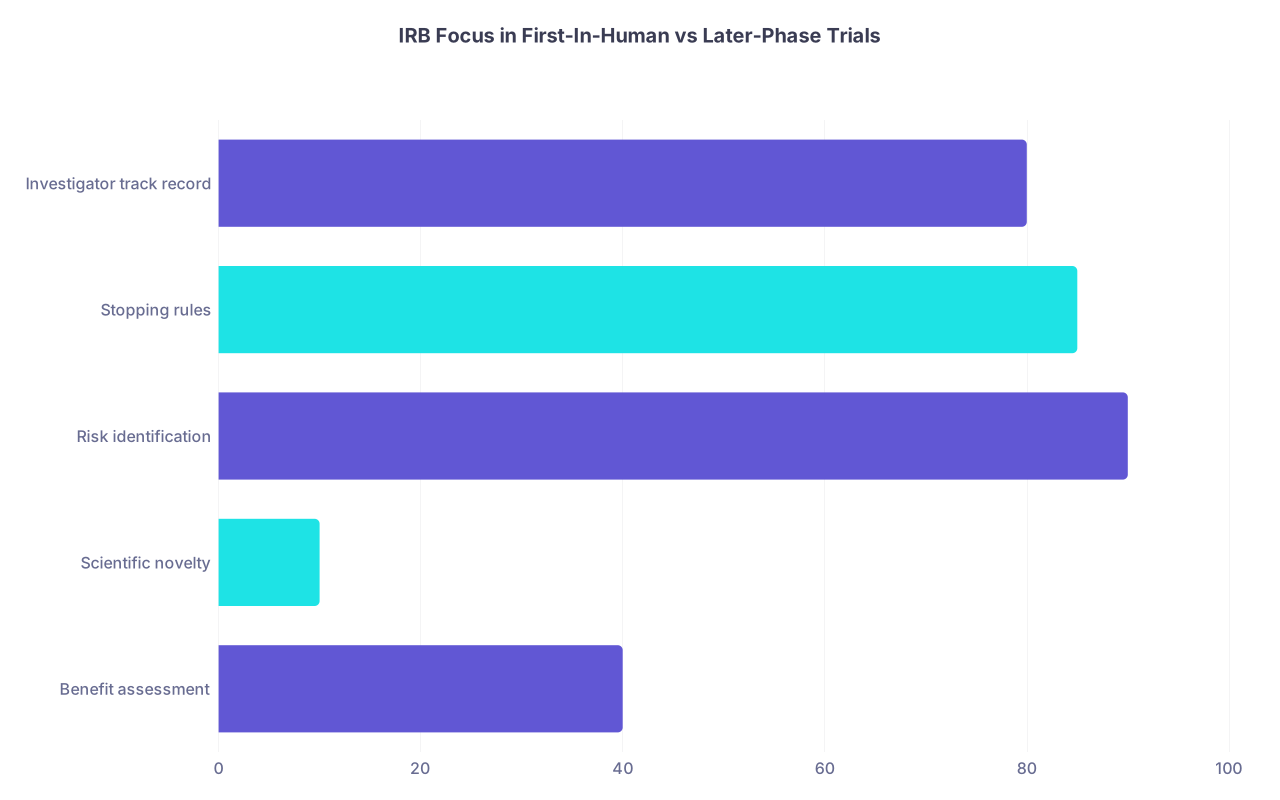
| Category | Value |
|---|---|
| Benefit assessment | 40 |
| Scientific novelty | 10 |
| Risk identification | 90 |
| Stopping rules | 85 |
| Investigator track record | 80 |
You’ll never hear it phrased this bluntly in the meeting minutes. But this is the mental calculus: benefit is speculative, risk is real, and someone has to stand between your enthusiasm and a ventilated 24‑year‑old who thought he was “helping science.”
The Ghosts in the Room: Historical Disasters They Actually Remember
There are names and events that sit in the back of every seasoned IRB chair’s mind when they look at FIH protocols. No one says them out loud every time, but they shape everything.
- The cytokine storm in that TGN1412 trial in London where healthy volunteers nearly died within hours.
- Jesse Gelsinger in the early gene therapy days. Teenager. Dead after “acceptable” preclinical work.
You know the case summaries. They lived through the fallout.
What they learned from those disasters isn’t “be cautious.” It’s more specific and much more cynical:
- Sponsors will always believe their own risk assessments are conservative.
- PIs will always believe they can handle bad events “clinically” rather than by stopping the trial.
- Monitoring committees can be slow, political, or asleep at the wheel.
- Adverse event grading language is elastic when careers and stock options are at stake.
So when an FIH protocol says, “No DLTs anticipated based on preclinical model,” the chair doesn’t nod. They think, “That’s exactly what they said last time too.”
You see a clean tox report. The IRB chair sees that tox report plus the institutional memory of what never made it into publication.
What They Really Read (And What They Barely Glance At)
Let me be very blunt. The IRB chair is not reading your entire protocol word‑for‑word. They do not have time. They triage.
If you want to know what they’re actually tearing apart for FIH work, it’s this:
Stopping rules and dose escalation schema
This is where the chair lives. They’re asking:- Who decides to stop?
- How fast do you escalate?
- What counts as a dose‑limiting toxicity, and who defined it?
- Is there any scenario where they are “allowed” to keep going when they absolutely should not?
Vague language here is a flashing red light. Words like “may” instead of “will,” “considered” instead of “triggered.” Chairs catch that. They push it back.
Inclusion/exclusion realism (not just wording)
For FIH, chairs are allergic to:- Healthy volunteers for high‑risk biologics when there is any plausible patient population.
- Soft exclusions like “investigator discretion” without clear boundaries.
- Ambiguous safety thresholds: “no significant cardiac history” means nothing. They want numbers.
Management of “unexpected but predictable” toxicities
There’s an entire class of adverse events that are predictable in mechanism but unpredictable in timing and severity. Cytokine release. Off‑target immune hits. Neuroinflammation.
Chairs look for:- A step‑by‑step emergency plan that you can actually execute at 2 am.
- Clear ICU back‑up, not hand‑waving about “availability.”
- Drugs on hand, staff training, escalation pathways spelled out.
Informed consent for uncertainty, not just risk
Not just “what might happen,” but “how little we actually know.”
The chair asks:- Does the form admit this is first‑in‑human in plain language?
- Do patients understand that direct personal benefit is unlikely?
- Is there any subtle coercion, especially with payment or language about “access to cutting edge treatment”?
The people, not the paper
FIH trials live or die on the humans running them. The chair quietly cross‑checks:- PI’s track record with previous early‑phase work.
- Who is actually at the bedside overnight on dosing days.
- Whether the statistician and safety officer are real, present people or names on paper.
Everything else? They care, but not in the same way. Sample size justification, secondary endpoints, fancy biomarkers—those are nice. But they do not keep the chair awake.
How Chairs Really Think About Risk: It’s Not a Box to Check
A lot of young investigators think “minimal risk,” “more than minimal risk,” “reasonable risk” are abstract regulatory categories. IRB chairs have their own taxonomy in their heads, especially for FIH:
- Contained and reversible
- Contained but irreversible
- Systemic but recoverable
- Systemic and not reliably survivable
If your FIH trial lives anywhere near that fourth quadrant—systemic and potentially not survivable—the scrutiny goes through the roof.
For example:
- New monoclonal antibody in oncology with a familiar target class, reasonable preclinical data, backup rescue meds: the chair is tense but not terrified. You’re in high but somewhat mapped territory.
- Novel cell therapy with live, replicating cells and incomplete off‑target studies in non‑human primates: now you’re in the “can this end someone’s life in a way we cannot stop” territory. Whole different mindset.

Here’s the part that no one tells you: in those last two categories, the IRB chair is no longer just asking, “Is the risk/benefit acceptable?” They’re also asking, “Is there any ethical justification for doing this here, now, with these people?”
That’s a higher bar than anything you’ll read in your regulations manual.
The Sickening Fear: “Therapeutic Misconception” and Desperate Patients
If you want to get an IRB chair visibly agitated, walk in with a first‑in‑human trial that recruits patients with no good options left and talk about “offering hope.”
They’ve seen this movie before. Dozens of times.
Here’s what they know, that you might not want to admit:
- Patients in extremis will overestimate benefit no matter how many times you say “experimental.”
- Families hear “trial” and think “treatment,” not “data collection.”
- Clinicians, especially those attached to their own science, will unconsciously reinforce that misconception.
So IRB chairs obsess over how you are actually going to counter this, not how you describe it in the protocol.
They look for:
Clear, blunt language in consent that separates care from research.
Not “you will receive an investigational therapy.”
But “This is a research procedure to test safety. It might not help you and could make you worse.”Consent processes that are not done at the bedside 2 hours after a prognosis meeting where the oncologist just said, “We’ve run out of standard options.”
Someone other than the treating physician available to walk through consent, especially if there’s a power dynamic or longstanding relationship.
Many FIH protocols get sent back not because of the science, but because the consent process is theater. A script to justify enrollment of desperate people. IRB chairs know when they’re being asked to sanctify that.
The Quiet Panic: Operational Reality vs. Protocol Fantasy
This is the part investigators consistently underestimate: IRB chairs do not just read the protocol; they mentally simulate the hospital at 3 am when things go wrong.
I’ve seen chairs do this in real time:
PI: “We’ll give the infusion over 2 hours and observe for 4 hours post‑dose.”
Chair: “And you’re telling me that if that patient crashes 3 hours after leaving, who is going to be at their bedside within 2 minutes?”
The chair is running through:
- Is there 24/7 coverage by someone who understands this agent, not just an intern with a pager?
- Is the ICU aware this trial is happening and has bought into the rescue plans?
- Are the pharmacy, lab, and blood bank integrated into this, or is it a theoretical plan that collapses when the on‑call pharmacist says, “What trial?”
When the protocol says, “Continuous cardiac monitoring,” the chair asks themselves, “Continuous where? On what unit? With which nurses? For how many hours? Who is reading those monitors?”
If those answers are not real, the IRB chair knows your first‑in‑human trial is a theoretical construct that the hospital cannot actually execute safely.
This is why some FIH trials fly at big academic centers but die at community sites. Not because the community docs aren’t smart. Because the system reality does not match the protocol fantasy.
Money, Prestige, and Conflicts: What People Pretend Not to See
On the record, IRBs are about protecting participants. Off the record, chairs are brutally aware of what’s pushing first‑in‑human trials through the system.
They see:
- Investigators who’ve built their careers on this molecule or device. Saying no feels like killing their lab.
- Departments chasing prestige and publications, wanting to be “first” to run this trial in the region.
- Institutional relationships with sponsors—especially for high‑profile gene, cell, or device therapies—that make outright rejection politically uncomfortable.
So IRB chairs look for real, operational signs of conflict management:
- Is the PI’s financial interest transparent and honestly handled? Equity in the startup? Patent royalties?
- Is the DSMB truly independent, or filled with colleagues fishing in the same pond?
- Is there pressure—subtle or not—from leadership to approve?
They worry not just about direct conflict, but about a culture where everyone is subtly incentivized to under‑call risk and over‑sell benefit.
You will never see this in the minutes. But in the hallway after a meeting, I’ve heard chairs say things like, “We are not being the beta site for their stock price.”
What Really Triggers a “No” (or a Very Uncomfortable “Not Yet”)
Most FIH protocols do not get an outright “No.” They get a “Tabled pending major revisions.” That’s IRB‑speak for: if you don’t fix the core safety and ethics issues, we’re going to kill this later.
The issues that reliably trigger that response are very consistent:
Vague or manipulable stopping rules
“Safety will be monitored, and the trial may be paused in case of concerning events.”
Translation: “We will keep going until someone admits we should not have.”Chairs want hard triggers:
- X number of Grade 3 events of type Y → automatic pause.
- Deaths or life‑threatening events related or possibly related → immediate halt and independent review.
First‑in‑human dosing that is not clearly linked to non‑human data
If you can’t trace the human starting dose back through a coherent safety margin from your animal data, chairs get nervous. I’ve seen protocols where starting doses were essentially set by “what felt reasonable” or aligning with industry norms. That doesn’t fly anymore.Consent that hides the true level of uncertainty
If your consent form sounds like a press release—“promising new therapy,” “cutting edge approach,” “strong preliminary data”—you’re going back to the drawing board.Inadequate backup plans for worst‑case scenarios
This is subtle. You may have an ICU plan written down. Chairs will still ask:- Do you have the right consultants actually committed?
- Is there an on‑call algorithm?
- Have you run simulations, not just tabletop exercises?
Underpowered or fake‑looking safety monitoring committees
A DSMB of three junior faculty from your own department? No.
A safety officer who is “available if needed,” with vague responsibilities? No again.
They’ll force you back to strengthen these pieces. And if your responses show that you still don’t really get it—that you see this as paperwork, not as life‑and‑death guardrails—some chairs will quietly dig in and never let that trial see day one at their institution.
| Red Flag Area | What Worries the IRB Chair Most |
|---|---|
| Stopping Rules | Vague language, no hard triggers, sponsor control |
| Dose Selection | Weak link to animal data, thin safety margins |
| Consent Language | Overstated benefit, hidden uncertainty |
| Operational Readiness | No real 24/7 coverage, ICU not integrated |
| Conflicts of Interest | PI equity, weak DSMB, institutional pressure |
Your Role: How To Not Sound Naive in Front of an IRB Chair
If you’re a trainee, junior faculty, or budding PI sitting in those meetings, there are two paths. You can be the person who parrots regulatory phrases and gets politely ignored. Or you can be the one the chair actually starts to trust.
The second path requires you to think like they do.
When you present or help design a first‑in‑human trial, show that you’ve already wrestled with:
- “What is the absolute worst‑case scenario here—and what do we do in the first ten minutes, first hour, first day?”
- “How could a participant misunderstand this trial, even if we think our language is clear?”
- “If we were wrong about the risk profile, what early signals would we see and how fast would we act?”
Bring those questions up yourself before the chair does. Admit uncertainty openly. Do not spin.
I’ve watched chairs change their stance in real time when a PI says something like:
“If I’m too close to this to call a stop, here is the person and process that overrides me.”
That’s the sentence of someone who gets it.
Because here’s the truth that almost no one tells you in training: IRB chairs do not expect first‑in‑human trials to be safe. They expect them to be risky. That’s the point.
What they demand is that the risk is known, bounded where possible, honestly presented, and paired with a team that will hit the brakes without hesitation.
Years from now, you won’t remember the exact wording of the stopping rule you fought over, or the p‑value on your early safety signal. You’ll remember whether you were the kind of clinician‑researcher who treated those first human subjects as people with one life, not as a hurdle between you and a publication.
And so will your IRB chair.