
You are in a small consult room, it is 4:45 p.m., and you are already behind. The patient in front of you has failed standard therapy. Oncology, neurology, rheumatology—pick your field, the story is the same. You know there is an experimental option: a phase 1/2 trial, off-label biologic, gene therapy, or something that did not exist when you were an intern.
You open your mouth to explain it and feel that familiar tension:
How do I describe this honestly without crushing hope?
How do I talk about risk and uncertainty without sounding evasive?
How do I avoid sliding into sales pitch or, worse, abdication: “You decide”?
You do not need more abstract ethics lectures right now. You need a script.
Something you can use tomorrow. Something that keeps you honest and keeps the patient actually informed, not just “consented.”
That is what we will build: a practical, repeatable script for explaining experimental therapies—plus a structure for customizing it to your specialty and your patients.
1. The Core Problem You Are Solving
Here is what usually goes wrong when clinicians explain experimental therapies:
- We bury the lede. We talk for five minutes before clearly saying: “This is experimental.”
- We are vague about risk. “There are some risks” is useless. Patients infer what they want.
- We confuse “no data” with “good data.” Absence of evidence magically becomes evidence of safety in patients’ minds.
- We project our own hope or fear. If you are excited about the science, they feel pushed. If you are skeptical, they feel shut down.
- We do not separate research vs care. Clinically therapeutic vs designed to generate data. Ethically, these are not the same.
You fix this by using a consistent framework every time. Same order. Same anchored phrases. Room for personalization, but the skeleton is stable.
I will give you the skeleton first, then specific phrases—the “script”—and finally a checklist you can run in your head in under 60 seconds.
2. The 7-Step Script Overview
This is the structure I recommend and use:
- Frame the situation and why we are here.
- Define “experimental” in plain language.
- Lay out the realistic options side by side.
- Explain potential benefits without hype.
- Explain risks and unknowns with clarity.
- Clarify research vs treatment, and practical details.
- Elicit values and decide together.
You can run through this in 8–12 minutes if you are focused. The key is not to improvise the order. Patients understand better when the sequence is predictable and logical.
3. Step-by-Step Script With Exact Phrases
I will walk through each step and then give you example language you can adapt. Assume a scenario: metastatic cancer, considering a phase 1 immunotherapy trial after standard lines of therapy have failed. You can adjust to your field.
Step 1: Frame the Situation and Why We Are Here
Goal: Align on facts and acknowledge emotions before adding complexity.
Script skeleton:
- Start with a brief recap.
- Name the fork in the road.
- Normalize that this is a tough spot.
Example phrases:
- “Let me start by summarizing where we are, and you can tell me if I have it right.”
- “We have tried [standard treatments X and Y]. They have either stopped working or caused side effects that you cannot tolerate.”
- “Because of that, we are now at a point where there are no standard treatments with strong evidence of benefit left to offer.”
- “In this situation, we can talk about three paths: treating symptoms only, trying other approved medicines off-label, and considering an experimental option through a clinical trial.”
Then pause. Let them absorb that there is a fork in the road. Let them correct any part of your recap.
Step 2: Define “Experimental” Clearly
This is where most people mumble. Do not.
Your job: Make “experimental” concrete, not scary-mysterious or secretly magical.
Key elements to cover:
- This treatment is not yet proven to work for their condition.
- The main reason it is being offered is to learn, not because we know it helps.
- Oversight exists (IRB, monitoring), but that does not equal guaranteed safety.
Example phrases:
“When I say experimental, I mean this:
We do not yet know for sure that this treatment helps people with your exact situation. That is the reason the study is being done.”“This therapy has passed some early safety checks on a small number of people, but it is not yet an approved standard treatment for you.”
“The goal of the trial is to learn: Does this help, what dose is safe, and what side effects occur? Some people may benefit, some may not, and some may be harmed by side effects.”
Avoid saying “cutting-edge” or “breakthrough” in this section. Save the marketing language for the pharma rep’s slide deck, not your patient.
Step 3: Lay Out All Realistic Options Side by Side
Patients anchor to the first option they hear. So you must present options in a structured way, not as “trial vs nothing.”
Use a simple grid in your mind: standard/supportive care, off-label/alternative standard, experimental/trial.
| Option Type | Evidence Level | Main Goal |
|---|---|---|
| Supportive care | Strong | Comfort/QoL |
| Off-label/last-line | Limited/mixed | Possible tumor control |
| Experimental trial | Early/uncertain | Learn + possible benefit |
Example setup:
- “There are three main paths we can consider from here:
- focusing on comfort and symptom control only,
- trying another approved drug that has weaker evidence in your situation, or
- enrolling in an experimental trial of a new treatment.”
Then briefly describe each, using similar language for fairness.
Supportive care example:
- “First path: We focus entirely on your comfort—managing pain, nausea, breathing, energy—as well as emotional and family support. This usually involves our palliative care team. It does not mean we give up on you; it means we stop trying to shrink the cancer and focus on quality of life.”
Off-label/alternative example:
- “Second path: There are a couple of other approved medicines we can sometimes use in situations like yours. The evidence that they help at this stage is limited. Some patients choose them because they want to keep trying something familiar, even if the odds are small.”
Experimental option headline only (details later):
- “Third path: There is an experimental option, a clinical trial testing a new immunotherapy. It is more uncertain—we know less about its benefits and risks in people like you, because that is what the trial is trying to find out.”
This side-by-side framing prevents the false dichotomy of “trial or nothing,” which is ethically sloppy and clinically misleading.
Step 4: Explain Potential Benefits Without Hype
Now you talk about why an experimental therapy is even worth considering. This is where you will be tempted to oversell. Resist.
Your job: give realistic upside, anchored in numbers or ranges where possible, and explicitly separate:
- What we know from data vs
- What we hope, but do not know
Structure your explanation:
- What the therapy aims to do (mechanism in simple terms).
- What has been seen so far (if any data exist).
- How that may or may not translate to this patient.
Example phrases:
“This drug is designed to help your immune system better recognize and attack cancer cells. That is the general idea.”
“In early studies in other patients with advanced cancers, around X out of 100 people had their tumors shrink, and about Y out of 100 had their disease stay stable for a while. Those numbers are early and may change as we treat more people.”
“We do not yet know if people with your exact cancer type and history respond in the same way. You could be someone who benefits, someone who has no response, or someone who mainly experiences side effects.”
If you do not have usable response numbers, say so bluntly:
- “We honestly do not have enough data yet to give a reliable percentage for benefit. The benefit is possible, but currently unproven.”
Step 5: Explain Risks and Unknowns With Clarity
Ethically, this is the spine of the conversation.
There are three risk buckets you must cover:
- Known common side effects
- Serious but less common side effects
- Unknown/uncertain risks and burdens
Use numbers or frequency words attached to numbers. “Rare” means nothing to most people unless you ground it.
Example structure:
- “Every treatment has risks. For this experimental option, there are three types of risk to think about: common side effects, more serious but less common ones, and risks we cannot fully predict yet.”
1) Known common side effects
- “In people treated so far, the more common side effects have been [fatigue, nausea, rash, lab abnormalities]. Roughly [30–40 out of 100] people have had these in early studies.”
2) Serious but less common
- “There have also been more serious side effects, like [serious infection, severe immune reaction, organ inflammation]. Those appear to happen in about [5–10 out of 100] people in early data, but as we treat more people, those numbers may shift.”
If you do not have numbers: “We have seen several cases of serious [organ toxicity] in early use, but we do not yet know the exact frequency. It is not common, but it is real.”
3) Unknowns and burdens
Do not skip this. Unknowns are the point of a trial.
“Because this is still being studied, there may be side effects we have not seen yet, especially in people exactly like you. We monitor closely, but we cannot say with certainty that we have seen the full risk profile.”
“There are also practical burdens: extra visits, more blood draws, imaging, and the possibility of hospital stays if you have a bad reaction. This means more time in medical settings and less time at home.”
Here is the key line that keeps you straight:
- “Absence of evidence is not the same as evidence of safety. It just means we have not treated enough people yet to be sure.”
That one sentence alone prevents a lot of unethical optimism.
Step 6: Clarify Research vs Treatment and Practical Logistics
You need to draw a clear line between “We are trying to help you” and “We are also collecting data.” Therapeutic misconception—patients thinking research is guaranteed personal benefit—is incredibly common and partly our fault.
Conceptual clarity:
“If you join this trial, I will still be your doctor, and your well-being is my first priority. At the same time, the trial has a second goal: to learn how this drug works in people like you.”
“That means some parts of the plan are designed for research: extra scans, questionnaires, sometimes randomization to different doses or different arms.”
If there is randomization or a control arm, say it clearly:
- “In this study, a computer randomly assigns people to [Drug A] or [Standard treatment/Placebo]. Neither you nor I choose the group. That helps make the results scientifically reliable, but it also means we cannot guarantee you will receive the new drug.”
If it is a single-arm trial:
- “In this study, everyone gets the experimental drug. There is no placebo or comparison drug. We compare your results with what we know historically about people in similar situations.”
Logistics to cover briefly:
- Visit frequency and duration
- Location (travel burden)
- Costs and coverage
- Who to call, and what happens if they want to stop
Example phrases:
“You would need to come in [weekly for the first month, then every three weeks]. Each visit would take about [half a day] including labs and infusion.”
“The study covers the cost of the drug and research-related visits. Your usual insurance is billed for routine care like blood tests and imaging that you would need anyway.”
“If at any point you feel this is too much, or the side effects are too severe, you can stop the study. You are never locked in. We would then shift our focus to the other paths we discussed.”
That last line reinforces autonomy and defuses fear of being “trapped” in a trial.
Step 7: Elicit Values and Decide Together
If you rush this step, you undo the value of all the careful explaining you just did.
Your goal: connect the medical facts to what matters most to this particular person.
Is their priority: more time at any cost? Maintaining function? Being at home? Avoiding hospitalization? Contributing to science?
Starter questions:
“Given everything we have talked about—benefits, risks, uncertainty—what matters most to you right now?”
“When you think about the next three to six months, what does a ‘good’ outcome look like for you, even if the cancer does not go away?”
“Different people in your situation choose different paths. Some say, ‘I want to try anything that has even a small chance of helping, even if it means more time in hospitals and more side effects.’ Others say, ‘I want to avoid aggressive treatments that could make me feel worse and focus on comfort and time at home.’ Where do you find yourself on that spectrum?”
Then propose a course of action that aligns with what they just told you.
Example synthesis:
- “You told me that staying well enough to spend time with your grandchildren and being at home is your top priority, and that you are wary of more hospital time. Given that, I am a bit concerned that this trial’s intensive schedule and unpredictable side effects might work against those goals. We can still consider it, but I want to be honest about the trade-off.”
or
- “You told me that you want to pursue any option that offers even a small chance of benefit, and that you are comfortable with extra visits and some risk to do that. In that case, the experimental trial is a reasonable path to consider, as long as you are clear about the uncertainty and the possibility that it may not help.”
End with a clear statement:
- “Based on everything we have discussed, my recommendation is [X]. This is not a decision you have to make today, but I want you to have a clear sense of where I stand and why.”
4. Quick Ethical Guardrails (So You Sleep at Night)
You do not need a full bioethics textbook in your head. You do need a few hard rules you do not cross.
Here are four:
No coercive framing.
Never imply “This is your only chance” unless that is literally true (it almost never is).
Replace: “If you don’t do this, there is nothing more we can do”
With: “If you choose not to do this, we will focus on comfort and support. That is an active kind of care, not ‘nothing.’”No data inflation.
If you are tempted to round a 5% response rate up to “around 10%,” stop. Say the real number. If the data are junk-level uncertain, say that.Separate your excitement from their decision.
It is fine to be intellectually excited by the therapy. Just do not offload that excitement onto the patient. You can say: “From a scientific standpoint, this is a very interesting approach. For you personally, the benefits are still uncertain, and we need to weigh them against the burdens.”Check for therapeutic misconception.
Explicitly ask:- “Can you tell me in your own words what you think the main goal of this trial is?”
If they say, “To treat my cancer,” you have not done your job yet. Gently correct: - “Treating your cancer is one hope, yes, but the main formal goal is to learn whether this approach works and how safe it is. You might benefit, but that is not guaranteed.”
- “Can you tell me in your own words what you think the main goal of this trial is?”
5. A 60-Second Mental Checklist Before You Walk In
You can run this quick checklist outside the exam room:

| Step | Description |
|---|---|
| Step 1 | Outside room |
| Step 2 | Frame situation |
| Step 3 | Define experimental |
| Step 4 | Side by side options |
| Step 5 | Benefits realistic |
| Step 6 | Risks and unknowns |
| Step 7 | Research vs care |
| Step 8 | Ask values and decide |
If you cannot confidently check all these, you are not ready to pitch the therapy.
6. Customizing the Script to Your Specialty
What I have given you is generic enough to apply to oncology, neurology, cardiology, rare disease, even psychiatry trials. But you should pre-build your own “pocket scripts” for your actual practice.
Here is how to do it in a focused 30–45 minute session once, then reuse forever.
Step 1: Pick your 2–3 most common experimental scenarios
For example:
- Phase 1/2 oncology immunotherapy for refractory solid tumors
- First-in-human gene therapy trial for inherited retinal disease
- New biologic or JAK inhibitor for severe autoimmune disease post-biologic failure
Step 2: For each, fill out a mini-dossier
| Aspect | Your Notes (Example) |
|---|---|
| Mechanism | Immune checkpoint inhibitor |
| Phase/Design | Phase 1b dose escalation |
| Known benefits | Early response rate 10–15% |
| Common side effects | Fatigue, rash, diarrhea |
| Serious risks | Colitis, pneumonitis |
| Visit burden | Weekly x4, then q3 weeks |
Have this in your head and, if allowed, in your EHR smart phrase library.
Step 3: Pre-write your “one-liners” for:
- Defining experimental in your field’s language
- Typical benefit framing for your common trials
- Typical risk explanation, with approximate numbers
This saves mental RAM in a busy clinic and makes you more consistent—and safer ethically.
7. Handling Three Common Tough Situations
You will hit these walls regularly. Prepare your responses now.
Situation 1: “What would you do if you were me?”
The classic trap. If you answer without values context, you are overstepping.
Better approach:
- “Different reasonable people make different choices here. Let me answer your question in two steps. First, I want to be sure I understand what matters most to you. Then I can tell you what I would lean toward if those were my priorities.”
Then ask the values questions from Step 7. After that, you can say:
- “If my top priority were [more time even with more visits and risk], I would lean toward trying the trial, as long as I understood it might not help. If my priority were [staying home and avoiding side effects], I would lean toward focusing on comfort and symptom control.”
You are modeling decision-making, not projecting your personal life into theirs.
Situation 2: Family pushing for “everything” when patient is ambivalent
You anchor in the patient’s values, not the loudest voice in the room.
- “I hear that as family you want every possible option explored. That is very understandable. At the same time, my responsibility is to [patient’s name], and I want to be sure we respect what matters most to them.”
Turn to the patient:
- “Can you tell me how you feel about trying an experimental option like this, given the extra visits and uncertain benefits?”
If the patient is clear and decisional, follow them. Families adjust better to a decision that is clearly grounded in the patient’s own words.
Situation 3: You personally think the trial is a bad fit
Maybe the chance of benefit is vanishingly small, or the burden is ridiculous for their functional status.
You still must be honest, but you do not have to be neutral.
“I want to be transparent with you. Given your current strength, how much time you are already spending in the hospital, and the very early stage of this drug, I think the likelihood of it improving your quality of life is low. It could add side effects and visits without much gain.”
“It is still your decision, and if you are strongly inclined, we can explore it. But if I were guiding a family member in a very similar situation, I would recommend focusing on comfort and time at home.”
Do not hide your clinical judgment under the guise of “offering all options.” That is abdication, not autonomy.
8. Quick Visual: Balancing Benefit, Risk, and Burden
Sometimes a simple visual helps patients (and you) think clearly.
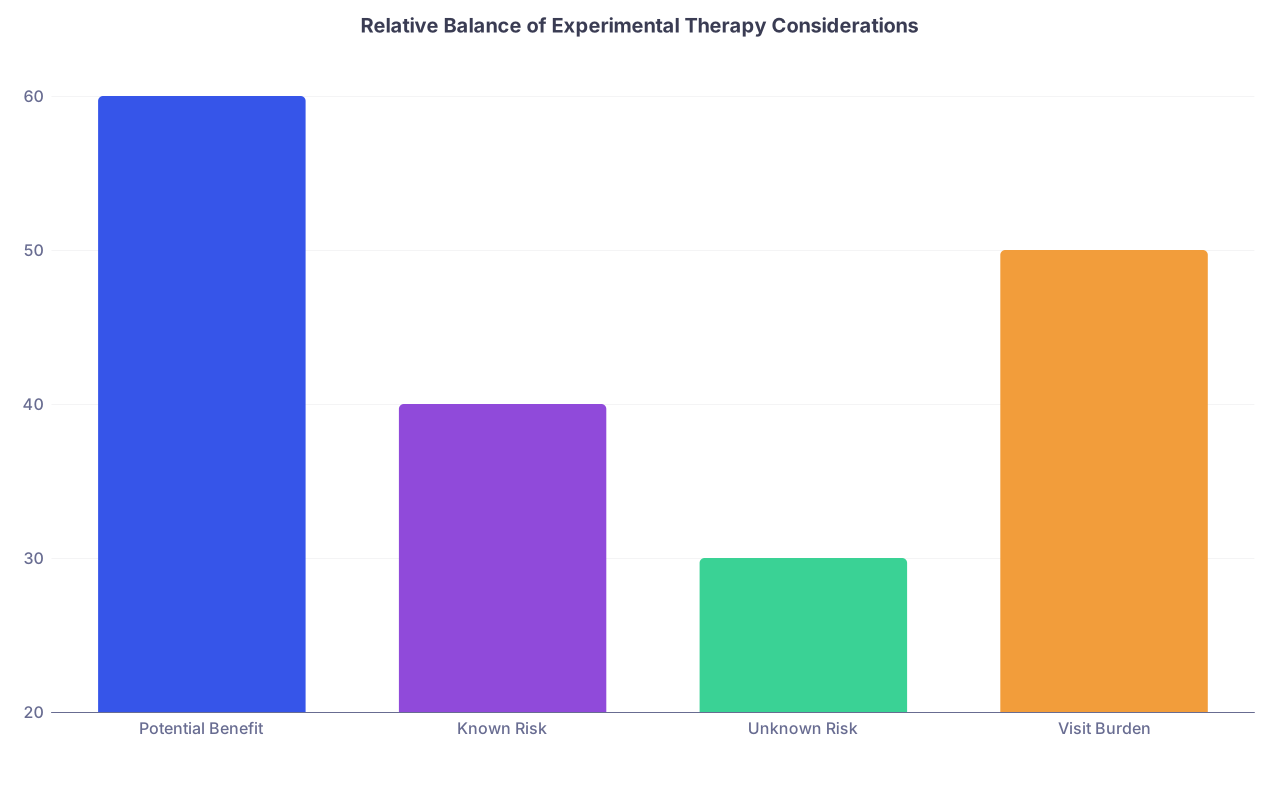
| Category | Value |
|---|---|
| Potential Benefit | 60 |
| Known Risk | 40 |
| Unknown Risk | 30 |
| Visit Burden | 50 |
You can roughly sketch something like this on paper: bars for benefit, risk, unknown risk, and burden. Then ask the patient: “Given this balance, where is your comfort line?”
9. Building This Into Your Routine (So It Actually Happens)
A script is useless if it lives only in your memory from one article.
Here is a simple implementation plan you can actually pull off while exhausted.
1. Create a smart phrase / template in your EHR
Include headings like:
- Situation/why experimental considered
- Experimental nature explained (yes/no)
- Options reviewed (supportive, standard/off-label, trial)
- Benefits discussed (data source, uncertainty)
- Risks including unknowns
- Research vs care distinction
- Patient values and stated priorities
- Shared decision and plan
This not only documents ethically sound consent, it forces you to walk the steps.
2. Practice out loud 2–3 times
I mean literally, in a call room or your car, run the script for one of your common experimental therapies. Out loud. Awkward once, smooth forever.
3. Debrief one case per month
Pick a trial discussion once a month and ask yourself:
- Did I explicitly define “experimental”?
- Did I present supportive/palliative care as a real option, not “nothing”?
- Did I check for therapeutic misconception?
- Did I anchor the decision in the patient’s own stated values?
You will get better faster than you expect.
10. Two Tools You Can Use Tomorrow
To make this painfully concrete, here are two short things you can literally copy.
A. One-sentence definition of “experimental therapy”
Use this, tweak the disease area:
- “This is an experimental therapy, which means we are still studying whether it helps people in your situation, and we do not yet fully know how well it works or what all the risks are.”
B. Three-sentence minimal explanation when time is tight
You will have days when you have 5 minutes, not 20. On those days, at least do this:
- “We have tried the standard treatments, and they are no longer working well. From here, we can focus on comfort, consider another approved drug with limited evidence, or look at an experimental option in a clinical trial.”
- “The trial uses a drug that is still being studied. Some people may benefit, some may not, and there are both known and unknown risks, including the possibility of serious side effects.”
- “Whether this makes sense depends on what matters most to you right now—more time even if it means more visits and risk, or focusing on comfort and time at home. Can you tell me what you are leaning toward?”
Not perfect. Better than 90% of what is currently happening in real clinics.

11. Closing: What Actually Matters
If you strip away the jargon and the regulatory noise, explaining experimental therapies well comes down to three things:
Say clearly that it is experimental and what that means.
Not “new,” not “promising,” but “not yet proven for you, still being studied.”Put all options on the table fairly.
Supportive care is a real option. Off-label is an option. Experimental is an option. Your framing should not predetermine the answer.Tie the decision to the patient’s values, not your excitement or fear.
You bring the facts and your clinical judgment. They bring the priorities. The decision sits where those meet.
If you use the 7-step script and those three anchors, you will give patients something most people in experimental therapies never get: a genuinely informed, genuinely shared decision. And you will be able to look back on these conversations years later and know you told the truth.