
The biggest mistake residents make about research is thinking, “I need more time and more publications before I can join serious clinical trials.” Wrong. You need a system, a role, and a team that sees value in you now.
You are not trying to “do some research.” You are trying to become indispensable to cutting-edge clinical trials teams while staying ethically clean and clinically competent.
Here is how you actually do that.
1. Get Your Head Straight: What Trials Teams Really Want
Cutting-edge clinical trials teams are not hunting for “interested residents.” Those are a dime a dozen. They are looking for:
- People who reliably execute protocols
- People who document cleanly and on time
- People who do not create regulatory headaches
- People who can communicate with patients like adults, not robots
You want them to think: “If we give this resident a task, it gets done, and we do not get audited into oblivion.”
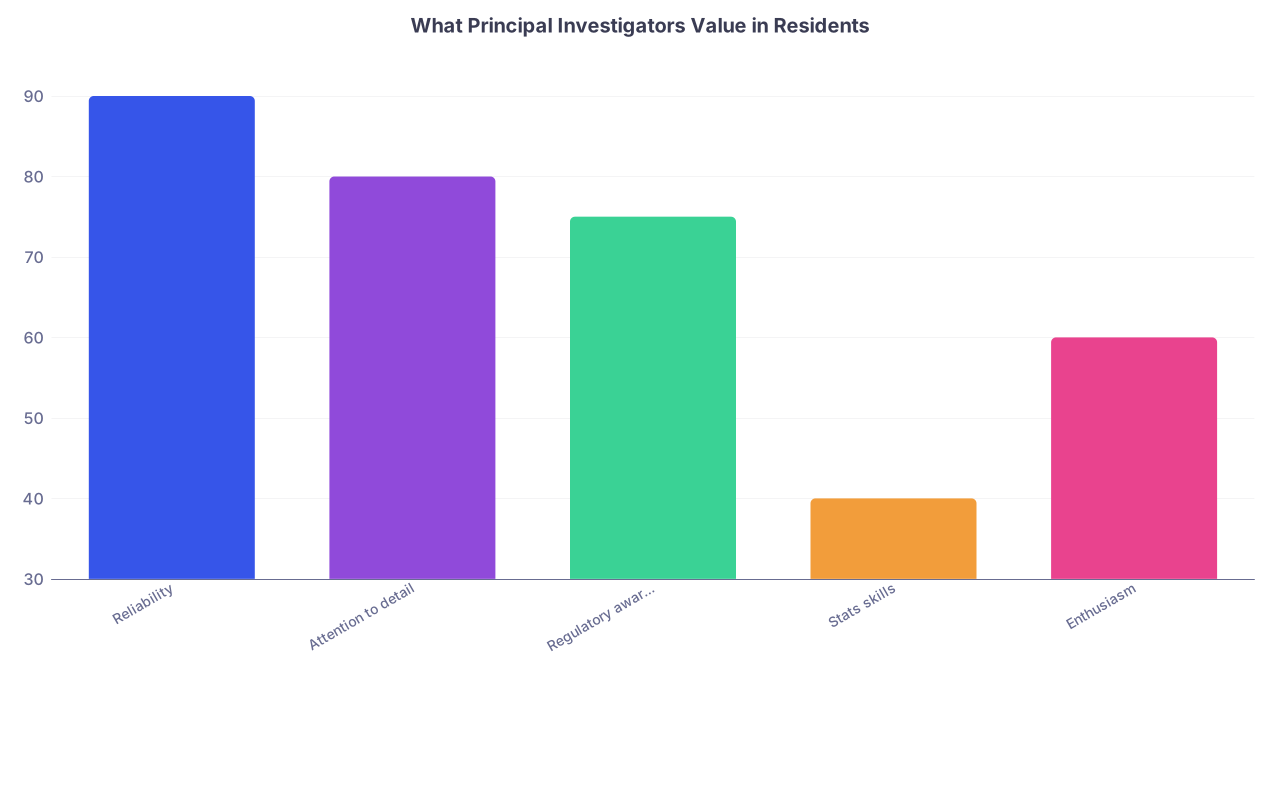
| Category | Value |
|---|---|
| Reliability | 90 |
| Attention to detail | 80 |
| Regulatory awareness | 75 |
| Stats skills | 40 |
| Enthusiasm | 60 |
Notice what is not at the top: raw intelligence, “passion for research,” or how many posters you had in med school. Those help, but they are secondary.
Your mindset shift
Stop asking: “How do I get on a paper?”
Start asking: “How do I make a PI’s life easier and safer?”
That mental shift alone will change how you email, how you show up, and how fast people loop you into serious projects.
2. Map the Terrain: Where the Trials Actually Happen
Most residents have only a vague sense that “our institution does trials.” That is not enough. You need a clear map.
Step 1: Identify your local trials ecosystem
Do this over a single focused week.
Hit ClinicalTrials.gov
- Search your institution name.
- Filter by:
- Recruiting / Active, not recruiting
- Your specialty
- Make a shortlist of:
- Trial title
- PI name
- Trial coordinator or contact email
Find the research infrastructure
- Office of Clinical Research / Clinical Trials Office
- IRB office
- Biostatistics core
- Data coordinating center (if your institution has one)
These groups know exactly who is running what, and who is drowning in work.
Talk to the people who actually know
Ask:- Research nurses
- Study coordinators
- CRCs (Clinical Research Coordinators)
- Subspecialty fellows who publish a lot
You will hear names repeated. Those are the hubs you want to orbit.

| Step | Description |
|---|---|
| Step 1 | Resident decides to join trials |
| Step 2 | Map active trials |
| Step 3 | Identify key PIs and coordinators |
| Step 4 | Meet with mentor |
| Step 5 | Select 1-2 feasible trials |
| Step 6 | Complete required trainings |
| Step 7 | Take on specific trial role |
Step 2: Choose your entry lane
You are not going to lead a phase III trial as a PGY-2. Ignore that fantasy.
Pick one of these lanes for your first 6–12 months:
Patient recruitment / screening
You learn inclusion / exclusion criteria cold and help screen clinic or ED patients.Data quality and follow-up
You verify data accuracy, track follow-up visits, and make sure no one is lost.Procedural / intervention support
You assist with or perform protocol-driven procedures (if within your training and credentialing).Substudy / secondary analysis
You handle a well-defined subset of data under supervision.
You start small. You prove you can be trusted. Then doors open.
3. Build the Minimum Ethical and Regulatory Skill Set
If you show up to a clinical trials team without regulatory basics, you become a liability. PIs sense this quickly and will quietly exclude you.
You need a bare-minimum compliance package. Do this before you start asking to join trials.
Your non-negotiable training checklist
Talk to your institution’s research office and complete:
- CITI Program modules (or equivalent) in:
- Good Clinical Practice (GCP)
- Human Subjects Research (Biomedical)
- Responsible Conduct of Research (RCR)
- HIPAA and data privacy training
- Any institution-specific:
- Conflict of interest forms
- Research credentialing
- Device / drug accountability training if relevant

Then you document it:
- Keep a PDF of completion certificates
- Maintain a simple “research CV” page for:
- Completed trainings
- IRB roles (co-investigator, sub-investigator)
- Trial experience
Why? Because when a PI wants to add you to a protocol or IRB, they need proof you are trained. If you can email them a clean one-page summary, you jump straight past half the friction.
Baseline ethical rules you do not get to break
You must have these drilled into your brain:
- You never consent your own inpatients or clinic patients alone unless:
- You are explicitly listed as study personnel on the IRB
- You have been trained on that specific consent process
- Your institution allows it
- You do not “simplify” risk language when consenting
This is how trials get shut down and reputations ruined. - You never promise benefit
You explain possible benefits and risks as written in the IRB-approved consent. - You separate clinical care from research
If you are their treating physician, you are extra cautious about:- Coercion
- Power dynamics
- Making it clear participation is voluntary and will not affect care
Residents get in trouble not because they are evil. They get in trouble because they are rushed and trying to “help” the study.
Slow down. Follow the script. Protect the patient and protect yourself.
4. Approach PIs and Teams the Right Way (Without Being Annoying)
Emailing, “I am a PGY-2 and very interested in research, do you have any opportunities?” is the research equivalent of spamming your CV on LinkedIn.
You need a targeted, specific, low-friction ask.
Step 1: Do your homework
Before you email:
- Read at least 1–2 of their recent trial papers.
- Skim the ClinicalTrials.gov entry for their active study.
- Ask a coordinator how the workflow actually runs.
Then you can identify gaps. Missing follow-up visits. Poor after-hours coverage. Complicated criteria that residents ignore.
Step 2: Send a surgical email
You keep it short, specific, and useful.
Subject:Resident interested in helping with [Trial Name] – proposal for [specific task]
Body skeleton:
- 1 line: Who you are (PGY year, service, relevant background)
- 1–2 lines: What you understand about their trial and current need
- 2–3 lines: A concrete way you can help that does not add work for them
- 1 line: Ask for a 15–20 minute meeting
Example:
I am a PGY-2 in IM on the cardio service. I have GCP and CITI human subjects certifications and previously helped with patient recruitment and REDCap data entry on a heart failure registry.
I reviewed your ACTIVE-HF trial on ClinicalTrials.gov and spoke briefly with your coordinator, who mentioned missed after-hours recruitment opportunities from the ED. I would like to help by taking responsibility for screening and flagging eligible ED admissions during my night float month, with a standardized handoff to your coordinators each morning.
Would you be open to a 20-minute meeting to discuss whether this could be useful and how to do it in a compliant way?
This does three things:
- Shows you did your homework.
- Offers a specific value-add.
- Signals that you respect regulatory boundaries and want to do it right.
You will be miles ahead of 90% of “interested residents.”
5. Lock In a Clear Role and Deliver Like a Machine
Once a PI or team says yes, your next move is critical: get your role defined in writing and then overdeliver.
Define your role explicitly
At your first meeting, ask concrete questions:
- For recruitment roles:
- “Exactly which criteria exclude patients?”
- “Who has final say on enrollment?”
- “What happens if I identify a patient at 2 a.m.?”
- For data roles:
- “Which fields are my responsibility?”
- “How do I document uncertainties or missing data?”
- “Who reviews what I enter, and how often?”
- For follow-up:
- “What is the target follow-up rate?”
- “How many contact attempts are acceptable?”
- “What script do we use when calling patients?”
You are not just a warm body. You are a defined function within the trial’s workflow.
| Role Type | Typical Tasks |
|---|---|
| Recruitment | Screen charts, identify eligible pts |
| Consent Support | Pre-consent education, scheduling |
| Data Entry / QC | Enter data, verify against chart |
| Follow-up Tracking | Call patients, schedule assessments |
| Substudy Lead | Analyze subset, draft manuscript |
Build a simple execution protocol for yourself
You want checklists. Residents who trust their memory under fatigue are the ones who blow eligibility criteria.
Create:
A daily or shift-based checklist, for example:
- 07:00–08:00 – Screen yesterday’s admissions for trial X
- Flag potential candidates in chart
- Message coordinator with MRN list
- Log actions in a simple spreadsheet or REDCap log
A brief documentation template for your own use:
- Date / time screened
- Inclusion criteria: met / not met
- Exclusion criteria: any present?
- Action taken: flagged, deferred, not eligible
Treat trial work like procedures. You follow a predefined sequence every time.
6. Stay Ethically Clean When You Are Tired and Under Pressure
Most ethical failures in trials are not masterminded. They are shortcuts taken at 2 a.m. by tired residents who “just want to help the patient get the new therapy.”
You need pre-committed rules for yourself.
Your personal red-line rules
- If I feel rushed, I do not consent
If the patient cannot be given real time to read / ask, you delay or involve someone else. - If I am confused about a criterion, I treat it as “no” until clarified
Never “interpret” inclusion / exclusion in favor of enrollment. - If I am the treating physician and the patient looks to me for guidance, I explicitly name the conflict
For example:
“I am both your doctor and part of the research team for this study. That means I am in two roles at once. Your care will be the same whether you join or not, and you can say no without changing anything about how we treat you.” - If the attending’s enthusiasm feels like pressure, I slow the process
“I want to make sure the patient fully understands this. I am going to step out and give them a few minutes to think and then come back to answer questions.”

If this feels “too cautious” to you, that is a red flag. Trials live or die on ethical credibility. Once a team realizes you cut corners, you are done.
7. Turn Trial Work into Real Career Capital (Not Just Busywork)
Being on a cutting-edge trials team has no value if you emerge with nothing but, “I helped out with some study, I think.”
You need to convert your work into:
- Skills
- Roles on record
- Concrete output (abstracts, papers, letters)
Step 1: Make your role IRB-visible
Ask directly:
- “Can I be added as a sub-investigator or co-investigator on the IRB?”
- “For this substudy, can I be listed in the protocol as the resident lead?”
This matters because fellowship PDs and hiring committees know the difference between:
- “I helped collect some data” and
- “I was a named sub-investigator on a multi-center phase II trial.”
Step 2: Negotiate a defined academic product
Once you have delivered consistently for a few months, you earn the right to ask:
- “Is there room for a secondary analysis or substudy that I could lead?”
- “If I take ownership of follow-up data, could we target an abstract for [Conference X] and a paper submission?”
Then you lock down:
- Primary question
- Dataset you will use
- Rough authorship expectations
Will authorship politics still be messy sometimes? Of course. I have seen residents do 80% of work and get middle-author. But clear early conversations reduce the odds of you being erased.
Step 3: Document growth in skills, not just outputs
Keep a running log (yes, actually write this down):
- Trials you have worked on
- Your evolving roles (screening → data QC → consent → analysis)
- Specific skills:
- Writing inclusion / exclusion screening tools
- Using REDCap or trial EDC systems
- Coordinating with DSMBs or monitoring visits
- Drafting sections of protocols or amendments
This helps when:
- Applying for fellowships (“Describe your research experience”)
- Asking for letters (“Could you comment specifically on my role in XYZ trial?”)
- Pivoting to industry or academic trialist roles later
8. Time Management: Fitting Trials Work Into a Brutal Schedule
Let me be blunt: if you try to “do research when I have time,” you will do nothing. Your schedule has to be structured, or the wards will eat it.
Use rotation-based planning
Different rotations, different expectations:
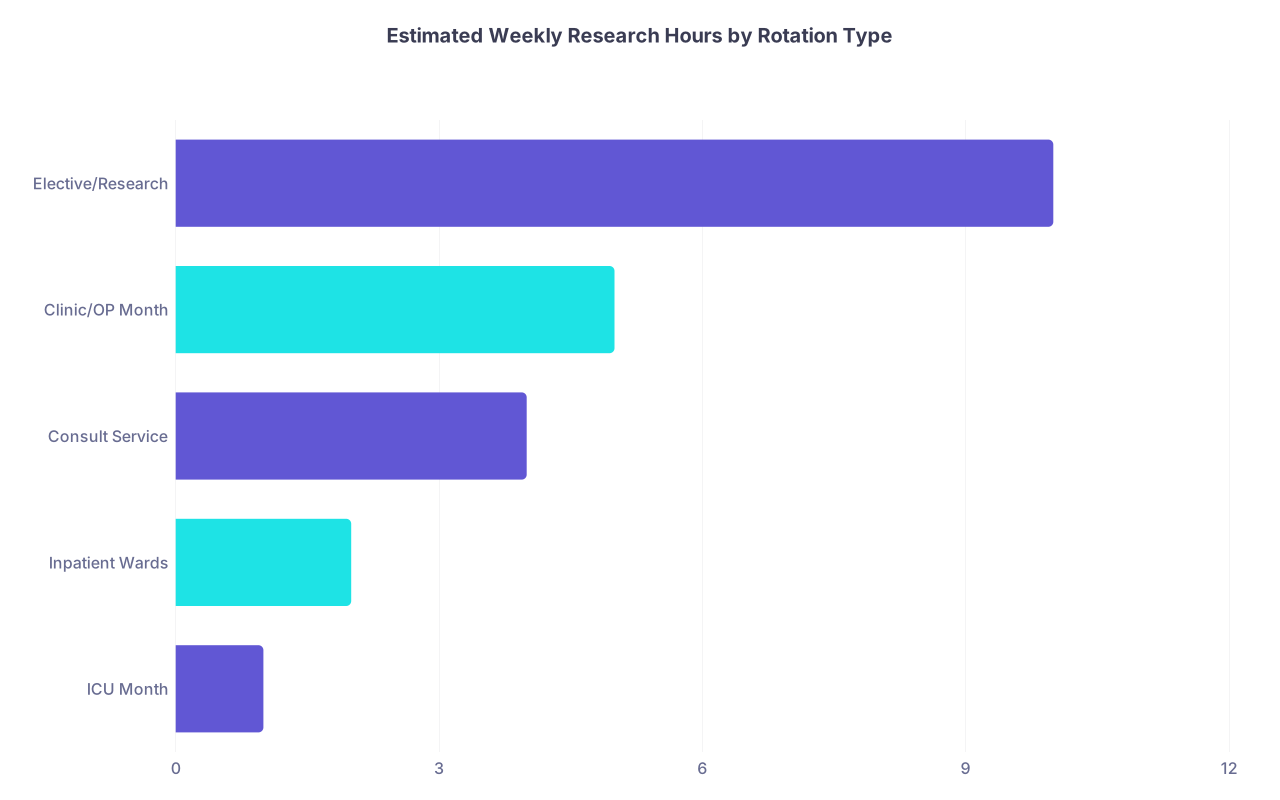
| Category | Value |
|---|---|
| ICU Month | 1 |
| Inpatient Wards | 2 |
| Consult Service | 4 |
| Clinic/OP Month | 5 |
| Elective/Research | 10 |
You design your trials involvement accordingly:
- On heavy inpatient / ICU months:
- Focus on simple screening / flagging roles.
- No major analysis or writing commitments.
- On lighter / elective months:
- Batch data cleaning, substudies, manuscript work.
- Take on leadership in one protocol area.
Protect fixed research micro-blocks
You are not going to get uninterrupted 4-hour chunks. Aim for:
- 3–4 sessions per week of 25–45 minutes:
- Post-call afternoon
- Early morning on clinic days
- A protected pre-bed slot on 2 evenings
Each block has a specific task:
- Screen X patients
- Enter Y data fields
- Draft Z paragraphs of the Methods section
You are not “working on the trial.” You are doing a tiny, concrete unit of work.
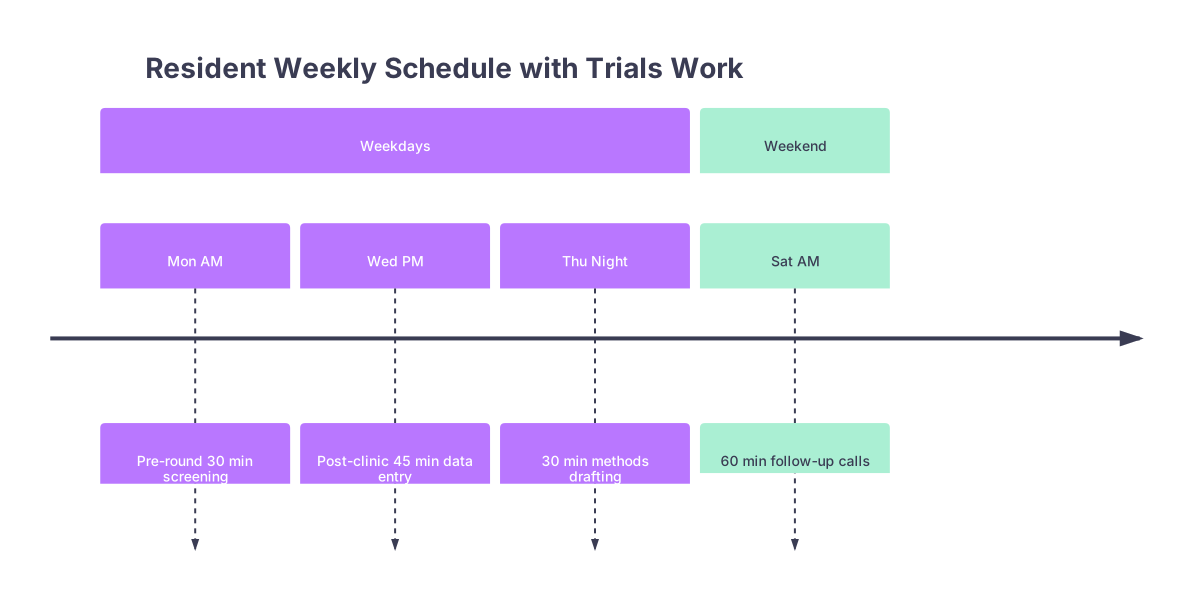
| Period | Event |
|---|---|
| Weekdays - Mon AM | Pre-round 30 min screening |
| Weekdays - Wed PM | Post-clinic 45 min data entry |
| Weekdays - Thu Night | 30 min methods drafting |
| Weekend - Sat AM | 60 min follow-up calls |
9. How to Avoid Becoming the Team’s Free Labor Mule
There is a real risk: you get labeled “the reliable resident” and suddenly every data dump and grunt task lands on your plate. No authorship. No leadership. Just work.
You prevent this early.
Set boundaries with clarity, not drama
At the start of any new trial task:
- State your available time honestly:
- “I can commit 3–4 hours per week consistently for the next 3 months.”
- Define scope:
- “I am happy to handle screening and initial chart abstraction, but I cannot be responsible for weekend follow-up calls on ICU months.”
Later, if scope creeps:
- “I am seeing the workload expand beyond what I can reliably do with my clinical schedule. I want to maintain high quality and not become a bottleneck. Can we clarify which parts are highest priority for me and which should go to the coordinator team or another trainee?”
That sounds formal, but it is protective. And PIs who run serious trials will respect it.
Ask for proportional recognition
When you have:
- Completed a clearly defined chunk of work
- Delivered consistently
- Taken initiative
Then you have earned the right to say:
- “Given the amount of data collection and QC I have contributed, would it be reasonable to include me as a co-author on the planned primary results paper?”
- “For this substudy that I am leading, I would like to be first author if expectations are met. Does that align with your view?”
If a PI consistently avoids giving you proportional credit, you do not keep arguing. You stop accepting new work from them and shift your energy elsewhere.
10. The Ethical Spine: Balancing Innovation, Patients, and Your Career
Cutting-edge trials are seductive. New drugs. Fancy devices. Big-name journals. It is very easy to lose your ethical bearings and start thinking of patients as “enrollment opportunities.”
You need a spine that does not bend every time someone says “this could change practice.”
Three grounding questions to ask yourself regularly:
- If this were my family member, would I feel comfortable with how we are presenting this trial?
Not the drug. The process. Are we rushing? Are we glossing risks? - If an auditor listened to this consent conversation, would I feel anxious?
If yes, something is off. - If this trial ended up in scandal on the front page, would my actions still look defensible?
Not perfect. Defensible.

You can be ambitious and ethical. The idea that you must choose is nonsense. The best trialists I know are ruthlessly precise about ethics because they understand something simple: unethical trials do not change practice. They get retracted.
FAQ (exactly 2 questions)
Q1: I am already a PGY-3 and have almost no research. Is it too late to join serious clinical trials teams?
No. You are late for the “med student with 12 posters” game, but not for meaningful trial experience. Focus on:
- Completing core regulatory training immediately
- Targeting 1–2 high-yield trials in your specialty
- Taking on a well-scoped, visible role (screening + follow-up or a defined substudy)
- Converting that into at least one abstract and one strong letter that specifically mentions your trial responsibilities
Programs care less about how early you started and more about whether you can function as a reliable, ethical member of a trials ecosystem now.
Q2: I am worried about getting exploited for grunt work without authorship. How do I protect myself without burning bridges?
You frontload clarity. Before committing major time, you state your scope, your weekly capacity, and your hope for academic credit if you meet expectations. During the project, you document your contributions and periodically review progress with the PI or senior fellow. If, after a reasonable period, there is a clear mismatch between your effort and recognition, you calmly step back from additional tasks with that group and reallocate your energy to teams that treat authorship and credit like adults. You do not need drama; you need boundaries and alternative options.