
The biggest myth about hospital innovation committees is that they’re about innovation. They’re not. They’re about risk.
You think it’s brainstorming, blue sky thinking, “how do we transform care?” No. Behind those closed doors, the real conversation is: “How do we not get sued, not blow the budget, not piss off the surgeons, and still look innovative enough for the board and the marketing team?”
Let me walk you through what actually happens in those rooms, because I’ve sat in them, watched the side-eye, heard the whispered “we tried this in 2014 and it was a disaster.”
Who’s Really in the Room — And Who Secretly Runs It
You look at the official roster: “Hospital Innovation Council” or “Digital Transformation Committee” or some other buzzword salad. The org chart lies to you.
Here’s the typical casting:
- One or two “innovation champions” (often a younger attending, maybe a hospitalist or EM doc)
- A couple of old-guard power players (big-name surgeon, senior internist, ICU director)
- The CMIO or CIO or both
- A finance person
- Risk/legal rep, sometimes sitting silently in the corner
- A nurse leader who actually knows how the hospital runs
- Occasionally, a resident or fellow “representative” included for optics
Now, who actually drives decisions? Spoiler: not the person with “innovation” in their title.
It’s a three-way power triangle:
- Finance (CFO proxy)
- IT/CIO side
- One or two high-RVU clinical heavyweights
Everyone else is flavoring.
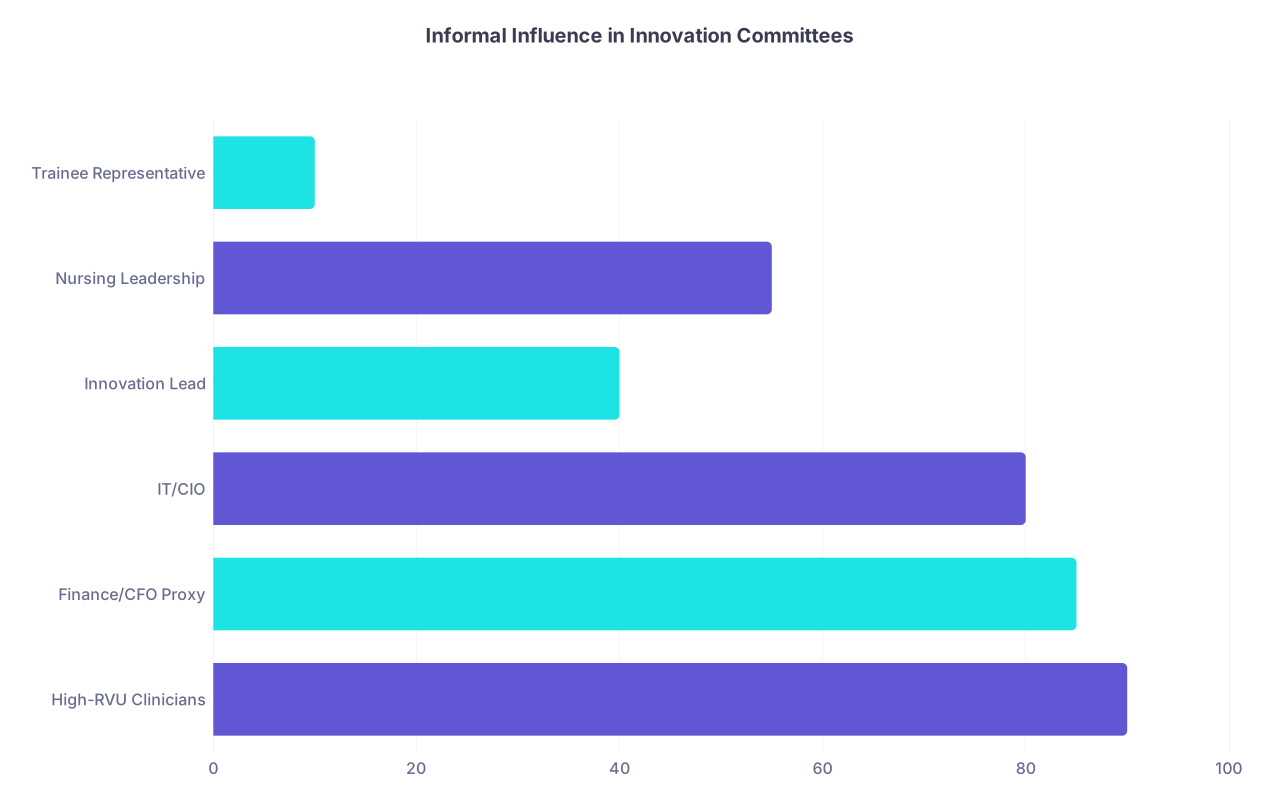
| Category | Value |
|---|---|
| High-RVU Clinicians | 90 |
| Finance/CFO Proxy | 85 |
| IT/CIO | 80 |
| Innovation Lead | 40 |
| Nursing Leadership | 55 |
| Trainee Representative | 10 |
The junior attending who spent six months building a prototype workflow is often treated as the “presentation layer” — useful for slides, not for the final call. Trainees? You’re there to signal “inclusivity” and occasionally to confirm: “Would residents actually use this?” They rarely ask you, by the way.
The real decisions are made either:
- Before the meeting, in side conversations between the CMIO and finance.
- After the meeting, in a 15-minute “just us” debrief once the junior people leave.
If you understand that, you’ll understand why so many “innovations” feel half-baked or misaligned with frontline reality. The people who live the workflow don’t control the levers.
The Agenda You See vs. The Agenda That Matters
On paper:
- Review pilot outcomes
- Evaluate new proposals
- Prioritize roadmap
In practice, every meeting has three hidden agenda items:
Protect the revenue engine.
Anything that threatens OR throughput, procedural volume, or throughput metrics gets intense scrutiny. An AI tool that “may slow documentation by 5–10% but improves quality”? Nice idea. Financial death sentence if it touches the big billers.Avoid public embarrassment.
Nobody wants to be the system that rolled out a tool that hit the news because it failed dramatically. If it smells like it could end up in a patient safety story, the risk people start to twitch.Feed the PR machine just enough.
The board and community want to see “innovation.” That does not mean they want risky transformation. They want photo ops with pretty dashboards and maybe a press release about AI or remote monitoring.
So when a new idea is presented, the discussion you hear is about “workflow,” “alignment,” “change management.” The discussion faculty have in the hallway after is: “Can we afford this politically and financially, and can we sell it as innovation without it blowing up?”
How Ideas Actually Get Evaluated (Not the Way They Tell You)
On the surface, you’ll see a matrix: cost, impact, feasibility, alignment with strategic plan, regulatory implications. Maybe a scoring sheet. Lots of fake objectivity.
The real filter looks more like this:
Does this make somebody powerful angry?
If it threatens attending autonomy, OR scheduling, or gives quality new visibility that can be used against departments, resistance spikes.Does any senior leader “love” it already?
If the CEO mentioned it in a town hall or the CMO saw it at a conference, the bar gets much lower. I’ve watched mediocre apps get pushed through because “our CEO met their CEO.”Can we blame someone else if it fails?
Vendor-run pilots with shared risk? Attractive. Internally developed tools that we alone own? Much scarier.Does it check buzzword boxes?
“AI,” “predictive,” “equity,” “patient engagement,” “burnout mitigation” — these are currency. If your proposal hits a couple of those and doesn’t cost much, you get air time.

Here’s the dirty little secret: most committees do not kill ideas straightforwardly. They slow-walk them. You’ll hear phrases like:
- “We should gather more data.”
- “Let’s see how this plays out in other systems first.”
- “We can revisit this in Q3 when budgets are clearer.”
Translation: “No, but we don’t want to be recorded as the person who said no if this becomes hot later.”
A Typical Meeting: What Actually Happens, Minute by Minute
Strip away the formalities, and a 90-minute innovation committee often goes like this:
Minute 0–10: Political Temperature Check
People arrive late. The senior surgeon walks in 8–12 minutes after the scheduled start. Laptops pop open. Somebody mentions a recent adverse event or a news story about another hospital’s AI tools. This sets the emotional tone.
If someone starts with, “Did you see that piece on AI triage missing sepsis?” you can kiss off anything high-risk on the agenda. Everyone tightens up.
Minute 10–30: Performance Theater
The first big agenda item is usually a status update on something already funded. This is choreographed.
Slide deck:
- Before: 30 slides
- After the CMIO’s edits: 12 slides, with 3 that really matter: cost to date, visible wins, no disaster so far.
Words you’ll hear a lot: “alignment,” “pilot,” “phase,” “stakeholders,” “iteration.” What you won’t hear much: “We had to quietly scrap half this because clinicians hated it.”
Behind the scenes, I’ve watched teams pre-meet and rehearse who will answer what, which “concerns” they’ll preemptively acknowledge, and what story they’ll use to impress the one or two senior people who truly matter.

| Step | Description |
|---|---|
| Step 1 | Pre meeting rehearsal |
| Step 2 | Curated slide deck |
| Step 3 | Committee presentation |
| Step 4 | Expand quietly |
| Step 5 | Keep pilot indefinite |
| Step 6 | Rebrand or sunset |
| Step 7 | Senior leader reaction |
Minute 30–60: Where Good Ideas Go to Die
This is the slot where “new proposals” show up. Usually:
- A clinician-led workflow improvement with some tech
- A resident project that worked on one unit
- A vendor demo that someone already half-promised to entertain
Here’s the pattern:
- They let the presenter talk uninterrupted. People nod.
- One or two clarifying questions from the safe crowd (IT, nursing).
- Then the heavyweights move.
The big clinician: “How will this affect my documentation time?” or “What does this do to throughput?”
Finance: “What’s the ROI timeline?”
Legal/risk: “Have other systems had any liability issues with this?”
The moment someone says, “We don’t yet have solid ROI data, but…” the energy drops. You can feel it.
I watched a resident present a brilliant idea: a simple EHR prompt that auto-suggested palliative care consults based on length of stay and certain orders. Ethically beautiful. Clinically sound.
The questions?
- “Will this create alert fatigue?”
- “Will this be seen as rationing care?”
- “Could this be interpreted as ageist?”
- “Do we have any data that this reduces costs?”
They shelved it “pending more data.” It never came back.
Minute 60–80: The Real Work — But Off the Record
This is where the real deals happen. Someone pipes up:
“Before we wrap up, we need to talk about the remote monitoring expansion. The vendor’s proposal came in higher than expected.”
Now you see the real power dynamic. This discussion is not about usability. It’s about:
- Negotiation posture with vendors
- What the board has already been told
- Who “owns” this initiative politically
Nurses might mention staffing impact; clinicians might raise panic about call burden. Finance listens but frames it all back to contracts and renewals. IT quietly mentions integration pain. Everybody looks at the CMIO or CIO for the read.
If you ever sit in that room, watch who people look at after a contentious question. That’s the real decision-maker.
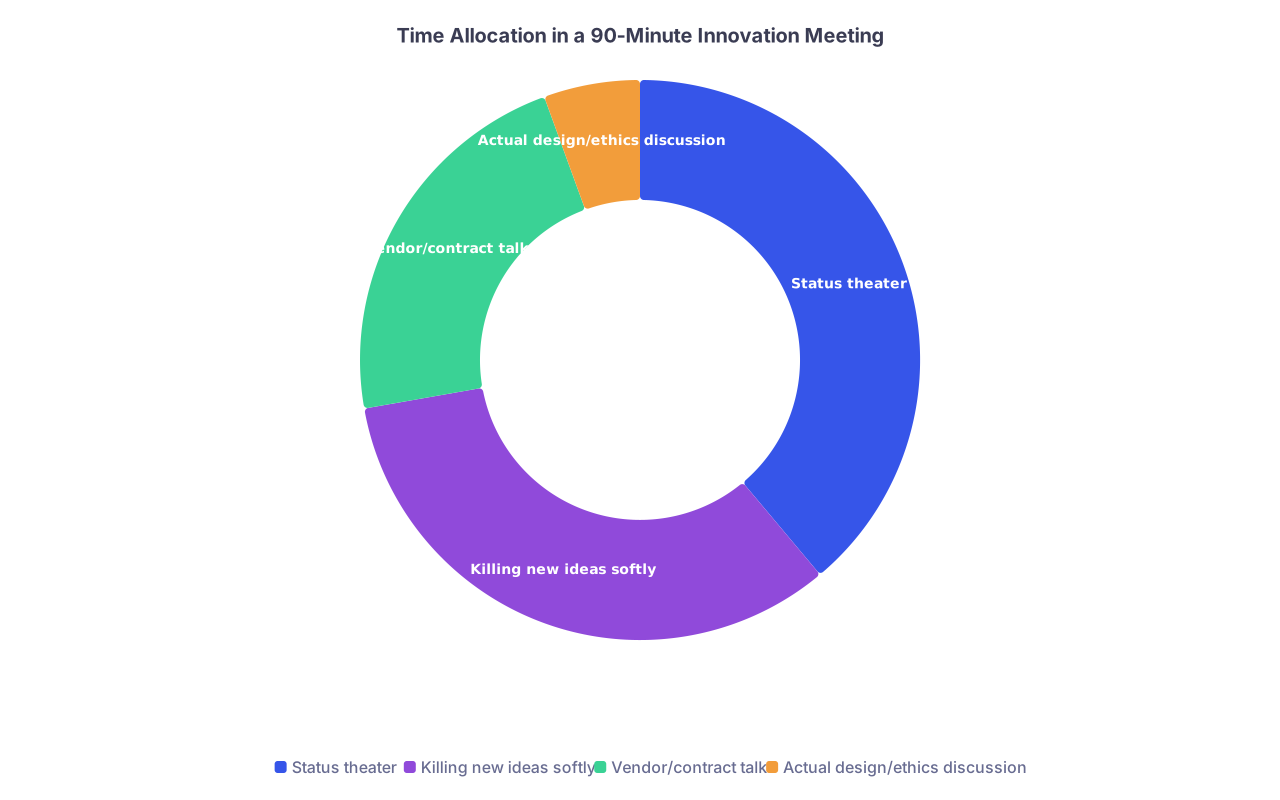
| Category | Value |
|---|---|
| Status theater | 35 |
| Killing new ideas softly | 30 |
| Vendor/contract talk | 20 |
| Actual design/ethics discussion | 5 |
Minute 80–90: Ethics in the Last Five Minutes
Ethics almost always shows up either as an afterthought or as cover.
Someone says, “We just need to make sure we’re doing this ethically.” Heads nod. Nobody defines what that means operationally.
Occasionally, a bioethicist or ethics committee member is technically “on” the innovation group. They get invited late, when something already smells risky.
I’ve heard this exchange almost verbatim:
Ethics rep: “This AI triage tool appears to perform worse for non-English speakers. How are we addressing that?”
IT lead: “We’re working with the vendor on ongoing model improvement.”
Chair: “Good, let’s make a note that equity is a key consideration in our evaluation.”
Then they move on.
Note. Consideration. Not action plan.
The Ethical Tension: Innovation vs. Patients vs. Trainees
Let me be blunt: committees systematically undervalue two groups when pushing innovation:
- Vulnerable patients
- Trainees and nurses who absorb the extra work
From the inside, here’s what often happens.
Patients as Metrics, Not People
New tools are almost always framed in terms of:
- Readmissions
- Length of stay
- ED throughput
- HCAHPS scores
Patient narratives are used selectively. You’ll get a heartwarming “Mrs. X used our remote BP monitoring and avoided admission” story. You will rarely hear, “Mr. Y doesn’t own a smartphone and got completely left out of this model of care.”
Equity gets lip service. Implementation rarely slows down for it.

When someone does raise equity concerns seriously, the response is often:
- “We can phase in outreach to underserved patients later.”
- “We’ll monitor that as part of our metrics.”
Which usually means: “We’ll collect data, but changing course will be hard once we’ve committed.”
Trainees and Nurses as Shock Absorbers
Every “small” workflow change hits residents and nurses like a truck.
A new alert. A new screening tool. An extra checkbox. “It only takes 30 seconds” multiplied by hundreds of encounters. That pain is not fully represented in deliberations.
Ethically, this is where committees fail most often. They externalize the burden:
- Residents are “asking for innovation experience,” so they get dumped with pilot work.
- Nurses are “closest to the patient,” so they’re told to operationalize it.
But the protected time, staffing, and compensation rarely line up.
I sat in one meeting where a resident said, “If we pilot this on nights, it will add at least 1–2 hours of extra admin work per shift for the cross-cover.” Silence. A senior attending replied, “Well, that’s temporary. It’s just a pilot.”
Of course, the pilot stretched to 18 months.
How Politics, Vendors, and PR Warp “Innovation”
You want the real behind-the-scenes mechanic? Follow three things: contracts, conference presentations, and board slides.
Vendors in the Shadows
Most “innovation” you see promoted externally is vendor-driven. Not internally imagined, designed, and built. And vendors are good at working the angles.
Common moves:
- They get a champion on the inside (often the innovation lead or CMIO).
- They offer a discounted “lighthouse site” deal if the hospital will be a reference client.
- They supply pre-made ROI decks and case studies from other systems.
By the time the committee hears about it, the narrative is half-written.
You’ll know this is happening when:
- The name of the vendor appears in the agenda item title.
- The CEO has already seen a previous version of the slide deck.
Saying no in that context is politically costly.
Conference-Driven Decisions
Another unspoken driver: what makes for good conference content.
Leadership wants to present at HIMSS, HLTH, academic meetings. Being “the hospital that rolled out X” is part vanity, part recruitment, part reputation management.
I have seen pilots pushed forward explicitly because “this would make a great abstract for next year’s meeting.”
Ethically, this gets muddy. Are we doing this for:
- Patient benefit right now?
- Institutional prestige?
- Individual CV lines?
Often all three. But the weighting is not as altruistic as people want to believe.

PR and the Board
The board wants to hear “we’re investing in AI” or “we built a hospital-at-home program.” That pressure trickles down.
Innovation committees feel a standing background demand: produce something visible.
So if the choice is between:
- A subtle optimization that quietly reduces nurse burnout by 15%, or
- A flashy AI readmission predictor that looks great on slides
The AI wins more often than it should.
If You’re a Student or Resident in the Room: How to Not Be Window Dressing
You might get invited “to represent the trainee voice.” Here’s how this really works, and how not to waste that seat.
Understand Your Leverage
You don’t have voting power. But you have two forms of influence:
- Reality checks. You can credibly say, “On night float, this will not be used,” and people listen more than you think if you’re specific.
- Moral clarity. You can say the thing others are too jaded to say: “This seems to benefit our metrics more than our patients, and it adds unrecognized work to the most burned-out parts of our workforce.”
Use both surgically. Not constantly. Constant complainers get tuned out.
Speak in Their Language
If you want to be taken seriously, frame things like this:
- “Here’s the workflow at 2 a.m. on a Saturday. Now layer this tool on it. Here’s exactly what happens.”
- “If you want this to succeed, you’ll need X hours of protected time and Y fewer clicks.”
- “The residents will either silently bypass this, or they’ll burn more time on documentation and less on patient care.”
Notice what you’re doing: you’re talking about adoption risk and operational failure, which they actually care about.
| Weak Trainee Phrase | Strong Trainee Phrase That Lands |
|---|---|
| "This will add to burnout." | "This adds 8–10 minutes per admission charting." |
| "Residents won’t like this." | "On nights, people will bypass this 90% of the time." |
| "This seems unfair." | "This shifts work to the least-supported providers." |
| "Patients might be confused." | "Our non-English speakers will be systematically excluded." |
| "This is not realistic." | "This conflicts with existing mandatory workflows." |
Guard Your Own Ethics
You’ll see compromises. You’ll see good ideas suffocated slowly. You’ll see leaders rationalize decisions that clearly burden patients and staff to hit revenue or PR targets.
Don’t become cynical too fast. But don’t be naive either.
The move is this:
- Learn the system.
- Notice how power and fear shape “innovation.”
- Decide what you’re willing to attach your name to.
Later, when you’re the one at that table with real authority, you’ll either repeat the cycle or break it. That choice starts now, not then.
How to Ethically Design and Pitch Innovation in This Environment
If you want an idea to survive this meat grinder and still be ethical, you need to be strategic.
Bake ethics in as risk mitigation, not as abstract virtue.
Don’t say, “We need to avoid bias.” Say, “If we don’t monitor performance by race and language, we’re exposed to legal and reputational risk when disparities appear.” Ugly, but it works.Quantify burden honestly.
Count clicks. Count minutes. Identify who pays the operational tax. Put it in your slide deck explicitly: “This adds 3 minutes per admission, so we propose protected time or removal of redundant steps X and Y.”Create patient stories that include the underserved.
Not just the perfect tech-enabled patient. Show the person who doesn’t have WiFi, the shift worker who can’t attend virtual check-ins, the non-English speaker facing a monolingual interface.Propose a kill switch.
Commit, from the start, to explicit stop criteria. “If this increases average door-to-doc time in the ED by more than 10%, we will pause the pilot.” Committees rarely hear that. It makes you sound serious and safe.Align with one or two strategic priorities clearly.
Read your hospital’s strategic plan. If “equity,” “burnout reduction,” or “digital front door” are on it, wire your project to those phrases explicitly. You’re gaming their language, not your ethics.
FAQ (Exactly 5 Questions)
1. Are hospital innovation committees mostly for show?
Not mostly, but there is a strong performative layer. They serve real functions—governance, risk control, budget alignment—but a non-trivial portion of what happens is about optics: looking modern to the board, to the public, and to recruits. The tension is that this performative pressure can distort which projects get air and which die quietly.
2. Do patients ever directly shape decisions in these meetings?
Rarely. You might see a token patient representative on some committees, or patient satisfaction data summarized as a metric. But direct patient voices shaping design decisions before rollout? That’s still the exception. When patient stories are used, they’re often curated to support a pre-decided direction rather than to question it.
3. Is it possible to do ethically sound innovation in this environment?
Yes, but it requires intentional design. You have to explicitly identify who’s bearing the operational burden, plan for equity from the start, and define kill criteria if harm appears. The default drift is toward projects that favor metrics and marketability; pushing back on that drift takes uncomfortable conversations and a willingness to slow down.
4. As a trainee, is it worth joining these committees, or is it a waste of time?
If you treat it as a checkbox, it’s a waste. If you treat it as a live lesson in how power, money, risk, and ethics interact in modern healthcare, it’s invaluable. You’ll learn more about how medicine actually runs in one year on a serious committee than in multiple “leadership” workshops. Just go in clear-eyed and protect your time.
5. Why do so many innovation projects feel disconnected from frontline reality?
Because the people who live that reality have the least formal power in the room. Projects are often shaped by vendor agendas, executive priorities, PR value, and budget constraints. Frontline workflows, resident nights, nurse workloads—those come in late, if at all. Unless someone forces those realities onto the table with specifics, they’re treated as implementation details, not gating criteria.
Key takeaways:
Hospital innovation committees are fundamentally risk and power management bodies, not pure idea labs. Ethics, equity, and frontline burden are often afterthoughts unless someone forces them into the core evaluation criteria. If you ever get into those rooms, your job—if you care about patients and colleagues—is to translate moral concerns into concrete operational and reputational risks, and to insist on counting who actually pays the price for “innovation.”