
The way most clinicians are using wearable data in clinic notes right now is lazy, legally risky, and occasionally unethical.
Let me walk you through what actually happens behind closed doors, what attendings say when you’re not in the room, and how program directors quietly judge your charting when you start dropping “Apple Watch” and “Oura Ring” into your notes like it’s cute.
This isn’t a tech problem. It’s a professionalism, liability, and documentation problem. And the unspoken rules around it are already forming, even if your EHR and hospital policy haven’t caught up yet.
What Really Happens When You Type “Apple Watch” in a Note
I’ve sat in enough chart review meetings to tell you this: the moment you explicitly document specific wearable numbers, you’ve just volunteered yourself as the interpreter, validator, and sometimes co-owner of that data.
Attendings don’t say it politely. They say things like:
- “If you’re going to document it, you own it.”
- “Once it’s in the note, the lawyer reads it as ‘you accepted this as real.’”
- “Why did you put an unvalidated AFib detection in the HPI if you didn’t order an EKG?”
That’s the first unspoken rule:
If you put wearable metrics in the chart as facts, you’re implying they’re clinically reliable and relevant.
So here’s how people actually behave:
They either
- ignore wearable data entirely (and silently roll their eyes), or
- over-document everything the patient says (“Smartwatch showed HR 180 for 2 hours”) and create a liability mess.
The smart clinicians take a third route: they document that the patient used a wearable and how it influenced the history or plan, without treating the numbers like they came from an ICU monitor.
Read that again. You’re not an Apple Watch stenographer. You’re a physician.
The Hierarchy of Evidence: Where Wearables Really Sit
No one is going to say this in your professionalism lecture, so I will: in clinic, we mentally rank data, even if we never write it down.
Here’s the unspoken hierarchy, as most attendings actually use it:
| Data Source | Typical Trust Level |
|---|---|
| Hospital-grade monitors | Very High |
| Lab/imaging from accredited lab | Very High |
| Clinic-acquired vitals | High |
| Home BP cuff (validated, taught) | Moderate |
| FDA-cleared medical wearables | Moderate |
| Consumer wearables (watch, ring) | Low–Moderate |
| Patient recall of numbers | Low |
So when you write in your note:
“Apple Watch showed HR 180 for 2 hours”
but you have no EKG, no physical symptoms today, and you’re not ordering anything… you’ve just blended low-moderate quality data into a chart that medico-legally will be read as high-quality “documented tachycardia.”
Program directors absolutely notice which residents blur that line.
The better approach is something like:
“Patient reports smartwatch notifications of ‘elevated heart rate’ up to ~180 bpm on several occasions; episodes not independently verified with medical-grade device. Used as context for patient concern; today’s exam and EKG without evidence of sustained arrhythmia.”
You’re not pretending the watch does not exist. You’re also not pretending it’s telemetry.
The Three Silent Questions Every Attending Asks About Wearable Data
No one spells this out for you, but every experienced clinician is running the same three-part filter the moment a patient starts scrolling their watch stats in front of you.
1. Does this change my differential or management?
If the answer is no, the wearable data belongs as context, not as primary evidence.
Example:
Patient with well-controlled HTN shows you a week of Apple Watch HR data, all normal. That doesn’t touch your differential. Your note might simply say:
“Patient has been tracking HR with smartwatch and reports values in normal range; this provides reassurance but did not alter management.”
Versus:
Patient with suspected POTS shows repeated wearables with HR jump from 60 supine to 130 standing, multiple times, with reproducible symptoms. That might nudge you toward formal testing:
“Patient has tracked repeated episodes of tachycardia on standing via wearable device, correlating with lightheadedness; while not a validated diagnostic tool, these patterns increase suspicion for dysautonomia, and formal autonomic testing is planned.”
2. If I write this down and something bad happens next week, how will it look?
This is the malpractice question. Honestly, it’s what your more senior attendings are really thinking.
If you document:
“Patient Oura Ring shows HR down to 32 overnight, several nights in a row.”
…and then you do nothing. No EKG. No referral. No follow-up instructions. Granular documentation like that makes you look reckless if something catastrophic happens.
So people who’ve been sued before (or sat in depositions) do something different. They either:
- Don’t document the precise number at all (“Patient reports low nocturnal heart rates on consumer wearable”) and then say “No concerning symptoms, normal exam, discussed limits of device accuracy and advised to report syncope, chest pain, etc.”
or - They act on it: “Given report of nocturnal bradycardia, will obtain EKG and consider Holter if concerns persist.”
The unwritten rule: If you document specific, abnormal wearable numbers, either qualify them clearly or show that you responded appropriately.
3. Who is responsible for ongoing monitoring?
This one is huge and almost never discussed explicitly in training.
If you say in your note:
“Patient has continuous glucose monitor; will monitor sugars and contact patient if any concerning trends.”
You have just promised asynchronous care you probably don’t have the time, infrastructure, or legal framework to provide. And the plaintiff attorney will have that line blown up on a poster board.
Instead, the senior clinicians say things like:
“Patient uses continuous glucose monitor and shares patterns during visits. Discussed that clinic does not continuously monitor data in real time; patient instructed to contact clinic or seek urgent care for symptomatic hypoglycemia or persistent hyperglycemia above X.”
Ownership of data and responsibility for response have to be explicit. In your note. Because your in-person explanation will not be in the record later.
How To Actually Phrase Wearable Data in Your Notes
Let’s get practical and a bit tactical. This is the part no one teaches because they’re worried about “overcomplicating” things. Meanwhile, residents are out there copying patient watch numbers straight into the chart like they’re lab values.
General pattern that keeps you out of trouble
Good notes follow a basic structure when it comes to wearables:
- Identify the source (consumer vs medical-grade, type of device)
- Attribute it to the patient as reporter
- State the clinical relevance (or lack of it)
- Clarify limitations or actions taken
Examples:
“Patient reports smartwatch notifications labeled ‘possible AFib’ on 3 occasions over the past month. This is a consumer-grade device and not diagnostic. Given underlying risk factors and patient concern, formal evaluation with EKG and possible Holter monitoring is planned.”
or
“Patient tracks sleep duration with a consumer wearable, perceives overall improvement in sleep since starting CPAP. Device metrics not validated but used to support patient subjective improvement.”
Notice the consistent moves:
- “Patient reports” or “patient tracks” → you’re not granting the data independent authority.
- “Consumer-grade” or “not validated / not diagnostic” → you are putting the data in its proper tier.
- “Given X, we are doing Y” or “does not change current management” → you show your clinical judgment.
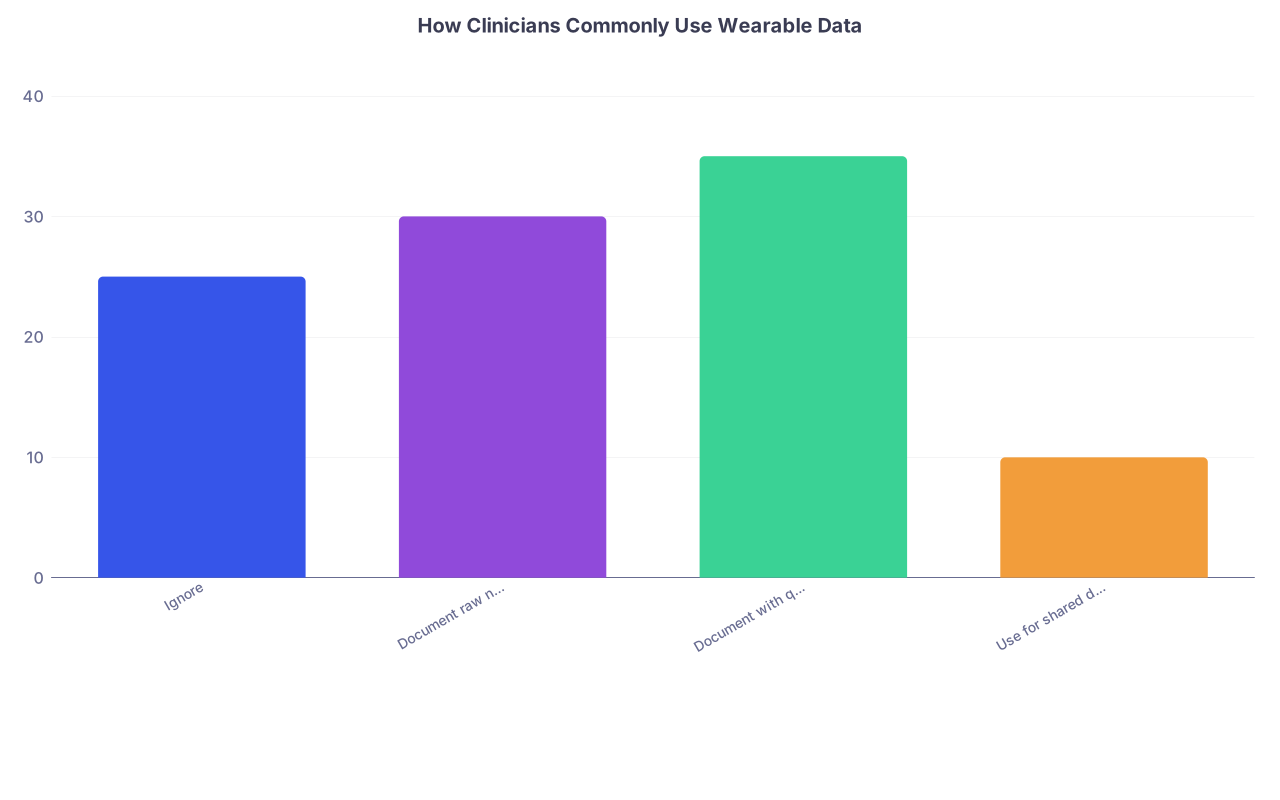
| Category | Value |
|---|---|
| Ignore | 25 |
| Document raw numbers | 30 |
| Document with qualifiers | 35 |
| Use for shared decisions | 10 |
Behind closed doors, many attendings would tell you that only one of those patterns is both safe and useful: documenting with qualifiers and clinical context.
Ethics: The Part Everyone Waves At But Rarely Practices Well
Here’s the uncomfortable part: wearable data is a gold mine for subtle bias and sloppy ethics.
I’ve seen this happen in chart reviews:
Two patients, same vague complaint of fatigue, same normal basic labs. One has a high-end Garmin with VO2 max, HRV, sleep staging, step counts. The other doesn’t own a wearable and shrugs when you ask about activity. Who gets more “thorough” consideration? The one who brought semi-objective-looking graphs.
That’s not neutral. That’s resource bias dressed up as “data-driven care.”
The three quiet ethical traps
Over-valuing tech-literate patients
Patients who can export PDF reports or navigate apps get their stories believed more easily. Documenting “patient presents multiple pages of smartwatch trends” vs “patient unsure of details” subtly tips future clinicians toward trusting one more than the other.Pathologizing normal variations
Write enough “mildly decreased HRV” or “possible REM sleep deficit per wearable” phrases and you’ll turn half your clinic into the worried well. Consumer wearables are designed to create “insights” and engagement, not clinically validated interpretations.Implicit surveillance expectations
If your note implies that the clinic is “following” the wearable data, you’ve just changed the moral and legal expectation. Suddenly, you’re not just a consultant during visits; you’re an always-on monitoring service. Without pay. Without infrastructure. Without clear consent.
The ethically solid notes make three things clear:
- Wearable data is adjunctive, not definitive.
- Interpretation is limited by validation status and context.
- The locus of responsibility for day-to-day monitoring remains with the patient, unless there is a formal remote-monitoring agreement.
How Program Directors And Faculty Really Judge You On This
You want the quiet, unfiltered version? Here it is.
When your notes start to regularly include wearable data, faculty look for three things:
Are you thinking like a clinician, or like a gadget enthusiast?
If every vague symptom leads to elaborate documentation of step counts and sleep staging from a Fitbit, you look unfocused. Residents who chase every wearable blip signal that they don’t yet grasp pretest probability or clinical thresholds.Are you clear on what is and is not your responsibility?
A note that implies “we’ll keep an eye on your wearable readings” tells faculty you don’t understand boundaries, clinic capacity, or liability. They will talk about this in eval meetings.Do you know how to “downshift” data without dismissing the patient?
The art is acknowledging the patient’s effort and concern without endorsing junk science. Good residents say things like:
“I’m glad you’re keeping track of this; it helps us see patterns. These devices can be off, though, so I’m going to use them mostly to understand trends and your symptoms, not each exact number.”
And then they mirror that posture in the chart. Which is what the faculty really read.
Practical Templates You Can Steal
You want the insider shortcuts—here they are. These are phrases I’ve seen senior clinicians use that make lawyers less nervous and ethicists less angry.
Use or adapt them, don’t copy-paste blindly.
For heart rate / rhythm alerts
“Patient reports smartwatch notifications labeled as ‘irregular rhythm’ on X dates. This is a consumer device and not diagnostic. Given [risk factors/symptoms], will [obtain EKG / refer to cardiology / provide strict return precautions].”
For sleep tracking
“Patient uses consumer wearable to track sleep and perceives improvements in sleep duration and consistency. Sleep metrics from device are not validated for diagnostic use and are used only to support patient-reported improvement.”
For activity / steps
“Patient tracks daily steps via smartwatch and has increased from estimated 2,000 to ~6,000 steps/day over 3 months per device. While exact counts may not be precise, this reflects a meaningful increase in activity and is encouraged.”
For CGM / glucose wearables
“Patient uses continuous glucose monitor (FDA-cleared device). Clinic does not provide real-time review of CGM data; patient brings summaries to visits. We reviewed trends today, which are consistent with A1c and fingerstick logs. Patient advised to follow preset thresholds for contacting clinic/urgent care.”
For “scary” low or high readings
“Patient reports several episodes of low heart rate and/or blood pressure on consumer wearable, without associated syncope, chest pain, or dyspnea. Device accuracy is uncertain. Today’s vitals and exam are reassuring. Discussed limitations of wearable readings and provided instructions for seeking care if concerning symptoms develop. No additional workup at this time.”
You see the pattern. You’re constantly doing three things: acknowledging, qualifying, and deciding.
Documentation vs. Conversation: Don’t Confuse the Two
Here’s the last layer the junior people always miss.
What you say to the patient and what you write in the note are related but not identical.
“I like that you’re keeping track. These devices aren’t perfect, though, especially for sleep or rhythm detection. I’m going to use this mainly to understand your symptoms and patterns. If anything seems really off—like sustained very high heart rate with chest pain—you should treat that as real until proven otherwise and get seen urgently.”
In the chart, you don’t need the whole script. You need the essence:
“We reviewed patient’s wearable data in clinic and discussed that such devices are imperfect and not diagnostic. Patient instructed on which symptoms/findings should prompt urgent evaluation vs routine follow-up.”
That single sentence demonstrates informed use of tech, ethical communication, and boundary setting. Faculty notice that level of thoughtfulness.

| Step | Description |
|---|---|
| Step 1 | Patient presents wearable data |
| Step 2 | Document briefly as context |
| Step 3 | Clarify limitations |
| Step 4 | No change in management |
| Step 5 | Assess reliability and risk |
| Step 6 | Use for shared decision making |
| Step 7 | Document with qualifiers |
| Step 8 | Order appropriate tests or referral |
| Step 9 | Document action and patient instructions |
| Step 10 | Clinically relevant? |
| Step 11 | Abnormal or concerning trend? |
This is how experienced clinicians actually think, even if no one’s ever drawn it out.
FAQs
1. Should I ever put exact wearable numbers (HR, steps, sleep hours) in my note?
You can, but you need to be selective and smart. Exact numbers make sense when they directly support a clinical decision and you frame them as patient-reported from a consumer device. If writing “HR 180 per watch” doesn’t lead to any action, it usually belongs as a vague trend (“episodes of elevated HR per wearable”) or left out entirely.
2. Is it okay to completely ignore wearable data if I think it’s junk?
Ignoring it in the chart is easy; ignoring it in the relationship is dangerous. If the patient clearly cares and you brush it off, you signal disinterest. Better to acknowledge it, explain limitations, and then choose whether or not it deserves documentation. A one-line HPI mention often suffices without legitimizing junk metrics.
3. Do I need consent to look at or document wearable data?
By bringing it into the visit and discussing it with you, the patient is implicitly consenting to its use in clinical care. The bigger issue is clarity about ongoing data access. If the patient shares portal access or device logins, you must still be explicit in your note that you are not continuously monitoring outside of visits unless a formal program exists.
4. How should I handle “potential AFib” or “irregular rhythm” alerts from watches?
Treat them as a risk flag, not a diagnosis. Document that they’re from a consumer device, correlate with symptoms and risk factors, and then decide: reassure with return precautions, get an EKG, or refer for monitoring. What you must not do is treat them as definitive AFib or completely ignore repeated alerts in a high-risk patient without explanation.
5. Will using wearable data in my notes make me look more “innovative” to program directors?
Only if it’s done with judgment. Randomly pasting watch metrics into every note makes you look unfocused and naive about evidence. Thoughtful, sparing use—where you clearly understand the technology’s limitations and legal/ethical implications—signals maturity and insight. Innovation without discernment is just noise; innovation with boundaries gets noticed for the right reasons.
Years from now, you won’t remember the specific heart rate a patient’s Apple Watch claimed on a Tuesday night. You’ll remember whether you learned to treat data—any data—as something that serves your clinical judgment, not something that replaces it. Wearables are just the newest test of that discipline.