Step-by-Step: Presenting a New Digital Tool to Your Program Director
You are in the resident workroom at 6:45 pm. The list is finally under control. On your phone is a prototype: a digital handoff tool / triage dashboard / patient tracker you hacked together with a friend from undergrad who codes for a living. You know it solves three problems your program complains about daily.
But there is a gap.
Between “this is cool” and “my program director will actually support this.”
That gap is where most good ideas die. Not because the idea is bad. Because the pitch is bad. Rushed. Vague. Ethically sloppy. Or it makes extra work for attendings without clearly saving them anything.
You want to be the exception. Someone who comes with a concrete solution, understands patient safety and ethics, and speaks the language of program directors: risk, feasibility, accreditation, and optics.
Here is how you do that, step by step.
1. Get Clear on the Problem Before You Sell the Tool
If you open with “I found this cool app,” you already lost. Your opening line is not about the tool. It is about the pain.
You need one sentence, maybe two, that your PD will immediately recognize as real:
- “Our cross-cover handoffs are inconsistent, and we have had three near-misses this month tied to information gaps.”
- “Clinic no-shows are at 25%, and we are losing continuity and revenue.”
- “We are double-charting vitals on paper during codes and later into the EHR. It is error-prone and a waste of time.”
Your tool is just a proposed way to fix that. But first, you must prove you understand the problem in their language.
Concrete prep steps
Write down:
- The problem in one sentence
- Who is affected (patients / residents / nursing / billing / accreditation)
- The current workaround and why it fails
Pull quick evidence:
- 2–3 de-identified specific examples from your recent rotations (e.g., “On call last Friday, we missed updating code status for 6 hours after transfer because it was buried in a scanned PDF from the outside hospital.”)
- One or two data points if possible:
- Missed labs
- Near-miss reports
- Average handoff length
- No-show rates
- If you do not have hard numbers, at least show pattern and frequency: “This happens multiple times per week on nights.”
Map your problem to what PDs actually care about:
- ACGME requirements (handoffs, supervision, fatigue mitigation)
- Patient safety
- Duty hours / resident workload
- Program reputation and survey responses
- Compliance (HIPAA, institutional policy, IT security)
Do this right, and your PD will start nodding in the first 30 seconds. Good. Now you have room to present a solution.
2. Pressure-Test the Tool Before You Ever Mention It
Most residents skip this. They see a shiny SaaS platform or half-built prototype and run straight to the PD. Then the PD asks three basic questions (security, cost, workflow integration) and the whole thing collapses.
You are going to pressure-test first.
A. Functional reality check
Ask yourself:
- Does this tool actually reduce steps, or just rearrange them?
- Does it add any double-documentation?
- How many clicks or taps from open to “useful”?
If your answer is: “Well, you still have to copy-paste from Epic,” you are not ready. Fix that first.
B. Stakeholder micro-pilot (informal)
Quietly test with 2–3 trusted colleagues:
- Show them the tool on a real or dummy patient (de-identified).
- Ask them to walk through:
- “Admit this patient using this tool.”
- “Do a cross-cover handoff.”
- “Track this clinic schedule.”
Watch exactly where they hesitate, mis-click, or say “honestly I would just use [current method].”
Write down:
- 3 things they liked
- 3 things they found annoying
- Any moments that risk confusion or error
If everyone says “This is great but I would never actually open a separate app on a busy night,” you have a design problem. PDs will sense that.
C. Ethics and compliance check – before you are in the room
You are in the “Medical Innovations” / “Personal Development and Medical Ethics” zone. That means you do not play fast and loose with:
- HIPAA / PHI
- Data ownership
- Conflicts of interest
Ask yourself bluntly:
- Does this tool store ANY identifiable patient data outside the EHR?
- If yes, where? Who owns that server? Is it encrypted? Is there a BAA (Business Associate Agreement)?
- Are you or a friend financially tied to this (equity, profit share, future plans)?
- Could this be perceived as residents doing unpaid IT work for a private company?
If you cannot answer those questions in plain language, you are not ready for the PD. Because they will ask. Or they will immediately forward you to compliance/IT, and your half-baked explanation will burn your credibility.
3. Build a One-Page Brief Your PD Will Actually Read
Program directors are overloaded. If you bring a 15-slide deck, you are not reading the room. Your primary artifact is a one-page brief.
Think of it as your “admission note” for this tool.
What goes on the one-pager
Keep it tight. No fluff.
Problem statement (2–3 sentences)
- Clear. Specific. No buzzwords.
Current workflow and limitations (3–5 bullets)
- “Handoffs done via printed Word template + ad-hoc text messages.”
- “No structured way to track pending tasks across teams.”
- “Information scattered across EHR notes, sign-out, and paper lists.”
Proposed solution: brief description (2–3 sentences)
- “A secure web-based handoff tool linked to hospital SSO that standardizes sign-out, tracks pending tasks, and auto-generates an exportable note for the EHR.”
Benefits in PD language (4–6 bullets)
- Reduced handoff variability
- Fewer missed tasks / near-misses
- Resident time saved per shift
- Potential improvement in ACGME survey items (“handoff quality,” “patient safety culture”)
Risks / ethical considerations (3–5 bullets)
- Data security / HIPAA storage
- Integration burden on IT
- User adoption challenges
- Conflict of interest if you are tied to the vendor
Mitigation and plan (3–5 bullets)
- “Pilot with 5 residents on night float only for 4 weeks.”
- “Use de-identified dummy data during testing if external servers involved.”
- “Obtain IT and compliance review before any PHI use.”
- “Formalize any financial conflicts through the institution if project proceeds.”
Ask (1–2 clear sentences)
- Not “What do you think?”
- Instead: “I am asking for your permission to present this to IT/compliance for a limited, PHI-free technical review, with your oversight as project sponsor.”
This one-pager is what your PD can forward to the DIO, IT, or compliance without you being in the room. Make it stand on its own.
4. Understand the Approval Path in Your Institution
If your plan is “I show PD → PD deploys app,” you do not understand how hospitals work.
Most places, the real path looks more like this:

| Step | Description |
|---|---|
| Step 1 | Resident Idea |
| Step 2 | Program Director |
| Step 3 | IT or Chief Medical Information Officer |
| Step 4 | Compliance and Privacy |
| Step 5 | IRB or QI Committee if needed |
| Step 6 | Pilot on Limited Unit |
| Step 7 | Evaluation and Report |
| Step 8 | Broader Implementation Decision |
You do not need to control this path. You do need to show you are not naive about it.
Map it out quietly
Ask around, informally:
- Chief residents
- One attending who is into QI or informatics
- A nurse manager who has seen new tools rolled out
Questions to ask:
- “When we implemented [secure messaging / EHR update / sepsis alert], who had to approve it?”
- “Who owns digital tools that touch patient data here?”
- “If I had a small QI tool to test, what committee would it need to go through?”
Then in your meeting you can say, calmly:
- “I know that anything touching PHI needs IT, compliance, and probably a QI committee review. I am not asking to skip that. I am asking for your support to take step one.”
Program directors are far more open to ideas that come with an understanding of institutional reality rather than resident fantasy.
5. Frame the Pitch Meeting: Timing, Structure, and Script
Do not ambush your PD after morning report with “Hey can I show you an app real quick?” That screams “I have not thought this through.”
Step A: Request the meeting like a professional
Send a short email:
- Subject: “Request: 20 minutes to discuss potential digital tool for safer handoffs”
- Body (tight, no attachments yet):
- One sentence on the problem
- One sentence on the proposed solution
- One sentence on what you are asking (“I would like 20 minutes to walk you through a one-page brief and get your feedback on whether this is worth routing to IT/compliance for a small pilot.”)
Attach the one-pager in PDF. Not a link. Not a Google Doc with half-baked notes.
Step B: Structure the conversation
Aim for 15–20 minutes. You will not get an hour. Use this rough outline:
0–3 minutes: Problem and current state
- Use that pain sentence.
- Give 1–2 concrete cases (de-identified).
- State how often this happens.
3–8 minutes: The tool – but only as it solves the problem
- “Here is what I have been working on / found.”
- Live demo with dummy data. No PHI.
- Show:
- “Here is how I create a sign-out.”
- “Here is how I track tasks.”
- “Here is how this could integrate or export to the EHR.”
8–12 minutes: Risks, ethics, and governance
- Directly say:
- Where data would live.
- Any financial relationships.
- That you understand this cannot deploy without formal review.
- Show your mitigation bullets from the one-pager.
- Directly say:
12–17 minutes: Proposed pilot and concrete ask
- Define:
- Scope: “Night float only, 3–5 residents, 4 weeks.”
- Guardrails: “Dummy data only until IT/compliance approve PHI.”
- Outcome measures: “Handoff completeness checklist, user satisfaction, near-miss report count.”
- Define:
17–20 minutes: Questions and next steps
- Then stop. Let them talk.
- End with: “If you think this is not a priority or not a fit for our environment, I would appreciate direct feedback so I know whether to keep working on this or redirect my efforts.”
That line is disarming. It signals you are not trying to force this. You are trying to align with program priorities.
6. Handle Pushback Without Getting Defensive
You will get resistance. Sometimes valid. Sometimes lazy. Your job is to sort which is which.
Common objections and how to respond:
Objection 1: “We cannot use anything outside the EHR.”
Translation: They have been burned by side-project apps before. Also, IT hates extra systems.
Response:
- Acknowledge first:
“I completely agree that patient data should not live in random apps. That is why I am not asking for clinical deployment now.” - Then pivot:
“My ask is permission to explore with IT whether:- This can live entirely inside our existing EHR tools, or
- We can do a PHI-free pilot to test the workflow concept, then work with them on an EHR-native version if they see value.”
You are saying: I am not married to this exact app. I am attached to solving the problem.
Objection 2: “We have tried something like this before and it failed.”
Response:
- Do not argue. Ask:
- “What made it fail? Adoption? Technical stability? Security? Leadership support?”
- Then:
- “If I can design a pilot that avoids those failure points, would you be open to revisiting the idea? And if not, I would still appreciate your thoughts on other ways to tackle this problem.”
You are positioning yourself as someone who learns from institutional history rather than repeating it.
Objection 3: “We have bigger problems right now.”
Sometimes this is true. The program may be under accreditation review, or the EHR may be mid-upgrade.
Response:
- “I understand. Would you prefer I:
- Drop this entirely,
- Park it and revisit in 6 months,
- Or quietly flesh out the technical and ethical groundwork so that when the time is right, we have a ready-to-go proposal?”
Then do exactly what they pick. No passive-aggressive end-runs to other leadership. That will end your credibility for years.
7. Ethics: Conflicts of Interest, Data, and Resident Boundaries
This is the “Medical Ethics” part people gloss over until it bites them.
A. Conflicts of interest
If you:
- Own equity in the company making the tool
- Are being paid by them
- Hope to commercialize this later
Your PD needs to know that. And in writing.
How to frame it:
- “Full disclosure: I have a small equity stake in the startup that built this tool. I am not asking the program to sign anything, buy anything, or endorse anything. If the institution sees value, I would expect any commercialization or adoption to go through the usual COI and legal review.”
If you try to hide this, and it comes out later, you will be done. PDs are very sensitive to residents being used as sales reps.
| Scenario | Red Flag Approach | Safer Approach |
|---|---|---|
| You own equity | Hiding ownership | Full written disclosure to PD and COI office |
| Uses PHI | Testing on real patients without approval | Dummy data only until IT/compliance sign off |
| External servers | Using free cloud storage | Confirm BAA, encryption, institutional approval |
| Resident time | Expecting others to use it off the books | Clear voluntary pilot, counted as QI/scholarly work |
B. Data and privacy
You should be able to answer, in plain language:
- Does any patient data leave the hospital network?
- Who can see the data?
- Is it encrypted in transit and at rest?
- How long is data stored?
- Who owns the data – you, the vendor, or the hospital?
If your answer is “The company says it is HIPAA compliant,” that is insufficient. HIPAA compliance is not a badge. It is a set of processes your institution must verify. Your PD will expect IT and compliance to confirm, not you.
So you say:
- “The vendor claims HIPAA-compliant hosting on [platform]. I have not asked any clinician to use it with real PHI. My ask is that, if you think the clinical problem is worth solving, we route this to IT and compliance to confirm or deny the vendor’s claims before any real patient data is used.”
8. Design a Small, Measurable Pilot
If you skip this, you sound like a salesperson. PDs do not want sales. They want controlled experiments.
A. Define the pilot
Limit it aggressively:
- Time-limited: 4–8 weeks
- Scope-limited: one team, one service, or one clinic
- User-limited: 3–6 residents, 1–2 attendings
Example: Night float cross-cover handoffs in the MICU, 4 weeks, 4 residents.
B. Define what you will measure
No vague “We will see if people like it.”
Pick 3–5 simple endpoints:
- Process:
- Handoff completeness score (e.g., % of notes that include code status, active issues, contingency plans)
- Average time to create or update a handoff
- Outcome (if feasible):
- Number of near-miss or safety event reports related to handoff during pilot vs prior month (small numbers, but still useful)
- User feedback:
- 5-question Likert survey:
- Easier to use than current method
- Perceived safety
- Time burden
- Willingness to continue
- Overall satisfaction
- 5-question Likert survey:
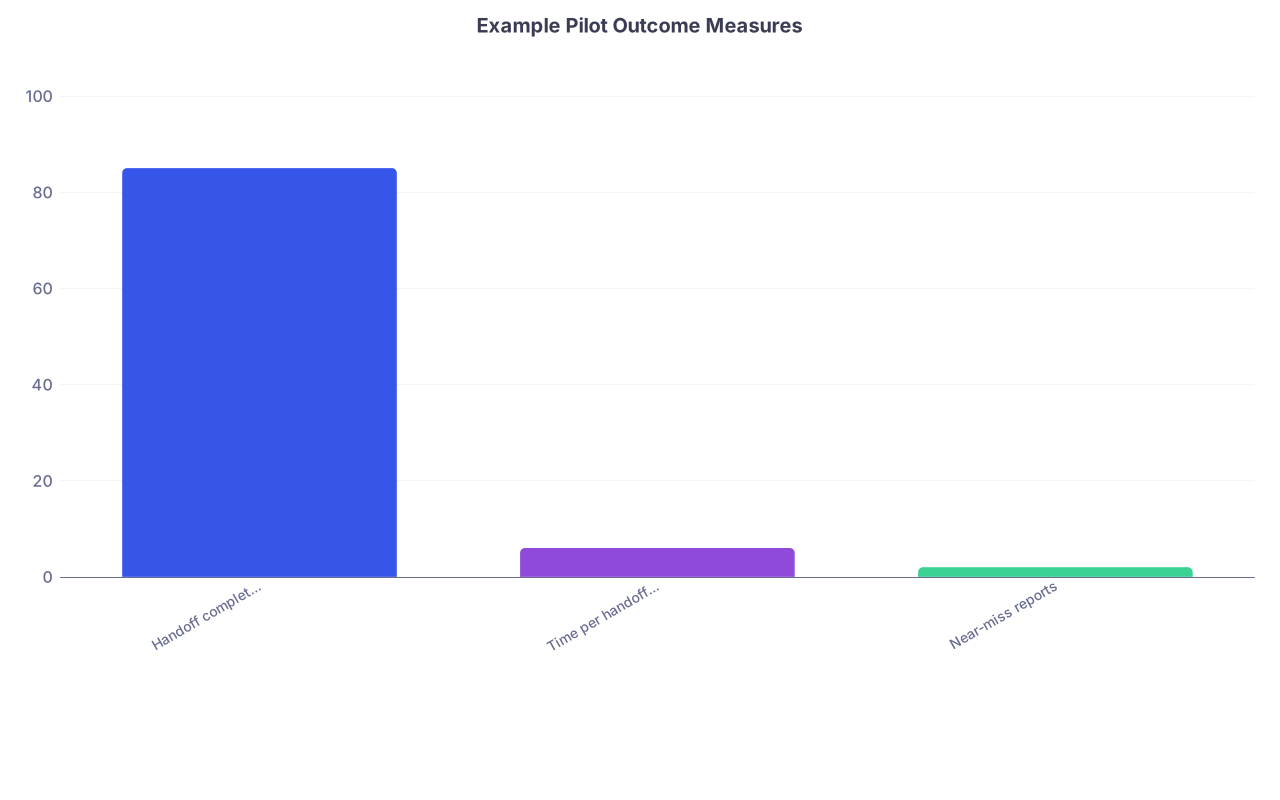
| Category | Value |
|---|---|
| Handoff completeness | 85 |
| Time per handoff (min) | 6 |
| Near-miss reports | 2 |
(Here, for instance, you would compare completeness pre- vs post-pilot, average time per handoff, and number of near-miss reports.)
C. Define how you will protect people
- Participation voluntary – no resident penalized for opting out.
- No evaluation tied to use or non-use.
- Clear instruction that tool is adjunct to, not replacement for, required EHR documentation during pilot, unless officially integrated.
Spell this out to the PD. They do not want another variable in the evaluation mess.
9. After the Meeting: Follow-Through That Builds Your Reputation
What you do in the 2–3 weeks after the meeting matters as much as the pitch.
A. Send a tight follow-up
Within 24 hours:
- Thank them for the time.
- Summarize:
- The problem as they agreed it exists.
- What they said about priority.
- Any next steps they requested (e.g., “I will show this to our CMIO,” “Talk to Dr. X on the QI committee,” “Pause for now.”)
Then do not email them again every 3 days. Respect the timeline they implied.
B. Execute what they asked, not what you wish they said
If they said:
- “Talk to IT first” – you email IT, reference PD’s name, send the one-pager, and CC the PD only if appropriate.
- “Loop in the chief residents” – you do that before touching any more workrooms with demos.
You are showing you can be trusted with small initiatives. That is career capital.
C. Accept a “No” like a professional
Sometimes the answer will be a hard no. Maybe your tool overlaps with something already in the pipeline. Maybe IT has a strict “EHR only” policy. Maybe leadership is traumatized from the last “innovative app” that crashed their network.
If you get a real no:
- Do not argue.
- Ask: “Is there any angle of this problem that would be useful for me to tackle as a QI project within current tools?”
- Thank them for the clarity. Then pivot your energy.
Programs remember residents who can hear no without drama. Those are the ones they trust later with yes.
10. Use This Experience for Your Own Development
Even if the tool never launches, you can convert this into personal and professional growth. If you are smart about it.
- Turn the problem analysis and pilot design into:
- A QI project
- A poster at your specialty’s national meeting
- A scholarly activity line on your CV
- Ask your PD:
- “If not this tool, are there existing institutional projects where you think my interest in digital tools and workflow could be useful?”
- Document:
- Problem statement
- Proposed solution
- Ethical analysis
- Approval path
- Outcome (including “not implemented and why”)
This is what mature innovation looks like in a medical environment: not just building shiny software, but understanding systems, ethics, politics, and the reality of patient care.
Key Takeaways
- Lead with the problem, not the app. Your PD cares about patient safety, accreditation, and resident workload – not your startup dreams.
- Show you understand ethics and governance. Be explicit about data, conflicts of interest, and the need for IT/compliance review.
- Ask for a small, structured pilot. Limited scope, measurable outcomes, clear guardrails – and accept “no” or “not now” without burning bridges.