
What do you do when the person with the loudest voice in your OR is the one who does not have privileges, no patient relationship, and is there to sell something?
The Quiet Reality: Tech Reps Often Know More About the Device Than You Do
Let’s be honest. In a lot of ORs, the device rep is the only one who actually knows:
- Where the trays are
- How the tower turns on
- Which screw length goes with which plate
- What sequence of clicks on the console gets you out of an error message
So what happens? People default to the rep.
You hear it all the time:
“Just ask the rep which size they usually use.”
“Let’s see what [rep name] recommends.”
“Can you walk us through the steps again?”
On paper, the rep is there to “support” the case. In reality, in some rooms, they are:
- Telling the circulating nurse what to open
- Directing the scrub on which implant to load
- Advising the surgeon on where to put a screw or how to position a device
- Prompting steps during a new or complex procedure
That’s when you’re crossing the line from support to “basically running the OR.”
And if you’re the junior resident, fellow, or even early attending standing there thinking:
“This feels wrong, but I do not want to blow up the case or humiliate anyone” — this is for you.
Step One: Nail Down the Lines You Will Not Let Be Crossed
Before you walk into the OR, you need your own internal red lines. Otherwise you’ll get steamrolled by “this is how we always do it here.”
Here’s the ethical baseline that should not be negotiable:
The device rep must not:
- Touch the patient
- Handle sterile instruments or implants
- Make clinical decisions (indications, approach, anatomy-based choices)
- Override or pressure the surgeon’s judgment
The surgeon of record:
- Owns the procedure
- Owns the intraoperative decision-making
- Owns the responsibility if something goes wrong
The rest of the team:
- Can ask the rep for technical product info (“what sizes are available?”, “what’s the torque limit?”)
- Should not offload core clinical decision-making to the rep
That’s the principle-level stuff. But you need concrete phrases and actions in the moment.
What To Do In the Room: Scripts and Moves You Can Use Right Now
Let’s walk through actual scenarios. Because this is where people freeze.
Scenario 1: The Rep Is Directing the Scrub and Circulator
You hear:
“Open the 60 mm screw.”
“You’ll need tray B and C next.”
“No, use the other driver.”
If you do nothing, the rep is functionally controlling instrumentation.
If you’re a resident or fellow, here’s how you intervene without blowing things up:
Calm, neutral, direct:
“Let’s have all instructions go through the surgeon or scrub, not the rep.”
Then immediately redirect:
“[Scrub name], can you confirm which screw size we’re using next with Dr. X?”
If the rep keeps directing:
“[Rep name], we appreciate your support. Please limit guidance to answering questions we ask you; the team will give the directions.”
If you’re the attending, drop the euphemisms:
“Team, do not take instructions from the rep. If you’re unsure, ask me.”
You say it once clearly, people adjust. If they don’t, that’s not a misunderstanding. That’s a culture problem.
Scenario 2: The Rep Is Advising on Clinical Choices
This is the big one.
You hear:
“For this fracture pattern, you should probably use the longer plate.”
“I wouldn’t put that screw there — you’ll hit the nerve.”
“You should really add another anchor here; that’s what most surgeons do.”
The moment the rep starts talking about what you should do to this patient, they’re edging into practicing medicine without a license.
As a trainee, your move is to re-center the decision on the surgeon:
“Let’s confirm with Dr. X: for this pattern, are you preferring the longer plate or the shorter one?”
Or:
“Dr. X, [rep name] is suggesting a longer plate — what’s your take for this particular patient?”
You’re not arguing the rep. You’re dragging the decision back into the surgeon’s lap where it belongs. In front of everyone.
If you’re the attending, your line should be clear:
“Clinical decisions are made by the surgical team. [Rep name], please keep your input to technical product details.”
If they keep going, you escalate the firmness:
“This is bordering on clinical advice. I’m not comfortable with that. Stay in the technical lane.”
You will feel like a jerk the first time you say this. You’re not. You’re protecting your patient and your own license.
Scenario 3: New Device, First Few Cases, Rep Is Doing a Verbal Play-by-Play
This is the gray zone where things slip. New navigation system. New robotic platform. New plating system. The surgeon’s done the company’s course, watched the videos, maybe done a lab. But in reality, this is case 2 or 3.
The rep is standing at the screen:
“Okay, now you’re going to select the ‘Align’ option.
Next you’ll rotate the view.
Now you want to dock here, then confirm.”
This is where people say, “Well they know the system better, so it’s fine.” No. This is exactly where you need structured guardrails.
Here’s the approach that works without killing innovation:
Before the case (this is key), you or the attending explicitly set boundaries aloud:
- “You’re here for console/software troubleshooting and product questions.”
- “Do not give us clinical guidance. If you think there’s a technical issue that could affect safety, flag it to me directly, not to the whole room.”
During the case, channel everything through the surgeon:
- Instead of the rep saying “Now press X,” they answer when asked:
“Doctor, the ‘Align’ function is under this tab.” - You avoid a continuous narration running the case.
- Instead of the rep saying “Now press X,” they answer when asked:
If you’re the resident and you see this drifting into “Simon Says” from the rep, you can quietly prompt correction:
To the attending, low voice, neutral:
“Do you want to have [rep name] wait for specific questions rather than walk us through every step?”
You’re giving the attending an easy out to take control back without being confrontational.
Who Actually Controls This? Hint: It’s Not You Alone, But You’re Not Powerless
Hospitals do not just wing this. Or at least they shouldn’t. Most places have explicit policies on vendor presence in procedural areas, even if nobody reads them.
Typically:
- Reps are credentialed, signed in, badged, and logged for each case.
- They’re restricted to technical assistance related to their products.
- They’re explicitly forbidden from direct patient contact or independent clinical roles.
Yet day-to-day culture often ignores this. Why?
Because people like convenience. And surgeons like having someone who knows the hardware cold.
Your leverage points:
Know your hospital’s actual policy.
Ask perioperative leadership or your PD for the written guideline on vendor presence in the OR. Do this once. Keep a copy.Use policy, not personal preference, when you push back.
Instead of, “I don’t like this,” say:
“This doesn’t match our hospital’s vendor policy — reps are limited to technical information, not directing instrumentation or clinical steps.”Loop in the right people after, not during, the meltdown.
If you see repeat patterns of reps running rooms:- Talk to your attending first. “I’m concerned about how much of that case was being directed by the rep. Are you okay if I flag this upward as a systems issue?”
- Then perioperative leadership, risk management, or your ethics committee if needed.
No, you don’t file incident reports on every mildly overstepping rep. But if you have someone who is habitually in a quasi-clinical role? That’s not a “vibe.” That’s liability.
The Hidden Pressure: When Your Attending Likes It This Way
Here’s the rough scenario:
You’re a PGY-3 on ortho or neurosurgery. Your attending:
- Loves one company’s system.
- Is openly dependent on the rep — calls them into pre-op, debriefs with them post-op.
- Says in front of the team, “I don’t even need to think anymore, [rep name] will just tell us what to open.”
You know this is gross. But this is the person writing your eval.
Your job is not to blow up your career on principle in one day. Your job is to:
- Protect the patient as much as you can in real time.
- Document patterns mentally.
- Escalate strategically, not impulsively.
What you can do in the room:
- Re-direct instructions: “Let’s confirm that with Dr. X.”
- Ask educational questions that spotlight the real decision-maker:
- “Dr. X, when would you not choose this configuration for a case like this?”
- That subtly frames that the logic should be coming from the surgeon, not from the rep’s sales script.
What you do outside the room:
- Talk confidentially with your PD or trusted faculty:
“I’m seeing a pattern of tech reps playing a really active role in certain cases, to the point they’re directing the flow. I’m worried about the ethics and medico-legal side of that. How do you recommend I handle this as a trainee?”
If your PD is halfway decent, they’ve heard this before. They might already be fighting this battle.
Where Innovation and Ethics Collide: Yes, You Need the Rep… to a Point
The reality: emerging tech in the OR often requires rep presence early:
- First generation robotics
- Custom implants
- Complex navigation
- Novel energy devices
Early in the adoption curve, nobody on your team fully understands the nuances. The rep has watched dozens of cases elsewhere. You want that brain in the room.
Fine. But structure it.
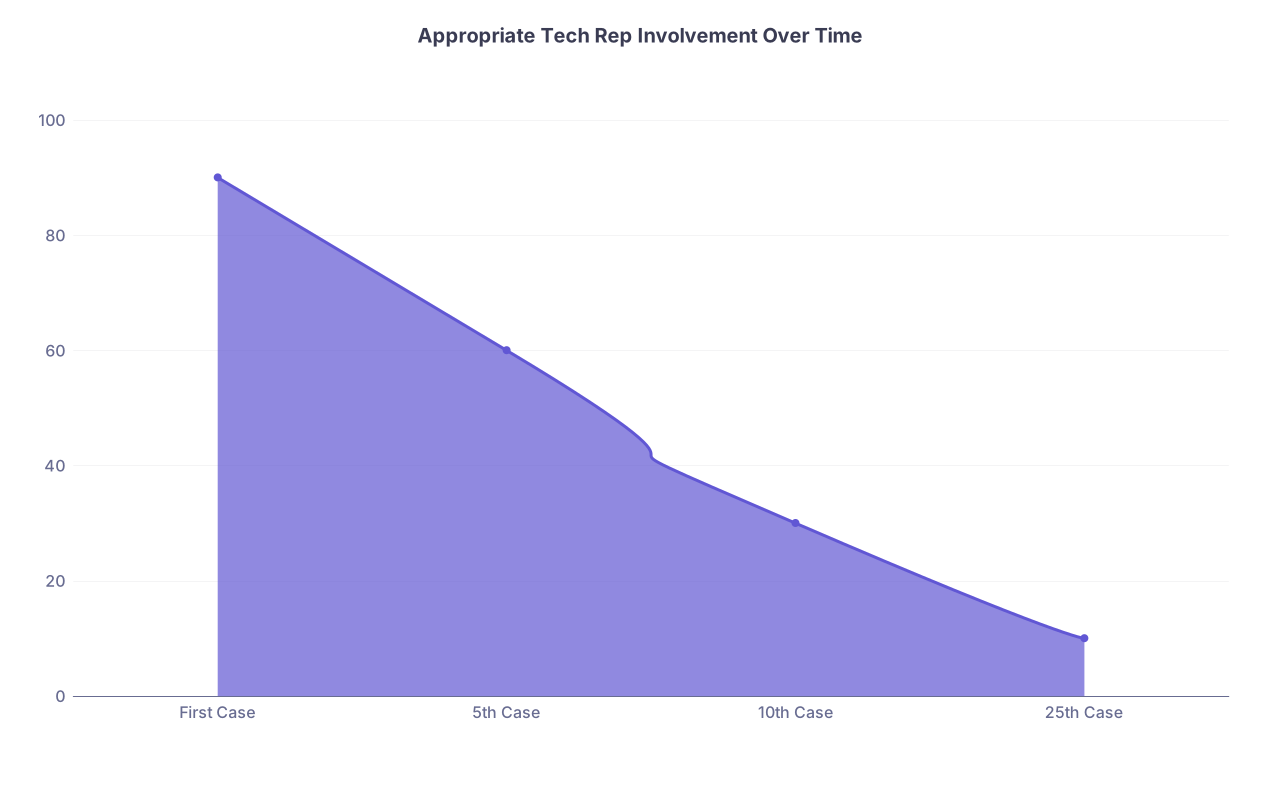
| Category | Value |
|---|---|
| First Case | 90 |
| 5th Case | 60 |
| 10th Case | 30 |
| 25th Case | 10 |
Interpretation: early on, you lean heavier on the rep for technical help — but this should taper as your team gains experience. If the rep is still effectively “driving” the case at case 25? That’s not innovation; that’s dependency.
As you move along that curve, your questions should change too:
- Early: “Where in the software do I see X?”
- Later: “We prefer this workflow — can the platform accommodate that?”
Notice the shift: from “teach me what to do” to “help me use this tool the way we practice medicine.”
Personal Development: How You Use This Tension to Grow Instead of Check Out
You can treat this whole “rep running the room” thing as a headache. Or you can use it as a training ground for three core professional muscles:
Boundary-setting under hierarchy.
You practice how to speak up without grandstanding. One firm sentence. Then redirect. No lecture.Ownership mentality.
Even as a resident, you start thinking like the person who will sign the consent and the operative note someday.
Ask yourself during every case: “If there was a complication here and plaintiff’s attorney pulled the video of this case, would I be comfortable with what the rep was doing and saying?”Critical thinking about technology.
Lots of surgeons slide into using devices the way the company wants them used, not the way that matches their own philosophy. You do not want to be that surgeon.
A simple practice: after a vendor-heavy case, jot down 3 things:
- What was actually helpful from the rep?
- What was borderline or over-the-line?
- How would I run that same case if the rep didn’t show?
You’re training yourself to not outsource your brain.
Practical Moves You Can Implement This Week
Let’s put this into a short list you can literally steal:
Before any rep-heavy case, ask the attending:
“What role do you want the rep to have in the room today?”
That alone makes people intentional instead of defaulting to chaos.When a rep starts giving instructions, say:
“Let’s have all directions go from the surgeon to the team. [Rep name], we’ll ask you when we need product details.”When a rep drifts into clinical opinion, re-anchor:
“Dr. X, what’s your threshold for adding that additional implant in this situation?”If you’re deeply uneasy, and things are really out of control (rep physically handling instruments, etc.), you can say to the circulating nurse quietly:
“This seems outside our normal policy for vendor involvement. Can we clarify with charge/OR leadership after this case?”
You’re not making a dramatic stand. You’re applying brakes.
When Things Really Cross the Line: Documenting and Escalating
If you see:
- The rep touching sterile instruments or the patient
- The rep logging into hospital systems under someone else’s credentials
- The rep making unilateral decisions about implant selection or configuration without the surgeon explicitly agreeing
That’s not just “bad vibes.” That’s a compliance and patient safety problem.
You have three steps:
- Immediately prioritize patient safety in the moment (do not start a war mid-case unless it’s catastrophic).
- As soon as possible afterward, write down exactly what you observed: date, time, case type, who was present, what was said/done.
- Talk to:
- Your attending (if they’re not the problem), or
- Your PD/program leadership, and/or
- Perioperative leadership or risk management, depending on your local culture.
You can say it plainly:
“I’m worried that in [specific case], the rep was functioning beyond what’s allowed by policy and may have been in a clinical role.”
Let administrators fight the battle with the vendor. That’s their job. Yours is to be clear and factual.

| Step | Description |
|---|---|
| Step 1 | Notice rep overstepping |
| Step 2 | Protect patient and stabilize situation |
| Step 3 | Redirect rep and team verbally |
| Step 4 | Debrief with attending |
| Step 5 | Document specifics |
| Step 6 | Discuss with PD or periop leadership |
| Step 7 | Refer to vendor policy and risk team |
| Step 8 | Immediate safety risk? |
| Step 9 | Pattern or one time? |
| Context | Acceptable Role | Problematic Role |
|---|---|---|
| Product info | Describes sizes, options, compatibility | Recommends clinical choice |
| Software/console | Explains functions when asked | Narrates every step unprompted |
| Instrumentation | Points out tray contents | Directs scrub/circulator what to open |
| Clinical decisions | None | Advises on technique or indications |

FAQ (Exactly 4 Questions)
1. What if my attending explicitly asks the rep for clinical advice in front of everyone?
You’re not going to fix that dynamic in the moment as a trainee. What you can do is reframe questions when you speak: aim them at the attending, not the rep. After the case, you can pull the attending aside and say, “I’m trying to understand your decision-making — could you walk me through how you think about when to choose that option, separately from what the company recommends?” That gently separates the surgeon’s reasoning from the sales pitch.
2. Is it ever okay for the rep to be scrubbed in?
In almost all hospitals, no. Scrubbing a rep is a bright red line for both infection control and liability. If your institution has some “special exception” situation, it should be explicitly approved and documented, and even then, the rep must not be performing clinical tasks. If you see a scrubbed rep manipulating instruments on the field, expect risk management to have a stroke if anything goes wrong.
3. I’m a med student. Do I have any business speaking up about this?
You do, but you have to be tactical. In the room, your influence is limited. Focus on questions that point authority back to the team: “Dr. X, could you explain why you’re choosing this implant configuration for this fracture?” Outside the room, talk to your resident or clerkship director: “I noticed the rep was very actively involved; how does that fit with our policy?” You’re flagging the issue without pretending you run the place.
4. How do I avoid becoming the attending who relies on reps for every decision?
Start now. Every time you use a new device, force yourself to understand the why behind each step, not just the “this is how the company taught it.” Read independent data when it exists. Ask your attendings to explain their decision-making separate from marketing language. And in cases, whenever you’re tempted to ask the rep “What should we do?”, redirect internally: “What do I think we should do for this patient, and what product info do I need to execute that safely?” That habit is what keeps you in charge later.
Two core points to keep in your head the next time you walk into a rep-heavy OR:
- The rep can support the case, but they cannot own it — clinical judgment stays with the team that holds the license and the consent.
- You do not need to make a scene to fix this; one or two clear, firm, well-placed sentences in the room, plus smart debriefing afterward, will shift culture much more than silent discomfort ever will.