

The default advice about residents and early‑phase trials is too cautious—and often wrong.
You’ve probably heard some version of: “Wait until fellowship” or “Phase I is just pharma busywork.” That’s lazy thinking. Joining an early-phase clinical trial team as a resident can be one of the fastest ways to level up your clinical judgment, your CV, and your understanding of medical ethics—if you do it intentionally.
Here’s the real question you should be asking: Does joining an early‑phase trial team fit your goals, your bandwidth, and your ethical comfort zone right now? Let’s break that down.
What “Early-Phase Clinical Trials” Really Mean For You
Early‑phase trials (Phase I and early Phase II) are not just “more research.” They’re a different kind of medicine.
Phase I: safety, dose finding, pharmacokinetics.
Early Phase II: early signals of efficacy, still a lot of uncertainty.
You’re not just adding a checkbox to a protocol. You’re stepping into a world where:
- The primary endpoint might be toxicity, not cure.
- You’re consenting patients for treatments with real risks and unknown benefit.
- The line between “physician” and “investigator” gets blurry fast.
If you join a Phase I oncology team, for example, you might:
- Round on patients getting first‑in‑human drugs.
- Manage unexpected toxicities that aren’t in any UpToDate chapter yet.
- Sit in meetings where decisions are made about dose escalation based on half a dozen patients.
That’s very different from retrospective chart reviews or QI projects.
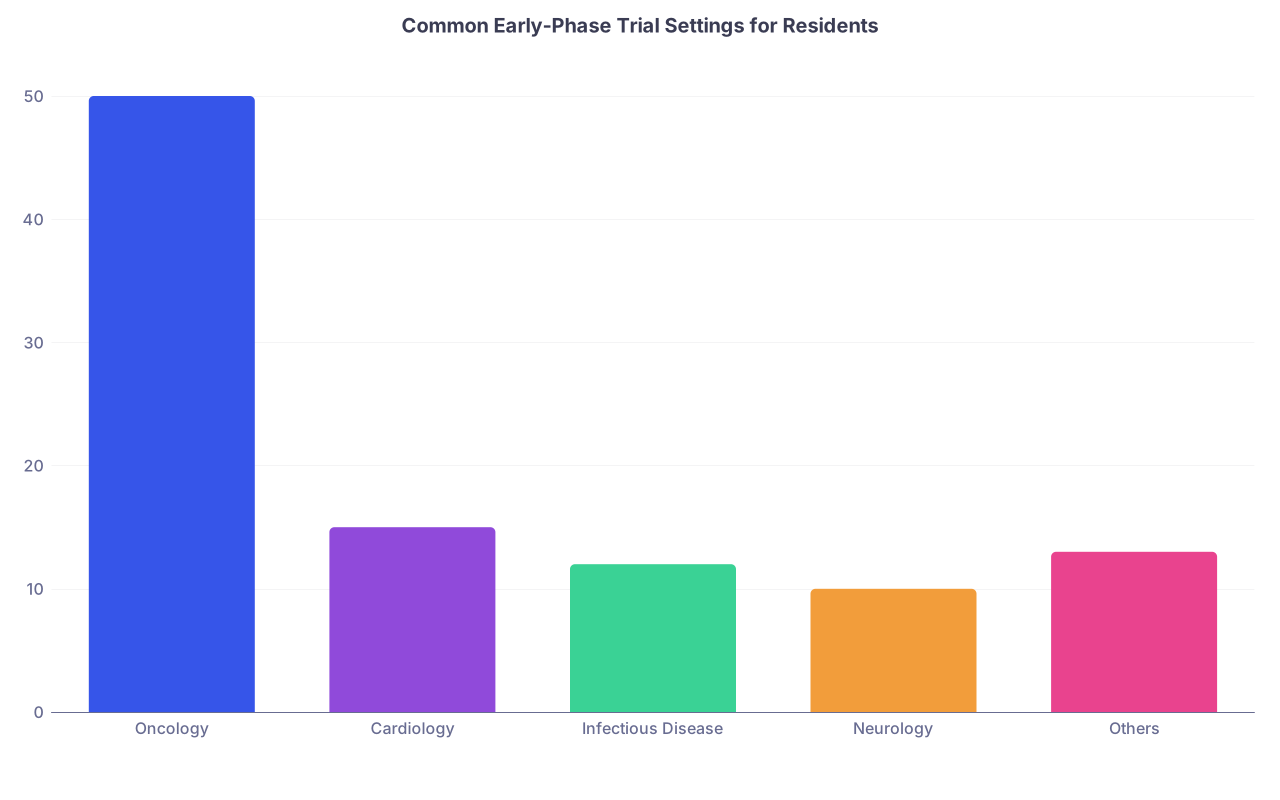
| Category | Value |
|---|---|
| Oncology | 50 |
| Cardiology | 15 |
| Infectious Disease | 12 |
| Neurology | 10 |
| Others | 13 |
If you want a career anywhere near academic medicine, drug development, device innovation, or even just being “the doc who understands new therapies,” this is prime territory.
The Upside: Why Joining Early-Phase Trials Can Be a Power Move
Let me be blunt: most residents’ CVs look the same. A couple of case reports, maybe a small retrospective study, a poster or two. Useful, but generic.
Working meaningfully on an early‑phase trial can set you apart.
1. You learn how new therapies actually get to patients
You stop thinking of “the literature” as magical tablets from NEJM and start seeing the machinery.
You see:
- How dose-escalation decisions are made when n=3.
- How safety monitoring boards think.
- How slow, messy, and human the process is.
When you’re later prescribing some fancy biologic, you’ll remember the first-in-human patients who took the real hit. That changes how seriously you take adverse events, counseling, and long‑term monitoring.
2. You build high‑value skills, fast
Stuff you actually use later:
- Complex consenting: Explaining unknown risks without sugarcoating, while still giving hope. If you can do an early‑phase consent properly, standard consents feel trivial.
- Risk–benefit reasoning under uncertainty: There’s no robust Phase III data. You’re making calls with fragments of information. That’s real medicine.
- Data literacy beyond p‑values: You see interim analyses, pharmacokinetic curves, safety signals. You learn to ask: “Is this noise or signal?”
And yes, it looks great on applications—especially for:
- Heme/Onc
- Cards (device/EP, structural)
- Neuro (especially movement disorders, epilepsy, stroke)
- Critical care / pulmonary (innovative therapies, ECMO adjuncts, etc.)

3. You get access—to mentors, networks, and future opportunities
Trial teams are full of the people who actually move the field:
- PI who sits on national guideline committees
- Pharmacists who design dosing strategies
- Biostatisticians who know what data actually matters
- Industry partners, sometimes, who will be funding your future career moves whether you like it or not
If you contribute real work—timely notes, thoughtful questions, reliability—you become “one of ours” to that group. That’s how you end up on:
- Multi-center protocols
- High-impact manuscripts
- Letters that say more than “hard‑working and pleasant to work with”
4. You see medical ethics in 4K, not in a textbook
Early‑phase work forces you to confront uncomfortable realities:
- Are we offering hope or false hope?
- How do we avoid therapeutic misconception (patients thinking this is standard care)?
- Are we enrolling this patient because it’s best for them, or because the study’s behind on accrual?
Seeing those tensions up close, and finding your own boundaries, is huge for your development as a physician.
The Downside: When Joining Is a Bad Idea
Now the part people like to gloss over. There are very real reasons not to jump in.
1. Your bandwidth may not support it
If any of this is true, slow down:
- You’re barely passing your in‑training exam.
- You’re routinely staying 2–3 hours late to finish notes.
- You’re on a malignant service with no schedule flexibility.
Early‑phase trial work isn’t something you “squeeze in when you can.” Patients are on rigid schedules. PK draws must happen on time. Protocol deviations have consequences.
If you can’t reliably show up or respond, you’re not just dropping a hobby—you’re compromising patient safety and generating bad data.

| Step | Description |
|---|---|
| Step 1 | Interested in early phase trials |
| Step 2 | Focus on core training |
| Step 3 | Start with low intensity research |
| Step 4 | Define goals with mentor |
| Step 5 | Join trial team strategically |
| Step 6 | Enough time and energy? |
| Step 7 | Supportive program culture? |
| Step 8 | Have clear goals? |
2. Program culture matters—a lot
Some programs:
- Protect research time
- Value IRB work, regulatory training, and teaching about trials
- Have coordinators who do the logistics so residents can focus on clinical and ethical issues
Others:
- Treat research as “extra work” you do at 2 am.
- Expect you to cover for clinical gaps because “patient care comes first.”
- Count your trial time as “elective” but then pull you back to the wards every time someone is out sick.
In the second environment, early-phase work will burn you out fast and won’t be high‑quality.
3. Ethical dissonance can be real
If you’re early in training and still forming your ethical framework, jumping into high‑stakes consent discussions can be destabilizing.
You might see:
- Patients with no good standard options being steered into a trial that’s more about data than benefit.
- Family members clearly misunderstanding what “experimental” means.
- Subtle (or not subtle) pressure to “close” consents to meet accrual targets.
If you don’t have strong mentors who actually invite hard conversations, not just “sign here, it’s all in the consent,” you can come out more cynical than educated.
How to Decide If You, Right Now, Should Join
Let’s get specific. Use this like a quick triage.
Ask yourself 4 blunt questions
Do I have at least 4–6 hours a week I can protect consistently for months?
If no, don’t join a core trial team yet. Shadow or do a side project instead.Is there at least one attending I trust who is deeply involved in early‑phase work?
If no, be wary of being the “workhorse” without guidance.Am I okay dealing with uncertainty and sometimes not knowing whether I helped or harmed?
If that keeps you up at night, start with later‑phase or observational work.Does this fit my likely career direction?
If you’re 90% sure you’re going into full‑time outpatient primary care with no research, the ROI is lower. Not zero, but lower.
| Situation | Join Now? |
|---|---|
| PGY-2 planning heme/onc fellowship, light elective block, strong mentor | Strong Yes |
| Intern barely keeping up clinically, no protected time | No |
| PGY-3 with research elective, interested in innovation but undecided on subspecialty | Conditional Yes |
| Resident in community program with no early-phase infrastructure | Probably No |
| Resident with solid research background looking to pivot to clinical trials | Yes |
If You Join, How to Do It Right (Clinically and Ethically)
Suppose you’ve decided to say yes. Don’t just “show up and help.” That’s how you end up doing scut and learning nothing.
Step 1: Define your role up front
Ask very specific questions:
- “What exactly do you expect from me weekly?”
- “Which parts are resident‑appropriate—consents, toxicity management, note writing, data review?”
- “What will I own versus just observe?”
Push for responsibilities that grow you:
- Being the primary clinician for trial patients on your service (with supervision).
- Leading or co‑leading part of the consent process (again, supervised).
- Presenting patients at dose‑escalation or safety meetings.
Step 2: Protect training first, then research
You’re still a resident. Your actual job is to become a competent independent physician.
Watch for these red flags:
- You’re missing core didactics repeatedly for research meetings.
- You’re less comfortable managing bread‑and‑butter conditions because you’ve offloaded them to co-residents.
- Attendings are hinting that your clinical performance is slipping.
If that starts happening, pull back. You can always ramp back up later. There’s no glory in being the trial expert who can’t manage a straightforward CHF admission.
Step 3: Take ethics seriously, not performatively
Don’t just click through the IRB training modules and call it “ethics.”
In the real world:
- Before a consent, ask: “What’s this patient’s actual alternative if they decline? How was that framed?”
- In conference, ask: “Would I recommend this to a family member in the same situation?”
- When you see pressure (even subtle) on patients, bring it up privately with a mentor you trust.
If your questions consistently get brushed off—“that’s just how this works”—you’ve learned something important about that team. Maybe too important.
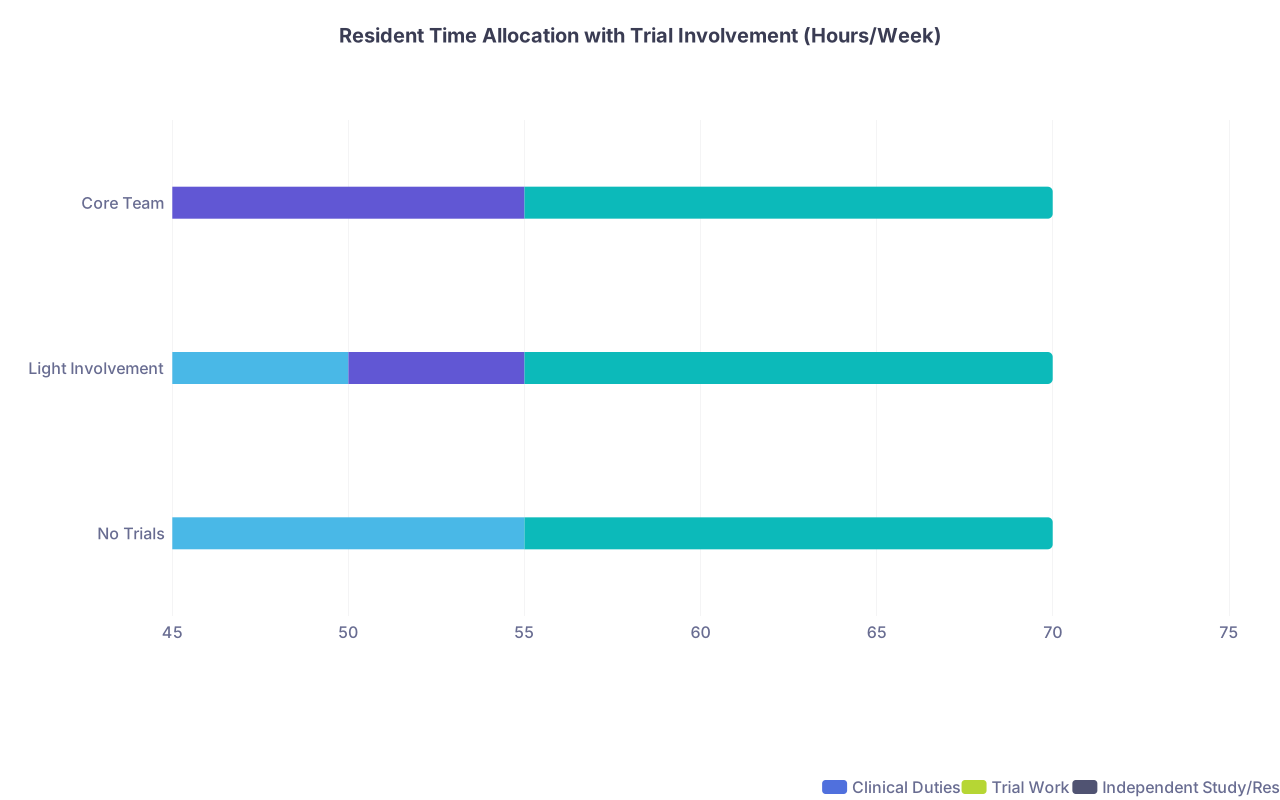
| Category | Clinical Duties | Trial Work | Independent Study/Rest |
|---|---|---|---|
| No Trials | 55 | 0 | 15 |
| Light Involvement | 50 | 5 | 15 |
| Core Team | 45 | 10 | 15 |
Step 4: Make it count academically
If you’re going to grind, get something tangible out of it.
Reasonable asks (discussed upfront):
- Co‑authorship on a paper if you contribute substantively to recruitment, data quality, or patient management.
- Lead authorship on a sub‑analysis, methods paper, or case series from trial experiences.
- Presenting trial outcomes or a related topic at grand rounds or a regional meeting.
You’re not being “transactional.” You’re recognizing that residents’ time is limited and valuable. Good mentors get that.

What This Means For Your Personal Development
Early‑phase work accelerates certain parts of your growth:
- You get comfortable saying “I don’t know, and neither does anyone else yet.”
- You learn to sit with watching outcomes you can’t fully predict or control.
- You see firsthand how system pressures (money, prestige, publication) intersect with patient care.
It’s not for everyone. Some residents come out energized, with a clear sense they want a career in trials. Others come out thinking, “I want to do clean, guideline‑driven medicine and let other people handle the experimental edge.”
Both are valid outcomes. The mistake is drifting into this world by accident.

Quick Reality Check
So, should you join an early-phase clinical trial team as a resident?
My honest, non‑hedged answer:
- Yes, if you have protected time, a trustworthy mentor, real interest in innovation, and enough clinical stability not to drown.
- No, if you’re doing it just for the CV line, your program doesn’t support it, or you’re already scraping by clinically or emotionally.
It’s not a prestige badge. It’s a serious commitment at the messy front edge of medicine. Treat it that way.


