
You’re in a dark call room, midnight, scrolling through a new protocol your attending is excited about. “Cutting‑edge,” “first‑in‑human,” “this could change the standard of care.” Meanwhile, your brain is just screaming one thing: What if we hurt someone doing this? What if I’m the one who signs the order?
Everyone else seems… weirdly comfortable. People toss around phrases like “acceptable risk” and “adverse event profile” like they’re talking about the weather. You’re thinking about someone’s actual mother, brother, kid, lying in that bed while you “innovate” on them.
And there’s this ugly, guilty thought underneath it all: If I’m this scared, maybe I’m not cut out for anything involving experimental treatments. Maybe I’m going to freeze. Or worse, say yes to something and regret it forever.
Let’s go straight at that fear.
The Fear Behind “Experimental” — And Why It Feels So Awful
You’re not actually afraid of “innovation.” You’re afraid of being the person who green‑lights harm.
Not theoretical harm. The kind that shows up in morbidity and mortality slides with your initials in the corner.
What’s running in your head looks something like this:
- “What if the drug causes a catastrophic reaction and I was the one who clicked ‘sign’?”
- “What if the data later shows this was harmful, and I was complicit?”
- “What if the patient’s family asks, ‘Why did you try this on them?’ and I have no good answer?”
- “What if I’m pressured to push something I’m not comfortable with and I cave?”
You’re not wrong to be worried. I’ve seen residents casually say, “Well, they’re going to die anyway, might as well try it,” and I could feel my stomach turn. That kind of thinking is lazy and dangerous.
But here’s the thing nobody tells you clearly: ethical fear is not a red flag that you’re unfit for medicine. It’s a sign you actually understand the stakes. The people who scare me are the ones who don’t feel that fear.
The trick isn’t to get rid of the fear. It’s to channel it into a structured way of deciding what’s okay and what’s not.
What “Experimental” Actually Means (And What It Doesn’t)
A lot of the anxiety comes from one word being used for ten different things.
“Experimental treatment” in a Netflix documentary about unethical research is not the same as an “investigational therapy” in a tightly monitored Phase 3 trial.
Let me break this down in a way that might calm your brain a bit:
| Type | How Controlled? | Typical Safeguards |
|---|---|---|
| Off-label use of approved drug | Moderate | Standard of care + MD judgment |
| Phase 3 clinical trial | High | IRB, DSMB, strict protocol |
| Phase 1/2 first-in-human | Very high oversight | IRB, DSMB, intensive monitoring |
| Compassionate/expanded access | Case-by-case | FDA/authority approval, ethics review |
| Wild, N=1 heroics | Low | Often… not enough |
You’ll see all of these mashed together as “experimental” in casual conversation. They are not the same.
Phase 3 trial at a major academic center with a Data Safety Monitoring Board? Every possible bad outcome is being tracked, reported, audited. You’re not lone‑wolf improvising on a human being. You’re operating inside a brick wall of oversight.
The thing your attending wants to try that’s “not in the guidelines but I saw a case report…”? That’s where your fear is probably more justified.
If you can sort which kind of experimental you’re dealing with, your brain goes from “all undefined risk = panicky” to “okay, specific category, specific questions I need to ask.”
Your Ethical Backbone: How to Decide If You Can Live With It
You can’t control everything. You can control your own line in the sand.
Here’s the uncomfortable truth: nobody will hand you a pre‑printed answer key for “this is always fine, this is always wrong.” Even in ethics conference, they kind of… hand‑wave.
So you need a personal checklist. Not a perfect one. A good enough to keep me from hating myself later one.
Here’s a framework I’ve seen actually help people sleep at night:
1. Do I really understand what’s known and unknown?
If you’re going to be part of giving something experimental, you need a bare minimum:
- What’s the goal? Survival? Symptom relief? Biomarker change?
- What’s already known from earlier phases/other cases?
- What are the realistic possible harms, not just the sanitized “grade 3 toxicity” list?
If you can’t explain it in plain language to a patient without sounding like you’re bullshitting, that’s a problem. You shouldn’t be more confident than your knowledge.
2. Is this truly the patient’s decision, or are we dressing up our curiosity?
Ask yourself, brutally:
- If this weren’t scientifically interesting, would we still be recommending it?
- Is there a reasonable standard option that we’re downplaying because this one is “cooler”?
- Are we subtly using their desperation to hook them?
If the thought “this will look great in a paper” crosses anyone’s lips, your antenna should go all the way up.
3. Is consent actually informed, or just signed?
I’ve watched “consent” done like this: someone rushes in, says “We have a new option that might help, there are risks, but we’ll be watching you very closely,” and a terrified patient signs.
That’s not informed consent. That’s paperwork.
Try this private test for yourself:
If you pulled the family aside and asked, “Tell me in your own words what you think we’re doing and why,” would they:
- Understand this is not standard care?
- Get that there is real, non‑trivial uncertainty?
- Know they can say no without losing our support?
If not, the process is broken, even if the forms are signed. And you’re allowed to be uneasy about that. In fact, you should be.
4. If this goes badly, can I defend my role without lying to myself?
Not to a committee. To yourself. In a dark room. At 3 a.m.
Can you say, “Given what we knew, and the alternatives, this was a reasonable thing to offer. The patient understood it wasn’t guaranteed to help. I wasn’t hiding anything from them or from myself.”
If the honest answer is, “I pushed this because the team wanted it and I didn’t want to look weak,” that will eat you alive.
Your job is not to be fearless. Your job is to be the person in the room who can say, “We’re crossing into territory I’m not ethically okay with,” and at least slow things down.
What To Do When You’re The Only One Worried
This is the worst‑case scenario in your head, right? Everyone pumped about a trial, the PI is a local legend, the chief resident is calling it “an incredible opportunity,” and you’re the one thinking, “Is this… actually okay?”
You’re terrified of looking naïve. Or worse, “anti‑science.”
Here’s how you can handle it without tanking your reputation.
Step 1: Ask “dumb” questions early and privately
Corner your senior or attending before rounds or conferences if you can.
“Can I ask something blunt? I’m having trouble understanding why we think the potential benefit outweighs the risks here. Could you walk me through your thinking?”
You’re not accusing. You’re making them explain the mental math. A good supervisor will welcome that. A bad one will brush you off. That tells you a lot.
Step 2: Use the patient as the anchor
If something feels rushed or too rosy, say things like:
“I just want to make sure we’re clear with the patient that this isn’t standard of care.”
or
“Would you be okay if I sat with them afterwards to go over what we mean by experimental here?”
You’re not attacking the plan. You’re advocating for clarity.
Step 3: Document your discomfort mentally, and sometimes literally
If you’re in a setting where things consistently feel ethically off, start mentally logging: what happened, what was said, what bothered you.
If you’re really uneasy, you can quietly talk to:
- The study coordinator
- A hospital ethicist
- A trusted attending not involved in the project
Not to blow things up immediately. Just to sanity‑check your perception. You don’t have to handle this in your own head alone.
What Helps Ease The Constant “What If I Harm Someone?” Loop
You can’t completely silence that loop. And you shouldn’t, honestly. But you can make it less paralyzing.
Here’s what I’ve seen actually help anxious, conscientious people like you.
Learn the safety systems, so your brain stops assuming it’s all on you
Part of your fear is this fantasy that you’re a solo operator making wild calls.
Go find out:
- How does your institution’s IRB work?
- What’s a Data Safety Monitoring Board and how often do they review?
- How are adverse events reported and acted on?
Once you see the machinery, you realize: there are layers. Imperfect layers, but layers. You’re not a lone human experimenter.
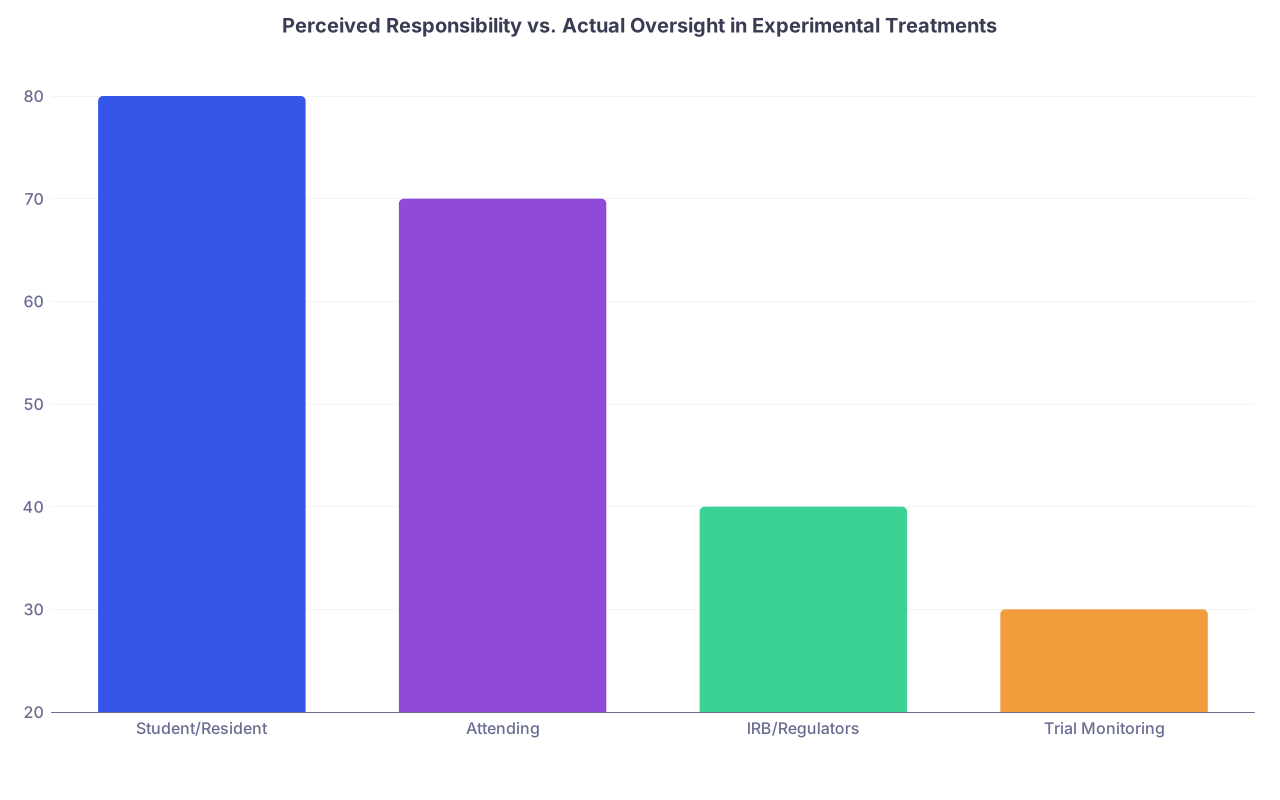
| Category | Value |
|---|---|
| Student/Resident | 80 |
| Attending | 70 |
| IRB/Regulators | 40 |
| Trial Monitoring | 30 |
(That’s how it feels in your head vs. how responsibility is actually distributed.)
Get fluent in saying “I’m not comfortable” without sounding dramatic
You need stock phrases ready, because in the moment, anxiety makes you either go silent or overreact.
Things like:
- “I’m not opposed, but I don’t think I fully understand the risk profile yet. Can we slow down for five minutes?”
- “From a trainee standpoint, I’m feeling out of my depth with this. Could we involve ethics or someone from the trial team to explain more?”
You’re not saying, “You’re unethical.” You’re saying, “I need more to be okay participating.”
Accept that zero risk is impossible — and that’s not your personal failure
Part of the torture is this internal standard of, “If I were really ethical, I’d only agree to things with no chance of harm.”
That world doesn’t exist. Not in medicine.
Standard therapies harm people too. Guideline‑recommended drugs kill patients via rare reactions. Surgeries accepted as routine end in complications.
The question is never, “Can I avoid harm completely?” It’s always, “Is this risk level, given what we know and what we’re trying to achieve, ethically tolerable and transparently shared with the patient?”
If you can’t stomach that question at all, medicine is going to be brutal regardless of innovation.
You Being Worried Is Actually The Point
The people who should be terrified of harming patients with experimental treatments… are exactly the ones who don’t seem worried enough.
You’re the opposite. You’re doing mental M&M before anything even happens.
That can spiral into paralysis, yes. I’ve seen students who avoid oncology, neurology, anything with trials because they just can’t stand the weight of the risk. They box themselves into the narrowest practice to feel “safe,” and still feel uneasy.
But used correctly, your fear becomes a built‑in early warning system. You will notice:
- When consent is rushed
- When optimism is oversold
- When a “maybe this will help” has no realistic mechanism
- When someone’s ego or curiosity is creeping in
And then, you can be the annoying but necessary person who says, “Hang on. Are we being straight with this patient?”
Patients need that person on the team. And frankly, so do other physicians, even if they act like you’re overthinking.
A Quick Reality Check: You Are Not Doing This Alone
You keep imagining the worst: you, signing off on something, patient crashes, and you’re solely to blame.
In reality:
- You can’t order trial drugs as a random trainee on a whim.
- You’re not designing protocols in your spare time and injecting people.
- There are legal, regulatory, and institutional barriers everywhere.
Could a broken culture steamroll over safeguards and still hurt people? Yes. It has happened, historically and recently.
But that’s exactly why people like you need to be in the room. Because you’re the one whose stomach twists when something feels off. That reaction is protective, not pathological.
You don’t have to love every innovation. You don’t have to be the brave pioneer enrolling everyone in first‑in‑human trials. But you also don’t have to opt out of all progress to be ethical.
You need to learn enough, ask enough questions, and build enough backbone so that when you participate, you can live with yourself afterward.

| Step | Description |
|---|---|
| Step 1 | Confronted with experimental option |
| Step 2 | Ask for clarification |
| Step 3 | Express concerns to team |
| Step 4 | Consider ethics consult |
| Step 5 | Slow down and clarify with patient |
| Step 6 | Participate with documentation |
| Step 7 | Do I understand it? |
| Step 8 | Risks vs benefit reasonable? |
| Step 9 | Consent truly informed? |
FAQ: Afraid of Harming Patients with Experimental Treatments
1. What if I refuse to participate in a trial or experimental therapy and my team thinks I’m difficult?
Then you’re difficult. In a good way. You’re allowed to say, “I’m not comfortable being the one to consent or push this, given my current understanding.” You might not always get out of involvement completely, but you can draw lines. And honestly, any environment that punishes basic ethical discomfort is a red flag for you long‑term.
2. How do I know if a trial or new treatment is actually ethical and not just dressed‑up experimentation?
Look at process, not vibes. Is there IRB approval? Is there a clear protocol? Are data safety and stopping rules in place? Is consent robust, with time for questions? Are alternative options presented fairly? If it’s hand‑wavy like “we’re trying something new, just sign here,” that’s not good enough. Ask to see the actual protocol. If they resist, that’s your answer.
3. I’m scared that my curiosity about new science means I secretly value research over patients. Is that a sign I’m unethical?
No. Curiosity is not the problem. The problem is curiosity without brakes. Wanting to be part of something new is normal. The key is whether, when push comes to shove, you’re willing to slow down, be transparent, and accept “no” from a patient without resentment. If you can do that, your curiosity is an asset, not a danger.
4. What if a patient begs for an experimental option and I think it’s more likely to hurt than help?
That’s one of the hardest scenarios. Desperation doesn’t automatically make something ethical to offer. Your role is to be honest: “I hear how much you want another option. Here’s what we realistically know about this one, including the chance it could make things worse. I don’t think I’d be comfortable recommending it as your doctor, but if you still want to explore it, we can talk with the research team together.” You’re not abandoning them; you’re refusing to lie.
5. Could being this anxious about harming patients be a sign I shouldn’t go into an innovation‑heavy field like oncology or critical care?
Not automatically. In fact, those fields desperately need people who don’t treat human beings like data points. If your anxiety completely paralyzes you, that’s something to work on with actual support (therapy, mentorship, supervision), not an automatic disqualification. Plenty of excellent, ethically solid physicians are anxious. The difference is they’ve built tools and support systems so the anxiety informs, not controls, their decisions.
6. What’s one concrete thing I can do right now to feel less helpless about this fear?
Go pull up a real clinical trial consent form from your institution (or a major center online) and read it slowly. Then ask yourself: “If I were the patient, what would I not understand from this?” Tomorrow, ask an attending or research coordinator those questions. You’ll start shifting from vague dread to specific knowledge — and specific knowledge is the only thing that ever actually calms this kind of fear.
Open a blank note or document right now and write one sentence: “My line in the sand is…” Then finish it with the clearest thing you know you’re not okay with — rushed consent, hiding uncertainty, whatever it is. That’s your starting point. You can refine the rest as you learn, but draw that first line today.