
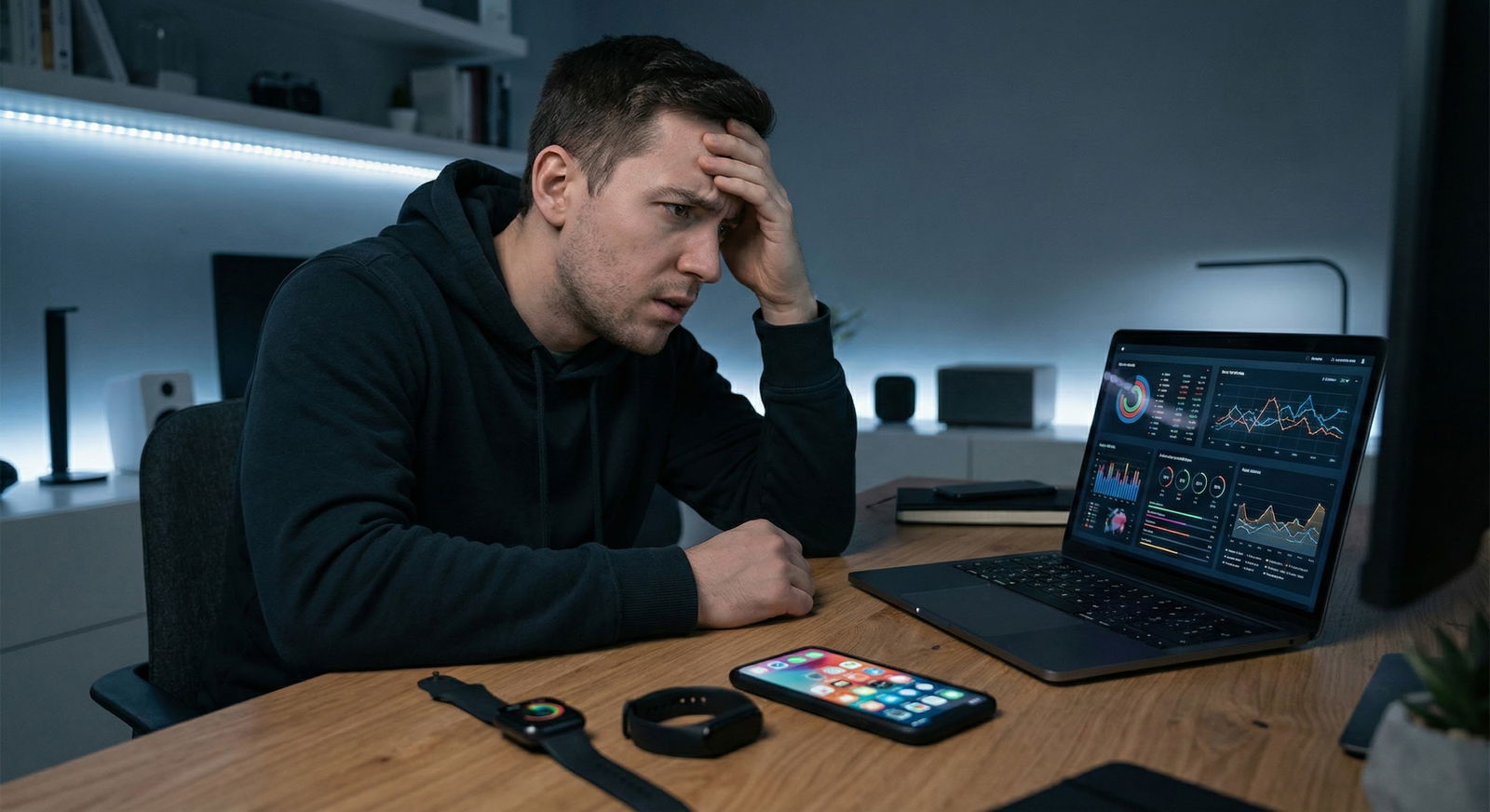
The belief that more health data from wearables always leads to better health decisions is wrong.
In medicine and in your personal life, unfiltered data can be a liability. And right now, consumer wearables are generating far more noise than clarity for a lot of people—patients and clinicians both.
Let me walk through what the evidence actually shows, not what the marketing decks promise.
The Core Myth: Data = Insight = Health
The implied story goes like this:
More sensors → more data → earlier detection → better outcomes.
Nice and linear. Reality is messier:
More sensors → more data → more false alarms → more anxiety → more testing → sometimes harm.
Notice what’s missing in the hype: precision, context, and calibration.
Wearables are good at producing numbers. They’re much worse at telling you which numbers matter, when they’re wrong, and when to ignore them.
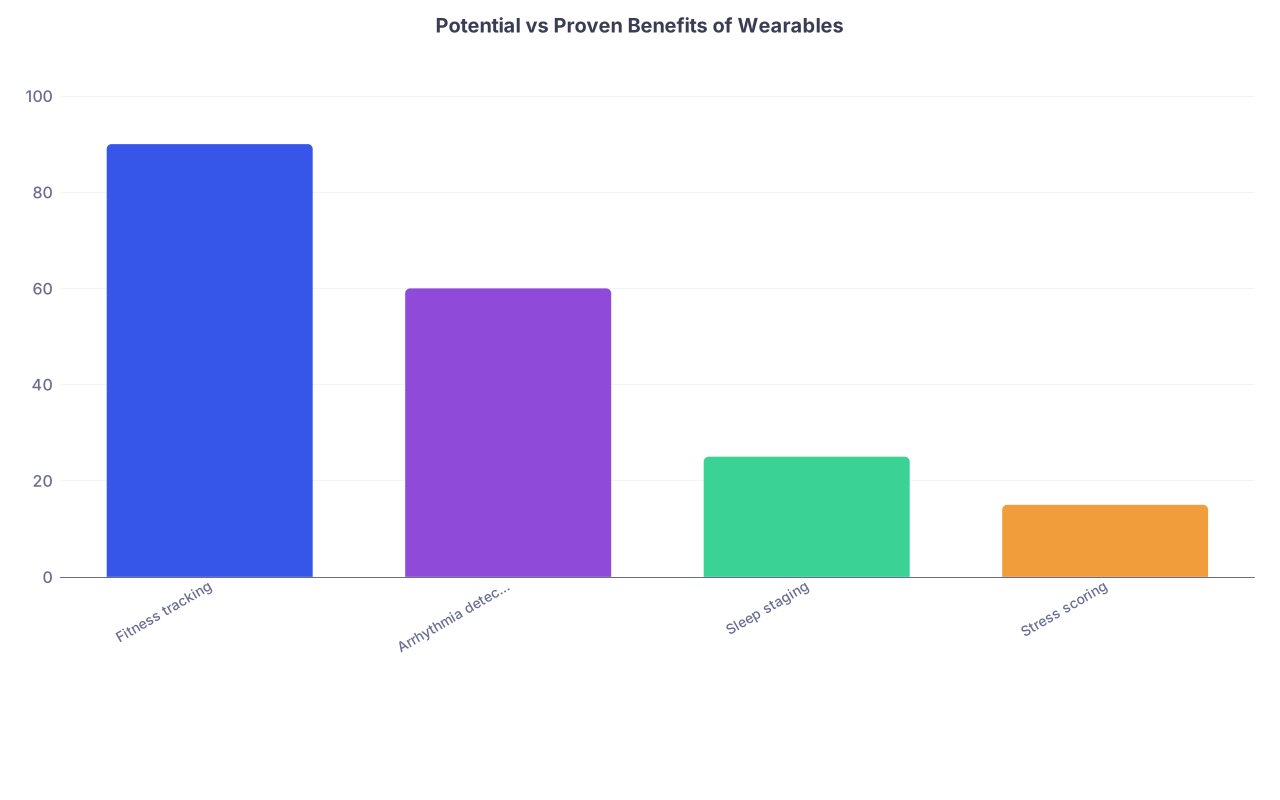
| Category | Value |
|---|---|
| Fitness tracking | 90 |
| Arrhythmia detection | 60 |
| Sleep staging | 25 |
| Stress scoring | 15 |
Interpret that chart this way: fitness tracking has clear, repeatable value; arrhythmia detection is partially useful in well‑defined cases; sleep staging and “stress scores” are mostly marketing with thin or inconsistent evidence.
False Alarms: How Wearables Manufacture “Patients”
The most dangerous thing about wearables isn’t the technology. It’s the combination of:
- Imperfect accuracy
- Continuous monitoring
- Anxious, health‑conscious users with Google and a portal login
I’ve watched this play out in clinic more times than I can count.
Example: AFib Detection That Creates Panic
Consumer devices like the Apple Watch and Fitbit can flag possible atrial fibrillation (AFib). That sounds amazing. Early detection of AFib can prevent stroke in high‑risk patients.
But here’s what the data actually shows from multiple validation studies:
- Specificity is high but not perfect: most positive alerts are true, but not all
- Sensitivity is moderate: they miss episodes, especially brief or intermittent ones
- Performance is best in older, higher‑risk adults—not in anxious 28‑year‑olds with palpitations after three espressos
Problem: you’re screening millions of low‑risk, health‑obsessed young adults with a tool calibrated for a different population.
Result: huge numbers of alerts, cardiology referrals, Holter monitors, and anxiety… to find a tiny number of clinically actionable cases.
And no, the answer is not “but if it saves one life, it’s worth it.” That’s how you justify any bad screening program. In medicine we’re supposed to ask: what’s the net benefit at population scale? How many people are we harming or stressing to help that one?
The Healthy Person Turned Into a “Case”
You know the script:
- 32‑year‑old software engineer
- “My watch said I had an abnormal rhythm last night.”
- No cardiac history, normal vitals, normal ECG in clinic
- They’ve already read 12 AFib articles and joined a Reddit group
Suddenly they’re not a healthy person. They’re “a borderline AFib case the doctors might be missing.”
That identity shift is not benign. It changes behavior and mental health. And it was triggered by a device that’s simply not designed or validated as a population-wide diagnostic tool.
The Data Quality Problem: Precision vs Accuracy
Wearables measure proxies, not gold‑standard clinical metrics.
- HRV from a wrist device is not the same as HRV from a clinical‑grade ECG
- “Deep sleep” from a wearable is not the same as polysomnography staging
- Calorie burn estimates are often hilariously off
- SpO₂ from cheap wrist sensors? Don’t base clinical decisions on it
But the UI makes it all look so official. Clean graphs. Two decimal places. Color‑coded zones.
Here’s the trap: humans equate more granularity with more truth. The decimal places and beautiful dashboards give a false sense of precision.
| Metric | Clinical Standard | Typical Wearable Accuracy* |
|---|---|---|
| Heart rate | 3‑lead/12‑lead ECG | Good at rest, degrades with motion |
| HRV | ECG | Moderate; method‑dependent |
| Sleep stages | Polysomnography | Poor‑moderate; especially REM/Deep |
| SpO₂ | Medical pulse oximeter | Variable; often unreliable |
| Calories | Indirect calorimetry | Poor; wide error margins |
*Varies by device and study, but the pattern is consistent: useful for trends, not diagnoses.
If you treat these consumer‑grade numbers as clinical truth, you’re not “data‑driven.” You’re just fooled by measurement theater.
Data Overload: When Numbers Make You Less Healthy
Let’s talk about the psychological fallout. Because it’s very real.
Orthosomnia: When Sleep Tracking Destroys Sleep
Yes, this is an actual term in the sleep medicine literature: orthosomnia.
People obsess over “fixing” their sleep based on tracker metrics, and their sleep gets worse. Why?
- They chase perfect sleep scores instead of listening to their own sleepiness and function
- They catastrophize minor variations (“My deep sleep dropped 15 minutes, what’s wrong with me?”)
- They stay in bed longer trying to force more “sleep time,” which wrecks sleep efficiency and conditions the brain to associate bed with frustration
In clinic, I’ve seen people who sleep worse after they buy a tracker. Take it off for a week, use basic sleep hygiene, and their insomnia improves. The data was the problem.
Exercise Anxiety and Over‑Quantification
You see the same pattern with fitness tracking:
- People feel like a workout “doesn’t count” if their watch died
- They push through pain to close a ring
- They feel guilty on rest days because the stats look bad
- They do low‑quality, repetitive movement just to hit step or calorie goals
Behavior driven by metrics, not by body signals or decent training principles.
This isn’t “empowerment.” It’s externalized control masquerading as motivation.
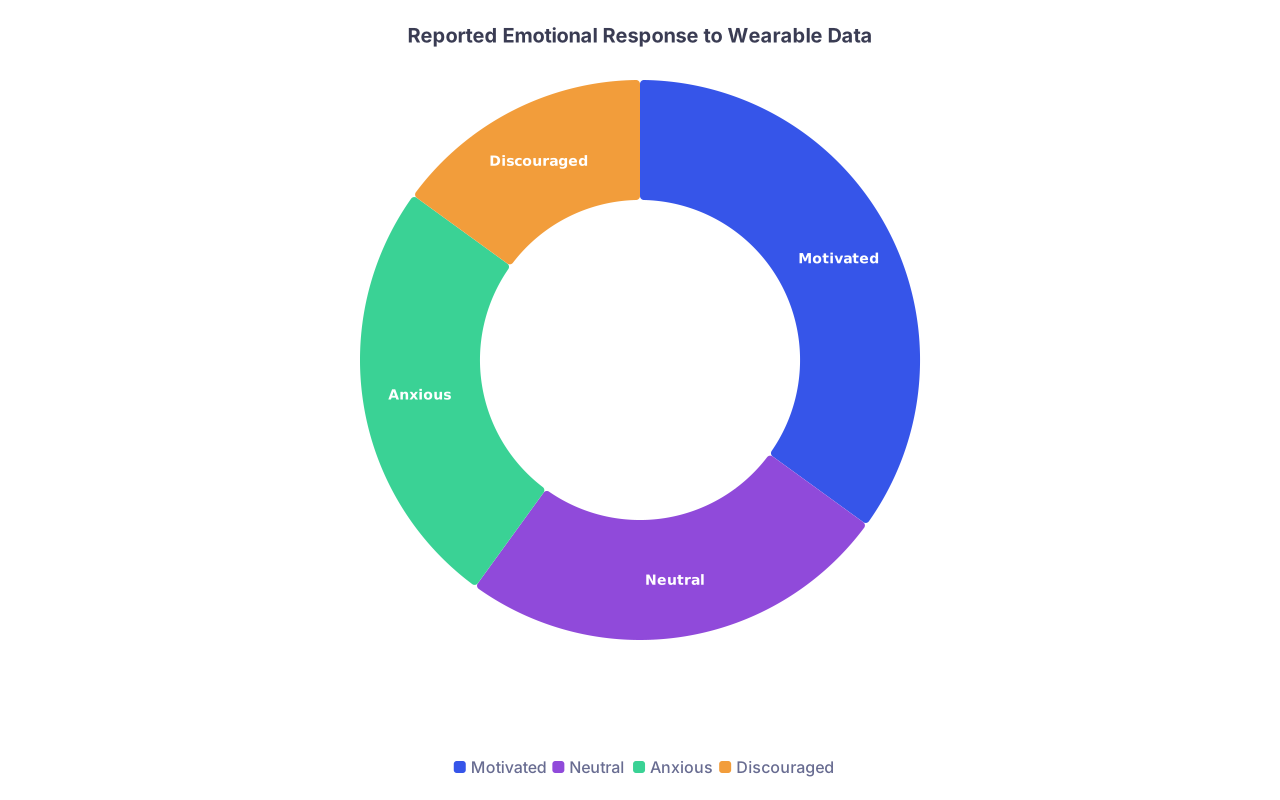
| Category | Value |
|---|---|
| Motivated | 35 |
| Neutral | 25 |
| Anxious | 25 |
| Discouraged | 15 |
The numbers vary by study, but the pattern holds: a sizeable chunk of users feel worse, not better, because of their dashboards.
When More Data Actually Helps (Narrow, Specific, Boring Use Cases)
Wearables are not useless. They’re over‑sold.
There are contexts where more data genuinely adds clarity:
Specific known condition, targeted metric
- A patient with known AFib using a validated device to monitor rate control or burden
- A diabetic using a continuous glucose monitor (CGM) under clear clinical guidance
In each case, we know what we’re looking for, what thresholds matter, and what to do about them.
Broad behavior trends, not individual datapoints
- Average daily steps over months, not today vs yesterday
- General sleep duration trend, not “I only got 14% deep sleep”
- Resting heart rate trend across weeks, not single‑day blips
Research settings with proper analysis and controls
- Population‑level activity data feeding into epidemiologic models
- Large cohorts where random noise cancels out and meaningful signals emerge
The pattern: well‑defined question → relevant metric → known action pathway.
That’s not how most people are using wearables right now.
The Ethics Problem: Surveillance Wrapped in Self‑Care
Let’s shift to the ethical side, because pretending this is just about “optimization” is naive.
Consent Theater and Data Exploitation
You tap “I agree” on a 40‑page terms of service. You do not meaningfully consent to:
- Long‑term storage of physiologic data
- Inference of sensitive states (e.g., pregnancy, mental health, substance use patterns)
- Sharing with third parties, advertisers, insurers, or “research partners”
You might think, “I don’t care, I’m boring.” That’s not the point. The point is: you’ve given away granular behavioral telemetry that can be cross‑referenced with everything else about you.
Health data is not just “private.” It’s powerful. It predicts and influences employment, insurance, and even targeted persuasion.
Medicalization of Normal Life
Constant tracking subtly reframes normal human variability as a problem:
- Normal sleep fluctuations become “sleep debt”
- Normal heart rate responses become “stress spikes”
- Rest days become “missed goals”
You’re nudged toward thinking of yourself as a perpetual patient in need of micro‑optimization. That’s excellent for engagement metrics and subscription revenue. It’s not obviously good for human flourishing.
That funnel is not hypothetical. It’s daily reality in primary care and cardiology clinics.
How to Decide: Is This Data Actually Useful To You?
Let’s be practical. You do not need to throw your watch in the trash. But you do need to stop assuming that more metrics equals better health.
Use a harsher filter.
Ask These Questions Before Trusting a Metric
Is this metric clinically validated for people like me?
Age, health status, skin tone, activity type—all matter for accuracy. Most marketing quietly ignores this.If this number changes, do I know exactly what I’ll do differently?
No clear action? Then it’s probably distraction, not insight.Does focusing on this metric make my behavior and mental health better or worse?
If you become more anxious, guilty, or compulsive—red flag.Would a simpler signal work just as well?
You don’t need a $300 watch to tell you that walking daily is good or that doomscrolling at 1am ruins your sleep.
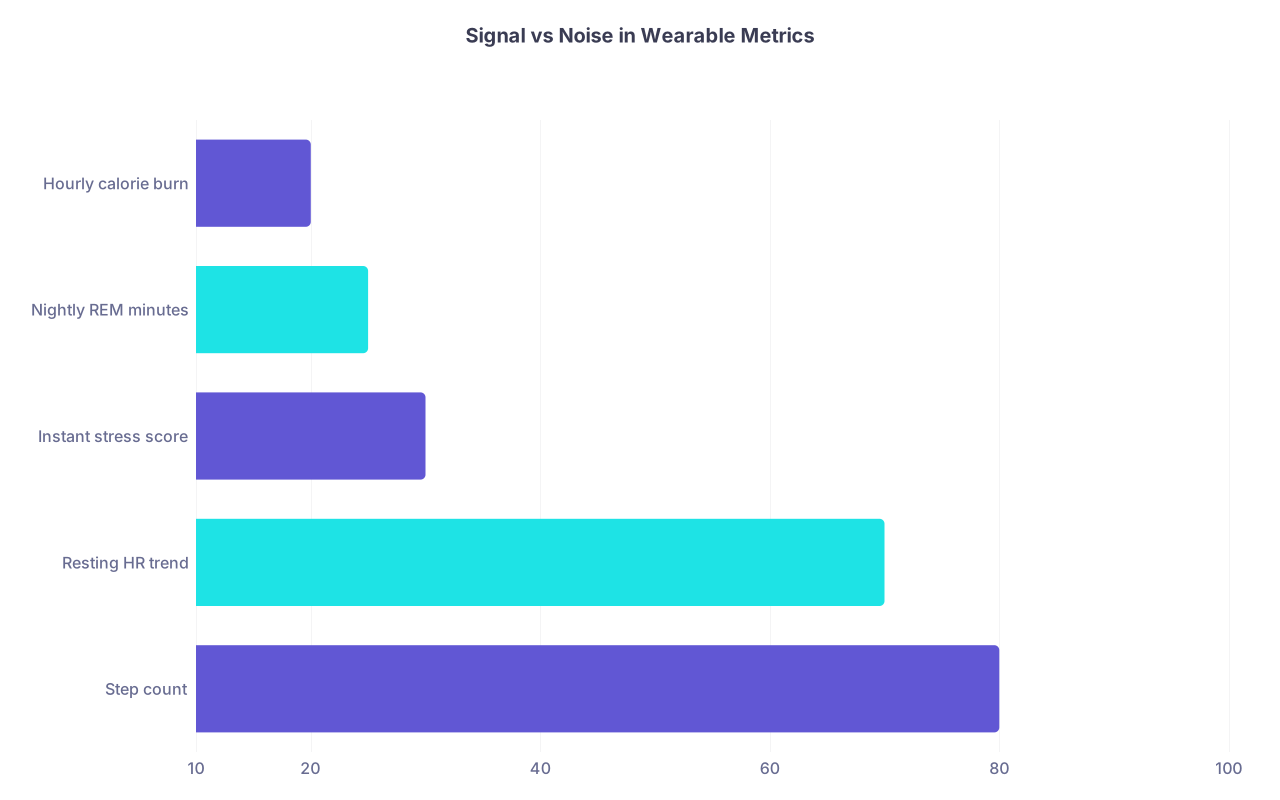
| Category | Value |
|---|---|
| Step count | 80 |
| Resting HR trend | 70 |
| Instant stress score | 30 |
| Nightly REM minutes | 25 |
| Hourly calorie burn | 20 |
Higher score = more likely to be useful signal in everyday life. Most of the sexy, AI‑flavored features live closer to the “noise” end.
For Clinicians and Trainees
If you’re in medicine, you’re going to see more of this, not less. A few guardrails:
- Treat wearable data like any other screening: apply pretest probability, not blind panic
- Anchor in symptoms and exam, not in the device notification
- Set boundaries: “We don’t interpret every single watch alert. Here’s when to contact us, here’s when to ignore.”
- Educate explicitly: these tools are adjuncts, not diagnostic authorities
The ethical move isn’t to worship or to dismiss wearables. It’s to contextualize them—and push back when they’re causing more harm than help.
The Real “Personal Development” Move: Less Worship, More Judgment
People buy wearables in the name of self‑improvement. That’s fine. But here’s the twist:
The more serious you are about your health, the less you should outsource judgment to gadgets.
- If the device helps you build and maintain broad, sustainable habits—great
- If it pulls you into the weeds of nightly sleep graphs and micro‑trends in HRV—step back
- If it’s worsening your anxiety, body image, or sense of autonomy—take it off for a month and see what happens
You’re not a data science project. You’re a human who needs a few solid behaviors done consistently, not 50 metrics checked obsessively.
Key Takeaways
- More data from wearables does not automatically equal better health; in many real‑world cases, it adds noise, anxiety, and unnecessary medicalization.
- Wearables are most useful for broad trends and specific, clinically guided use cases—not for micromanaging sleep stages, stress scores, or every rhythm blip.
- Ethically, the combination of imperfect accuracy, continuous surveillance, and aggressive marketing demands skepticism, not blind trust.


