
The default advice that “every physician-entrepreneur should get an MBA” is wrong.
For physicians who want to build healthcare companies, an MBA can be powerful—but it’s also a 2-year, six-figure detour that many founders simply don’t need. The real question isn’t “Is an MBA good?” It’s: Is an MBA the highest-ROI move for you given your specialty, risk tolerance, and timeline?
Let’s walk through this like adults, not brochure copy.
The Real Question: What Kind of Company Do You Want to Build?
Before debating the MBA, you need clarity on the target.
If your goal is:
- “I want to run my own private practice or a small group”
- “I want to be a strong medical director or department chair”
- “I want to consult on the side and understand business better”
Then an MBA is usually optional, sometimes overkill.
If your goal is:
- “I want to build a venture-backed healthcare startup”
- “I want to raise millions and eventually exit”
- “I want to sit across from VCs and not be outgunned”
Then an MBA can be worth it—but not by default. It depends which gaps you actually have: network, skills, or credibility.
Here’s the decision lens I use:
Don’t ask: “Is an MBA good?” Ask: “What problem do I expect the MBA to solve?”
Common problems:
- “I don’t understand finance or business models.”
- “I don’t know how to get in front of investors.”
- “I don’t have cofounders or a network outside medicine.”
- “I’m scared I’ll look naive next to seasoned operators.”
Some of these justify an MBA. Many don’t.
What an MBA Actually Gives a Physician Founder (When It Works)
Strip away the marketing. For a physician planning to build a healthcare company, an MBA tends to be good for exactly four things:
- Network
- Pattern recognition and language
- Structured time to pivot or ideate
- Signaling and credibility in certain rooms
Let’s break those down.
1. Network: The Single Biggest Value (at Top Programs)
At places like Harvard, Wharton, Stanford GSB, Kellogg, Booth, Columbia, etc., the real asset isn’t the accounting class. It’s the people sitting next to you.
You get:
- Former consultants and bankers (McKinsey, BCG, Goldman) who understand deals, modeling, and go-to-market.
- Engineers and product folks who’ve already worked at healthtech or SaaS startups.
- Access to alumni who are partners at VC firms or execs at health systems and payers.
If you want to raise venture money or recruit a nonclinical cofounder, that network can shortcut a 5-year grind into 1–2 years.
If you’re at a regional MBA program where most grads go into local corporate roles and almost nobody is building startups? That’s not a startup founder network. That’s a career pivot network.
For physicians wanting to build healthcare companies, network quality is non-negotiable. A weak network + big tuition bill = bad trade.
2. Pattern Recognition and Language: Not “Learning Business,” but Learning How Business People Think
Harsh truth: you can learn almost every MBA “hard skill” from:
- Online courses (accounting, corporate finance, basic modeling)
- YC Startup School, Indie Hackers, startup books, podcasts
- Working inside a startup for 1–2 years
What’s harder to fake is comfort in rooms full of investors, operators, and executives. MBA programs force that exposure.
You’ll pick up:
- How investors talk about TAM, CAC, LTV, unit economics, churn, runway, burn multiple.
- How product managers think about problem-solution fit, MVPs, and experiments.
- How healthcare payers and systems think about risk, reimbursement, value-based care.
This matters because a lot of physician founders show up to VC meetings sounding like they’re defending a grand rounds case, not pitching a business. MBA exposure can smooth that out fast.
But again: you can get similar exposure by:
- Joining a healthtech startup in a product/clinical strategy role
- Going through top accelerators (YC, Techstars, a16z programs)
- Surrounding yourself with non-physician founders and operators
MBA just compresses it and gives structure.
3. Time and Space to Pivot Out of Full-Time Clinical
Most physicians don’t just wake up and quit residency or attendingship to start a company cold. Too much at stake. Too many golden handcuffs.
MBA can act as:
- A socially acceptable “bridge chapter” in your story.
- A safe place to test ideas, join startup competitions, hackathons, incubators.
- A natural way to relocate to a startup hub (Boston, SF Bay Area, NYC).
For some, the protected time is the real win. You’re not on calls, not on overnight, not writing endless notes. You’re thinking, meeting, iterating.
Of course, you can also:
- Negotiate a 0.5–0.7 FTE clinical position and use freed-up time to build.
- Take a 6–12 month leave of absence or sabbatical, if your situation allows.
- Join a startup part-time and transition.
None of that comes with a $200k tuition bill.
4. Signaling Power: Where an MBA Degree Actually Matters
Here’s where the degree itself—not just skills—has benefit:
- Corporate roles: Chief Medical Officer at a payer, pharma, or large hospital system. Operational leadership roles. Many of these explicitly prefer or require MBA or equivalent.
- Certain investors: Some VCs (especially old-school, East Coast, PE-adjacent shops) are biased toward pedigrees. MD + HBS/Wharton/GSB looks “de-risked” to them.
- Cross-credibility: You can talk medicine with clinicians and margin with CFOs. You become legible to both sides.
But if your plan is:
- “I want to bootstrap a SaaS tool for private practices,” or
- “I want to build a niche digital health product and sell for $10–30M someday”
Then the letters after your name matter a lot less than your traction.
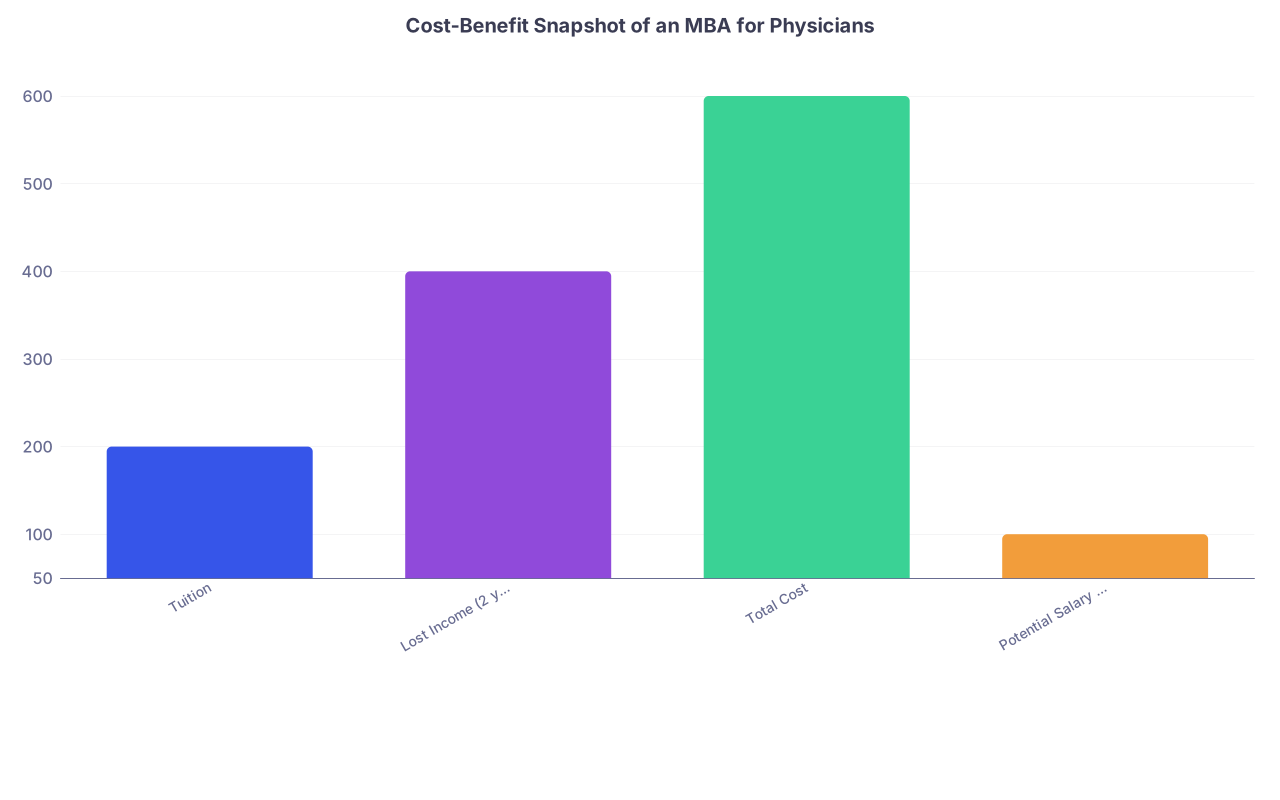
| Category | Value |
|---|---|
| Tuition | 200 |
| Lost Income (2 yrs) | 400 |
| Total Cost | 600 |
| Potential Salary Boost (corp roles) | 100 |
(Values in thousands of dollars; rough illustrative numbers for a US attending leaving practice for a full-time MBA.)
When an MBA Makes Sense for Physician-Founders (and When It Doesn’t)
Let’s get surgical.
Strong Cases FOR an MBA
I’d seriously consider an MBA if you check several of these boxes:
- You’re early: finishing residency/fellowship or in your first 3–5 years as an attending, not yet deeply locked into a high-expense lifestyle.
- You want a nonclinical or hybrid career long term: healthtech leadership, payer, pharma, consulting, VC, or hospital C-suite.
- You can get into a top 10-ish program with real healthcare/entrepreneurship ecosystems.
- You’re willing to use the MBA aggressively: start a company during school, join incubators, meet investors weekly, build something, not just sit in lectures.
- You want to relocate to a hub (SF, Boston, NYC) and need a launchpad.
In that scenario, the MBA can accelerate your shift out of pure clinical and into founder/operator mode.
Weak Cases / Bad ROI for an MBA
I’d be skeptical or flat-out say “don’t do it” if:
Your only goal is to “understand business better” but you plan to stay 0.9–1.0 FTE clinical.
Use books, courses, a coach, and some advisory/investing experience instead.You can only access lower-tier or online MBAs with weak entrepreneurial ecosystems.
For startup building, that’s mostly just an expensive ego boost.You’re already a senior physician with strong income, heavy financial commitments, and no desire to go full-time on a company.
The opportunity cost is massive; consider targeted executive education instead.You’re purely chasing credential FOMO because other people on LinkedIn have MD/MBA.
That’s not a reason. That’s insecurity.
Concrete Alternatives to an MBA for Physician Entrepreneurs
You have more options than “do nothing” vs “full MBA.”

Here are realistic paths I’ve seen physicians use successfully:
1. Join a Healthtech Startup Before Founding Your Own
Instead of learning in a classroom, learn inside a real company.
Target roles like:
- Clinical strategy / medical director
- Product manager with clinical focus
- Partnerships / payer relations with clinical expertise
You’ll see:
- How roadmaps actually get prioritized
- How sales cycles with hospitals and payers really work
- How fundraising, board meetings, and churn look from the inside
One or two years of this is often more directly useful than a broad MBA.
2. Build on the Side with Aggressive Learning
If you’re mid-career or can’t walk away from income:
- Drop to 0.5–0.7 FTE if possible.
- Use structured online resources:
- YC Startup School (free)
- Reforge, Section, or similar for product & growth
- Accounting/finance courses from Coursera/edX
- Join healthtech founder communities and accelerators.
You won’t get a diploma. You will get a product.
3. Targeted Executive Education / Certificates
Programs like:
- Harvard Business School Executive Education (e.g., value-based care, leadership)
- Wharton Executive Programs in healthcare innovation
- MIT or Stanford short programs on digital health, AI, etc.
These won’t teach you “how to do a startup” in 5 days, but they’ll:
- Upgrade your vocabulary and frameworks
- Give you a small but solid network
- Avoid 2-year, full-MBA cost
Good path if you’re already an attending or leader and just need business fluency, not a full reset.

| Step | Description |
|---|---|
| Step 1 | Want to build healthcare company |
| Step 2 | Use courses + side projects |
| Step 3 | Join startup or accelerators |
| Step 4 | Do MBA and build during school |
| Step 5 | Full-time founder in 1-3 years? |
| Step 6 | Admitted to top program? |
| Step 7 | Can afford cost and 2 years out? |
Physician + MBA vs Physician Founder Without MBA
Here’s a quick comparison for context.
| Factor | MD + MBA Path | MD Founder Without MBA |
|---|---|---|
| Time cost | 1–2 years out of practice | 0–6 months to ramp self-education |
| Cash cost | ~$150k–$250k tuition + lost income | Minimal (courses, travel, small fees) |
| Network | Strong if top-tier program | Must build via startups/accelerators |
| Business skills | Broad, structured exposure | Focused, practical, project-driven |
| Best if goal is | Corporate leadership + startups | Pure founding, faster experimentation |
Notice what’s not on this table: “Can you succeed?” Because both paths can work. The difference is how you learn and what trade-offs you accept.
How to Decide: A Simple 5-Question Test
Answer these honestly:
In 5–7 years, do I want to be mostly clinical, mostly nonclinical, or fully founder/operator?
- Mostly clinical → MBA usually not worth it.
- Mostly nonclinical/founder → maybe.
Can I get into (and afford) a program with real startup/healthcare chops and network?
- Think HBS, GSB, Wharton, Kellogg, Booth, Columbia, Sloan, etc.
Am I prepared to use the MBA as a build period, not a vacation from medicine?
- If you just want a break, there are cheaper ways to rest.
Am I okay delaying real-world startup learning by 2 years?
- Some people need structure first. Others will be bored in class by month 3.
What’s my Plan B if I graduate and don’t raise money or start a company?
- If the answer is “go back to standard attending life unchanged,” ROI is shaky.
If you’re clearly “yes” on 1–4 and have a solid Plan B? An MBA can be a very reasonable move.
If your answers are mostly “maybe” or “I don’t know,” you’re probably romanticizing the degree.
Quick Reality Checks: Common Myths
Let’s kill a few fantasies.
“Investors won’t take me seriously without an MBA.”
They won’t take you seriously without traction, a sharp pitch, and a credible team. Degrees are secondary.“MBA will teach me how to be a CEO.”
No. It’ll give you frameworks. You become a CEO by leading teams, owning outcomes, and suffering through mistakes.“I need an MBA to understand P&L and valuation.”
You can get 80% of that from a decent finance course and a few weekends with a spreadsheet.“All the big healthtech founders have MBAs.”
Many don’t. Plenty came from engineering, product, or straight clinical backgrounds and learned on the job.
FAQs
1. Should I do an MD/MBA during medical school if I know I want to build companies?
If your school has a strong, low-cost MD/MBA option and it only adds 1 year, it’s not a bad hedge—especially if you’re already convinced you want a nontraditional path. Just don’t assume it replaces actual startup experience. If the MBA portion is weak or generic, you’re usually better off using that time on:
- Technical skills (data, product, coding basics)
- Internships in healthtech
- Building and shipping small projects
2. Is an online MBA worth it for physician entrepreneurs?
For pure startup building? Usually no. Online MBAs rarely offer the concentrated founder network, startup ecosystem, or fundraising credibility you’re probably hoping for. They can make sense if:
- You want a formal business credential for hospital/administrative roles
- You can’t relocate or leave practice But if your core goal is “start a healthcare company,” the opportunity cost of 2–3 years of part-time classes is huge compared with actually building.
3. How do I learn what I’d miss by not doing an MBA?
Focus on three areas:
- Finance: take 1–2 solid online courses on accounting, modeling, and startup finance.
- Product/marketing: YC Startup School, Reforge-like programs, product management books (e.g., “Inspired”, “Lean Startup”).
- Environment: join a startup as advisor or part-time clinical lead, attend healthtech meetups, join accelerators. Within a year, you’ll have most of the practical pieces you’d actually use.
4. If I already have offers from top MBA programs, should I delay to get more clinical experience first?
If you’re straight out of residency or early attending, going sooner can be a plus—you’re closer to the pain points and not yet deeply locked into a high-expense lifestyle. If you’re thinking of starting a company that deeply depends on understanding real-world operations (e.g., hospital workflow tools, payer contracting), 1–2 years of attending-level exposure can help, but don’t drag it out. Momentum matters more than perfect timing.
5. What’s one small step I can take this month to test whether I even like “business stuff”?
Do this: pick one health problem you complain about regularly (prior auth, scheduling, documentation, readmissions). Write a one-page “problem + solution + business model” doc:
- Who exactly has this problem?
- How do they solve it now?
- What would you build?
- Who would pay, and why? Then show it to one nonclinical founder and one hospital admin and ask them to tear it apart. If that conversation excites you instead of draining you, you’re a good candidate for the founder path—with or without an MBA.
Action step today:
Open a blank page and write, in one sentence, the exact role you want in 5 years (e.g., “Full-time founder of a venture-backed virtual care startup” or “0.6 FTE hospitalist, 0.4 FTE CMO at a healthtech company”). Once that’s clear, you’ll know whether an MBA is a tool you genuinely need—or just an expensive way to avoid making the real leap.