
The default path for post‑residency physicians traps founders: high income, zero freedom, and a business idea that never leaves the Notes app.
You cannot “see how it goes” and hope your startup magically replaces your attending salary. You need a staged, time‑bound exit plan from clinic work. With clear thresholds, dates, and non‑negotiable moves.
This is that plan—broken into three stages:
- Side‑Hustle Mode
- Transition Mode
- Full‑Time Founder
You are post‑residency, on the job market or already in your first attending role. At every point below, you will know exactly: “Right now, I should be doing X, not Y.”
Stage 1: Side‑Hustle Mode (Months 0–12) – Build While Safely Employed
Your goal in Stage 1 is simple and ruthless: prove that someone will pay for your product or service while you have a stable clinical paycheck.
Not user interviews. Not “interest.” Money.
Months 0–1: Lock Your Constraints and Income Floor
At this point you should:
Decide your runway target: how many months of living expenses you want banked before you reduce clinic work.
- Conservative physicians: 12–18 months
- Aggressive but sane: 9–12 months
Calculate your bare‑bones monthly burn:
- Rent / mortgage
- Utilities
- Food
- Insurance (health, malpractice tail if relevant)
- Loan minimums
- Childcare
Write the number down. No rounding. No optimism.
Set your income floor:
- Example: “I will not cut clinic time below 0.8 FTE until the startup generates at least $4,000/month for 3 consecutive months.”
Lock your time budget:
- Pick 3 fixed work blocks per week for startup work (e.g., Tue 7–10 pm, Thu 7–10 pm, Sat 8–12).
- Treat these like OR time. Not optional. Not negotiable.
Months 1–3: Narrow the Problem and Test Something Real
Most physician founders waste this phase writing 40‑page business plans no investor will read. Do this instead.
At this point you should:
Choose one painful, narrow problem in your clinical world.
Example buckets:- Scheduling / no‑shows in outpatient psych
- Chronic care coordination for CHF patients
- Prior auth hell in rheumatology
- Locums and shift‑swap logistics for hospitalists
Talk to 15–20 people who actually feel the pain:
- 5–10 clinicians
- 5–10 admins / practice managers / billers / patients (depending on your product)
Ask:
- “Walk me through the last time this problem cost you money or time.”
- “What did you do instead?”
- “If I fixed this perfectly, what is that worth per month to you?”
Define your Minimum Revenue Product (MRP), not just an MVP.
That means: the smallest, ugliest version someone would realistically pay for.
Examples:
- SaaS: a basic web dashboard + manual backend using Google Sheets / Airtable
- Service: a done‑for‑you prior auth concierge for 2 practices
- B2C: a structured, paid telehealth program for one diagnosis with Stripe payments + scheduling
Months 3–6: Build the Scrappy Version and Charge Money
Stop calling it “validation” if no one pays you. Revenue or it does not count.
At this point you should:
Build the fastest possible version:
- Use low‑code / no‑code where possible (Bubble, Glide, Softr, Airtable automations).
- Or a service with you and a VA behind the scenes.
Line up beta customers with actual payment:
- Goal by Month 6:
- 3–5 paying customers (practices or individuals)
- OR $1,000/month in predictable recurring or near‑recurring revenue
- Goal by Month 6:
Use simple, non‑negotiable pricing:
- B2B practices:
- Start: $300–$1,000/month per clinic location
- B2C patients:
- Start: $75–$250/month program pricing, not $20 one‑off calls
- B2B practices:
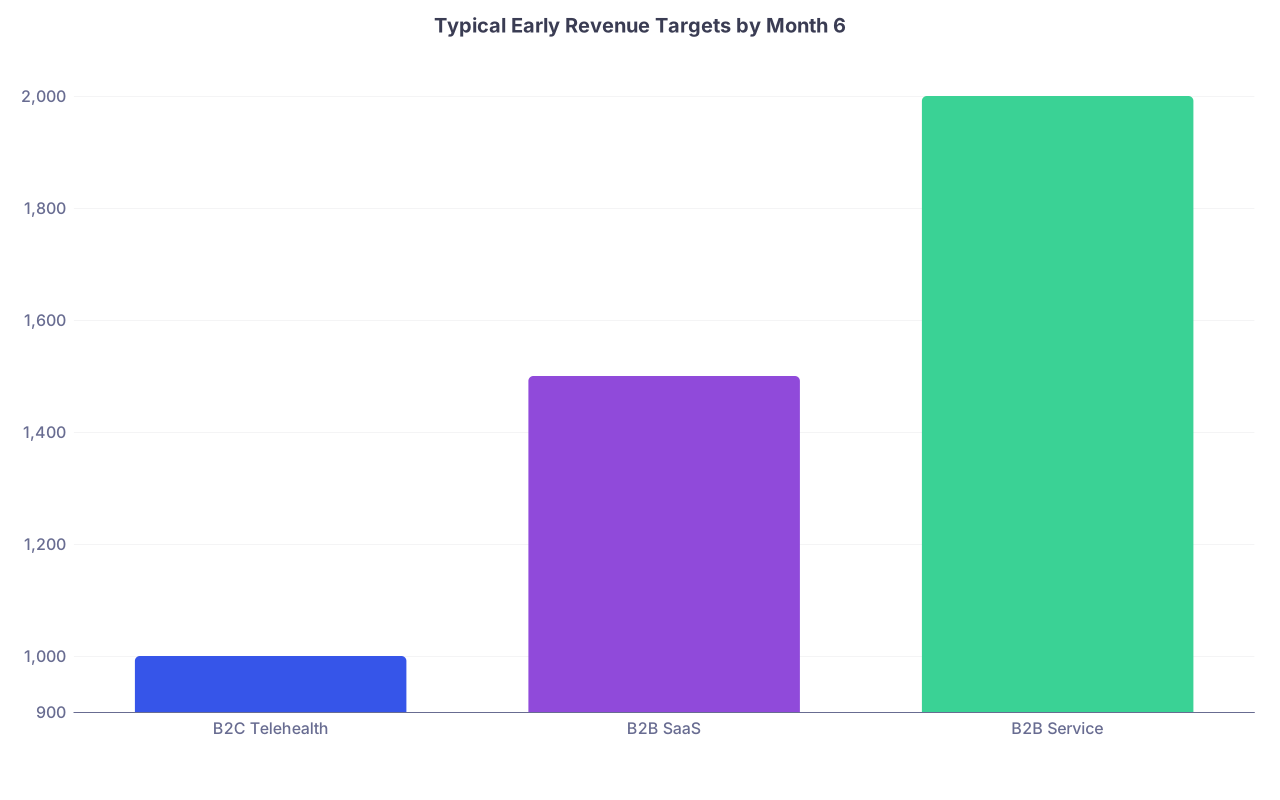
| Category | Value |
|---|---|
| B2C Telehealth | 1000 |
| B2B SaaS | 1500 |
| B2B Service | 2000 |
Months 6–9: Hit Hard Milestones or Kill / Pivot
By this point, you should stop lying to yourself. Either it is working, or it is not.
At this point you should:
Decide on three measurable milestones. For example:
- 10 paying customers
- $3,000/month recurring revenue
- 80% customer retention over 3 months
Set a kill or pivot date:
- Example: “If by Month 9 I am under $1,500/month and fewer than 5 customers, I will pivot the product or niche. Not extend the experiment indefinitely.”
Tighten your documentation:
- Simple CRM (Notion, Airtable, HubSpot free)
- Record of every sale / cancellation and exact reason
- A clean one‑pager: problem, solution, price, who it is for
Months 9–12: Prepare for Reduced Clinical Time
If you have any traction at all, you must start setting up the exit conditions now. Not later. Clinics need lead time.
At this point you should:
Choose your Stage 2 start date (0.8 or 0.6 FTE):
- Typically between Month 12–15
- Put it on your calendar now
Speak to your group / employer:
- “I would like to transition to 0.8 FTE starting [date]. I am happy to be flexible within a 2–3 month window.”
- Do not lead with, “I am starting a startup.” Lead with “family, consulting, academic projects.” The reality is politics. Use them, do not fight them.
Build your personal cash runway:
- Target by the time you reduce FTE:
- 6–12 months of bare‑bones expenses in cash
- If you are below 6, do not cut FTE unless your startup revenue is extremely strong.
- Target by the time you reduce FTE:
Define your Stage 2 revenue threshold to justify reduced FTE:
- Example: “I will go from 1.0 → 0.6 FTE when I reach $3,000/month revenue for 3 consecutive months and have 9 months runway in cash.”
Stage 2: Transition Mode (Months 12–30) – Part‑Time Clinic, Serious Founder
Stage 2 is where most physicians fail because they half‑commit forever. They stay at 0.8 FTE, dabbling for years. You will not.
You will treat Stage 2 as a temporary, 12–18 month bridge with a clear endpoint.
Month 12–15: Drop to 0.8 FTE (First Shift of Time)
At this point you should:
Move to 4 clinical days → 1 full founder day per week:
- Example:
- Mon–Thu: clinic
- Fri: startup only
- Example:
Restructure your startup time:
- Founder Day (8–10 hours) = deep work: product, sales, systems
- 2–3 evenings (2–3 hours each) = calls, demos, follow‑ups
Set Stage 2 targets by Month 18:
- For B2B:
- 10–20 clinics or
- $7,000–$10,000/month recurring revenue
- For B2C:
- 50–100 recurring patients or program members
- $5,000–$8,000/month predictable revenue
- For B2B:

Months 15–18: Professionalize Operations and Stop Being the Entire Product
If everything depends on you personally, you do not have a startup. You have a fancy shift trade.
At this point you should:
Document clear processes:
- Onboarding a new clinic or patient
- Handling support requests
- Monthly reporting / billing
Offload low‑value work:
- Hire a VA 5–10 hours/week to:
- Schedule calls
- Track invoices
- Prepare reports
- Basic customer emails
- Hire a VA 5–10 hours/week to:
Clarify unit economics:
- Customer Acquisition Cost (CAC) – even if basic:
- Marketing spend + your time cost / new paying customers
- Gross margin:
- Revenue – direct costs (software, staff doing the work)
- Customer Acquisition Cost (CAC) – even if basic:
If your margins are under 50% at this stage without heavy paid ads, you need to raise prices or change the model before Stage 3.
Months 18–21: Decide on 0.6 FTE and Pre‑Exit Thresholds
Now you choose: keep grinding at 0.8 FTE or lean further in.
Most strong startups that come from physicians took a decisive step here.
At this point you should:
Drop from 0.8 → 0.6 FTE (3 clinic days, 2 founder days weekly) if all of these are true:
- You have at least 6 months of personal runway in cash
- Your startup brings in at least $4,000–$6,000/month
- Revenue has grown or held for 3–6 consecutive months
Set your Stage 3 (full‑time) entry criteria in writing:
- Example physician‑friendly thresholds:
- $8,000–$12,000/month revenue
- 10–15 months of runway OR
- External funding secured (e.g., $250k–$500k pre‑seed)
- Example physician‑friendly thresholds:
Decide whether you are bootstrapping or raising:
- If B2B SaaS or platform: strongly consider a pre‑seed in Stage 2
- If niche service / telehealth: bootstrapping is often cleaner and more profitable
| Stage | Clinical FTE | Monthly Startup Revenue | Personal Runway (months) |
|---|---|---|---|
| Stage 1 Start | 1.0 | $0–$500 | 0–3 |
| Stage 2 Start | 0.8 | $2,000–$3,000 | 6–9 |
| Stage 2 Deep | 0.6 | $4,000–$6,000 | 6–12 |
| Stage 3 Entry | 0–0.2 | $8,000–$12,000+ | 9–15 |
Months 21–24: Build Proof, Not Just Revenue
You want more than just cash. You want evidence this can scale.
At this point you should:
Lock 2–3 marquee customers or use cases:
- A multi‑site group
- A large employer
- A hospital unit or service line
Collect hard outcomes:
- For a clinical operations tool:
- “Reduced no‑show rate from 18% → 9% over 3 months”
- For a chronic care service:
- “Cut 30‑day readmissions by 22% for enrolled patients”
- For revenue cycle:
- “Improved collections by $X per provider per month”
- For a clinical operations tool:
Build one tight pitch deck (even if you are not fundraising yet):
- Problem, solution, traction, revenue, unit economics, roadmap
This becomes your tool in Stage 3 for investors, partners, and hires.
Months 24–30: Lock Your Exit Date and Backup Plan
Do not let Stage 2 stretch to Year 7. Decide.
At this point you should:
Choose your full‑time founder start date, 6–12 months out:
- Example: “On July 1 next year, I will reduce to 0–0.2 FTE.”
- Put it in writing and share it with:
- Spouse / partner
- Co‑founder
- Trusted colleague
Define your clinical backup plan:
- Simple list:
- 2–3 local per‑diem / locums options
- 1–2 telemedicine panels willing to give you 4–8 hours/week
- You want options if revenue dips, without crawling back to full‑time.
- Simple list:
Formalize legal and compliance:
- Entity structure (LLC, C‑Corp)
- Contracts (BAA, MSAs, telehealth compliance by state)
- Basic data security posture
Stage 3: Full‑Time Founder (Months 30+) – Exit Clinic with a Safety Net
Stage 3 is where you flip the default. Your primary job is founder; clinic is optional and tactical.
Your goal: grow or fail decisively within 18–24 months, not drift.
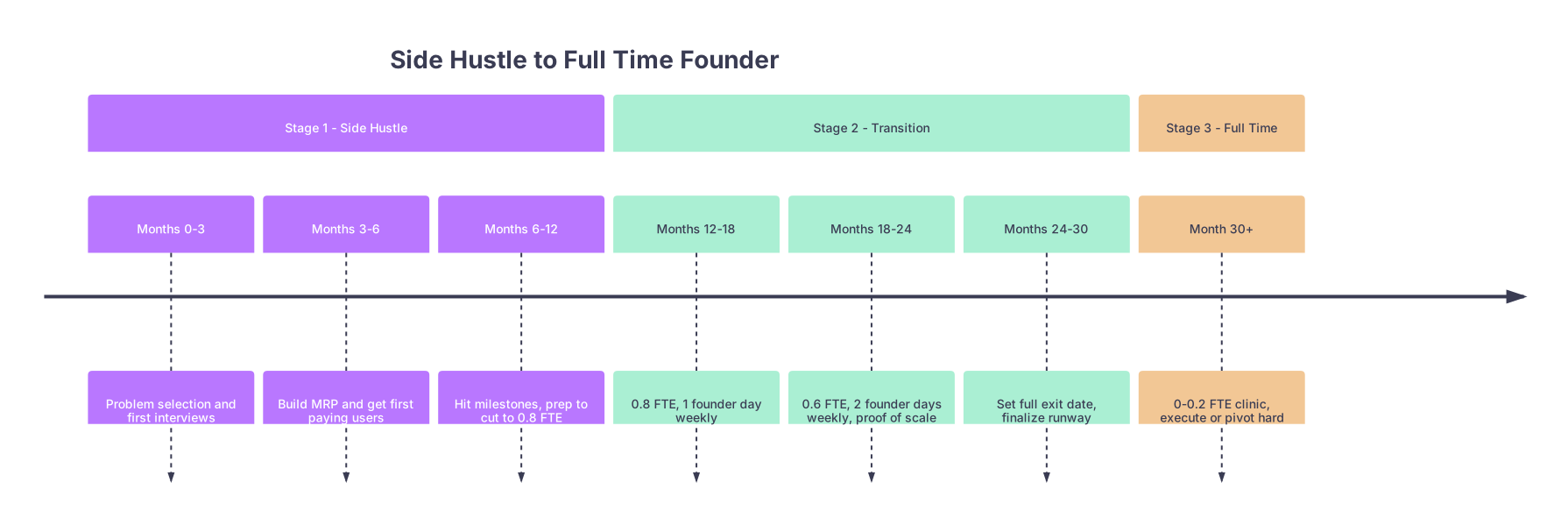
| Period | Event |
|---|---|
| Stage 1 - Side Hustle - Months 0-3 | Problem selection and first interviews |
| Stage 1 - Side Hustle - Months 3-6 | Build MRP and get first paying users |
| Stage 1 - Side Hustle - Months 6-12 | Hit milestones, prep to cut to 0.8 FTE |
| Stage 2 - Transition - Months 12-18 | 0.8 FTE, 1 founder day weekly |
| Stage 2 - Transition - Months 18-24 | 0.6 FTE, 2 founder days weekly, proof of scale |
| Stage 2 - Transition - Months 24-30 | Set full exit date, finalize runway |
| Stage 3 - Full Time - Month 30+ | 0-0.2 FTE clinic, execute or pivot hard |
Month 30–33: Execute the FTE Drop
At this point you should:
Give formal notice to your clinical employer:
- “As discussed previously, I will be reducing to 0.2 FTE / leaving my full‑time position effective [date]. I am committed to a smooth transition over the next X months.”
Secure bridge clinical work if useful:
- 1 day/week urgent care
- 1–2 telehealth shifts/week
- Short locums blocks every 2–3 months
This is optional. The key is that startup time is now the core, not leftover.
- Rebuild your weekly calendar from scratch:
- Example week:
- Mon: Sales + outreach
- Tue: Product + operations
- Wed: Customer success + metrics
- Thu: Marketing + partnerships
- Fri: Strategy + hiring + admin
- Example week:
Months 33–36: Scale What Works, Kill What Does Not
Now you behave like a real startup, not a physician with a hobby website.
At this point you should:
Double down on one main acquisition channel:
- Examples:
- Partnerships with specialty societies
- Direct outreach to practice managers
- Content + webinars directed at a specific provider niche
- Examples:
Set quarterly revenue goals and tie them to actions:
- Example:
- Q1: Grow from $10k → $18k MRR
- 100 outbound touches/week
- 10 demos/week
- Close rate ≥ 20%
- Q1: Grow from $10k → $18k MRR
- Example:
Cut features and offerings that distract:
- If you have 3 product lines and only 1 sells, kill or pause 2.
Months 36–42: Decide: Scale Hard, Stay Sustainable, or Change Course
You now have enough data to know what you really have.
At this point you should:
Evaluate with brutal honesty:
- Revenue trajectory
- Churn
- Unit economics
- Your own energy
Choose one of three macro paths:
Scale Hard (Growth Company)
- Criteria:
- $20k+ MRR
- Month‑over‑month growth > 10% for 3+ months
- Strong margins and clear TAM
- Actions:
- Raise a serious round (if needed)
- Hire 1–3 key roles (engineering, sales, ops)
- You stay effectively 0 FTE clinically
- Criteria:
Stay Sustainable (Lifestyle / Profitable Niche)
- Criteria:
- $8k–$15k/month profit
- Stable or modest growth
- You genuinely like this pace
- Actions:
- Solidify systems
- Maybe add 0.1–0.2 FTE clinic for fulfillment or benefits
- Keep team lean
- Criteria:
Change Course (Pivot or Partial Return)
- Criteria:
- Flat or declining revenue for 6–9 months
- Customer acquisition stall
- No compelling path to profit
- Actions:
- Consider a hard pivot to a new product using your infrastructure
- Or return to 0.6–0.8 FTE clinical and keep the business as a side service
- Criteria:
Daily and Weekly Operating Rhythm as a Full‑Time Founder
Once you are out, the biggest risk is drift. You are used to schedules, pages, and shifts. Startups have none of that built‑in.
At this point you should:
Keep a simple weekly checklist:
- Spoke to at least 10 current or potential customers
- Shipped at least 1 product improvement or new SOP
- Measured and reviewed:
- Revenue
- Churn
- Cash in bank and runway
- Closed 1–2 small, annoying tasks that prevent future scaling
Run a monthly founder review:
- Revenue vs target
- What worked in sales / marketing
- What you will stop doing next month
Final Snapshot: The 3‑Stage Exit Plan in Plain English
- Stage 1 (Side‑Hustle) – While full‑time in clinic, you prove people pay for this. Set thresholds, collect real money, and book a date to cut to 0.8 FTE.
- Stage 2 (Transition) – You deliberately move to 0.8, then 0.6 FTE with specific revenue and runway targets. You professionalize, stop being the whole product, and lock in a full‑time founder date.
- Stage 3 (Full‑Time Founder) – You flip your identity. Founder first, clinician second. Then you give yourself 18–24 focused months to grow aggressively, maintain a profitable niche, or pivot with your eyes open.