
What if your startup crashes publicly and every colleague you’ve ever met watches it burn?
Because that’s the nightmare, right? Not just failing. Failing loudly. As a doctor. In front of attendings, co-residents, med school classmates, maybe even former patients who Google you.
You’re supposed to be “the safe one.” The reliable one. Not the one on LinkedIn posting about a product that never ships.
Let’s be clear: physician founders are terrified of public failure. I’ve watched brilliant people stall for years because the idea of their chief resident seeing their half-baked website is worse than just staying in a safe hospital job forever.
You’re not the only one spiraling with:
- “What if I launch and nobody signs up?”
- “What if my colleagues laugh at me behind my back?”
- “What if I quit my job, burn my savings, and have to crawl back to the hospital begging for shifts?”
You’re not crazy. This fear is real. But physicians do build startups, and they do it while being just as anxious, reputation-obsessed, and catastrophically imaginative as you and me.
The question is: how do they handle the visibility without mentally imploding?
Why Public Failure Feels So Much Worse When You’re a Physician
First thing: you’re not just afraid of failure. You’re afraid of witnessed failure.
If your startup died quietly on your laptop, you’d be disappointed, but you’d survive. The panic starts when you imagine:
- Your old program director saying, “Oh, they left clinical for that app… guess it didn’t work out.”
- Your family asking during holidays, “So… how’s the company going?” while you try not to cry into the mashed potatoes.
- Your co-residents whispering, “Yeah, they tried that startup thing. Didn’t pan out.”
Here’s why it hits harder for physicians:
You’ve been conditioned your whole life that failure is unacceptable.
Failed an exam? Catastrophe. Failed a rotation? Career-ending. The whole system trains you that a mistake is a permanent stain.Medicine worships linear success.
College → med school → residency → job → partnership. Deviating from that path invites commentary. And medicine loves commentary.You feel like you represent the profession.
When a physician launches something ridiculous or cringey, doctors talk about it. You know they do. You’ve done it.
So when you think “startup,” your brain doesn’t think “learning experiment.” It thinks:
“This is a one-shot public referendum on whether I’m smart, serious, and respectable.”
That’s a brutal way to step into anything.
How Physician Founders Quietly Reduce the Blast Radius
Most physician founders do not jump straight to “Huge public launch, press release, LinkedIn blast, TechCrunch article.”
That’s what your anxiety is picturing. A spotlight the size of the sun.
Reality is usually much more… small. Controlled. Almost sneaky.
Here’s how they make failure survivable:

| Step | Description |
|---|---|
| Step 1 | Idea |
| Step 2 | Private Validation |
| Step 3 | Soft Launch |
| Step 4 | Iterate Quietly |
| Step 5 | Go Public |
| Step 6 | Pivot or Park |
| Step 7 | Traction? |
1. They validate in tiny, embarrassingly small circles
I’ve seen founders start with:
- 5–10 trusted colleagues in a WhatsApp group
- One residency program as a pilot site
- A single clinic using a homegrown tool
Not a website. Not a deck. Just a problem and an ugly solution.
They’ll literally say: “Hey, I’m messing around with something to fix call handoffs. It’s probably terrible, but would you test it for a week and tell me what’s broken?”
The subtext: “This is not my magnum opus, so please don’t judge me like it is.”
You’re setting expectations low on purpose. That’s not weakness. That’s insulation.
2. They separate “experiments” from “identity”
The healthiest founders I’ve seen use language like:
- “We’re running a small test.”
- “I’m trying a pilot version.”
- “This is V0.1, not the real launch.”
Psychologically, this is crucial.
You’re not saying, “This is my life’s work, please validate my existence.”
You’re saying, “I’m experimenting with a thing. If it sucks, we learned something.”
Same reality. Completely different mental story.
3. They delay the big public reveal way longer than you think
A lot of people imagine the sequence like this:
Idea → Build → Website → Social media posts → Ta-da, I’m a founder now.
Actual sequence for many physician founders:
Idea → Quiet conversations → Manual version → First paying user → More users → Real product → Then they start talking publicly.
Sometimes they already have revenue before they’ve even updated their LinkedIn title. They’re “Dr. X, Hospitalist at Y” while quietly signing their 10th client on evenings and weekends.
Your fear is of failing in front of thousands.
So don’t start in front of thousands. Start in front of ten.
The Uncomfortable Truth: Physician Founders Fail Constantly… and Keep Going
Here’s the part nobody likes to say out loud:
Most physician-led startups don’t become unicorns. Some don’t even become “quit your job” good.
But failing at a startup is not the same as failing at medicine.
Let’s be blunt:
- Did your prototype flop? That’s not a never-event.
- Did you mis-price your first product? That’s not a malpractice suit.
- Did you abandon your first startup idea after 6 months? That’s called “normal.”
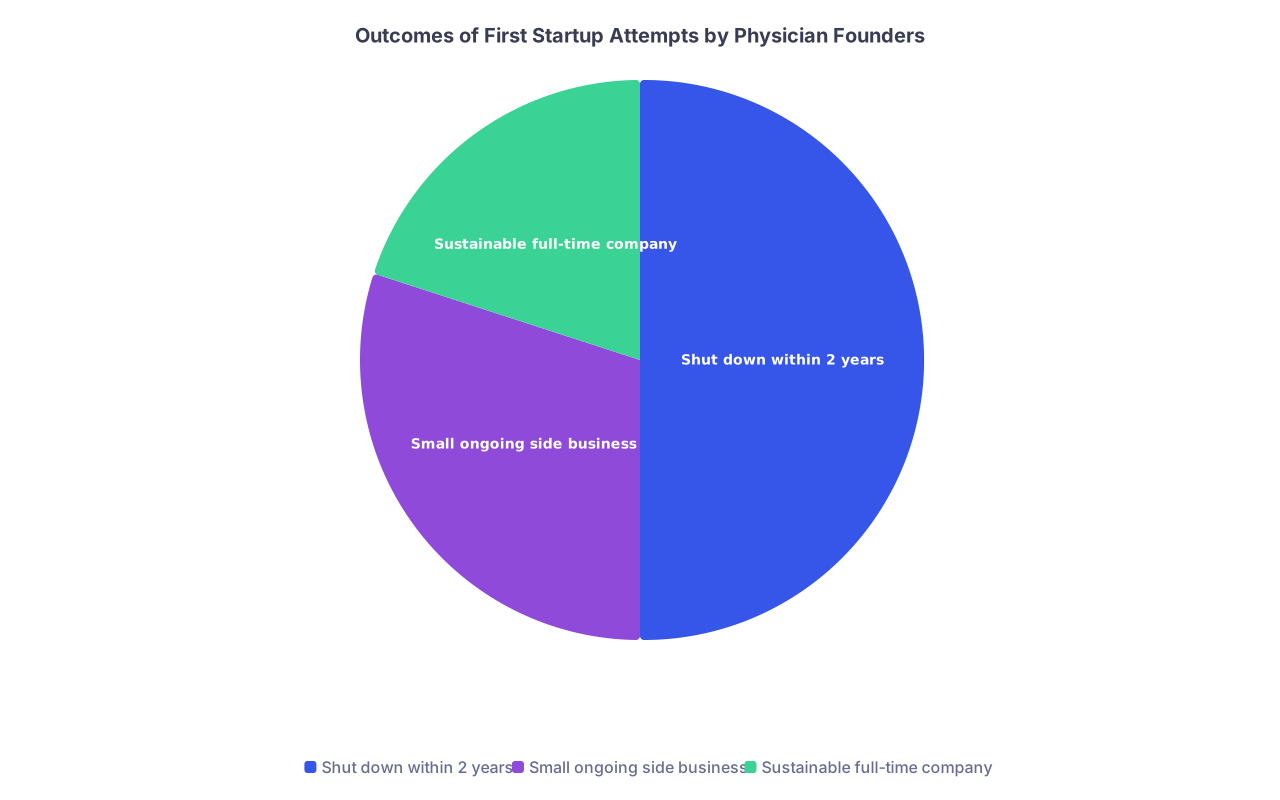
| Category | Value |
|---|---|
| Shut down within 2 years | 50 |
| Small ongoing side business | 30 |
| Sustainable full-time company | 20 |
These numbers aren’t official; they’re just reflective of what I keep seeing. Half shut down or morph into something different. A chunk become nice side businesses. A minority turn into full-on careers.
But you know what almost all of them gain?
- A reputation for being interesting, not pathetic
- Actual skills: product, sales, contracting, basic tech understanding
- Way better opportunities after the “failure” than before it
Hospitals, health systems, and digital health companies like people who have actually tried to build something. Even if it crashed.
You’re scared of becoming “that person who tried a startup and failed.”
What I see more often is: “that doctor who built something cool—even though it didn’t fully work.”
Very different energy.
Tactics Physician Founders Use When They’re Scared Out of Their Minds
Let’s get practical. This is what people actually do to not drown in anxiety.
1. They time their visibility
Most people blast LinkedIn the minute they have a logo. But you don’t have to.
You can set thresholds like:
- “I’ll talk publicly about this once we have our first paying user.”
- “I’ll update my LinkedIn after 3 months of steady pilots.”
- “I’ll start posting content when we’re confident the product won’t be dead in six weeks.”
You pick the line that feels barely tolerable, not soul-crushing.
| Trigger Point | What You Reveal Publicly |
|---|---|
| Idea stage | Tell close friends only |
| First 5 pilot users | Mention to selected colleagues |
| First paying customer | Soft LinkedIn update |
| Consistent revenue | Public founder identity |
You’re not hiding. You’re pacing your exposure.
2. They create a “respectable escape hatch”
The worst fear: “If this flops, I’ll look like a loser with no job.”
So founders quietly secure:
- Per diem clinical shifts
- A part-time appointment at a community hospital
- Telemedicine work they can ramp up if needed
Then if the company dies, the story isn’t “I failed and crawled back.” It’s:
“I tested a company for 18 months while working clinically, learned a ton, and decided to pause it.”
That’s not social annihilation. That’s a mature career experiment.
3. They mentally pre-write the failure story
This sounds dark, but it helps.
Sit down and literally write the “it didn’t work” update you’d post someday if you had to. Something like:
“After 18 months working on X, I’ve decided to wind down the company. We helped Y patients and learned Z about A, B, C. I’m incredibly grateful to everyone who trusted us. I’m now focusing on [new direction].”
Is it painful to imagine? Yes.
But once you’ve seen the words, your brain calms down a bit because the “worst-case public announcement” is no longer a big, formless monster.
You learn: “I could actually survive saying this.”
4. They treat colleagues’ opinions like background noise, not a scoreboard
There will always be:
- The attending who smirks and says, “So you’re leaving real medicine for apps now?”
- The former co-resident who only sees your company when it’s smallest and most awkward
- The LinkedIn lurker who never likes your posts but definitely reads them
Successful founders decide whose opinion counts. Usually:
- People who build things
- People who take risks
- People whose careers you’d actually trade places with
Everyone else becomes… static.
How They Handle Being “Seen” While Still Figuring It Out
Let’s talk about that awful in-between stage: you’re not a real company yet, but you’re too far in to pretend it’s nothing.
You’re visible. And vulnerable. It sucks.
Here’s how physician founders keep from melting down:
, Leaving clinical job](https://cdn.residencyadvisor.com/images/articles_svg/chart-common-anxiety-triggers-for-physician-founders-1007.svg "Common Anxiety Triggers for Physician Founders")
| Category | Value |
|---|---|
| Posting on LinkedIn | 80 |
| Telling colleagues | 65 |
| [Pitching investors](https://residencyadvisor.com/resources/medical-startups/what-investor-meetings-really-look-like-for-physician-founders) | 70 |
| Leaving clinical job | 90 |
They normalize “cringe” as part of the job
Your early website? Kinda ugly.
Your first pitch? Rambling.
Your pricing slide? Wrong.
They stop expecting it to look like a Series C company on day 20. They embrace “messy but real.”
The founders who survive aren’t the least anxious. They’re the ones who say:
“I’m mortified, but I’m going to post this anyway.”
“I hate how rough this looks, but I’m still sending it to five people.”
That’s the muscle. Not confidence. Tolerance for visible imperfection.
They shrink the audience when it feels like too much
You do not have to be doing:
- Twitter/X threads
- LinkedIn thought leadership
- Conference talks
- Podcasts
All at once. Or at all.
Lots of physician founders do:
- One channel only (usually email or LinkedIn)
- One audience segment (e.g., just hospitalists, or just program directors)
- One message, repeated a hundred times
You’re allowed to say no to extra visibility until your nervous system catches up.
The Hidden Upside of “Failing” in Public (That Your Brain Won’t Admit)
Your anxiety is stuck on one frame:
“You fail. Everyone sees. End of movie.”
But here’s what often actually happens when something doesn’t work:
People respect that you tried.
Especially the quiet ones who wish they had the guts.Interesting doors open.
“Hey, we saw what you built. Want to help lead innovation at our system?”
“We’re starting a digital health division. You’ve actually done this stuff. Come talk to us.”You stop being terrified of new attempts.
Once you’ve had one public “didn’t work out,” the spell is broken.
You’ve lived through it. The second time, your hands still shake, but less.
I’ve watched a physician close their first startup with maybe 12 users. Two years later they got recruited as medical director at a health tech company. Why? Because they were the only one in the candidate pool who had actually printed a contract and convinced even 12 people to sign it.
Your anxiety thinks in humiliation. The real world often thinks in signal.
If You’re Post-Residency, Stuck, and Terrified to Be Seen
So where does this leave you, sitting there refreshing your email and avoiding touching your half-finished pitch deck?
Here’s a brutal but honest framing:
You have three choices:
- Stay invisible and safe
- Go visible and pretend you’re not scared (and then probably burn out)
- Go visible strategically while openly accepting you’re terrified and doing it anyway
The founders I see succeed pick option 3.
They:
- Start tiny and local
- Delay big announcements
- Build a soft landing if it doesn’t work
- Prepare for public “failure” in advance
- Give themselves permission to look awkward for a while
You don’t have to suddenly love visibility. Most never do.
You just have to be willing to be a little more visible than your fear says is allowed.
And yes, your colleagues may talk. Some will project their own fear right onto you.
Let them.
They’re watching you do something they’re too scared to try.

FAQs
1. What if my startup fails and I have to go back to full-time clinical work?
Then you go back. With more skills and more perspective than when you left.
Most hospitals don’t blacklist you for trying something. If anything, you become more interesting in interviews:
“I spent a year building a platform to improve follow-up care. It didn’t scale the way we hoped, but I learned a lot about workflows, contracts, and where the system actually breaks.”
That’s not a red flag. That’s a story.
Protect yourself with:
- Maintain a license and board certification
- Keep a toe in clinical (per diem, telemed) if you can
- Don’t ghost your network when you leave
You’re not exiled. You’re just taking a detour.
2. How do I talk about my startup to colleagues without sounding cringe?
Understate. Aggressively.
Bad version:
“I’m building a disruptive AI platform that will transform healthcare.”
Better:
“I’m working on a small tool to help with X problem. We’re piloting it with a few people to see if it’s actually useful.”
Keep it:
- Specific
- Modest
- Framed as an experiment, not a revolution
People cringe when they hear hype with no proof. They respect honest, grounded attempts.
3. Should I quit my job before going public with my startup?
Not automatically. And definitely not just to “look committed.”
Plenty of physician founders:
- Work 0.5–0.7 FTE clinically
- Spend the rest on the company
- Only step away when there’s clear traction (like reliable revenue or funding)
Quitting just to signal seriousness is a fear move, not a business move.
Change your clinical load when the company’s demands justify it, not because of optics.
4. How do I know when it’s “safe” to post about my company on LinkedIn?
It’s never fully safe. But you can pick a milestone that makes you less nauseous. For example:
- You’ve got at least 1–2 real users
- You have something specific to offer (beta signups, pilot slots)
- You’re committed to working on it for at least the next 6–12 months
And you can start small:
- Soft post: “I’ve been spending time working on X. If you’re dealing with Y problem, I’d love to chat.”
No “We’re disrupting healthcare.” No grand declarations.
5. What if other doctors talk about me behind my back?
Some will. That’s reality.
They already talk about:
- The attending who left for pharma
- The colleague who moved into admin
- The person who went part-time for family reasons
People gossip about anyone who leaves the script.
You can’t control the commentary. You can choose:
- Whose opinion you actually lose sleep over
- Who you keep updated directly (mentors, close friends)
- To be the person who will have actually tried something when everyone else is still complaining in the workroom
6. Is it better to wait until my product is perfect before going public?
No. And that’s not perfectionism; that’s self-sabotage dressed up as “standards.”
Healthcare products must be safe and ethical. Yes.
They do not have to be:
- Feature-complete
- Beautiful
- “Exactly how you imagined it”
Better rule:
Launch when it’s safe, honest, and useful to a tiny group of people—even if it’s ugly.
Perfection is usually a way to hide from the fear of being seen.
Key points:
- Physician founders are scared of public failure too; they just reduce the blast radius by starting tiny and delaying big visibility.
- Your first attempt doesn’t define you; it gives you skills and signal that often help your career, even if the company dies.
- You don’t need to be fearless—you just need to be willing to look a little imperfect, a little visible, and keep going anyway.