
The typical advice for dual-career academic couples is naïve. “Just communicate and be flexible.” That is how you end up with one person quietly sacrificing their career while the other pretends it is equal.
You and your partner are both medical educators. You’re juggling teaching, maybe some clinical work, maybe research, and you’re trying to build two careers that actually go somewhere. Not just “we both have jobs,” but real trajectories: promotion, leadership, impact.
Here is the uncomfortable truth: nobody in your institution will coordinate your two careers for you. HR does not care. The Dean’s office is not secretly tracking your couple status. If you want two viable, fulfilling medical educator careers in the same life, you have to run this like a joint strategic project.
Let’s treat it that way.
1. Get Brutally Clear On What Each Career Actually Is
You cannot coordinate two paths if you’ve never really defined either one.
I’ve seen couples say, “We both do medical education,” and then I read their CVs:
- One is essentially a clinician with a teaching hobby
- The other is on a serious educator track with curriculum leadership, scholarship, committees, and a national presence
Those are not the same career. They have different leverage points, different promotion criteria, different flexibility.
Spend one evening doing this exercise. Not vibes. Facts.
A. Map your current roles
For each of you, write down on paper (not just in your head):
- Percent effort: clinical vs teaching vs research vs admin vs “other”
- Titles: institutional title (Assistant Professor, etc.) and functional titles (Course Director, Clerkship Director, Simulation Lead)
- What you’re actually known for right now: “the OSCE person,” “the wellness curriculum person,” “the assessment nerd,” “the doc who always precepts on Wednesdays”
Then write your realistic 5-year target for each person. Not fantasy. Something like:
- “Associate Professor, Director of Preclerkship Education, 30–40% clinical, recognized regionally for simulation-based assessment”
- “Clerkship Director in Internal Medicine, major role in remediation, national-level workshops at AAMC”
Now look at those side by side.
If your paths require:
- Different institutions, or
- Different cities, or
- Very different time demands (e.g., one 80% clinical, one 80% admin/education)
…you’re in a negotiation, not just a scheduling problem.
B. Name your “career driver”
Every dual-career couple I’ve seen succeed had this clear: in any given phase, one person is the career driver and the other is the stabilizer.
That does not mean one person is “more important.” It means:
- Driver: whose career needs the bigger move right now (e.g., leadership role, protected time, big promotion step)
- Stabilizer: whose career can grow with fewer disruptive changes (e.g., same institution, smaller step up, more flexible)
You can and should switch over time. But pretending you are both drivers simultaneously in every decision is how you both stall or one of you quietly loses.
State this out loud: “For the next 3 years, you’re the driver; I’m stabilizing.” Then make decisions accordingly.
2. Turn Vague Hopes Into a Concrete 3–5 Year Plan
If you both just chase “opportunities as they come,” you will end up where the most aggressive recruiter points you, not where you actually wanted to go.
You need a shared horizon.
Build a shared 3–5 year map
Sit down with a calendar (literally pull up 2026, 2027, etc.) and answer these, separately then together:
- Where do we want to be geographically?
- What would a “good” job look like for each of us by Year 5?
- What must we protect? (kids’ schooling, elder care, immigration status, mortgage, etc.)
- What is optional to change? (clinical site, division, leadership role, institution)
Then sketch a rough timeline:
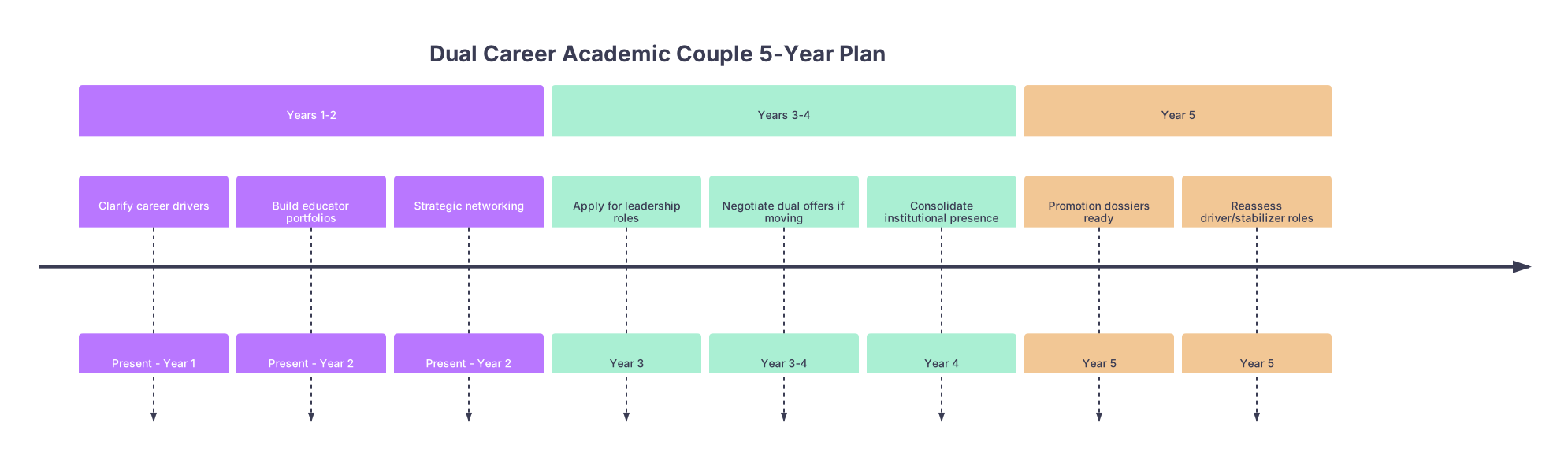
| Period | Event |
|---|---|
| Years 1-2 - Clarify career drivers | Present - Year 1 |
| Years 1-2 - Build educator portfolios | Present - Year 2 |
| Years 1-2 - Strategic networking | Present - Year 2 |
| Years 3-4 - Apply for leadership roles | Year 3 |
| Years 3-4 - Negotiate dual offers if moving | Year 3-4 |
| Years 3-4 - Consolidate institutional presence | Year 4 |
| Year 5 - Promotion dossiers ready | Year 5 |
| Year 5 - Reassess driver/stabilizer roles | Year 5 |
This is not rigid. Life will blow it up in parts. But now when one of you gets an email saying, “We’re starting a search for Vice Chair of Education,” you can ask: does this fit the 5-year map, or is it a shiny distraction?
3. Understand What Academic Medicine Actually Trades In
You and your partner are in medical education, not just medicine. The currency is slightly different. It’s not just “RVUs and publications.”
You need to coordinate around three currencies:
- Titles and roles – Course Director, Clerkship Director, Program Director, Vice Chair for Education, Associate Dean.
- Protected time – Percent FTE for education or administration that is genuinely off-limits to clinical reassignment.
- Reputation and network – Who knows you in the med ed world, locally and nationally.
Here’s a quick comparison table I’ve used with couples in exactly your situation:
| Lever | Why It Matters | Coordination Risk for Couples |
|---|---|---|
| Course/Clerkship Directorship | Entry to leadership + protected time | Both taking new roles at once overloads family life |
| Program Directorship (UME/GME) | Huge influence, often 50%+ FTE | One takes PD, other may need a more flexible phase |
| Protected Time Lines | Determines burnout vs growth | Misaligned protected time → resentment and imbalance |
| Promotion Clocks | Impacts pressure and job mobility | Being out of sync makes joint moves harder |
| National Involvement | Opens future options | If only one invests here, power imbalance grows |
You do not both need the same lever at the same time. In fact, that often backfires. Far better to stagger:
- Years 1–3: Person A takes the big role; Person B stabilizes but steadily builds scholarship.
- Years 4–6: Person B steps into a larger leadership role; Person A consolidates or shifts to a role with more flexibility.
4. If You’re Early-Career: Do NOT Overcommit Both Careers at Once
Phase: assistant professor, maybe just finished fellowship, first real med school teaching positions.
This is where people blow it. They’re flattered. They both say “yes” to everything. Within 18 months:
- Two course directorships
- Two major committees
- Full clinical loads
- Maybe a toddler at home
Resentment is inevitable. And one person’s “yes” will cost the other person opportunities.
For early-career dual-educator couples, here’s a sane structure:
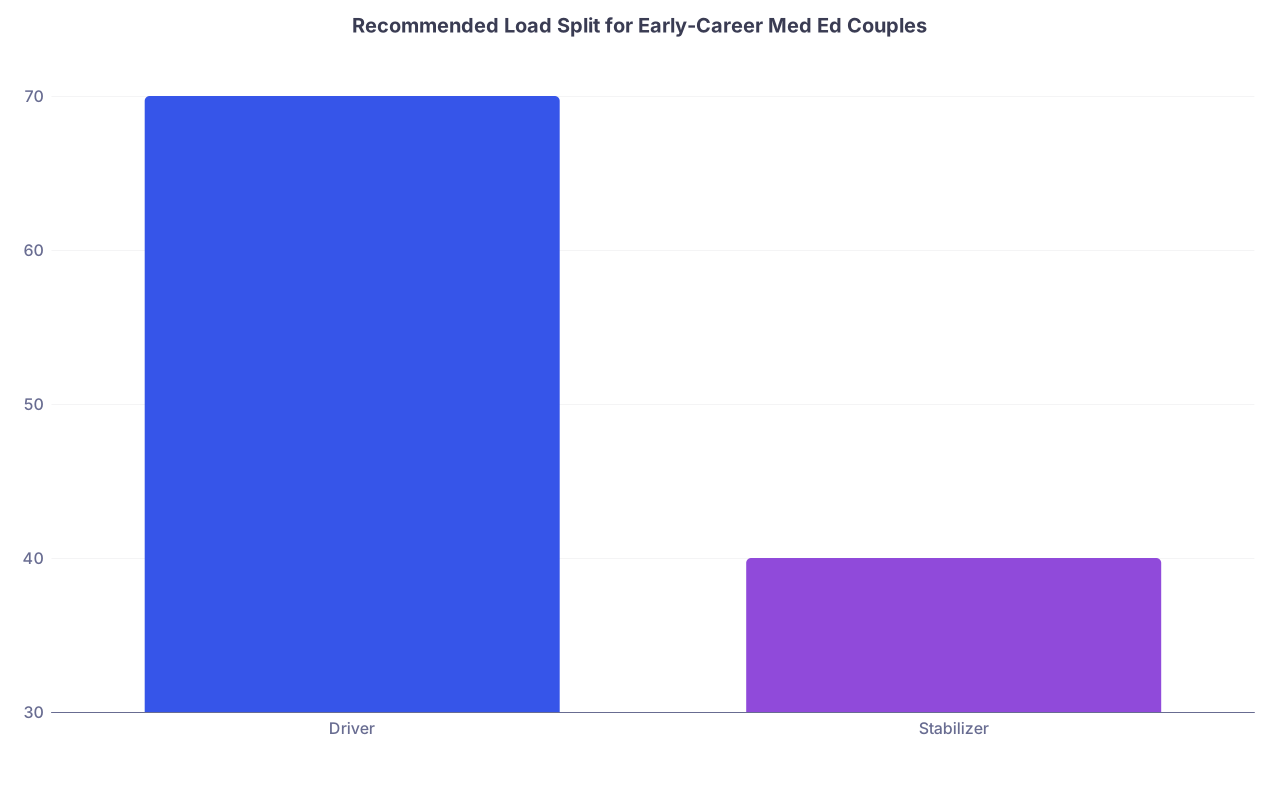
| Category | Value |
|---|---|
| Driver | 70 |
| Stabilizer | 40 |
Interpretation (not exact percentages, but relative):
- Driver: carries bigger leadership role and more visible institutional responsibility
- Stabilizer: carries a smaller but real educator role, more clinical or family flexibility, plus deliberate scholarship building
Concrete moves:
- Only one of you becomes a Course/Clerkship Director in the first 3–4 years at a new institution.
- The other takes roles like small group leadership, OSCE design, assessment committee – real but more modular.
- You purposely schedule non-overlapping peak times: if one has a heavy curriculum-change year, the other avoids major new projects.
If a chair tries to recruit both of you into big roles at the same time, you say: “We’re a dual-career academic couple and want sustainability. We’d like to stagger major leadership roles over a few years.”
That line changes the conversation immediately.
5. If You’re Mid-Career: Avoid the “One Star, One Support Staff” Trap
Phase: one or both at associate professor level, maybe one of you is already a PD, Clerkship Director, Vice Chair, or similar.
This is where I see couples get stuck for a decade. One becomes “famous” and the other becomes invisible support.
Typical pattern:
- Person A: Associate Professor, Director of Something Big, known nationally, speaking at conferences, grants, leadership programs.
- Person B: quietly runs half the actual work, teaches heavily, but lacks titles and national visibility.
Everyone outside your home thinks you’re a power couple. Inside, it tastes bitter.
If this feels uncomfortably familiar, you need a recalibration phase. Not a fight. A re-engineering.
Try this approach:
Sit down with both CVs and mark:
- Leadership roles
- Protected time
- National presentations/committees
- Promotion readiness (or already promoted)
Ask two blunt questions:
- Who has gotten the bigger institutional lift in the last 5 years?
- What would it take for the other person to get an equivalent lift in the next 3–5 years?
Then map a re-balance:
- The current “star” might intentionally decline the next big role and instead mentor the other into visibility.
- The “support” person targets one specific high-yield step: e.g., associate PD, course co-director with a path to director, or chairing a key curriculum committee.
You can literally say to your chair or dean: “My partner and I are both committed medical educators in this institution. In the next few years, I’d like to grow into X-type role while my partner consolidates Y. How can we sequence that so the department benefits from both of us long-term?”
If they glaze over or show no interest in helping either of you grow, that is data. It might be time to consider a dual move.
6. Coordinating a Dual Job Search (The Part Nobody Teaches You)
Trying to move institutions as a dual-career academic couple is… not fun. But there’s a playbook.
Step 1: Decide your “anchor” specialty and person
Some fields are easier to place than others.
In many markets:
- Internal medicine, family medicine, pediatrics – relatively easier to place
- Neurosurgery, dermatology, some subspecialties – much harder to fit, especially with specific FTE or niche needs
If one of you is in a high-demand, narrow field (e.g., pediatric nephrology) and the other is a more easily placed clinician-educator (e.g., general internal medicine hospitalist), your anchor for negotiation is usually the scarce one.
But the driver might be the other person, if their educator career is at a key inflection point. You have to consciously choose which combination you’re optimizing.
Step 2: Decide your disclosure strategy
You do not lead with “we’re a dual-career couple” in the first 10 minutes of first contact. You also don’t hide it until the day of the offer.
What usually works:
Initial contact / first interview: talk about your own fit and vision.
Once there is clear interest (second interview, or explicit “we’re moving towards an offer”): say something like:
“I want to share something that’s important for long-term fit. My partner is also a medical educator and academic physician, currently [role]. We’re looking for roles where both of us can contribute meaningfully. Is there a good way to explore whether there might be opportunities for them here as well?”
Good chairs and deans hear this all the time. They may have spousal hire mechanisms. Or they may not—but you’ve signaled that your decision depends on two careers, not one.
Step 3: Use the med ed angle as an asset
Administrative and education FTE are often more flexible than clinical slots. Many schools can creatively build roles like:
- 0.4–0.5 FTE in an education office (curriculum, assessment, simulation, faculty dev)
- 0.5–0.6 FTE clinical
For you two, that means you can propose creative combinations that a pure clinician couple cannot.
Be ready with a one-page concept for each of you:
- Brief background (3–4 lines)
- 2–3 key med ed strengths
- 1–2 possible roles you could fill (even if they do not yet have a formal posting)
7. Day-to-Day Logistics So You Both Don’t Burn Out
People romanticize “we both teach and practice medicine.” The reality can be two exhausted people on Zoom at 9pm finishing slides.
You need operational rules. Not just vibes.
Here are configurations I’ve seen work:
A. Protected “deep work” blocks that do not overlap
Both of you needing quiet time at home every evening to prep teaching? Disaster.
Instead:
- Person A: protected deep-work afternoon (e.g., Mondays 1–5 pm), no clinical, no meetings, no family duties.
- Person B: a different half day.
You defend those blocks like OR time. You don’t “trade” them constantly for childcare or errands.
B. Asynchronous peak responsibilities
Try like hell to avoid both having:
- OSCE weeks
- Major course launch weeks
- Recruitment interview seasons
- Grant deadlines
…all at the same time.
Obviously you cannot control everything. But you can:
- Coordinate with your curriculum offices when volunteering or accepting roles: “My partner runs the OSCE in March; I’d like my heaviest assessment period to be fall if possible.”
- Choose complementary roles: one heavy in summer, one heavy in winter.
C. A household “minimum viable support” plan
This is unglamorous but non-negotiable if you’re both in serious academic roles.
Baseline rules I’ve seen sustain couples:
- You outsource at least one domestic burden if you can afford it (cleaning, lawn, grocery delivery).
- You have backup childcare written down for your heaviest weeks.
- You define non-negotiable recovery times after major pushes (e.g., after an OSCE cycle, that weekend is off-limits to extra work for that person).
8. Promotion and Recognition: Keep Both Ladders Visible
Big risk: you both get so busy running the machine that you forget to climb the ladder.
You should, at minimum, do this once a year:
Each of you meets with your department’s promotions person or vice chair for faculty development.
You bring your CV and ask four questions:
- Where am I on the promotion trajectory?
- What’s missing for the next step?
- Which of my current roles actually count toward that?
- What should I say no to this year?
You then sit together at home and compare notes.
If one of you keeps hearing, “You’re ready for promotion soon,” and the other keeps hearing, “You need more scholarship/national activity,” then your family-level planning should give the latter person more bandwidth for scholarship this year.
And if either of you is on an “educator track” or “clinician-educator track,” you absolutely need to treat educational scholarship as real work, not nights-and-weekends hobby. That means one or both of you negotiating for:
- Named protected time for scholarly activities (assessment projects, curriculum research, etc.)
- Resources: access to biostat support, education research collaborators, etc.
Your partnership should amplify, not cannibalize, that effort.
9. When You’re Hitting a Wall Institutionally
Sometimes the problem isn’t your planning; it’s your environment.
Red flags that your current institution is hostile or indifferent to dual-career medical educator growth:
- They constantly “forget” that your partner is also an educator and only negotiate around the higher-RVU or more prestigious clinical subspecialty.
- There’s no transparent educator promotion pathway.
- They chronically erode your protected time and say, “it’s just for now.”
- There’s no serious faculty development or leadership pipeline for educators.
- Every time you raise coordinated planning, you’re told, “We can only look at individuals, not couples.”
You have three options:
Accept that one of you will have a limited career and decide if that is tolerable. For some couples, it is, if done consciously.
Shift your expectations and invest more in national work, remote collaborations, or part-time roles that build your portfolio anyway.
Start planning a dual move over 2–3 years, not 2–3 months. That means:
- Both polishing CVs and educator portfolios now.
- Presenting at national conferences together and separately.
- Quietly exploring institutions known to be friendly to educator couples (some schools have strong med ed centers and are used to splitting FTE creatively).
Do not stay a decade in a place that demonstrably will not grow either of you in the direction you want.
10. How to Talk to Each Other About All This Without Blowing Up
Everything I’ve written so far is operational. The emotional side is where people crash.
A few ground rules for the conversations you will need:
- You are a team against the system, not against each other. Academic medicine will happily exploit both of you; do not reenact that at home.
- Call out invisible labor. If one person is quietly doing the majority of child/household/emotional logistics, that’s part of career bargaining. You don’t fix career inequity without addressing that.
- Name resentment early. It’s much easier to solve “I feel like I’ve been saying yes to more childcare slots this semester” than “For 10 years I gave up my career for yours.”
Concrete script that helps:
“For the next 3 years, I want to prioritize your step into [role]. But I need us to agree on what that actually costs me and what I get, career-wise, in the following 3–5 years.”
This is how adults trade. Not with martyrdom, not with vague promises.