
The way most institutions talk about Entrustable Professional Activities sounds elegant. The way they actually use them on the wards is a mess.
Let me break down how to operationalize EPAs so they stop being a buzzword in your curriculum document and start driving what your students and junior residents actually do at 3 a.m. in the step-down unit.
1. What EPAs Actually Are (And What They’re Not)
EPAs are not checklists. They are not mini-CEXs with different branding. They are chunks of clinical work that you either trust a trainee to do with a certain level of supervision…or you do not.
The classic undergraduate medical education example: “EPA 1 – Gather a history and perform a physical examination.” That is a unit of work. You can picture a student doing it, you can decide whether you need to go in with them, and you can say, “Yes, I’d be comfortable if they did this alone and reported back.”
At their core, EPAs combine:
- A defined activity (e.g., “prioritize differentials and initial workup for a new admission”).
- A supervision level (from direct, in-room supervision to unsupervised practice with distant oversight).
- A judgment of trust, in context, for a specific trainee.
Where people go wrong:
- They treat EPAs as static tick-boxes, not as ongoing trust decisions.
- They push “EPA mapping” at the curriculum level and never translate it to ward-level behavior.
- They drown faculty in 13 national EPAs without telling them: “On night float, these 2 are your core business.”
If you are on the wards, you do not need theory. You need a simple structure:
- What EPAs actually matter on this rotation?
- What supervision levels am I aiming for, by when?
- How do I communicate and document that without killing my workflow?
We will build exactly that.
2. The EPA Operationalization Blueprint (Ward-Level)
On a busy inpatient service, you realistically operationalize 4–6 EPAs, not all 13. You tie them to specific ward routines: pre-rounds, admissions, discharge, cross-cover, consults.
Pick Your Core EPAs Per Setting
For a general medicine ward with third-year medical students and PGY1 residents, your “live” EPAs might be:
- EPA 1: History and physical exam.
- EPA 2: Prioritizing differential dx and initial tests.
- EPA 3: Oral and written handover.
- EPA 4: Urgent evaluation of a deteriorating patient.
- EPA 5: Inter-professional communication (nursing, consult services).
- EPA 6: Documentation and orders.
You do not need laminated cards for all of them. You need clarity for the team.
| EPA # | Activity Focus |
|---|---|
| 1 | History and physical exam |
| 2 | Differential and initial workup |
| 3 | Handover and sign-out |
| 4 | Acute patient evaluation |
| 5 | Inter-professional communication |
| 6 | Documentation and order entry |
Now the key step: link each to a supervision gradient.
The Supervision Levels You Should Actually Use
Most frameworks use 5 levels. On the wards, you only need 4 in your vocabulary:
- Level 1 – “Watch me while I do it.”
- Level 2 – “Do it while I’m physically there.”
- Level 3 – “Do it, then check out with me before action.”
- Level 4 – “Do it, and just inform me as needed.”
When I operationalize this for teams, I literally say it that way. Short, plain language. People remember.
You’re not “granting” Level 4 permanently. You’re saying: In this clinical context, for this EPA, with this patient complexity, I trust you at this level. That can go up or down.
Now, how do you embed this in routines instead of in some faculty development slide deck? You anchor each EPA to a specific daily activity.
3. Integrating EPAs Into Ward Workflow
If EPAs do not live inside your normal workflow, they die. Fast. So we rig the workflow.
A. Morning: Pre-rounds and Admission Work
Morning pre-rounds are where EPAs 1, 2, and 6 should quietly run your script.
For third-year students:
- Goal by end of rotation:
- EPA 1 at Level 3 (they see the patient alone; you repeat key elements as needed).
- EPA 2 at Level 2–3 (they propose a differential and plan; you heavily edit early, endorse more later).
- EPA 6 at Level 2–3 (they draft notes and basic orders; you finalize and cosign).
For PGY1s:
- Goal by 2–3 months into internship on a familiar service:
- EPA 1 at Level 4 for routine patients.
- EPA 2 at Level 3–4 depending on patient complexity.
- EPA 6 at Level 4 except for high-risk orders.
During pre-rounds, you ask different questions depending on EPA and expected level:
Low EPA level (e.g., new M3, EPA 2 at Level 1–2):
“Talk me through your top three diagnoses and what tests you’d order. Why those? What are you worried about missing?”Higher EPA level (e.g., late M4 or strong PGY1):
“What is the problem list, what are you ruling out, and what have you already ordered? Anything you’re not sure I’d agree with?”
That’s EPA in action: you adjust how much you let them act before you step in.
B. Midday: Cross-Cover and Pages
This is where EPA 4 and EPA 5 become concrete. Most programs are terrible at making this explicit. They either let interns flail or overprotect them.
You can do this better in under 60 seconds at sign-out.

| Step | Description |
|---|---|
| Step 1 | Start of Cross-cover |
| Step 2 | All nurse pages triaged by senior first |
| Step 3 | Nurse calls trainee first, senior on standby |
| Step 4 | Trainee evaluates and updates senior as needed |
| Step 5 | Reassess level after events |
| Step 6 | Trainee EPA 4 Level |
Tell the team explicitly:
- “On acute changes overnight, I consider you Level 3 for urgent evaluation. That means: you go see the patient, initiate basics (vitals, O2, STAT labs), and call me before any big management decisions or transfers.”
- Or, for a stronger PGY1: “You are Level 4 for straightforward issues. If you’re thinking pressors, transfer, or code status changes, bump me early.”
Nurses will feel the difference when this is actually spelled out on day one instead of implicitly assumed.
C. End of Day: Handover as EPA 3
Sign-out is EPA 3 in pure form. You train it like a procedure.
- Day 1–2: Student / PGY1 gives sign-out with you right there (Level 2). You interrupt and restructure it out loud.
- Mid-rotation: They give sign-out, you listen off to the side or at the end (Level 3). Debrief afterward: “You buried the lead about that GI bleed. Start with the sickest patient.”
- Late-rotation: You let them run it (Level 4), you step in only for major safety issues.
Use a simple pattern like I-PASS or your institution’s equivalent. But the EPA twist is: you explicitly label the expected supervision level for that trainee and tell them what they would need to do to “level up” their handoff.
D. Weekly: 5-Minute “EPA Rounds”
Once a week, you carve out 5–10 minutes. That is it. Quickly tag each trainee’s EPA level trajectory.
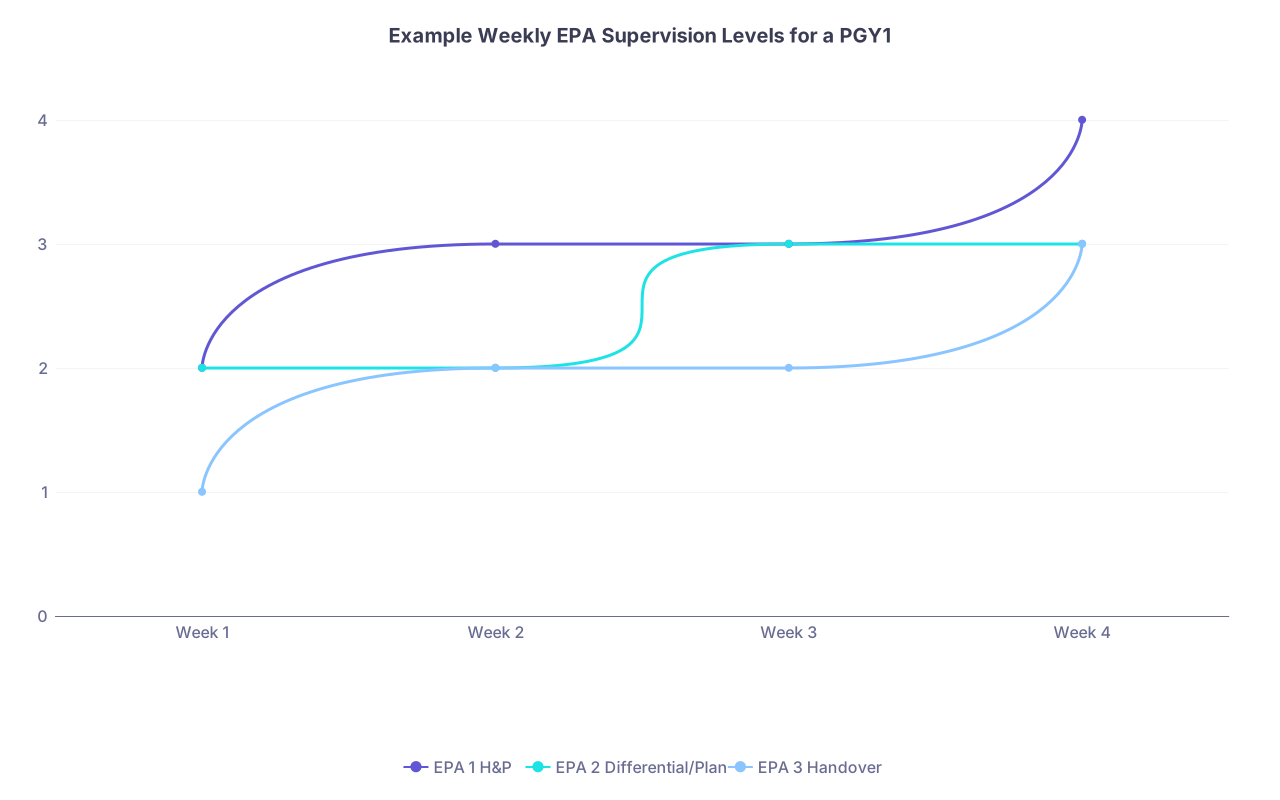
| Category | EPA 1 H&P | EPA 2 Differential/Plan | EPA 3 Handover |
|---|---|---|---|
| Week 1 | 2 | 2 | 1 |
| Week 2 | 3 | 2 | 2 |
| Week 3 | 3 | 3 | 2 |
| Week 4 | 4 | 3 | 3 |
Have a one-sentence rule for escalation:
- If supervision level does not improve by at least 1 step over 2–3 weeks, that is a flag.
- If supervision needs regress by 2 levels (e.g., from 4 to 2 after a safety event), you explicitly reset expectations and document.
Those trajectories matter more than the final number.
4. Making EPA Assessments Fast and Honest
The usual barrier: “I don’t have time to fill out more forms.” Fair. So you design EPA documentation to steal, not add, time.
A. Collapse Assessment Into 3 Elements
For each observation (even informal), you only need:
- EPA number / short label.
- Supervision level used in that encounter.
- One-line rationale / feedback.
Example from a call night:
- “EPA 4 – Level 3: You went to see the patient quickly and gathered key data. Next time, activate the rapid response earlier if lactate or mental status makes you nervous.”
This can be typed into:
- A simple EPA tile in your existing evaluation system.
- A running “coaching log” note in the EMR (not ideal, but I have seen it used).
- A shared team spreadsheet during pilot phases.
B. Use Micro-Observations, Not Grand Judgments
You do not wait until the end of the block to decide if someone is “entrustable.” You make dozens of micro-calls:
- Each handoff you hear.
- Each discharge summary you cosign.
- Each cross-cover call they field.
Most will never be formally logged. But at least a few per week should be captured intentionally, especially for borderline trainees.

When you actually sit down for mid-rotation feedback, you pull those 5–10 data points and say:
- “Here is your trajectory in EPA 3 (handoff). You started at Level 1–2; now I mostly stand back at Level 3. To get to Level 4, I need you to consistently front-load the biggest overnight risks and contingency plans.”
That is a lot more actionable than “communication needs improvement.”
C. Anchor Feedback to Specific Behaviors
Trust is vague; behavior is not. For each EPA, define 3–5 concrete behaviors that correspond to higher supervision levels.
Example: EPA 4 – Acute patient evaluation.
Moving from Level 2 to Level 3:
- Goes to bedside without prompting.
- Gets full vital signs and quick focused H&P.
- Articulates “sick vs stable” in one sentence.
Moving from Level 3 to Level 4:
- Activates additional resources appropriately (rapid response, ICU consult).
- Initiates initial interventions without delay (fluids, oxygen, basic meds within scope).
- Calls senior with a clear assessment and question, not just a narrative.
When you see those behaviors consistently, you bump the level. If they go missing, you drop back down.
5. Aligning EPAs With Milestones, Competencies, and Reality
If you are in GME or UME leadership, you cannot pretend EPAs float alone. They connect directly to existing frameworks.
A. Mapping EPAs to Milestones
Most UME and GME programs already have milestone levels per competency domain. You do not need to start over. You map.
| EPA | Main Milestone Domains |
|---|---|
| 1 | Patient Care, Medical Knowledge |
| 3 | Interpersonal, Systems-based |
| 4 | Patient Care, PBLI, Professionalism |
What changes with EPAs is the lens: you stop asking, “Are they at PC2.3 level 3?” and instead ask, “For an acute deterioration at 2 a.m., what level of supervision do I need for this person?” The milestones can sit behind the scenes to justify your call.
B. Avoiding the Documentation Overload Trap
I have seen programs fail by:
- Requiring a separate EPA form for each observed encounter.
- Using long narrative rubrics for each micro-entrustment.
Do the opposite. Integrate EPAs into what you already do:
- End-of-rotation form: Instead of 30 granular items, include ~5 EPA “global entrustment” items for this setting, each with a supervision level scale plus brief comment.
- Mini-CEX: Add a quick EPA tag (which EPA did you implicitly observe?) and a supervision level, alongside the traditional domains.
- Clinical competency committee: Review patterns of entrustment levels across settings, not just Likert-scale checkboxes.
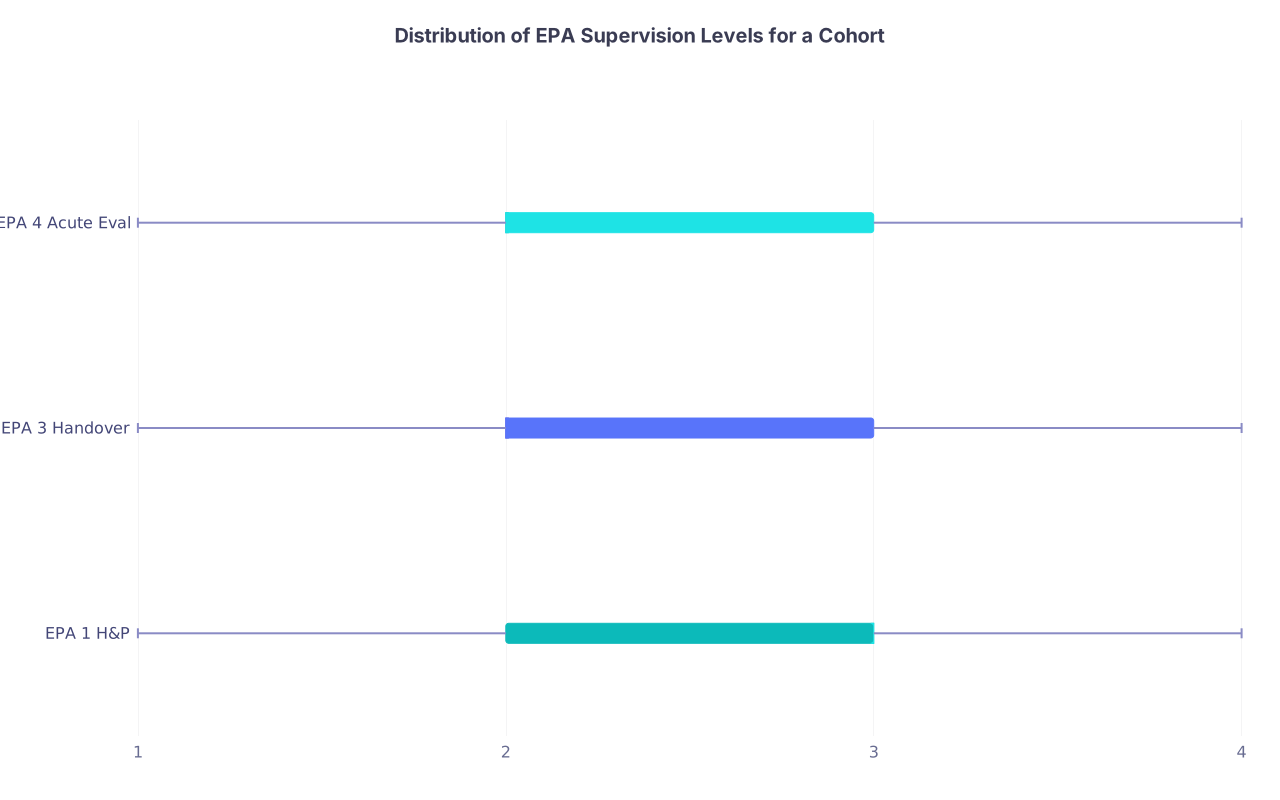
| Category | Min | Q1 | Median | Q3 | Max |
|---|---|---|---|---|---|
| EPA 1 H&P | 1 | 2 | 3 | 3 | 4 |
| EPA 3 Handover | 1 | 2 | 2 | 3 | 4 |
| EPA 4 Acute Eval | 1 | 2 | 2 | 3 | 4 |
That kind of visual (even if you never generate the actual boxplot) is what your CCC needs: where are trainees clustered, and which EPAs lag behind?
6. Handling Struggling Trainees Using EPAs
EPAs are brutal in one good way: they expose when a trainee can “talk a good game” but cannot be trusted to act.
A. Spotting Red Flags Early
Patterns that should concern you:
- A PGY1 who is still at Level 1–2 for EPA 3 (handover) after 2 months on wards.
- A senior student whom no attending is comfortable letting write discharge orders without line-by-line review (EPA 6 stuck at Level 2).
- A resident who “knows the medicine” but is repeatedly late to bedside for urgent pages (EPA 4 behavior mismatch).
Because entrustment is an integrated judgment, these patterns carry more weight than a single bad day.
B. Designing EPA-Focused Remediation
Do not send them to another generic communication workshop. Target the EPA.
Example: EPA 3 – Handover remediation plan:
- Week 1: Micro-observation of every sign-out for 2–3 days, with immediate 1–2 line feedback.
- Assign a script (e.g., I-PASS) and have them practice on one stable and one unstable patient each day with the attending present.
- Document supervision level and specific misses (“You forgot code status and overnight risk”).
If improvement stalls, you escalate support and consider formal performance plans. But now your documentation reads like this:
“Despite two weeks of direct observation and coaching, trainee remains at supervision Level 2 for EPA 3 in a context where Level 3–4 is expected. Persistent difficulty in organizing handoff around anticipatory guidance and contingency planning, creating risk for missed deterioration.”
That is far more defensible than “communication below level.”

7. Faculty Development That Actually Works
Most faculty development on EPAs is painful. Too theoretical, too long, zero relevance to the wards.
If you want clinicians to operationalize EPAs, you hit three things, fast:
- Shared mental model of supervision levels (in simple language).
- 2–3 example EPAs they will see tomorrow on their own service.
- Phrases to use on the ward and in feedback.
A. Teach the “Supervision Language” First
You can do this in a 10-minute huddle:
- “When I say Level 2, I mean you are doing it while I am physically there.
- Level 3: you do it and check out with me before acting.
- Level 4: you act and inform me as needed, based on your judgment.”
Run one concrete scenario:
- “New GI bleed admission at 8 p.m. PGY1 is new to wards. Based on tonight’s performance, what level would you use tomorrow if another similar case came in?”
Make people say it out loud.
B. Give Ready-to-Use Ward Phrases
Examples you want attendings and seniors to start using:
- “For handoff tonight, I consider you at Level 3. Run everything by me before you close out sign-out.”
- “You just demonstrated Level 4 performance in evaluating that hypotensive patient. You got the team there fast and had a clear plan before calling me.”
- “I am stepping you back to Level 2 for acute calls after that event. We will build back up, but for now I want you to call me before acting.”
Those statements change behavior and set psychological safety: trust is dynamic but transparent.
C. Keep It Visible
Use simple tools:
- A one-page card with your service’s “active EPAs” and short level descriptions.
- Whiteboard reminders in the team room (“This week: focus on EPA 3 – Handover; goal: level up at least one learner.”).
- Quick debrief in resident reports where someone presents a case through the EPA lens: “Was this resident acting at appropriate supervision level for EPA 4?”
8. Bringing Students Into the EPA Game
Most students experience EPA language only in official forms they never see. That is a waste.
You want them using EPA terminology to:
- Self-assess.
- Ask for graduated autonomy.
- Understand why they are being supervised so closely on some tasks and not others.
Have them write, at the start of the rotation:
- “On this service, I’d like to reach at least Level 3 for EPA 1 and EPA 3, and Level 2–3 for EPA 4.”
Mid-rotation, ask them:
- “Pick one event where you felt over-supervised and one where you felt under-supervised. What EPA and level do you think applied in each case?”
You are teaching self-regulated learning and professional insight, not just skills.
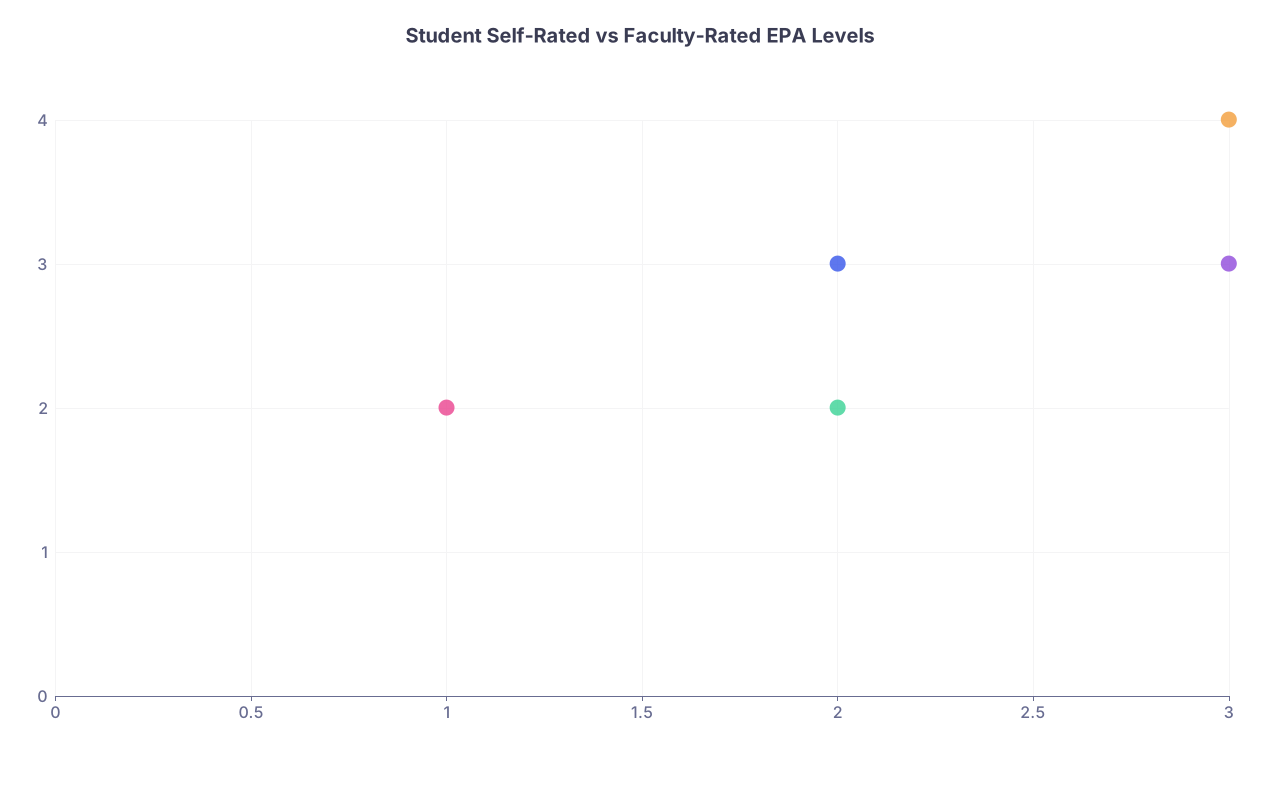
| Category | Value |
|---|---|
| Student 1 | 2,3 |
| Student 2 | 3,3 |
| Student 3 | 2,2 |
| Student 4 | 3,4 |
| Student 5 | 1,2 |
Looking at discrepancies like this (self vs faculty for a given EPA) during mid-rotation feedback is eye-opening—for both sides.
9. Practical Implementation Plan (First 3 Months)
If you are serious about operationalizing EPAs on wards, stop rewriting documents and start small and concrete.
Month 1 – Pilot on one ward team:
- Choose 3–4 EPAs.
- Teach the 4-level supervision language to attendings and residents in a 15-minute session.
- Build a one-page EPA card and a very short, mobile-friendly logging tool (even a shared online form).
Month 2 – Collect real stories:
- Ask for 2–3 “EPA moments” per week per attending—places where trust decisions shifted strongly up or down.
- Share these anonymized in morning reports or debrief sessions.
- Adjust expectations if something is clearly misaligned with patient safety or workload.
Month 3 – Scale up slightly:
- Add one more EPA, or add a second ward team.
- Start feeding EPA-level trends into existing evaluation and CCC meetings.
- Cut at least one redundant evaluation item and replace it with an EPA-based question, so this is swap, not addition.
If it feels like an academic exercise with no impact on scheduling, supervision, or evaluation decisions, you have missed the point.
FAQ (Exactly 4 Questions)
1. How many EPAs should a single rotation realistically focus on?
Four to six. Any more and faculty ignore them. Pick the activities that are most safety-critical and high-frequency on that service—admissions, handover, acute evaluations, documentation—and leave the rest for other rotations or settings.
2. What do I do when faculty disagree on a trainee’s EPA supervision level?
You do not average them. You examine the contexts. A resident might be Level 4 for routine admissions but Level 2 for unstable patients. Have faculty specify the clinical context with their level. Use the “lowest safe supervision level in the highest-risk context” as your anchor for patient safety and remediation.
3. How do EPAs interact with traditional grades or summative evaluations?
EPAs should not replace final grades outright, but they should heavily inform them. A student who consistently functions at higher supervision levels for core EPAs should not receive the same global rating as one who requires constant oversight, regardless of test scores or likeability. Use EPA patterns as the backbone, and let narrative comments and exam performance add nuance.
4. Can EPAs be used in subspecialty or purely consult-based services?
Absolutely, but the EPAs must match the work. For a consult service, EPAs around consult question clarification, focused history and exam, succinct consult notes, and communication with primary teams become central. You are still deciding how much you trust a trainee to independently perform those core tasks and represent your service safely—that is EPA territory, just in a narrower domain.