
It is 10:42 p.m. You have finally signed your last note, the list is stable enough that no one is hovering at the door, and New Innovations / MedHub / E*Value is glaring at you with six overdue resident evaluations.
You click into the first one. Milestones checkboxes. EPA levels. You blaze through them in under a minute.
Then the free-text box appears:
“Please provide narrative comments on this resident’s performance.”
Your brain: completely empty. You type “Pleasure to work with. Hard worker. Will be an excellent physician.” You know it is useless. They know it is useless. But you hit submit anyway.
Let me be blunt: that kind of narrative assessment is noise. It helps nobody. Not the resident, not the CCC, not your program when it gets audited, and not you when you are trying to remember in 18 months whether this person is safe to graduate.
The good news: writing narrative comments that are actually useful is a skill. It is learnable, and it does not require long essays or creative writing talent. It requires structure, specificity, and a bit of discipline.
Let me walk you through it properly.
What Narrative Assessment Is Actually For (And Who Uses It)
Before fixing how you write, you need to be clear on what problem narrative assessment is supposed to solve.
Milestones, EPAs, numeric ratings—they compress a complex human into a few digits or levels. They are necessary for aggregation but terrible for:
- Explaining why you gave a certain rating
- Distinguishing “okay but needs support” from “outstanding and independent”
- Documenting professionalism, judgment, and longitudinal concerns
- Providing residents with something actionable to do differently next month
Narrative comments are the evidence layer under those ratings.
Who actually reads what you write?
Clinical Competency Committee (CCC).
This is the big one. The CCC is trying to answer:- Is this resident on track for graduation?
- Are there patterns across rotations?
- Are there specific, recurring issues (handoffs, professionalism, clinical reasoning)?
They will scan dozens of comments in one sitting. Vague praise is dismissed instantly. Specific behavior-based comments get highlighted and quoted.
Program Director and Associate PDs.
They use your comments for:- Remediation plans
- Letters of recommendation
- Difficult conversations (“Here is what multiple attendings have observed…”)
The resident.
When residents actually see useful narrative feedback, they:- Identify what is working
- See concrete examples of where they fell short
- Build a growth trajectory that is not just “be more confident”
Accrediting bodies and institutional oversight.
When something goes wrong and someone asks, “Did you have any earlier concerns?” your narrative assessments are Exhibit A. “Great to work with” repeated 20 times will not look good if a serious issue surfaces later.
So: the target use-case for your comments is decision support. Graduation, remediation, promotion, entrustment.
Not morale-boosting. Not politeness. Decision support.
Why Your Current Comments Are Probably Useless
I have read thousands of narrative comments on residents across multiple programs. The same five problems show up over and over.
1. Generic praise with no content
“Great resident. Hard worker. Team player. Will be an excellent attending.”
Nice sentiment. Zero informational value.
The CCC cannot:
- Map that to any milestone
- See specific strengths
- See conditions (e.g., “great when the service is light, struggles under pressure”)
Residents cannot:
- Replicate what worked
- Prioritize their development
2. Global judgments instead of behaviors
“She is a natural leader.”
“He lacks confidence.”
“Very smart but needs to trust himself more.”
These are labels, not observations. They hide the actual behavior:
- What did “natural leader” look like on a Tuesday morning with a crashing patient?
- What did “lacks confidence” look like during prerounds or family meetings?
Labels are almost impossible to remediate. Behaviors are not.
3. Vague “needs improvement” with no direction
“Could improve time management.”
“Needs to work on communication.”
“Should read more about patients.”
Everything and everyone could improve those. They are filler if you do not name how.
If the behavior cannot be visualized as a brief video clip, it is too vague.
4. Mixed-signals comments
You have seen this:
“Pleasure to work with. Great attitude. Occasionally struggles with presentations but overall doing well.”
The CCC tries to translate: is this benign “junior is junior” struggling, or is this code for “not safe for level”?
The real intent often was: “Struggles significantly with case synthesis and cannot present independently, but is nice and I don’t want to tank them.”
So the comment gets sanded down and becomes useless for everyone.
5. Time-of-click bias
You write evals two weeks later, with no notes, relying on vibes.
That leads to:
- Recency bias (the last call night dominates the month)
- Halo effect (one great family meeting colors everything)
- Underreporting of subtle, repeated issues
If you do not capture at least a few real-time examples, your narrative assessment will be cloudy at best.
The Core Template: SOAR Comments
You do not need a hundred frameworks. Use one.
I like SOAR: Situation – Observation – Assessment – Recommendation.
Example first, then breakdown.
“On a busy cross-cover shift when managing four new admissions and a rapid response (Situation), Dr. Patel consistently prioritized sickest patients first, communicated updates to nursing without prompting, and documented concise problem lists by the end of each encounter (Observation). This performance is at or above the expected level of a rising PGY-2 in managing multiple simultaneous high-acuity demands (Assessment). I would encourage continued practice delegating tasks explicitly to the intern and clarifying closed-loop follow-up items during hand-off to strength this leadership skill (Recommendation).”
Let’s strip the jargon.
- Situation – Anchor your comment to a real context. “Night float with three admissions and MICU consult.” “Family meeting in the ICU for new brain death diagnosis.” Concrete setting.
- Observation – Describe specific behaviors or outcomes, not traits. “Called the consultant directly with a focused question.” “Re-examined the patient after labs returned showing worsening acidosis.”
- Assessment – Place the behavior relative to expectations for that level. “Below / at / above the level expected for an entering PGY-1 / graduating PGY-3.”
- Recommendation – One specific, forward-looking suggestion. What to do more of, or differently.
If you consistently hit those four in 3–5 sentences, your comments will be more useful than 90% of what is currently in your evaluation system.
Targeting What Matters: Map to Clinical Competencies (Without Writing a Textbook)
You do not need to write a mini-novel on every ACGME competency. You need to pick 1–3 domains that actually stood out on that rotation.
The following domains are the highest-yield for narrative comments:
- Clinical reasoning / decision-making
- Communication (with team / consultants / patients / families)
- Professionalism and reliability
- Teamwork and leadership
- Procedural skill and supervision
- Practice-based learning (feedback response, reading, self-improvement)
Here is a simple mapping between what you observe on the wards and where it fits:
| Observed Behavior | Primary Domain |
|---|---|
| Synthesizes problem list, clear plans | Clinical reasoning |
| Runs family goals-of-care meeting | Communication |
| Pre-rounds thoroughly, shows up on time | Professionalism |
| Organizes rounds, delegates tasks | Teamwork/Leadership |
| Performs LP, teaches intern | Procedural/Supervision |
| Asks for feedback, adjusts practice | Practice-based Learning |
If your comment does not clearly connect to one of these, it is probably too vague.
Examples: Useless vs. Useful Comments (Side-by-Side)
Let me be very specific. This is where people get it or they do not.
Clinical Reasoning
Weak:
“Very smart. Strong medical knowledge. Reads a lot.”
Useful:
“On our busy cardiology service, Dr. Nguyen consistently generated prioritized problem lists and adjusted plans based on overnight events and new diagnostics. For example, she independently recognized an unexpectedly high troponin trend in a patient admitted for CHF, re-examined for ischemic symptoms, and appropriately initiated the ACS protocol before rounds. This level of proactive clinical reasoning is at or above expectations for a rising PGY-3.”
Why this works:
- Clear setting
- Specific behavior
- Tied to expectation level
Communication
Weak:
“Good with patients, communicates well with staff.”
Useful:
“During several complex family meetings in the ICU, Dr. Holmes was able to explain multi-organ failure and poor prognosis using clear, non-technical language and frequently checked for understanding from each family member. When emotions escalated, he paused, validated their distress, and summarized the plan before closing. This skill in high-stakes communication is advanced for his training level and he should continue to take the lead in such conversations.”
Professionalism / Reliability
Weak:
“Very professional and pleasant. Always on time.”
Useful:
“Dr. Alvarez is consistently prepared for rounds; he knows the overnight events, latest labs, and key imaging for every patient without prompting. Nursing staff frequently sought him out because they trusted that when he committed to a task (e.g., updating on call-back CT results, calling a consultant), it would be completed promptly and documented clearly. This reliability allowed the team to function efficiently even on high-volume days.”
Growth Area Example
Weak:
“Needs to work on presentations and time management.”
Useful:
“At the start of the rotation, Dr. Singh’s case presentations were often lengthy and focused heavily on historical details at the expense of problem synthesis, which delayed rounds. With coaching, he began using a more structured, problem-based format but still requires frequent redirection to prioritize active issues and make explicit assessments. He is below the expected level for a rising PGY-2 in focused, efficient presentations. I recommend continued practice with a standardized template (one-liner, active problems with assessment, brief plan) and deliberate time limits per patient.”
Notice the key pieces:
- There is a trajectory (“at the start… with coaching… still requires…”)
- There is a level-setting (“below expected level”)
- There’s a concrete recommendation (template, time limits)
Making Negative or Concerning Feedback Clear Without Being Cruel
The most common failure mode: you have real concern but you soften the language so much that the CCC cannot see it.
Here is what you should stop doing:
- “Has room for growth” when you mean “below expected level and impacting patient care.”
- “Will benefit from more experience” when you mean “struggles with basic tasks for current level.”
- “May lack confidence” when you mean “avoids making decisions and delays care.”
Here’s a translation table I use with faculty:
| Vague Phrase | Clearer Alternative |
|---|---|
| Has room for growth | Currently below expected level for [PGY] in [skill] |
| Needs to work on confidence | Hesitates to make decisions in [situation] |
| Could improve communication | Frequently omits [specific info] when calling consults |
| Will benefit from experience | Requires close supervision for [task/situation] |
You are not doing anyone favors by being ambiguous. Residents cannot fix what they cannot see. Programs cannot support or remediate what is not documented.
Here is how to write a clear but humane critical comment:
“Throughout the month, Dr. R struggled to independently generate assessment and plans, often reading lab values verbatim without synthesizing a differential diagnosis or proposing a management approach. Even with direct prompting, he frequently deferred to others rather than articulating his own clinical reasoning. This performance is below the expected level for a PGY-2 on general medicine and required closer supervision than typical. I recommend a focused development plan in clinical reasoning, including structured case presentations that require him to state his problem representation and leading diagnosis before team discussion.”
That is frank. It is not cruel. And it gives the CCC something solid to work with.
Efficient Workflow: How to Capture Enough Detail Without Losing Your Mind
You have a legitimate concern: all of this sounds great, but you barely have time to pee on call, much less take detailed field notes on residents.
You do not need a novel. You need fragments captured while they are still fresh.
Use 30-second micro-notes
End of the day, 10 seconds per learner. In your personal notes app, not the EMR:
- “PGY1 Alex – great family meeting w/ CHF patient (clear, empathic).”
- “PGY2 Maria – slow prerounds, misses overnight events; needed reminder to recheck K.”
- “PGY3 James – ran code smoothly but forgot to assign compressions timer.”
That is better than trying to remember the entire rotation from memory.
Build a simple comment prompt in your head
Before you start typing the actual eval, mentally answer 4 questions:
- What stood out as this resident’s strongest behavior this month?
- What is one behavior that is clearly below where they should be for their level?
- In what specific situation did I see each of these?
- What is the next step I would want them to take on the next rotation?
Those four answers = your SOAR comment content.
Pre-build some sentence stems
This is not “templating your comments.” It is avoiding writer’s block.
Situation stems:
- “On our busy [service / block] with [key characteristics]…”
- “During multiple [specific scenario]…”
- “In the setting of [night float / cross-cover / ICU]…”
Observation stems:
- “Dr. X consistently…”
- “He / She repeatedly demonstrated…”
- “I observed that when [trigger], they would…”
Assessment stems:
- “This is at the expected level for a [PGY] on [rotation].”
- “This performance is below the level expected for…”
- “This is a clear strength and above expectations…”
Recommendation stems:
- “Going forward, I would encourage Dr. X to…”
- “A concrete next step would be to…”
- “To strengthen this skill, I recommend…”
You still fill in the content. This just gets you moving.
Aligning Comments with Milestones and EPAs (Without Writing in Bureaucratese)
You do not need to quote milestone numbers. But you should implicitly tie your narrative to progression.
Think about EPAs (entrustable professional activities) in plain language: “Can I trust this resident to do X with indirect supervision?”
Common EPAs:
- Admit and manage a common inpatient case
- Run a cross-cover night
- Conduct a family meeting
- Perform a procedure and manage complications
- Lead a ward team
When you write:
“Dr. Lee can be trusted to independently manage typical general medicine admissions overnight, including initial stabilization, diagnostic workup, and early management decisions, with appropriate escalation for unusual or complex circumstances.”
That is essentially an EPA statement. It screams “entrustable at level 4” to a CCC.
To make this more visual:
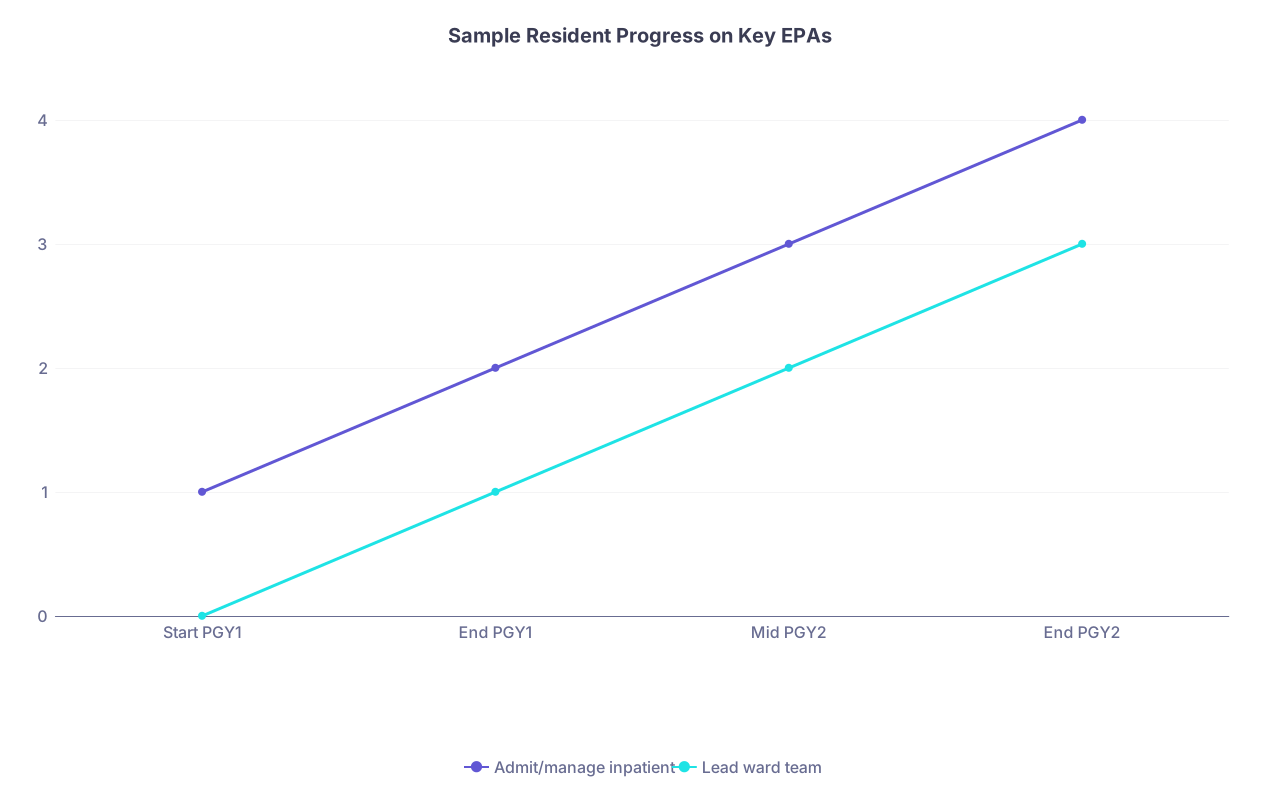
| Category | Admit/manage inpatient | Lead ward team |
|---|---|---|
| Start PGY1 | 1 | 0 |
| End PGY1 | 2 | 1 |
| Mid PGY2 | 3 | 2 |
| End PGY2 | 4 | 3 |
You anchor your narrative to what you would trust them to do without hovering. That is more useful than “meets milestones in patient care.”
Writing for Different Levels: PGY-1 vs Senior Resident vs Fellow
You cannot use the same language for a brand-new intern and a graduating chief. If your comments sound identical across all years, that is a problem.
PGY-1: Basic Safety, Work Habits, Emerging Reasoning
Focus your comments on:
- Reliability, follow-through, asking for help
- Gathering data, basic presentations, responsiveness to feedback
- Early communication skills
Example:
“As a new PGY-1, Dr. T is reliable and thorough. She consistently checks critical labs and notifies the senior resident without delay when abnormalities are found. Her presentations are currently detail-heavy and she sometimes struggles to prioritize active issues, which is expected early in training. With continued practice and feedback, she is on track for her level.”
PGY-2/PGY-3: Independence, Team Management, Advanced Communication
Here you want to comment on:
- Independent decision-making
- Supervision of juniors and students
- Handling of complex, ambiguous situations
Example:
“As a senior resident, Dr. M ran our ward team effectively. He came prepared with clear plans for each patient, delegated tasks appropriately to the intern and student, and ensured that critical items were completed before sign-out. During a complex goals-of-care discussion, he led the meeting with empathy and clarity, then debriefed with the intern about the communication strategies used. This performance meets and in some aspects exceeds expectations for a graduating PGY-3.”
Fellows: Specialty-Specific Judgment, Consultation, Teaching
Now you comment on:
- Subspecialty-level expertise and judgment
- Functioning as a consultant
- Mentoring residents and students
Example:
“During his cardiology consult month, Dr. R functioned at the level of a junior attending in several respects. He evaluated new consults promptly, identified the key question for cardiology input, and communicated clear, evidence-based recommendations back to primary teams. He frequently incorporated brief teaching points for residents, tailored to their level of understanding. He is fully ready for independent practice in this domain.”
Dealing with Edge Cases: Limited Contact, Rotations with Weird Structures
You will sometimes be asked to evaluate a resident you barely worked with. Do not invent data.
If you had very limited interactions
Say it explicitly, then focus on what you did see.
“My direct contact with Dr. X was limited to 3–4 half-day clinics. Within that scope, I observed that she was well-prepared for each patient, communicated plans clearly, and followed up on abnormal lab results. I am not able to comment on her inpatient or team-based behaviors.”
This prevents your three half-days from being overweighted as if they were an entire month of ward time.
Subspecialty rotations with narrow windows
In procedural or consult-heavy rotations, your narrative should still hit SOAR but in context.
“On the pulmonary consult service, Dr. K performed 8 supervised bronchoscopies. She demonstrated good technical skill with scope manipulation and gentle handling of the airway. She still requires frequent prompting to think ahead to post-procedure management and follow-up imaging. For her level, her procedural technique is appropriate, but I recommend focused pre-procedure planning and post-procedure debriefing to build more comprehensive ownership of the patient episode.”
Using Narrative Comments to Support Residents, Not Blindside Them
The worst situation: resident sees a negative narrative evaluation for the first time in the electronic system. No prior conversation. No coaching. Just a nasty surprise.
Good narrative assessment should echo conversations you have already had on the rotation, not introduce brand-new criticisms.
If you are going to write:
“Below expected level in clinical reasoning, requires close supervision.”
You should have already:
- Told the resident clearly during the rotation
- Given specific examples
- Outlined what you want them to work on
Then, when they see the written comment, it is not an ambush. It is documentation of something they have already been told.
That said, if you failed to have the conversation, you still have an obligation to document what you saw. Do not erase honest concern just because you missed the earlier step. But learn from that and do it differently the next time.
A Quick Mental Checklist Before You Hit Submit
Last filter. You have typed your comment. Before you click submit, ask yourself:
Could another attending, who has never met this resident, visualize what I am describing?
If not, add at least one concrete scenario.Would the resident understand why I said this, based on our rotation together?
If not, you probably need more specific examples or clearer language.If this resident struggled in 6 months, would I stand by this comment in a meeting?
If the answer is no, you may be sugarcoating or being too vague.Can the CCC infer “safe to progress / needs support / concerning” from this alone?
If they cannot, your comment is not carrying its weight.
If you hit all four, you are in good shape.

| Step | Description |
|---|---|
| Step 1 | Observe resident |
| Step 2 | Capture micro notes |
| Step 3 | End of rotation reflection |
| Step 4 | Answer 4 key questions |
| Step 5 | Write SOAR comment |
| Step 6 | Apply final checklist |
| Step 7 | Submit evaluation |

What “Actually Useful” Looks Like: A Composite Example
Let me give you a full, realistic example for a PGY-2 on wards, tying everything together.
“On our high-acuity general medicine service with frequent overnight admissions, Dr. L demonstrated strong ownership of her patients. She arrived each morning with a clear understanding of overnight events, had already reviewed new labs and imaging, and updated her plans accordingly without prompting. For example, when a patient’s creatinine rose from 1.0 to 1.9 overnight, she independently held nephrotoxic medications, ordered a focused ultrasound to assess for obstruction, and discussed volume status at the bedside before presenting a thoughtful plan on rounds. This performance is at the expected level for a PGY-2 in clinical reasoning and patient care.
In contrast, Dr. L’s communication with consultants was inconsistent. On multiple occasions, she paged subspecialty services with very broad questions (e.g., ‘Any recs?’) rather than a focused question and summary. After feedback early in the block, she improved somewhat but still requires reminders to include a one-line summary, specific question, and brief pertinent data when requesting consults. At this time, her consult communication skills are slightly below where I expect a PGY-2 to be. Going forward, I recommend that she use a structured approach for all consult calls and ask seniors to observe and provide feedback on a few of these interactions.”
If the CCC reads that, they now know:
- Stronger side: ownership and reasoning
- Weaker side: consult communication
- Level relative to expectations
- Trajectory and next steps
And if Dr. L reads it, she knows exactly what to work on next month.

Final Thoughts: The 3 Things to Remember
Keep these three points in your head the next time the eval system pings you:
Describe behaviors in real situations, not personality labels.
Think “what did I see on a specific day?” not “they are a hard worker.”Anchor to level and direction.
Explicitly state whether what you saw is below, at, or above expectations for their PGY level, and suggest a clear next step.Write like the CCC will rely on your words to decide graduation.
Because they will. If your comment could describe any resident on any rotation, it is not good enough.
You do not need more time to write better narrative assessments. You need a little structure, a bit of honesty, and the willingness to say something specific.
The residents—and the program—deserve that.