The worst time to learn how to manage a rare emergency is when a real patient is crashing in front of you.
If you teach medicine and you are not using simulation to train for low-frequency, high-stakes events, you are leaving a dangerous gap in your learners’ competence. Let me break down how to do this properly—not with toy scenarios, but with serious, reproducible educational design.
Why Rare Emergencies Demand Simulation (And Why Lectures Fail)
Rare but critical emergencies live in a nasty corner of clinical practice: you almost never see them, but when you do, you must get it right on the first attempt.
Think:
- Malignant hyperthermia in the OR
- Obstetric amniotic fluid embolism
- Pediatric status epilepticus with impending respiratory failure
- Local anesthetic systemic toxicity in a block room
- Tension pneumothorax post–central line
- Anaphylaxis under general anesthesia
- Post-thrombolysis intracranial bleed with deterioration in the ED
Most clinicians will see only a handful of these in an entire career. Many residents will see none. And yet, they are expected to “know what to do” instantly.
Traditional teaching approaches for these:
- A 45-minute lecture on Thursday at noon
- A PDF guideline living in someone’s SharePoint graveyard
- A multiple-choice exam question that tests recall, not action
Those do not build performance. They build awareness, at best. You cannot lecture someone into managing malignant hyperthermia at 3 a.m. while the CO₂ is climbing and the core temperature is 40°C.
Simulation-based education is uniquely suited here because it targets:
- Cognitive skills – rapid pattern recognition, diagnostic framing, correct sequencing of interventions.
- Psychomotor skills – specific procedures under time pressure (emergent cricothyrotomy, perimortem C‑section, needle thoracostomy).
- Team and communication skills – running the code, delegating tasks, closing the loop, calling for help early.
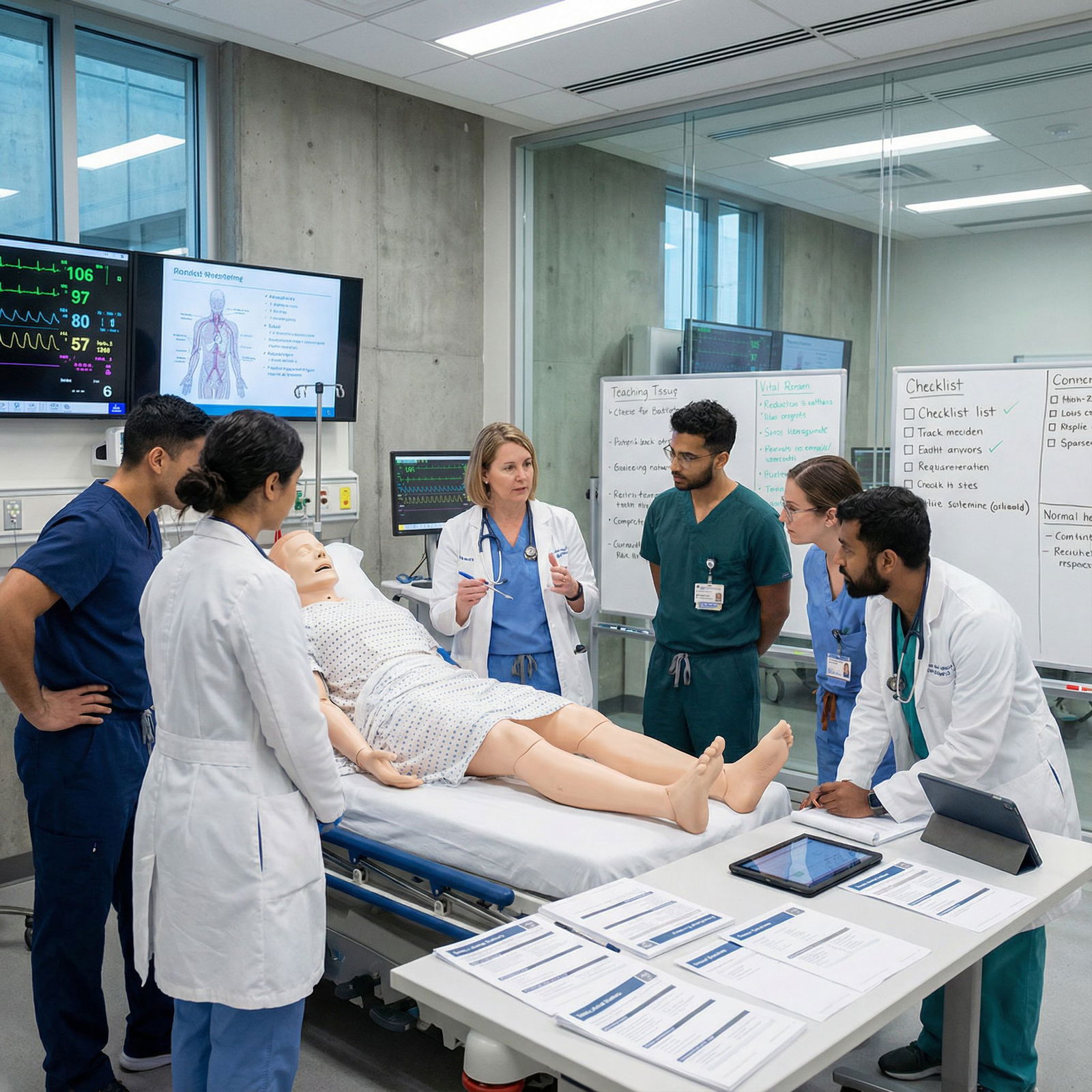
You are reproducing not just the disease, but the entire environment of failure: noise, incomplete data, emotion, hierarchy. Then you let learners make decisions that have visible consequences—on a mannequin, not on a real patient.
Choosing the Right Simulation Modality for Rare Events
Not every rare emergency needs a $200,000 mannequin. The trick is to match your educational goal to the right technology and design.
| Modality | Best Use Case | Fidelity Focus |
|---|---|---|
| High-fidelity mannequin | Complex resuscitations, codes | Physiologic |
| Task trainer / part-task | Procedures (cric, chest tube) | Anatomic/procedural |
| Standardized patient + props | Early recognition, communication | Interpersonal |
| Screen-based / virtual sim | Algorithm/decision-making, triage | Cognitive |
| In-situ interprofessional sim | Teamwork, systems testing, latent errors | Environmental |
Let me be concrete.
When you need high-fidelity mannequins
Use high-fidelity when:
- Physiologic parameters must change in real time.
- Drug administration and interventions need to have believable, time-linked effects.
- You want to immerse the learner in the feel of a crashing patient.
Perfect for:
Malignant hyperthermia, massive PE in the ICU, pediatric septic shock, PEA cardiac arrest from tamponade, status asthmaticus.
When task trainers are enough—and better
If your outcome is “can perform a rare procedure under stress,” go to a task trainer or low-fidelity setup.
Examples:
- Emergency front-of-neck access (cricothyrotomy trainer, pig trachea).
- Perimortem C‑section (low-cost torso models, foam abdominal wall).
- Needle decompression and chest tube insertion (rib models).
You can still wrap these in a scenario, but the realism that matters is tactile and procedural, not full-body physiology.
Standardized patients for the early window
Many rare emergencies are missed at the “subtle sign” stage:
- Early spinal epidural hematoma in a post-op patient on LMWH.
- Evolving necrotizing fasciitis that looks like “cellulitis plus pain”.
- Early anaphylaxis in PACU that is written off as “anxiety”.
Here, a trained standardized patient (SP) with specific scripts, subtle cues, and an escalating trajectory over 15–20 minutes can be far more effective than a mannequin. You can still later “convert” the SP to a mannequin when collapse occurs if you want to run the full resuscitation.
Screen-based or virtual simulation
Wildly underused for algorithm-heavy emergencies. No, it will not teach you chest compressions. It will teach you to:
- Recognize patterns from vitals and labs.
- Sequence interventions (e.g., in status epilepticus: lorazepam → second-line antiepileptic → intubation thresholds).
- Make decisions based on probabilistic reasoning when imaging is pending.
Cheap, scalable, great for spaced repetition.
In-situ simulation
This is where teaching and systems engineering intersect. You run the emergency in the actual clinical environment, with the real team, using real equipment (dedicated for simulation, obviously).
Perfect for uncovering:
- The MH cart that is behind three locked doors.
- The code blue phone that nobody knows how to operate.
- The fact that pharmacy does not stock intralipid on OB.
Rare emergencies are where system failures hurt the most. In‑situ simulation is how you flush those out.
Building Scenarios for Rare but Critical Emergencies: Step-by-Step
Let us get specific. Here is how I would design a malignant hyperthermia (MH) scenario for anesthesia residents. You can adapt the same structure to whatever rare event you care about.

| Step | Description |
|---|---|
| Step 1 | Define objectives |
| Step 2 | Select modality |
| Step 3 | Create case stem |
| Step 4 | Program timeline and triggers |
| Step 5 | Prepare environment and roles |
| Step 6 | Run scenario |
| Step 7 | Debrief and evaluate |
1. Define focused, behavioral objectives
Not “understand malignant hyperthermia.” That is useless.
You want 3–5 objectives that describe observable behaviors, for example:
- Recognize evolving malignant hyperthermia within 5 minutes of trigger signs.
- Initiate MH protocol, including discontinuation of volatile agents and hyperventilation with 100% O₂.
- Call for MH cart and mobilize additional help within 2 minutes of diagnosis.
- Calculate and administer correct dantrolene loading dose within 10 minutes.
- Assign roles and lead team communication using closed-loop commands.
All of those can be assessed during the scenario.
2. Select the minimal modality that achieves those objectives
For this MH example:
- High-fidelity OR mannequin with realistic end-tidal CO₂ is ideal, but a mid-fidelity mannequin with Q‑4 min vital sign updates can also work if you program it well.
- The critical piece is access to a real or mock MH cart with dantrolene vials, mixing supplies, and protocol posted.
Do not overbuild. Overbuilding is how programs die under their own logistical weight.
3. Create a tight case stem and baseline
You need just enough story to suspend disbelief:
- 27‑year‑old otherwise healthy patient, elective laparoscopic cholecystectomy.
- Induction with propofol, rocuronium. Maintenance with sevoflurane.
- You join the case 30 minutes in, stable vitals, surgeon just insufflating.
Give learners baseline values and lab availability. Avoid sloppy details that will derail them (“what is the exact weight” should be available quickly, not a side quest).
4. Program the physiologic trajectory
Here’s where many people get cute and ruin the scenario. You want a controlled, reproducible trajectory with clear triggers.
Example MH timeline:
- Minute 0–10: ETCO₂ gradually rises from 35 to 55, HR from 80 to 110, temp normal.
- If no intervention: ETCO₂ continues to climb to 70, HR 130, temp starts to rise. Masseter rigidity if succinylcholine was used (optional).
- Once learners verbalize concern for MH and take appropriate actions (turn off gas, increase FGF with 100% O₂, call for help):
- ETCO₂ stabilizes or decreases after dantrolene.
- Temp starts trending down.
- If they do nothing: hypotension, arrhythmia, eventual pulseless VT.
Program branches, but do not explode into infinite complexity. The goal is to link actions to effects clearly.
5. Script confederates and cues
Put in an OR nurse and surgeon confederate with defined scripts:
- Nurse: “Doctor, ETCO₂ looks high compared to earlier.”
- Surgeon: complains about “losing pneumoperitoneum” when high flows start, to test assertiveness.
- Tech: can be prompted to say “Do you want me to get the MH cart?” if learners are totally stuck. This is not cheating; it is scaffolding.
Your confederates can ruin a scenario if they improvise beyond the script, so brief them well.
6. Run, observe, and capture data
Have one facilitator running the simulator and one observing performance, ideally with a checklist aligned to your objectives.
You are watching for:
- Time to recognition (first verbalization of MH suspicion).
- Time to specific actions (turn off gas, switch to TIVA or O₂, call for MH cart, call for help).
- Whether the team lead emerges and uses names and closed-loop communication.
- Medication errors (wrong dantrolene dose or route).
Video is nice but not mandatory. A well-trained observer with a checklist is often enough.
Debriefing: Where the Real Learning Happens
If you rush the debrief, you just wasted an hour of everyone’s life. The learning is not in the mannequin; it is in the structured reflection afterward.
Structure your debriefing
I like a simple, reproducible structure:
Reactions (2–3 minutes)
Let them ventilate. “That was intense,” “I was lost,” etc. Emotion clears the channel.Description and shared mental model (5–7 minutes)
Brief timeline, from the learners’ perspective. “Walk me through what you noticed and when.” Clarify facts.Analysis and key themes (15–25 minutes)
Two or three big buckets:- Clinical reasoning: When did MH first enter your differential? What pushed it up or down?
- Actions and priorities: Why did you give more opioids? What made you decide to call (or not call) for help?
- Teamwork: How were tasks assigned? How did communication feel?
Summary and take-home commitments (3–5 minutes)
Ask each learner for one concrete behavior they will adopt in real practice.
Notice what is missing: a 20‑minute lecture in the middle. Mini-teaching moments are fine (“Let us clarify dantrolene dosing”), but debrief is not a second didactic.
Use advocacy-inquiry, not cross-examination
Instead of “Why did you not diagnose MH earlier?” (which is accusatory), use:
“I noticed that ETCO₂ had increased for about 10 minutes before MH was mentioned. I am concerned that we may be missing opportunities to recognize it earlier in real life. Can you share what you were thinking as the ETCO₂ was climbing?”
You put your observation and concern on the table, then genuinely explore their mindset. That is where faulty mental models surface.
Close the loop with guidelines and tools
Now is the time to show the actual institutional MH protocol. Not before the scenario. Put it side‑by‑side with what they actually did.
You can:
- Highlight deviations that are dangerous.
- Validate adaptations that are reasonable in your context.
- Modify the protocol if simulation exposed a mismatch with reality.
When simulation starts driving policy revision, you are doing it right.
Assessment and Mastery: Moving Beyond “We Did a Cool Sim”
Education leadership will eventually ask you: “Does this actually work?” Hand‑waving is not going to cut it forever.
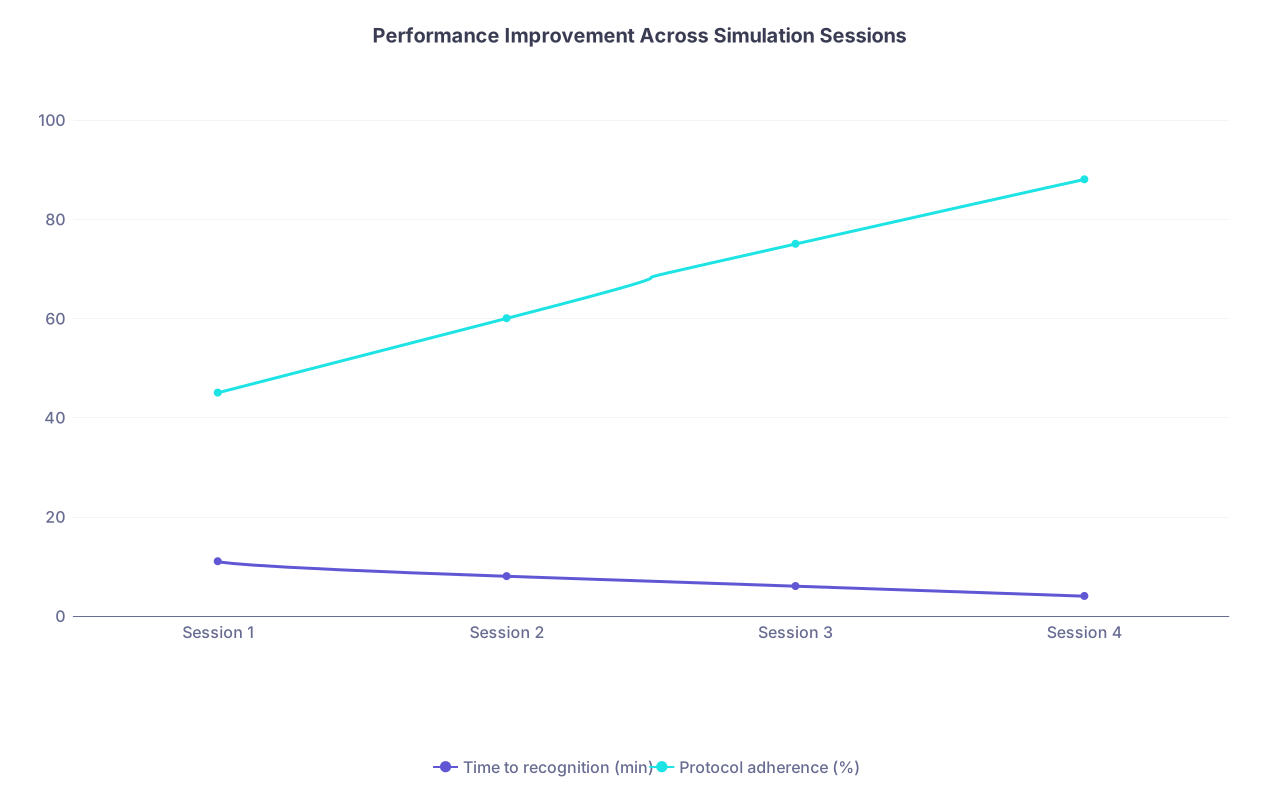
| Category | Time to recognition (min) | Protocol adherence (%) |
|---|---|---|
| Session 1 | 11 | 45 |
| Session 2 | 8 | 60 |
| Session 3 | 6 | 75 |
| Session 4 | 4 | 88 |
You need two things:
- A way to measure performance during simulation.
- A plan to revisit and reinforce skills over time.
Build simple, reliable checklists
For each rare emergency scenario, create a one‑page checklist:
- Critical actions (must happen, or patient likely dies).
- Important but not absolutely time‑critical actions.
- Communication and leadership behaviors.
Make them binary (“done correctly / not done / not applicable”) and time‑stamped where appropriate.
Example critical actions for anaphylaxis in the OR:
- Recognizes anaphylaxis as likely diagnosis within 3 minutes of hypotension and bronchospasm.
- Discontinues potential offending agents and anesthetic.
- Administers intravascular epinephrine at appropriate dose.
- Initiates aggressive IV fluid resuscitation.
- Calls for help and communicates diagnosis clearly to team.
Over time, you track unit performance. You will see patterns: maybe everyone underdoses epinephrine. That becomes a focused educational target.
Distinguish formative vs summative use
If you use simulation as high‑stakes assessment (e.g., remediation, promotion decisions), you will change the tone. Learners become more defensive, less open in debrief. Sometimes you need that—competency committees appreciate hard data. But be deliberate.
My typical pattern:
- Early training: simulation is purely formative, safe to fail.
- Late residency / certification: add a smaller number of well‑defined, summative scenarios with transparent criteria and no “gotcha” elements.
Be honest with learners about which is which.
Spaced repetition for rare events
Seeing MH once as a CA‑1 and never again does virtually nothing for long‑term retention. You need planned re‑exposure.
This is where shorter, lower‑fidelity refreshers shine:
- 20‑minute screen‑based or tabletop “what would you do next” exercises every 6 months.
- Brief “micro‑sims” at the start of a shift—10 minutes to run the first half of a case, stop before resolution, quick discussion.
- Annual multidisciplinary in‑situ drills for the highest-risk events (e.g., OB massive hemorrhage, pediatric code blue).
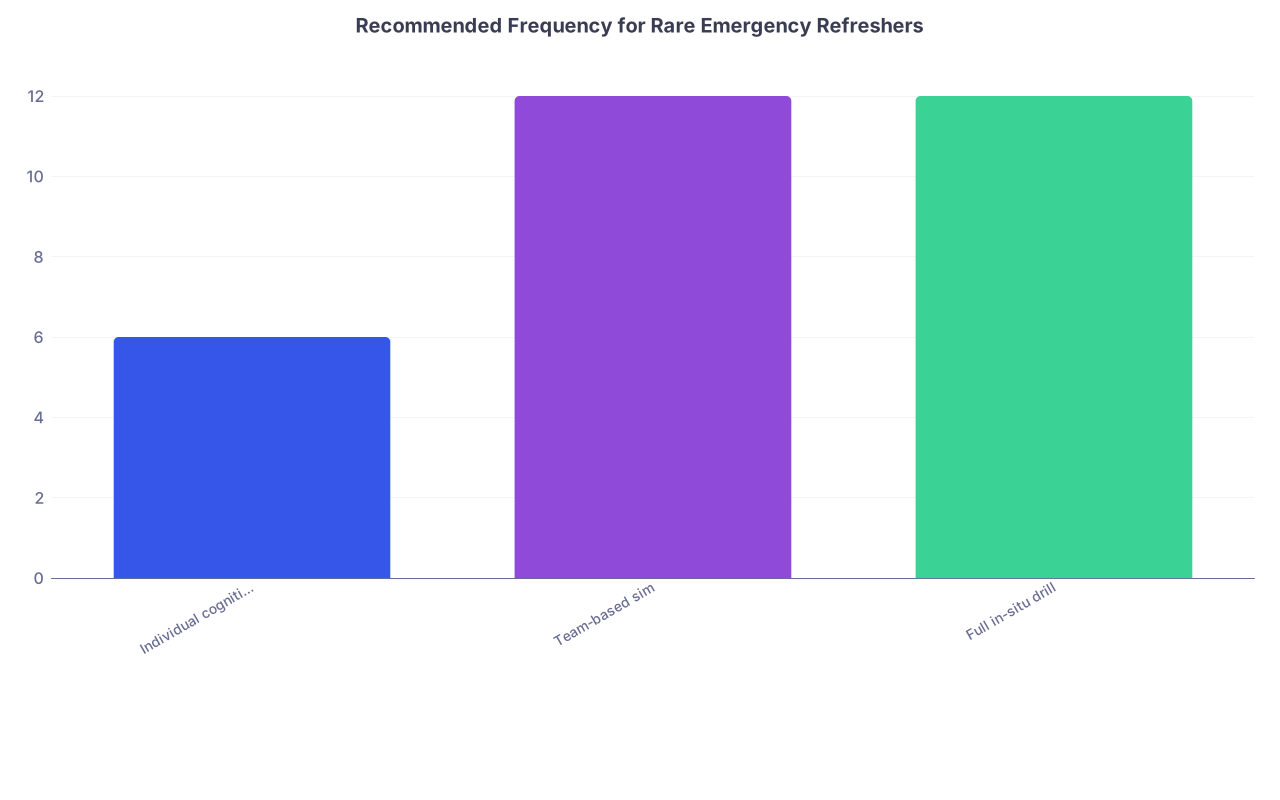
| Category | Value |
|---|---|
| Individual cognitive refresh | 6 |
| Team-based sim | 12 |
| Full in-situ drill | 12 |
(Values represent suggested interval in months.)
You are not trying to make them experts in the rare disease. You are trying to keep a functional script alive in their brain.
Operational Realities: Making Rare-Emergency Sim Sustainable
Here is where many well‑intentioned programs crash: they design one beautiful massive scenario that requires 12 faculty, 2 sim techs, and a full Saturday, and then they cannot repeat it.
You need to design with constraints in mind.

Start with 3–5 high-yield rare emergencies per specialty
You cannot cover everything. Pick your battles.
For emergency medicine residents, I would start with:
- Pediatric septic shock with decompensation
- Massive pulmonary embolism with PEA arrest
- Status asthmaticus refractory to usual treatment
- Toxicologic arrest (e.g., TCA overdose with ventricular arrhythmia)
- Post-tPA intracranial hemorrhage with rapid deterioration
For OB:
- Amniotic fluid embolism
- Eclampsia with status epilepticus
- Massive postpartum hemorrhage with DIC
- Shoulder dystocia with neonatal depression
You can rotate focus annually, but have a core “rare emergency” curriculum that is explicit and revisited.
Share scenarios and infrastructure across departments
An MH scenario belongs to anesthesia, OR nurses, PACU, and surgery. Design it once, run it with different groups.
Same for:
- Local anesthetic systemic toxicity (anesthesia, ED, pain service).
- Difficult airway leading to emergent cricothyrotomy (ED, ICU, anesthesia).
- Sepsis with rapid deterioration (ED, wards, ICU).
You do not need 4 different versions; you need 1 flexible template with adjusted roles and objectives.
Use checklists and pre-briefing to protect psychological safety
These events are stressful even in simulation. You want learners to stretch, not freeze.
Before each scenario:
- Clarify that this is a learning environment, not a trap.
- Remind them that no patient can be harmed.
- Set expectations about video recording and confidentiality.
- Brief about fiction contract: some things will not be perfectly realistic; treat them as if.
You want them to feel safe enough to attempt high‑risk decisions.
Train your faculty
Badly facilitated simulation is painful to watch. Common sins:
- Over-talking during the scenario.
- Hijacking decisions (“What you should have done is…”).
- Using debriefing to show how smart they are.
Invest in faculty training for:
- Scenario design
- Operating the technology
- Debriefing skills, especially advocacy-inquiry
One or two well‑trained simulation educators per program are enough to anchor a strong curriculum.
Connecting Simulation to Real-World Outcomes
If you want institutional resources, you must eventually connect simulation to patient care metrics or risk management.
You will not prove that “our MH simulation saved this exact patient.” But you can show patterns:
- Before and after simulation, time to epinephrine in real anaphylaxis cases from code records.
- Reduction in “failure to rescue” metrics for specific deterioration patterns.
- Staff survey data on confidence and perceived preparedness for rare events.
- Fewer incident reports about system issues previously exposed in in‑situ sims.
| Domain | Potential Metric |
|---|---|
| Clinical care | Time to first epinephrine in anaphylaxis |
| Systems performance | % units with MH cart stocked and accessible |
| Education | Protocol adherence score in re-sim |
| Staff perception | Self-rated preparedness (Likert scale) |
Even before you have outcome data, anecdotal “simulation echoes” will show up: a resident saying, “I had a case just like the sim and knew exactly what to do.” Collect those stories. They matter.
The Bottom Line
Teaching rare but critical emergencies is not optional. It is a core duty of any serious medical educator. Simulation is the only method that lets you:
- Rehearse high-stakes, low-frequency events in a controlled, repeatable way.
- Train not just knowledge but decision-making, procedures, and team function under genuine pressure.
- Expose and fix system weaknesses before they hurt real patients.
Build a focused set of well-designed scenarios, debrief them properly, and revisit them regularly. Do that, and your learners will not meet their first malignant hyperthermia, amniotic fluid embolism, or pediatric code on a real, unprotected patient. They will have seen it before—where mistakes were allowed, expected, and learned from.