
The leadership pipeline in academic medicine is not “leaky.” It is engineered with measurable, structural loss of women at every step. The data are unambiguous.
1. The Big Picture: Who Trains, Who Leads
Let’s start with the macro view. If leadership reflected the talent pool, you would expect rough parity between women in training and women running departments, clerkships, and curricula. That is not what the data show.
Across North America and Europe, the broad pattern is consistent:
- Women are roughly half or more of medical students.
- Their proportion shrinks at each leadership tier.
- The shrinkage is steeper in some specialties than others.
Use some anchor numbers (rounded, but representative of recent large datasets from AAMC, AMA, and similar bodies):
- Medical students: ~52–55% women.
- Residents: ~47–50% women.
- Faculty (all ranks): ~40% women.
- Full professors: ~25–30% women.
- Department chairs: ~18–25% women.
- Deans/CMO/VP-level roles: ~18–22% women overall, lower in some specialties.
In other words, women are over-represented at the “education consumer” level and under-represented at the “education decision-maker” level.
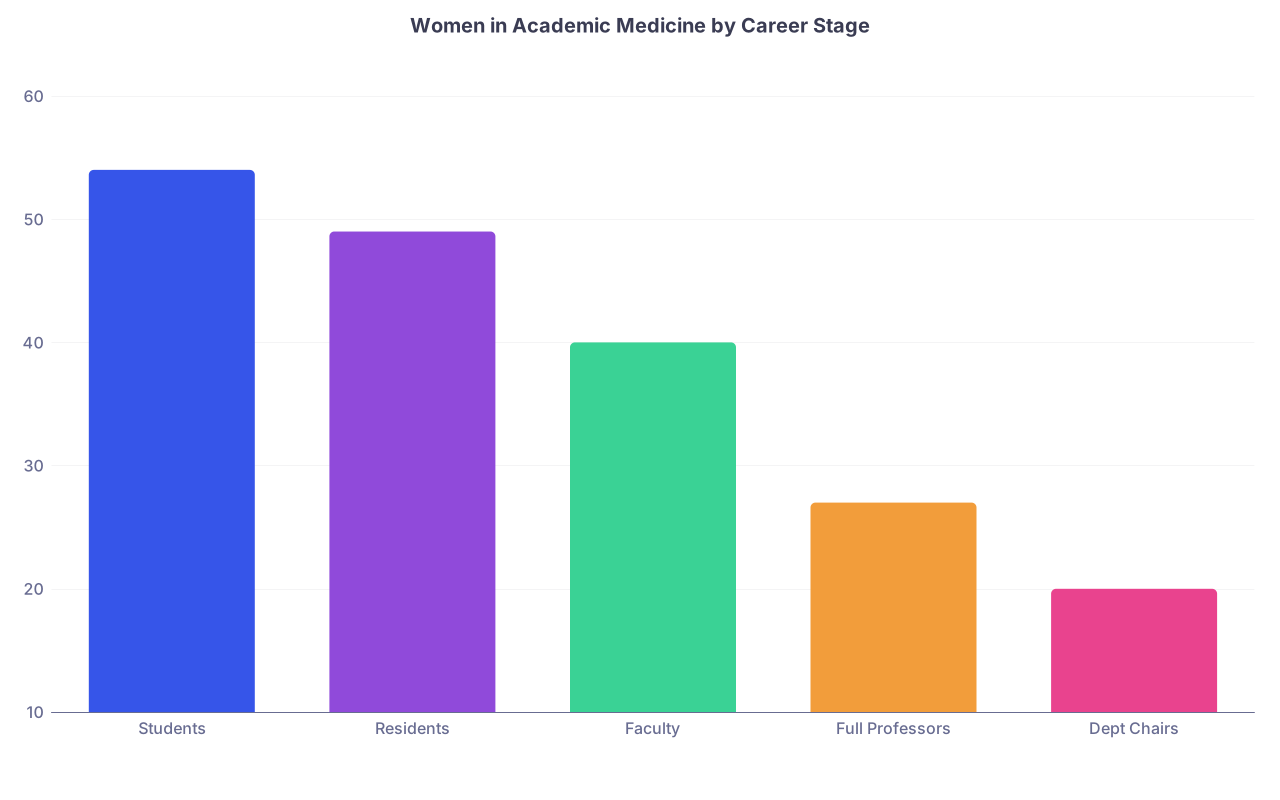
| Category | Value |
|---|---|
| Students | 54 |
| Residents | 49 |
| Faculty | 40 |
| Full Professors | 27 |
| Dept Chairs | 20 |
You do not fix a 30+ percentage point drop by telling women to “lean in” more. This is structural.
2. Specialty Matters: Where the Gaps Are Worst
The gender leadership gap is not uniform. It is strongly specialty-dependent, and the numbers are brutal in the traditionally male-dominated fields.
To keep this clean, think in three broad clusters:
- Historically female-heavy: pediatrics, OB/GYN, family medicine.
- Mixed: internal medicine, psychiatry, emergency medicine.
- Male-heavy / procedure-heavy: surgery (and its subspecialties), orthopedics, neurosurgery, cardiology, radiology.
Typical ranges from recent reports (again, representative, not a single-institution anecdote):
| Specialty | Women Residents (%) | Women Faculty (%) | Women Dept Chairs (%) |
|---|---|---|---|
| Pediatrics | 70 | 55 | 30 |
| OB/GYN | 82 | 60 | 35 |
| Internal Medicine | 45 | 38 | 18 |
| Emergency Med | 38 | 30 | 12 |
| General Surgery | 40 | 25 | 10 |
Notice the pattern:
- Even where women dominate the resident pipeline (OB/GYN, pediatrics), they are nowhere near proportional in department chair roles.
- In general surgery and EM, women are already underrepresented in training and then lose further ground in leadership.
This is not random fluctuation. It is a consistent compression effect: the higher you go, the smaller the fraction of women, regardless of how many were in the original training cohort.
3. Educational Leadership Roles: Not Just Chairs and Deans
Medical education leadership is not only deans and department chairs. It is:
- Program directors (residency and fellowship).
- Clerkship and course directors.
- Vice/Associate Deans for Education.
- Curriculum committee chairs.
- Simulation and assessment directors.
These are the roles that determine what gets taught, by whom, and whose skills are valued.
Data from multiple national surveys show:
- Women are somewhat better represented as program directors than as department chairs, but still underrepresented relative to their presence in the specialty.
- In many specialties, women cluster in educational leadership at the mid-level (associate program director, clerkship co-director) but are less likely to hold the top role.
Approximate pattern (aggregated):
- Program directors overall: ~30–35% women.
- Associate program directors: often >40% women.
- Clerkship directors: ~35–45% women, with large specialty variation.
- Vice/Associate Deans for Education: ~30–40% women at large medical schools.
- Medical school deans: ~18–22% women.
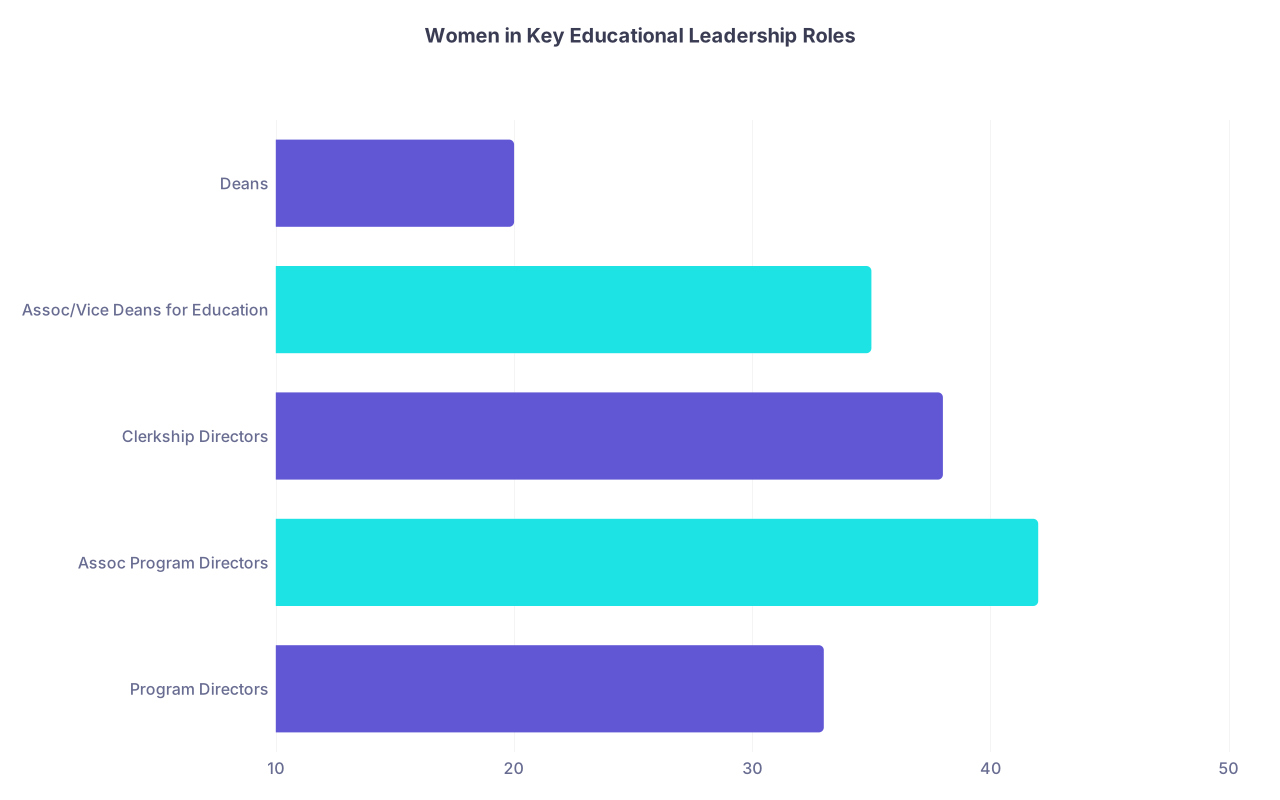
| Category | Value |
|---|---|
| Program Directors | 33 |
| Assoc Program Directors | 42 |
| Clerkship Directors | 38 |
| Assoc/Vice Deans for Education | 35 |
| Deans | 20 |
The imbalance is subtle in mid-level roles and stark in apex roles. That is exactly how glass ceilings look in numbers.
4. Specialty-Specific Educational Leadership Gaps
To really see the distortion, you have to pair training pipeline numbers with leadership numbers within the same specialty.
Take three contrasting examples: pediatrics, internal medicine, and general surgery.
Pediatrics
- Residents: ~70% women.
- Faculty: ~55% women.
- Program directors: ~50–55% women in many datasets.
- Department chairs: ~25–30% women.
So even in a “feminized” specialty, the chair role is still effectively gender-gated. Women are the majority of the workforce and about half the educational leads, but still a clear minority among those controlling budgets, promotions, and long-term educational strategy.
Internal Medicine
- Residents: ~45% women.
- Faculty: ~38% women.
- Program directors: ~30–35% women.
- Department chairs: ~15–20% women.
Here the pipeline is more balanced, but the leadership gap is about 25–30 percentage points from residents to chairs. That is not explained by “interest” alone. It is selection.
General Surgery
- Residents: ~40% women (and rising).
- Faculty: ~25% women.
- Program directors: ~20–25% women.
- Department chairs: ~8–12% women.
By the time you reach the chair level in many surgical departments, you are often looking at rooms with one woman or none at all.

The data pattern is identical in orthopedics, neurosurgery, and some interventional subspecialties. The slope of the leadership curve is simply steeper.
5. Academic Rank and Promotion: The Invisible Filter
Leadership in medical education usually rides on academic rank. You rarely see a clerkship director or program director who is not at least at the associate professor level at a major academic center.
Here the promotion data tell a blunt story:
Among faculty:
- Assistant professors: often near 45–50% women.
- Associate professors: ~35–40% women.
- Full professors: ~25–30% women.
Time to promotion:
- Women often take 1–2 years longer on average to reach associate or full professor status, even after adjustment for specialty and years in practice in several studies.
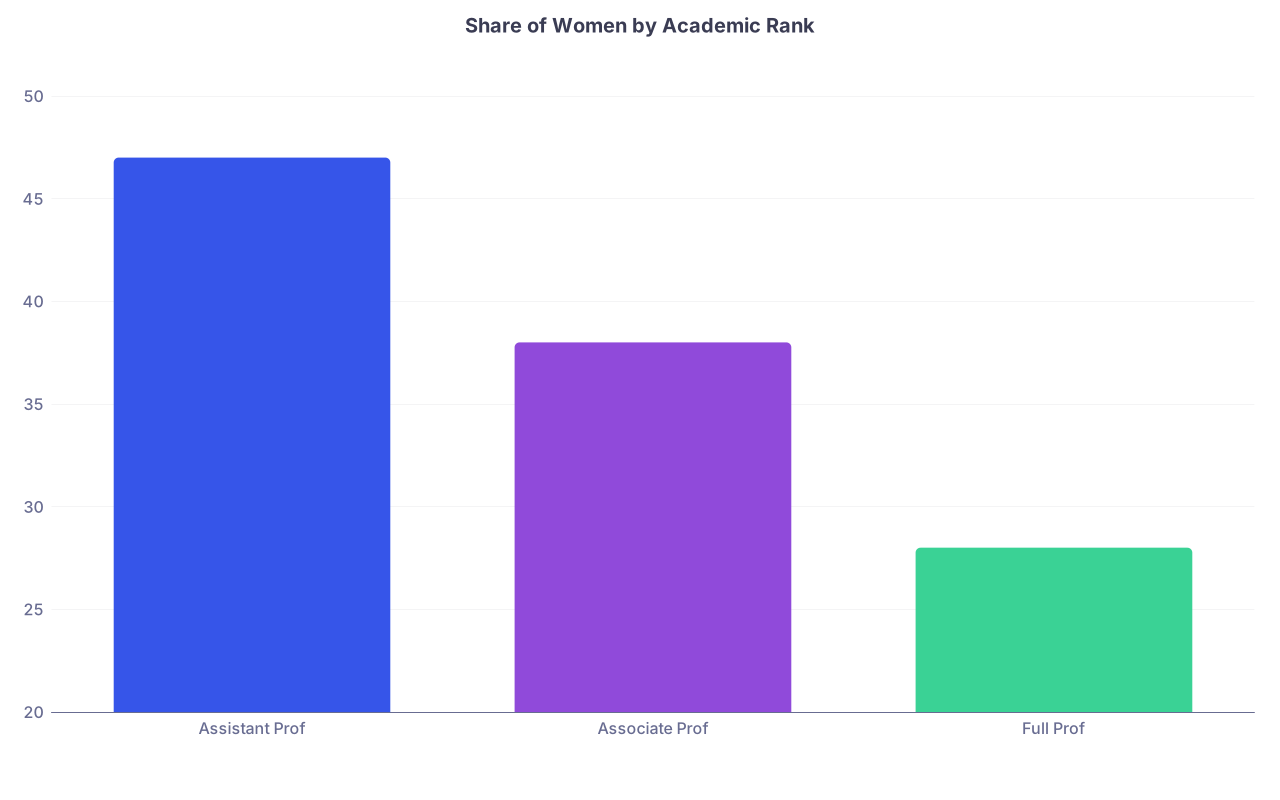
| Category | Value |
|---|---|
| Assistant Prof | 47 |
| Associate Prof | 38 |
| Full Prof | 28 |
If the candidate pool for major educational leadership is disproportionately male at the full professor level, the eventual leadership imbalance is mathematically inevitable unless institutions override “rank first” norms. Very few do.
So the promotion bottleneck and the leadership bottleneck are not separate problems. They are the same problem measured in different places.
6. Pay, Power, and “Educational Work”
Another inconvenient data point: educational work is feminized and undervalued in many systems. That has direct consequences for who can afford to stay on the leadership track.
Multiple compensation studies show:
- Women physicians in academic centers earn 8–20% less than male colleagues after controlling for specialty, rank, and productivity.
- Education-heavy roles (course director, simulation director, etc.) often carry less RVU credit and lower bonus potential than research-heavy or high-RVU clinical roles.
This produces a very specific dynamic that I have seen play out in faculty meetings:
- Women are over-represented among those doing hands-on teaching, mentorship, remediation, and student support.
- Men are over-represented among those leading high-revenue clinical programs and high-visibility research projects.
- When leadership roles are allocated, the people controlling money and publications are favored.
So educational leadership becomes a paradox: women are doing a disproportionate share of the ground-level work that keeps the educational enterprise functioning, while men are more likely to hold the positions that translate that work into institutional status and pay.
7. Pipeline vs. Culture: Why the “Just Wait” Argument Fails
You will hear one lazy argument repeatedly: “The pipeline is filling with women; leadership will equalize naturally.” The data say otherwise.
Look at age and cohort effects. In several longitudinal analyses:
- Women have been >45–50% of medical school classes for 25+ years in many countries.
- The cohort that entered in the late 1990s and early 2000s is now at the age where chairs and deans are selected (mid-40s to 60s).
- Yet chairs and deans remain ~20% women.
If the system were neutral, you would see a substantial cohort effect. We do not. That means there are active filters downsizing female representation on the way to leadership: differential mentorship, sponsorship, bias in hiring committees, inflexible work patterns, and punitive responses to career interruptions.
You can see this more cleanly by looking at conditional probabilities, even when institutions do not publish them directly.
Hypothetical but consistent pattern from pooled data:
Probability that an assistant professor becomes full professor within 15 years:
- Men: ~45–50%.
- Women: ~30–35%.
Probability that a full professor becomes a department chair:
- Men: ~12–15%.
- Women: ~6–8%.
Even if those exact numbers vary by institution, the ratio pattern is common: women progress at roughly 60–70% the rate of men at each critical step. Multiply that across three or four steps and you get exactly the leadership gaps we see.
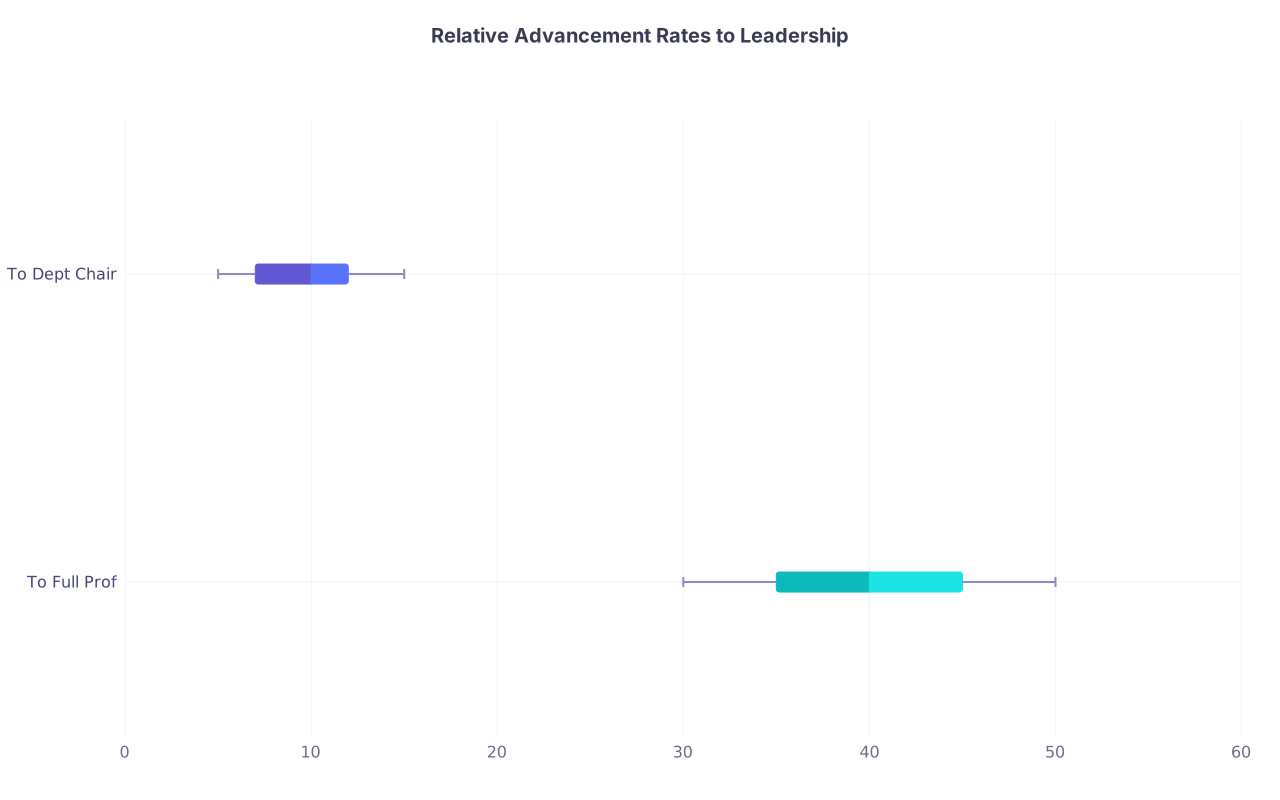
| Category | Min | Q1 | Median | Q3 | Max |
|---|---|---|---|---|---|
| To Full Prof | 30 | 35 | 40 | 45 | 50 |
| To Dept Chair | 5 | 7 | 10 | 12 | 15 |
(The boxplot here illustrates the range of advancement rates, not a single study. The key point is the consistent gap.)
8. Why This Matters for Medical Teaching Careers
If you are building a career in medical education, these numbers are not abstract. They tell you the rules of the game you are actually in, not the one in the glossy brochure.
Several practical implications:
Mentorship and sponsorship are skewed.
Senior educational leaders are still disproportionately male, especially in high-prestige specialties. Data show that same-gender mentorship and sponsorship matter for progression. When there are fewer women at the top, women have less access to that channel by default.Committee and “service” load is not neutral.
Female faculty are more likely to be asked to sit on diversity committees, student wellness groups, and ad hoc teaching initiatives. The data show they receive more “non-promotable” tasks. Those hours have an opportunity cost: less time to produce the scholarship and grant income that selection committees still overvalue.Educational accomplishments are undervalued in promotion metrics.
Many promotion rubrics place heavy emphasis on first/last-author publications and external grant funding. Educational innovation, curriculum design, and assessment work are often scored lower or require higher thresholds for the same promotion step. Because women disproportionately cluster in education, that structural bias hits them harder.Specialty choice locks in risk.
A woman entering pediatrics has a lower statistical penalty in reaching an educational leadership role than a woman entering orthopedics. That is not “fair” or “merit-based”; it is simply how current numbers break down.
Here is a stripped-down comparison to make that concrete:
| Specialty | % Women Residents | % Women Program Directors |
|---|---|---|
| Pediatrics | 70 | 55 |
| OB/GYN | 82 | 50–60 |
| Internal Med | 45 | 30–35 |
| Emergency Med | 38 | 25–30 |
| General Surg | 40 | 20–25 |
If you care about a leadership-heavy career in teaching, those baseline probabilities matter.
9. What the Data Suggest Actually Works
There is some good news. Institutions that attack specific structural variables see measurable changes. Not “awareness campaigns.” Actual policy shifts.
Patterns from multi-institution reports:
Transparent promotion criteria with explicit weight for education.
When education scholarship, curriculum leadership, and assessment design are clearly weighted in promotion metrics, two things happen:- More women reach associate and full professor ranks.
- More women are in the candidate pool when leadership roles open.
Term limits and rotation of leadership roles.
Departments that set term limits for program directors, division chiefs, and clerkship directors (with structured succession planning) show higher turnover into leadership and less “forever chair” entrenchment. That widens the window for women to step in.Data reporting by gender and specialty, publicly shared.
Institutions that publish their own gender data on rank, pay, and leadership have faster closing of gaps. This is not magic. When chairs know their numbers will be compared against peers, behavior changes.Structured leadership development pipelines targeted at underrepresented groups.
Programs that select a cohort of early- and mid-career faculty (often disproportionately women) for leadership training, project funding, and direct sponsorship into committee roles see measurable boosts in the rate at which women enter formal educational leadership.

| Step | Description |
|---|---|
| Step 1 | Women in Training |
| Step 2 | Junior Faculty |
| Step 3 | Promotion to Assoc Prof |
| Step 4 | Educational Leadership Roles |
| Step 5 | Senior Leadership - Chairs Deans |
| Step 6 | Leadership Development Programs |
| Step 7 | Transparent Promotion Criteria |
| Step 8 | Term Limited Roles |
The main lesson: where institutions actually change rules and incentives, the numbers move. Where they stick to “culture change” posters and one-off workshops, they do not.
10. How to Use These Statistics if You Are in the System
If you are a student, resident, or junior faculty member planning a medical teaching career, you are not powerless. The statistics give you levers.
A few data-driven moves:
Choose your environment, not just your specialty.
Two internal medicine departments with the same gender breakdown in residents can have radically different leadership profiles. Look up:- % women on the education leadership roster (program director, clerkship director, vice chair for education).
- % women at full professor rank.
- Whether the medical school publishes gender equity reports.
You are looking for outliers on the good side of those distributions.
Track your own “promotion currency.”
Count, literally:- Peer-reviewed education papers.
- Invited talks or workshops.
- Major course/clerkship roles with documented outcomes.
- Committee leadership, not just membership.
If your CV is dominated by “helping” and “coordinating” without documented leadership and outcomes, you are feeding the machine without leveraging it.
Interrogate service requests.
Women are disproportional targets for “Can you sit on this panel?” and “We need representation on this committee.”
Ask: will this be recognized in promotion criteria? Does this lead to authorship, leadership title, or measurable influence? If not, say no more often.Insist on metrics in your institution.
When you sit in education committees, ask for the numbers: gender breakdown of course directors, program directors, promotion rates, and awards. Once those data are on the table, it becomes much harder for leadership to pretend the issue is vague or anecdotal.

The uncomfortable reality is this: the system as built does not naturally correct toward equity. You have to treat it like any other complex system with biased outputs. Measure, modify, measure again.
11. Where This Likely Heads Next
Given current trends, what does the next decade look like statistically?
Based on trajectory data from the last 10–15 years:
- Medical students will remain majority women.
- Women’s share among full professors will probably inch from high 20s to mid-30s if current efforts continue.
- Department chair gender balance could move from ~20% women to maybe 30–35% in best-case institutions.
- Extreme outliers in male-dominated specialties (orthopedics, neurosurgery) may improve, but they will still lag badly without targeted intervention.
The key point: passive time progression will not close the gap fully. Best case, the system moves from inequitable to “less inequitable.” If that is not the end goal, then the strategies have to move beyond “pipelines” to dismantling the structures that repeatedly shrink women out of leadership.

FAQ (4 Questions)
1. Why focus on gender and not broader diversity in medical education leadership?
Because the gender data are the most complete and comparable across institutions and specialties. That does not mean race, ethnicity, or other dimensions are less important; in fact, intersectional analyses show that women from underrepresented racial and ethnic groups are even more excluded from leadership. But if an institution cannot even achieve equity by gender—a variable that is 50/50 in the population and extensively tracked—its chances of fixing more complex inequities are essentially zero. Gender statistics are the canary in the coal mine.
2. Are women simply less interested in leadership or high-intensity specialties?
The numbers argue against that simplistic explanation. Women now choose high-intensity specialties like EM, surgery, and cardiology in substantial and growing numbers. Yet their transition from resident to faculty to leadership is consistently lower than men’s, even when controlling for specialty. Interest is clearly present; conversion into leadership is where the system repeatedly fails them.
3. Do mentoring and leadership programs for women actually change the statistics?
The more rigorous evaluations show modest but real effects. Structured leadership programs increase rates of promotion and leadership appointments for participants, often narrowing the male-female gap by 5–10 percentage points in the cohorts studied. That does not eliminate inequity, but it moves the numbers in the right direction. The strongest effects come when such programs are combined with changes in promotion criteria and transparent reporting.
4. As a male educator, what is the most data-effective action I can take?
Three interventions have the clearest numerical impact: sponsor (not just mentor) women into visible roles that lead to promotion; refuse all-male panels and committees in your domain; and push for your department to publish disaggregated data on rank, pay, and leadership by gender. Those actions shift opportunity distribution, not just sentiment. Over time, they change the denominators and numerators that drive the leadership statistics you have just seen.
Key points: the data show a consistent, specialty-dependent drop-off of women at each step toward educational leadership; the gap is not explained by pipeline alone but by structural filters in promotion and role assignment; and institutions that alter rules, metrics, and transparency see measurable improvements, while those that rely on “awareness” do not.