
It’s 7:10 a.m. You’re standing in the workroom before morning teaching rounds. The attending you co-teach with just finished ripping into a resident in front of the whole team for “asking stupid questions.” Yesterday, the program director brushed off a student’s concerns about mistreatment as “part of being in medicine.” The clerkship coordinator quietly tells you, “I know it’s bad, but we can’t rock the boat with him. He brings in too much RVU.”
You’re an educator physician, you care about learners, and you’re realizing: the culture where you teach is toxic. And worse, it’s not an accident. It’s protected.
You’re stuck between three unpleasant options that keep circling your head:
- Put your head down and try to shield learners one by one
- Take this on and risk being labeled “not a team player”
- Get out—but then what happens to the students and residents you care about?
Let’s walk through what you can actually do. Not ideals. Not fluffy “advocacy” talk. Real options, with real tradeoffs.
Step 1: Diagnose the Kind of Toxicity You’re Dealing With
Before you act, you need clarity. “Toxic” is vague. The specific pattern drives your options.

Most toxic teaching environments fall into a few buckets:
Personality-driven toxicity
One or two powerful individuals create fear and humiliation:- Public shaming on rounds
- Sexist/racist “jokes” passed off as “old school”
- Retaliation or subtle punishment for speaking up
Structural toxicity
The system itself makes cruelty feel normal:- Chronic understaffing → no time for real teaching
- Culture of “if you’re not suffering, you’re not learning”
- Evaluation systems that reward volume, not education
Institutionally sanctioned toxicity
The worst one. Leadership knows and doesn’t care—or benefits from it:- Repeat offender attendings kept for RVUs or grants
- Learner mistreatment complaints “handled” by shuffling rotations, not addressing behavior
- DEI and wellness messaging plastered everywhere, but behind the scenes nothing changes
You probably recognize pieces of all three. But you need to be honest:
Is this a good system with a few toxic outliers?
Or a bad system that will protect them and punish you?
Your risk tolerance and strategy depend on that answer.
Step 2: Build a Reality-Based Map of Your Power and Risk
This is where people get hurt: assuming they have more leverage than they actually do. Or assuming they have none when they actually have some.
| Role/Status | Relative Power | Retaliation Risk |
|---|---|---|
| Tenured core faculty | High | Moderate |
| Non-tenure, but long-term faculty | Moderate | High |
| Community preceptor (volunteer) | Low | Low-Moderate |
| Hospital-employed clinician-educ. | Moderate | High |
| Fellow with teaching role | Very Low | Very High |
Ask yourself, in plain language:
- Who actually controls my contract or clinical privileges?
- Who controls my teaching assignments?
- Who owes me favors? Who do I owe favors to?
- If someone wanted to quietly sideline me, how would they do it? (Schedules, committees, promotion letters, call assignments, OR time, etc.)
This isn’t paranoia. It’s just reading the board before you move your piece.
Once you know your position, you choose from three basic strategies:
- Local damage control – protect learners in your sphere without taking on the system head-on
- Targeted confrontation – pick specific fights you can realistically win
- Strategic exit + legacy protection – get out while leaving some guardrails behind
Step 3: Local Damage Control – What You Can Do Right Now
Sometimes you can’t change the culture yet. But you can stop pretending it’s fine.
3.1 How you run your teaching space
This sounds small. It’s not. Learners remember the single attending who didn’t humiliate them.
Concrete moves:
Name the dysfunction without naming the person
In your sessions you say things like:
“Some teaching styles in this hospital still use shame. That’s not evidence-based, and it’s not how I work with learners.”
You just gave them language and permission to question what they’re seeing.Model boundaries
When rounds go off the rails:- If a senior starts berating: “We’re all capable adults here; let’s ask questions without attacking people.”
- Or to a learner later: “What happened on rounds today was not about your worth or intelligence.”
Build micro safety zones
Before or after rounds, run a quick 3–5 minute check-in with your team:- “Any teaching approaches lately that felt off or unhelpful?”
- “Anything happening that makes it harder for you to learn here?”
Keep it casual, but regular. Repetition builds trust.
3.2 Teaching learners how to survive a toxic environment
You’re not just teaching medicine; you’re teaching professionalism in a broken system.
With residents and students, quietly cover:
- How to document mistreatment (dates, witnesses, emails)
- Who the relatively safe people are (clerkship director vs GME office vs ombudsperson)
- How to phrase feedback so it’s taken seriously and not dismissed as “too sensitive”
A practical script you actually can use:
“You’re going to see a range of teaching styles. Some are frankly outdated or harmful. If something crosses the line from challenging to demeaning—document it for yourself. You can always decide later whether to report. I’m available to talk if you’re not sure.”
You’re not telling them to report. You’re telling them they’re not crazy.
Step 4: Targeted Confrontation – When and How to Push Back
Sometimes you can’t live with “local damage control” anymore. Someone’s behavior is too egregious, or it’s getting worse, or you just hit your personal line.
Here’s how to do confrontation like a professional, not a martyr.
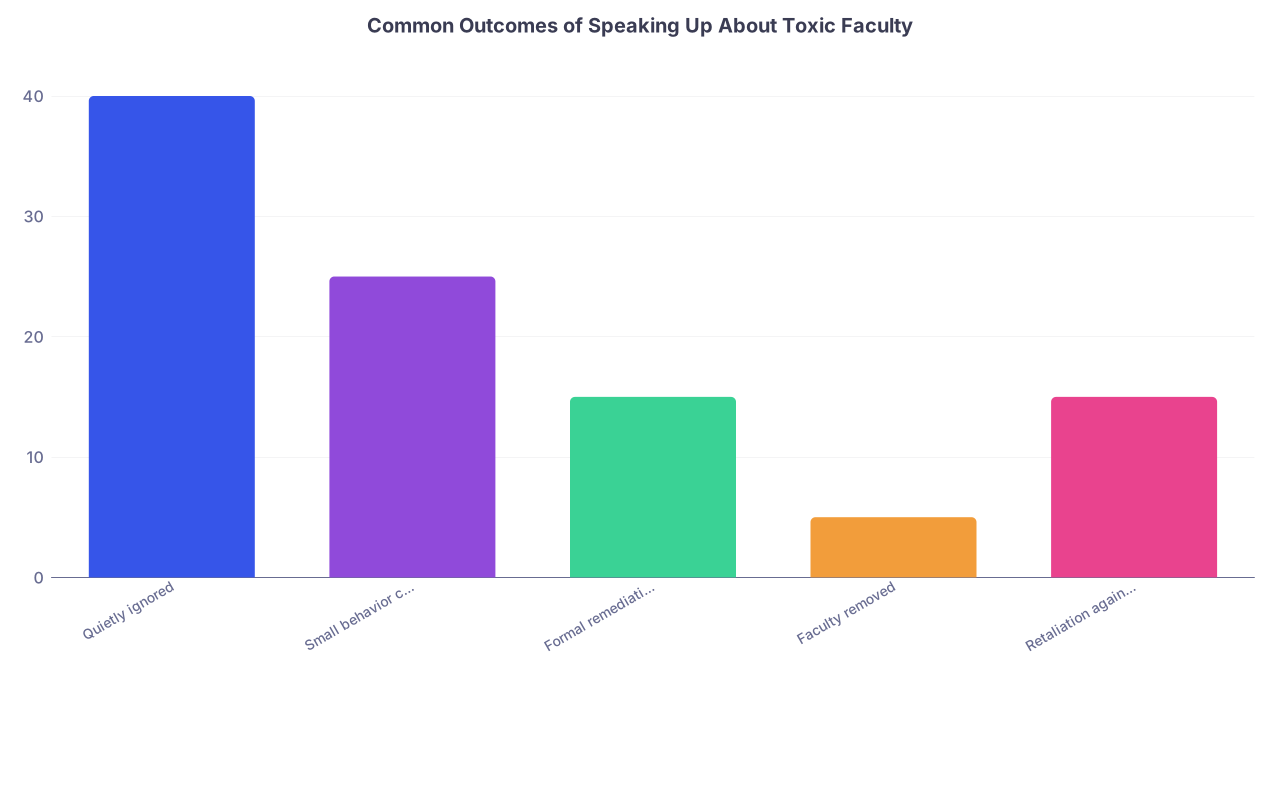
| Category | Value |
|---|---|
| Quietly ignored | 40 |
| Small behavior change | 25 |
| Formal remediation | 15 |
| Faculty removed | 5 |
| Retaliation against complainer | 15 |
4.1 Direct conversation with the offender (only sometimes)
Use this only if:
- There’s no clear pattern of retaliation
- The person has some history of responding to feedback
- You have enough standing that they can’t crush you easily
The conversation is not about their character. It’s about specific behaviors and impact.
Example:
“On yesterday’s rounds, when you said to the intern ‘did you even read about this?’ in front of the team, I saw the entire group shut down. People stopped asking questions. That kind of public shaming undermines learning.”
They’ll probably defend themselves. Fine. You’re planting a flag: someone noticed.
If you do this, document it for yourself. Date, time, what was said. Not melodramatic. Just factual.
4.2 Use existing structures—strategically, not naively
Most institutions have:
- GME office
- Faculty affairs
- Mistreatment reporting systems
- DEI or professionalism committees
Here’s the blunt truth: many of these structures exist to protect the institution first. But some actually work. Your job is to find out which is which.
Quietly ask trusted people:
- “Have you ever seen our institution take real action on faculty mistreatment?”
- “If you had a serious concern about teaching behavior, who would you actually go to?”
When you do report or raise concerns:
- Focus on behaviors and patterns, not “he’s a jerk”
- Use documented, specific events and any corroboration
- Tie it to accreditation and liability, not just feelings
- “This pattern of humiliating behavior is driving residents to avoid asking questions about patient care.”
- “We’ve had X students request to avoid his service; that’s eventually going to show up in LCME/GME surveys.”
You’re speaking the only language some leaders respect: risk.
4.3 Create external pressure (when internal pressure fails)
If internal efforts go nowhere and the behavior crosses serious lines (discrimination, harassment, dangerous care), there are outside entities that suddenly make people pay attention:
- ACGME resident/fellow surveys
- LCME student mistreatment data
- Title IX offices
- State medical board (in severe cases)
- External hospital system leadership if your med school is just a tenant
I’ve seen programs completely ignore internal complaints until the ACGME site visitor asks, “Explain the pattern of reported mistreatment by Dr. X.” Suddenly everyone cares.
You don’t threaten this lightly. But you should remember it exists.
Step 5: When You Decide to Leave – How to Do It Without Burning Everything Down
Sometimes the most honest assessment is: this place is not fixable in the timeframe of my career. The people in power like it exactly the way it is.
If you’re there, you’re not “quitting.” You’re reallocating your energy where it isn’t wasted.

5.1 Get clinically and financially safe first
Do not announce your outrage and then start job hunting. That’s how people end up unemployed with a reputation for being “difficult.”
Instead:
- Stabilize your clinical value: keep your volume reasonable, your complication rates clean, your documentation timely.
- Quietly update your CV with teaching, curriculum, and mentoring work.
- Start networking discreetly. Talk to colleagues at:
- Community programs with better culture
- Newer medical schools hungry for solid clinician-educators
- VA systems, which often have more stable teaching environments
- Non-clinical spaces (simulation centers, educational technology, CME companies, etc.)
You’re building exit ramps, not slamming doors.
5.2 How to talk about why you’re leaving
You’ll be asked. Don’t dump your whole soul out. But don’t lie to protect people who harmed learners either.
A professional framing:
“I’m looking for an institution where the culture of teaching aligns better with my values—where feedback is challenging but not demeaning, and where educational excellence is actually prioritized in promotions and resources.”
That sentence is both true and non-defamatory. It also signals to smart leaders: “This person has seen some things and knows how to read culture.”
5.3 Leaving some guardrails for the people behind you
You can’t fix everything, but you can make it slightly less awful for the ones after you.
A few options before you go:
- Put your concerns in writing to someone with nominal responsibility (program director, associate dean, etc.). Calm, factual, not ranting.
- Encourage learners to use anonymous, formal feedback channels that show up on institutional dashboards.
- Hand off any well-functioning, learner-safe initiatives you’ve built (case conferences, mentorship groups) to someone you trust. Not to the very people who ruined everything.
This is not heroism. It’s just leaving the campsite slightly cleaner than you found it.
Step 6: Alternatives Outside Classic Academic Medicine
If the whole academic structure feels rotten to you, you’re not out of options as an educator physician.
| Path | Teaching Focus | Relative Toxicity Risk |
|---|---|---|
| Community residency faculty | Bedside and didactics | Moderate |
| Simulation center faculty | Skills and scenarios | Low-Moderate |
| Online med-ed companies | Board prep/content | Low |
| CME/industry education | Practitioner updates | Low-Moderate |
Some concrete paths I’ve seen people take:
- Join a community-based residency where the program is small enough that one toxic person can’t disappear so easily.
- Work in simulation – high teaching, often fewer entrenched hierarchies.
- Move into full-time undergraduate medical education (pre-clerkship, curriculum design). Sometimes less malignant than the clinical world. Sometimes.
- Online education companies (AMBOSS, Boards & Beyond-type work, Medscape Education, etc.) where your “students” are thousands of anonymous learners, and you never have to hear “this is just how surgery is taught” again.
You’re still an educator. You’ve just changed your battlefield.
Step 7: Psychological Survival While You Decide What to Do
One thing people underestimate: how much a toxic teaching environment warps your sense of normal. If you stay long enough, you start adjusting to it.
You’ll catch yourself:
- Minimizing learner distress: “It’s not that bad compared to what I went through.”
- Getting numb when someone is humiliated right in front of you.
- Snapping at a student and hearing the words of that toxic attending coming out of your own mouth.
That’s the real danger: not just the harm to them, but the slow corrosion of you.
Concrete things to keep your head clear:
- Have at least one colleague (even at another institution) you can talk honestly with about what’s happening. Not to “vent,” but to sanity-check.
- Periodically ask yourself: “If my kid/partner/best friend were a student here, would I accept this?” If the answer is no, stop pretending it’s fine for other people’s kids.
- Re-anchor in spaces where teaching is done well—CME conferences, national educator meetings, online educator communities—so you remember you’re not crazy for thinking it should be different.
A Quick Framework: Stay, Fight, or Leave
When you’re stuck and looping on the same thoughts, use this simple sanity check:

| Step | Description |
|---|---|
| Step 1 | Recognize Toxic Culture |
| Step 2 | Document and Report Patterns |
| Step 3 | Stay and Keep Pushing Targeted Changes |
| Step 4 | Stay Short Term Focus on Learner Safety |
| Step 5 | Plan Strategic Exit |
| Step 6 | Is Leadership Open to Change |
| Step 7 | Can You Protect Learners Locally |
| Step 8 | Any Meaningful Response |
If:
- Leadership is closed
- You can’t protect learners reliably
- And it’s changing you for the worse
Then you’re not obligated to be the martyr that saves the institution. You’re allowed to plan an exit.
What You Can Do Today
Pick one of these and actually do it before you move on with your day:
- Write down the last three concrete incidents that made you think, “this place is toxic.” Dates, what happened, who was there. Get it out of your head and onto paper.
- Send one quiet email to a trusted colleague (inside or outside your institution):
“Can I get your perspective on how our teaching culture is functioning lately? I’m seeing some things that feel off.” - Block 30 minutes this week to update your CV with only your teaching and education work. Just to remember what you’ve built—and what you can take somewhere else.
You don’t have to solve the whole system this week. But you do need to stop pretending you’re powerless inside it.