
What do you do when your training says “speak bluntly” but your new med school expects “safe space” and course evaluations rule your job security?
You are an international graduate who just joined a medical school faculty. Maybe you trained in India, Nigeria, Eastern Europe, the Middle East, Latin America. You’re used to hierarchy, harsh feedback, students standing when the professor walks in, and nobody calling attendings by their first names.
Now you’re in the US, UK, Canada, Australia (or another system with similar culture), and suddenly:
- Students complain that your “tone is harsh”.
- You hear words like “psychological safety”, “learner-centered”, “inclusive teaching” in every faculty meeting.
- Your chair tells you your student evaluations “need to improve” if you want promotion.
You’re not incompetent. You are misaligned with the culture.
Here’s how to fix that without selling your soul or becoming a caricature of yourself.
1. Get bluntly honest about the culture you just walked into
You can’t adjust what you don’t name. So let’s name it.
Most Western medical schools (and many big academic centers elsewhere) are built on a few non-negotiables now:
- Student evaluations matter. A lot more than you think they should.
- “Professionalism” is defined less by hierarchy and more by interpersonal behavior.
- Psychological safety is not optional language; it’s a metric for accreditation and reputation.
- Teaching is expected to be interactive, not “monologue + humiliation”.
Where you trained, the norm might have been:
- Public shaming for errors (“How can you not know this?!”).
- Teaching by intimidation (“Next time you know or you fail.”).
- No one questions the professor in public.
- You correct knowledge and behavior immediately and openly.
You land in your new job and do what you’ve been rewarded for your whole life: you push. You correct aggressively. You expect respect by default.
Students interpret that as:
- “Hostile learning environment”
- “Yelling”
- “Targeting”
- “Disrespectful”
- “Unapproachable”
And they write that in your anonymous evaluations. Which your promotion committee reads.
I have watched brilliant international faculty get quietly sidelined or non-renewed not because of clinical ability or knowledge, but because they refused to accept this cultural shift as real. They thought, “If I teach good medicine, they’ll get over it.”
They won’t. The system is not going to bend toward you. You need to decode it and adapt.
You don’t have to agree with it to work within it.
2. Learn the three big norms: safety, autonomy, and feedback style
If you focus on everything at once, you’ll drown. Focus on these three cultural pressure points first.

A. Psychological safety: “I can speak up without being attacked”
What this actually means in practice:
- No public shaming. Correct answers, not people.
- No mocking, sarcasm, or exaggerated disbelief at wrong answers.
- No “How did you get into medical school if you don’t know this?”
Instead, you do:
- “That’s a common misconception. Let’s clarify it.”
- “You’re mixing two concepts. Try walking us through your reasoning.”
- “You’re not there yet. Who can build on that answer?”
The outcome: students feel they can expose what they don’t know. That’s all “psychological safety” really is.
B. Autonomy and adult learner respect
You might come from a culture where students are treated like secondary school children: you order, they obey.
Here, medical students are legally adults and culturally expect to be treated like junior colleagues in training.
So:
- Do not talk to them like below-average high schoolers.
- Do not demand obedience “because I said so”.
- Do not control by humiliation or fear.
Instead:
- Explain your expectations: “On this rotation, I expect you to pre-round independently and have a one-line assessment for each patient.”
- Give rationale: “Because in residency, this will be your daily job; I want you ready.”
- Treat pushback as discussion, not insubordination: “I hear you think this is busywork. Let me show you what I see when you present a patient.”
C. Feedback style: from attack to coaching
Your old model: “Harsh but fair” = respect. You survived it, right?
The new model: Feedback is specific, behavior-focused, and usually private.
Wrong way:
- “You’re lazy.”
- “You’re not cut out for surgery.”
- “If you do that again, I’ll fail you.”
Better way:
- “Today you didn’t see your patients before rounds. That’s not acceptable at this level. Tomorrow, I expect you to see all patients before 7:30 and have notes ready.”
- “Your fund of knowledge in cardiology is below where I expect a student at this stage. Let’s make a plan: 30 minutes a day with this resource, and we’ll review in one week.”
- “In that patient encounter, you interrupted early and didn’t explore psychosocial factors. Next time, I want you to start with an open-ended question and let the patient talk for at least 60 seconds before you steer.”
You’re still being strict. Just targeted and constructive instead of global and personal.
3. Script your teaching language before it gets you in trouble
You don’t get in trouble because of your intentions. You get in trouble because of the words that fall out of your mouth when you’re rushed and annoyed.
So steal some phrases. Memorize them. Use them until they feel natural.
| Old Phrase (High Risk) | New Phrase (Safer Alternative) |
|---|---|
| "How do you not know this?!" | "Let’s review this key concept together." |
| "That’s a stupid answer." | "That reasoning has a gap. Walk me through your thought process." |
| "You’re lazy / not serious." | "Your engagement today was below expectations for this level." |
| "You will never be a good doctor." | "You have important gaps you must close to practice safely." |
Add a few more to your mental list:
- Instead of “You are wrong”, try “That’s not accurate; here’s the correct approach.”
- Instead of “You should be ashamed”, try “This is a serious issue; I expect you to address it urgently.”
- Instead of “You’re not paying attention”, try “I’m noticing you’re not as focused today. Is something going on?”
It may sound soft to you. I don’t care. You’re not being hired to recreate the worst parts of your own training.
You’re hired to teach effectively in this system.
4. Protect yourself early: understand evaluations and politics
If you’re an international graduate on faculty, you already have an invisible target on your back: accent, different training system, “unfamiliar” style. If there’s conflict, people will subconsciously side with the style they recognize.
So you need data, allies, and documentation.
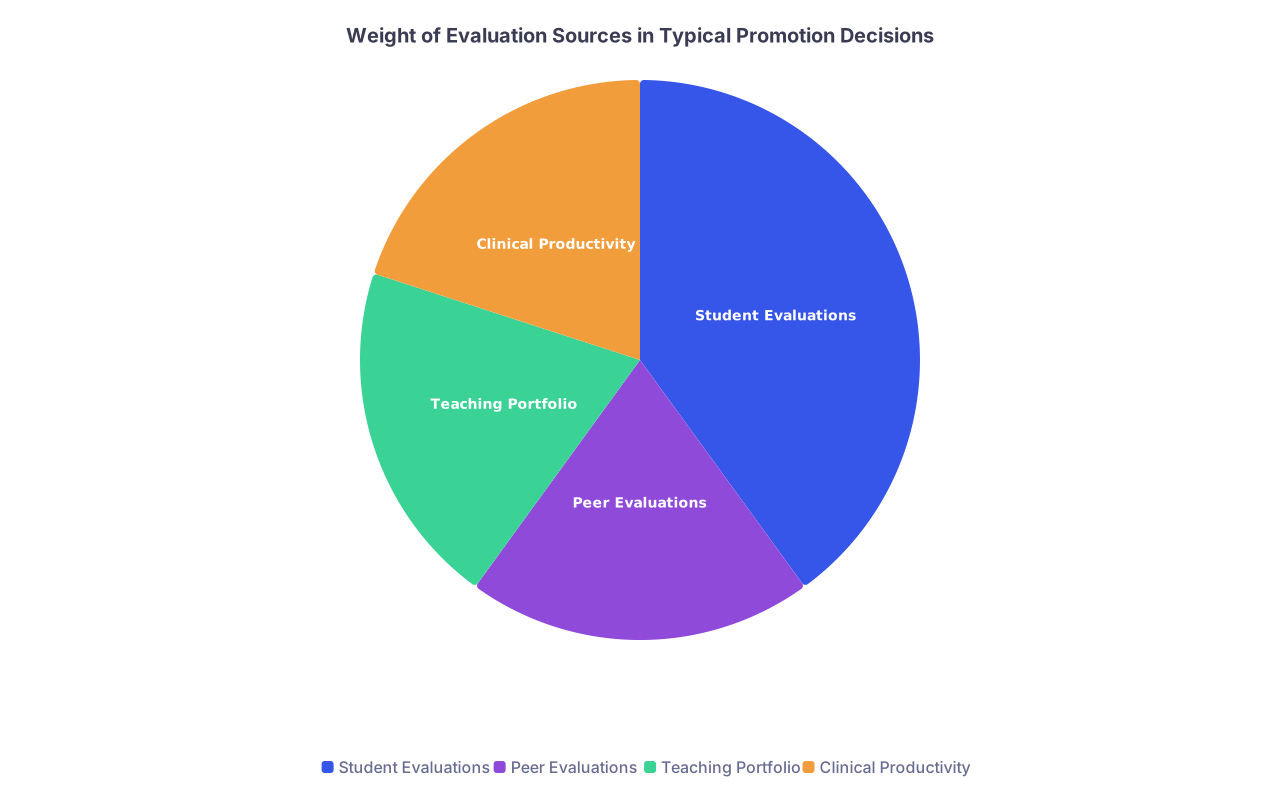
| Category | Value |
|---|---|
| Student Evaluations | 40 |
| Peer Evaluations | 20 |
| Teaching Portfolio | 20 |
| Clinical Productivity | 20 |
Numbers vary, but that pie chart isn’t far off from what I’ve seen in many institutions.
A. Ask directly how you’ll be judged
Do this in the first 3–6 months:
- Ask your division chief or vice chair for education:
“How much weight do student evaluations carry in promotion decisions here?” - Ask for examples:
“Can you show me examples of teaching evaluation comments that are considered concerning vs acceptable?”
If they dance around it, push once:
“I’m coming from a very different training culture. I want to align early. Concrete examples help me more than general advice.”
B. Get a trusted observer in your sessions
Do not wait until there’s a complaint. Set this up early:
- Ask an experienced faculty member with a good reputation for teaching:
“Can you observe one of my sessions and give me feedback on my teaching style specifically in this culture?”
Tell them what you want:
- “I’m concerned I may come across as too blunt or harsh. Please be honest.”
Document this feedback in your teaching portfolio. It becomes evidence that you are actively working to adapt.
C. Track your own evaluations with a cold eye
Don’t just glance at your overall scores. Read the comments, and sort them into themes:
- “Too harsh”
- “Great teacher but intimidating”
- “Unapproachable”
- “Explains concepts clearly”
- “Respects students”
Pay attention to pattern, not the one or two outliers who hate everyone.
If you see “harsh/intimidating” more than once or twice per term, you don’t debate the students. You revise your behavior.
5. Day-to-day tactics: how to teach firmly without being labeled “abusive”
Here’s where we get practical. You’re on the wards tomorrow. What do you actually do?

| Step | Description |
|---|---|
| Step 1 | Start of Day |
| Step 2 | Set expectations |
| Step 3 | Ask students for goals |
| Step 4 | Use neutral questioning tone |
| Step 5 | Correct calmly and specifically |
| Step 6 | Reinforce good performance |
| Step 7 | Offer next steps plan |
| Step 8 | End of Day debrief |
| Step 9 | Student error? |
Start of day: set the tone
Two minutes at the beginning can prevent a complaint later.
Say something like:
“On this rotation, I will challenge you a lot. I’ll ask questions, I’ll expect you to prepare, and I’ll give you direct feedback. My goal is to make you safe and competent, not to embarrass you. If at any point you feel my tone is off, tell me or email me. I want you to learn and feel respected.”
That one speech changes how they interpret everything you do.
During questioning: change your face, not your standards
The problem often isn’t your content; it’s your facial expression and tone. I’ve watched this in real time:
- International faculty asking a normal question, but with a stern expression that in their culture means “I’m listening”.
- Student reads it as “I’m angry”.
So:
- Soften your face deliberately when questioning. This feels ridiculous, but it works.
- Lower your voice volume slightly when correcting.
- Use more neutral words: “Tell me more”, “What are you thinking here?” instead of “No, that’s wrong.”
You can still ask hard questions. Just deliver them calmly.
Correcting in front of others: reframe the moment
Avoid the instinct to drill the student into the ground in front of the team.
Example of a better script:
- Student: “We should give this patient 2 liters of fluid bolus for shortness of breath.”
- You (old style): “That’s completely wrong. Have you even examined the patient?”
- You (adapted style): “I’m hearing you suggest a fluid bolus. Let’s pause. Who can tell me what exam findings would support that plan, and what would argue strongly against it?”
You’ve turned an error into a group teaching moment without annihilating the person.
After rounds, you can pull the student aside and say:
“Earlier, your plan was unsafe for a patient in pulmonary edema. That’s serious. I want you to review fluid management in heart failure tonight and send me one key learning point by email.”
Clear. Serious. Still professional.
6. Dealing with actual complaints without self-destructing
You will get a complaint at some point. Not “if”. When.
The worst response is angry denial. The second worst is passive, silent self-blame. Let’s go for a third path: professional triage.

Step 1: Listen to the wording, not just the accusation
When your clerkship director or chair says:
“Some students feel your teaching style is harsh and intimidating.”
Ask:
“Can you share the exact comments or examples they provided?”
You care about the specific behavior they describe, not the label “harsh”.
You might hear:
- “Dr. X raised his voice and said, ‘How can you not know this?’ in front of the team.”
- “Dr. X rolled his eyes when I gave an incorrect answer.”
- “Dr. X told me I should reconsider my career.”
Every one of those is fixable behavior.
Step 2: Own what’s true, clarify what isn’t
Your response should be something like:
“I see how that behavior could be perceived as harsh. That comes from the culture where I trained, but I recognize it doesn’t work here. I’m already working on changing my phrasing and tone. I’d appreciate specific feedback as I adapt.”
Do not say:
- “Students just need to toughen up.”
- “They’re too sensitive.”
- “This is how medicine is supposed to be.”
Even if you believe that in your bones. Saying it in a meeting about a complaint is how you get labeled “unprofessional” and “resistant to feedback”.
Step 3: Put a concrete adjustment plan in writing
Send a short follow-up email:
“Following our discussion today, I will:
- Begin every rotation with an expectations talk about my teaching style.
- Use more neutral phrasing during corrections (avoiding ‘How can you not know?’).
- Request a peer observation of my teaching in the next 2 months.
I appreciate your guidance as I adapt my style to best support our learners.”
Now there is a paper trail that you are coachable and proactive. That matters later.
7. Use your international background as an asset, not a liability
Right now, it might feel like everything about your background is “wrong” for this place. That’s not true. You have advantages.
You’ve likely:
- Seen diseases your students only read in textbooks.
- Practiced with fewer resources, making you good at clinical reasoning without endless tests.
- Trained in systems where responsibility comes earlier, giving you a sharp eye for unsafe practice.
The key is to package that experience in a way that fits the teaching culture.

Examples of how to leverage it:
- Case discussions: “In my previous hospital, we saw this condition regularly with almost no imaging available. Let me show you how we relied on exam findings.”
- Professionalism teaching: “Where I trained, there was a very strict hierarchy. Here it’s flatter, but the responsibility to the patient is the same. Let’s talk about what professionalism looks like in both.”
- Resource stewardship: “You will work in systems with limited resources, even here. I’ve practiced where the laboratory closed at 4 p.m. Use my experience as practice for thinking about cost and access.”
Now your international status becomes a source of valuable perspective, not just “the strict doctor with an accent.”
8. Build a small safety net: mentors, allies, and your own mental health
Teaching in a foreign culture while being judged on unwritten rules is exhausting. You need a few supports.
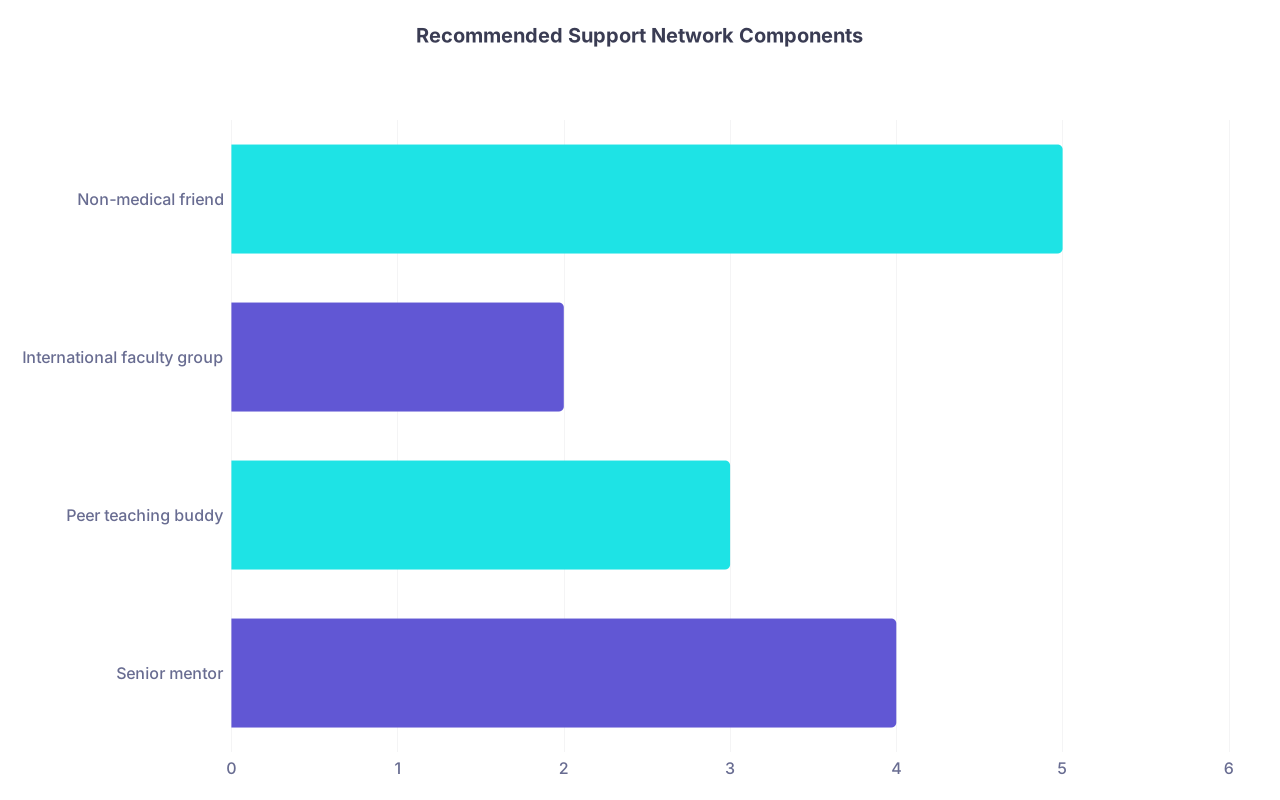
| Category | Value |
|---|---|
| Senior mentor | 4 |
| Peer teaching buddy | 3 |
| International faculty group | 2 |
| Non-medical friend | 5 |
On a scale of 1–5 (how crucial), all of these matter. Especially the last one.
What to actually do:
- Find a senior mentor who gets it. Ideally someone who is either an international graduate themselves or someone who has a track record of supporting diverse faculty. Ask them directly: “I’m adjusting to teaching here. Can I check in with you twice a year about how I’m doing and where I need to adjust?”
- Get a peer teaching buddy. Another junior faculty member who teaches the same learners. Trade observations. Be brutally honest with each other.
- Join or create an international faculty group. Even if it’s just three people who meet for coffee once a month and swap survival strategies.
- Have at least one friend outside medicine. Someone you can complain to who doesn’t escalate it into institutional drama. You will need to blow off steam somewhere.
If you don’t consciously set this up, you’ll wait until you’re burned out and bitter. Then every small correction from your chair will feel like an attack on your identity, not guidance on your teaching.
9. You do not have to become “Americanized”; you do have to become effective
Let me be blunt with you.
Some international faculty cling to their old style as a point of pride. “This is how real doctors are trained. I will not change.”
And then they wonder why they never get promoted, why fewer students sign up for their electives, why they are always “respected but not chosen” for leadership roles.
You do not have to abandon your values:
- High standards
- Seriousness about patient care
- Demand for preparation
- Respect for hierarchy when it protects patients
You do have to change:
- Your default tone
- The way you deliver feedback
- Your assumptions about what “respect” looks like
- Your tolerance for variance in student behavior
Think of it the way you think of practicing medicine in a new country: different formulary, different protocols, different electronic record. You don’t call it “selling out” when you learn new drug names or forms; you call it practicing safely in that system.
Teaching is the same.
If you remember nothing else, remember this:
- The culture will not adjust to you. You must decode it and adapt your delivery while keeping your core standards.
- Students judge you more on how you make them feel while they’re wrong than on how much you know when you’re right.
- Document your efforts to adapt, get observed early, and use your international experience as a teaching strength—not an excuse to refuse change.