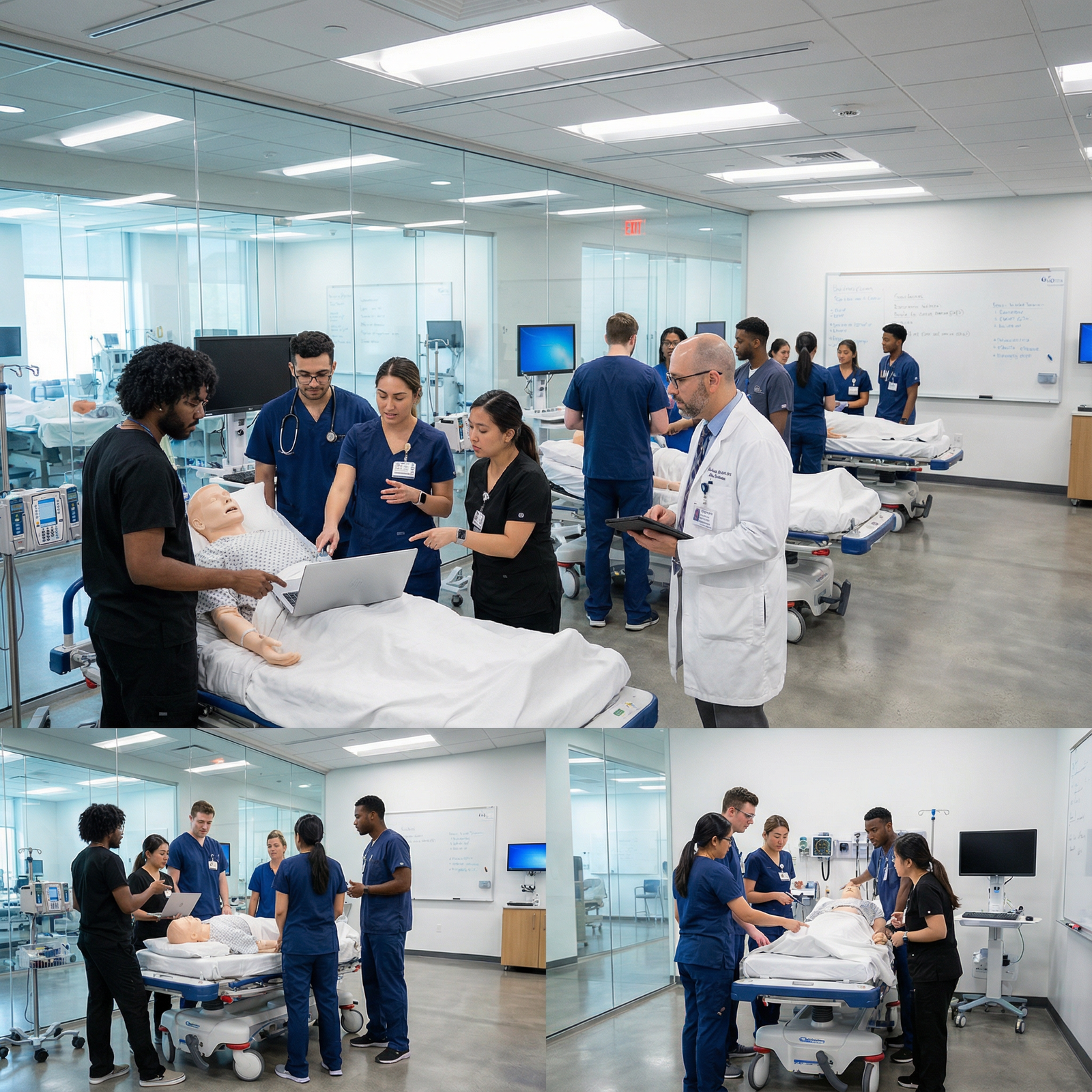
The idea that you “need” a Master’s in Medical Education to be a serious medical educator is exaggerated at best and flat‑out wrong at worst.
Let me be blunt: a Master’s in Medical Education is a tool, not a ticket. Hospitals are not lining the halls with clipboard-wielding deans saying, “No MMedEd? No teaching for you.” But there are specific situations where that degree moves from “nice vanity credential” to “actually worth your time, money, and sleep.”
Let’s separate the hype from the actual value.
The Myth: “Serious educators need a Master’s in Med Ed”
You’ve probably heard versions of this:
- “If you want to be a PD, you basically need a medical education degree now.”
- “All the big-name educators I know have one.”
- “It’ll massively boost your academic promotion.”
This is mostly survivorship bias and marketing.
Look at your institution’s current program directors, clerkship directors, deans. Many of them were in those roles long before med ed master’s programs exploded over the last 10–15 years. Even now, a good chunk have no formal medical education degree. What they do have: experience, outcomes, and a reputation for showing up for learners.
Does that mean the degree is useless? No. It means it is neither a magic key nor a mandatory entry pass.
Let’s anchor this with what actually gets people into education leadership roles.
| Factor | Real Impact on Getting Roles | Often Hyped As Critical |
|---|---|---|
| Showing up consistently | Very high | Low |
| Doing unglamorous admin | High | Almost never mentioned |
| Good evaluations | High | Moderate |
| Mentorship & networking | Very high | Underappreciated |
| Formal med ed degree | Moderate | Overstated |
The uncomfortable truth: most early and mid-level education roles go to people who say “yes” when the department needs something done, not to those with the prettiest CV line.
What these degrees actually teach you (when they’re good)
Good med ed master’s programs are not just fluff and buzzwords. When done right, they give you four things that are legitimately hard to get piecemeal:
Solid grounding in education theory
Not just “adult learning” as a phrase you drop in meetings. You actually understand things like cognitive load, retrieval practice, deliberate practice, self-determination theory, and how they translate into curriculum and assessment design.Real assessment and curriculum design skills
Writing non-garbage MCQs, mapping curricula to competencies or EPAs, designing OSCEs that are actually psychometrically defensible. Not trivial. Most clinicians wing this.Basic education research skills
Not “I ran a SurveyMonkey and got p < 0.05.” I mean study design, reliability/validity, qualitative methods, basic stats, and how to write something that survives peer review.A network of people who care about teaching
You meet other weirdos who stay late to tweak rubrics, care about feedback, and read Academic Medicine voluntarily. That’s your tribe.
Where people get burned is when they assume any program with “medical education” in the title will deliver this. Plenty do not.
The real question: Necessary for what?
Stop asking, “Is a Master’s in Medical Education necessary?” and ask, “For what goal?” Because the answer changes dramatically depending on what you actually want.
1. “I just want to be a good clinical teacher”
You do not need a degree for this. At all.
You need:
- Reps at the bedside
- A few good books or open resources
- Feedback from learners and peers
- Maybe a local teaching certificate or faculty development series
There are free or cheap ways to become far better than the average teacher:
- Local teaching academies
- Half‑day or full‑day workshops on feedback, bedside teaching, assessment
- Online courses (e.g., Coursera/EdX education courses; SGU, Harvard, UCSF free resources)
If your endgame is: “I want learners to love my teaching and I want to feel competent,” a master’s is massive overkill.
2. “I want formal education leadership roles”
Now we’re getting closer to where a degree actually starts to matter.
For roles like:
- Clerkship director
- Residency program director (PD)
- Associate/vice/assistant dean for education
- Director of assessment or curriculum
…a Master’s in Medical Education/Health Professions Education can be:
- A moderate advantage at mid-tier institutions.
- A strong advantage at big academic centers that care about accreditation optics and scholarship.
Will you be locked out without one? No. But if there are two similar candidates and one has successful experience + a med ed degree and the other has just experience, that degree is absolutely a tie‑breaker in some places.
I’ve heard this exact line behind closed doors: “We like Candidate B, but Candidate A has the master’s and a couple of education papers. That helps us with LCME/ACGME and our promotion committee.” Not hypothetical. Real conversation.
What the data actually shows about career impact
You’re not going to find a randomized trial of “same doctors, with or without med ed degrees, followed for 15 years.” But we do have patterns from institutional reports and CVs of education leaders.
Commonly observed:
- Many education leaders do not have a med ed degree—but the proportion with one is rising in newer appointments.
- Having a master’s in med ed is strongly associated with:
- More peer-reviewed education publications
- More formal leadership titles
- Higher likelihood of being on promotion tracks that value education scholarship
Cause vs correlation? Mixed. People who care enough to do a master’s probably already cared about education and were more proactive. But functionally, the association still matters.
Here’s the more practical breakdown:
| Career Direction | Degree Value |
|---|---|
| Occasional bedside teaching only | Low |
| Core teaching faculty, small leadership roles | Low–Moderate |
| Clerkship or small program leadership | Moderate |
| Major residency/fellowship PD roles | Moderate–High |
| Dean/Associate Dean for Education | High |
| Education research career | High |
If you want to be “the education person” in your department or institution, the degree reinforces your identity and credibility. If you just want to be “a good teacher,” it’s unnecessary.
The cost side: this is where most people lie to themselves
Programs love to market “flexible,” “online,” “for busy clinicians.” Translation: you’ll still be doing a second job in your so‑called spare time.
Realistic costs:
- Time: 10–20 hours/week for 1–3 years, depending on intensity and whether there’s a thesis/capstone.
- Money: often $15,000–$50,000+ all-in if not institutionally funded.
- Opportunity cost: lost research time, moonlighting, or just not being constantly exhausted.
Where people especially miscalculate is the time drag from education research projects. It’s not the structured coursework that breaks them; it’s:
- IRB
- Data collection
- Chasing survey responses
- Writing and revising manuscripts
That’s where you’ll either come out with real scholarship—or a half-finished “project” you never publish.
Who should definitely not do a med ed master’s
Let’s be clear about poor reasons to sign up:
“I don’t know what else to do, so I’ll get another degree.”
That’s how you collect credentials instead of building a career.“It will fix my CV and cover up weak clinical or research output.”
No. If your main problem is clinical performance or non‑existent scholarship, this does not magically fix that.“Everyone else seems to be getting one.”
Peer pressure is a terrible basis for a multi‑year commitment and five figures of debt.“I want more letters after my name.”
You will get those letters. You will not get automatic respect. People respect impact.
If this is you, you’re better off with targeted, lower‑burden development: a teaching certificate, a focused course on assessment, or just actually leading a project and getting mentored.
When the degree is strategically smart
Now the flip side. There are situations where I’d seriously recommend it.
You’re already doing the job in all but title
You’re designing curricula, building OSCEs, reading about assessment in your free time, doing QI projects on evaluations. You’re the “education person” informally. In that case, a structured degree:- Gives you a framework and language for what you’re already doing.
- Converts your ad hoc work into something publishable.
- Gives your institution a clean justification to formally recognize what you’re already contributing.
You want to move institutions or countries
If you’re aiming for big-name academic centers or moving abroad, a med ed master’s travels better than “I did a lot of teaching at my home hospital.” It’s a recognizable signal.You want to do education research seriously
Not just the occasional survey study, but an actual scholarly portfolio. The methods training you get in a good program (especially the ones built on health professions education science, not generic education) is hard to patch together on your own while working full‑time.
How to choose a program that isn’t a waste
Here’s where people get burned. They pick based on brand name or convenience and never ask the only questions that matter.
You want to know:
- Who teaches in the program, and what have they published?
- How many graduates have first‑author education publications?
- Is there hands‑on project work tied to your institution, or just theory papers?
- Is there actual mentorship for scholarship, or are you on your own?
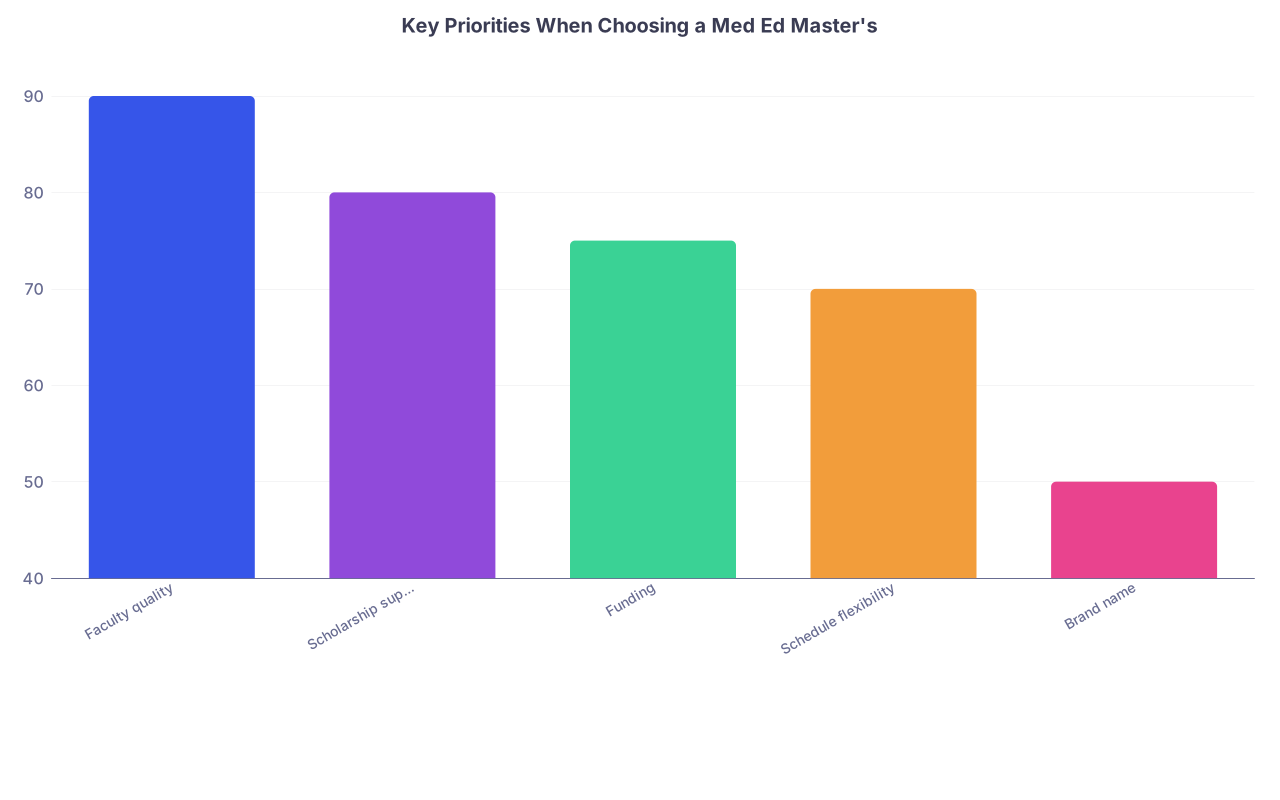
| Category | Value |
|---|---|
| Faculty quality | 90 |
| Scholarship support | 80 |
| Funding | 75 |
| Schedule flexibility | 70 |
| Brand name | 50 |
Look for programs that:
- Require you to design, implement, and evaluate real curricula or assessments.
- Have faculty with recognizable education research portfolios.
- Integrate your coursework with your current teaching role, not as something totally detached.
If the website is full of buzzwords but light on actual graduate outcomes, that’s a red flag.
Alternatives that get you 60–80% of the value for 5–10% of the pain
There’s a huge middle ground between “do nothing” and “do a full master’s.”
Concrete options:
- Longitudinal faculty development programs (1–2 years, often internal, sometimes with certificates)
- Medical education fellowships (post-residency or mid‑career)
- CME‑bearing short courses in assessment, curriculum design, or simulation
- Cross‑registration in a few targeted education or statistics courses instead of a full degree
These can:
- Give you enough theoretical grounding to stop making rookie design mistakes.
- Show commitment to education on your CV.
- Move you into local leadership roles without the time and money hit of a master’s.
A blunt decision framework
Let me summarize this in a simple filter. Answer honestly.
Do you want your primary academic identity to be “education person” (rather than mostly clinician, mostly researcher, etc.)?
- If no → you almost certainly do not need a master’s.
- If yes → go to 2.
Do you see yourself aiming for PD/clerkship director/dean‑level roles or education research as a major output?
- If yes → a master’s is often a strategically good idea.
- If no → consider smaller, targeted training instead.
Can you get institutional funding or protected time?
- If yes → big plus. Now the cost–benefit tilts more in your favor.
- If no → you need a very clear, specific career payoff plan, not vague “maybe this will help.”

| Step | Description |
|---|---|
| Step 1 | Do you want major education role? |
| Step 2 | Skip master degree |
| Step 3 | Leadership or research focus? |
| Step 4 | Use smaller programs |
| Step 5 | Funding or protected time? |
| Step 6 | Proceed only with clear payoff |
| Step 7 | Master degree likely worthwhile |
That’s really it. Strip away the hype, the marketing, the peer pressure—and you’re left with a fairly clear choice tree.
The bottom line
A Master’s in Medical Education is not the new MD. You’re not doomed without it. You’re not automatically transformed with it.
For many clinicians and early educators, it’s overkill. Experience, mentoring, and targeted development will get you 80% of what you need to be effective.
For people who want to stake their career on education leadership or scholarship, it can be a powerful lever—if it’s a good program, if you actually apply what you learn, and if it’s aligned with real institutional roles and opportunities, not fantasies.
Years from now, nobody will care how many credits you took. They’ll remember whether you built programs that worked, supported learners when it mattered, and left your training environment a little less dysfunctional than you found it. The degree is optional. The work is not.