
You are absolutely not doomed to a purely clinical life just because your residency or fellowship doesn’t have a formal “medical education track.”
Let me say that bluntly because this fear spirals fast. I know the mental script: “Everyone else has a clinician-educator track, a MedEd certificate, a Masters, a teaching portfolio. My program barely has noon conference. Did I already ruin my chances at an academic teaching career?”
No. But you can waste your years there if you’re passive.
Let’s walk through this like two people sitting in the call room at 2 a.m., scrolling through other programs’ fancy “scholarship in medical education” web pages and quietly panicking.
First: You’re Not Behind Just Because Your Program Isn’t Fancy
There’s a quiet myth going around: “If you’re not in a big-name program with a formal clinician-educator track, you can’t build a serious teaching career.”
That’s just wrong.
I’ve watched people from small community programs with zero official MedEd infrastructure end up as:
- Clerkship directors
- Program directors
- Associate deans of education
And I’ve also watched people in ultra-structured “educator tracks” do the minimum, collect the certificate, and… that’s it. No real portfolio. No identity as an educator. Nothing that screams, “I’m obsessed with teaching.”
So, the real problem isn’t “no track.”
The real problem is: no initiative, no documentation, no narrative.
The danger of a program without a formal education track is this: it’s very easy to let teaching become invisible. You’ll teach all the time—students, interns, patients—but if you never shape it or record it, it won’t exist on paper when you apply for your first academic job or a fellowship.
Your goal isn’t “be in the right track.”
Your goal is “leave residency/fellowship with real, demonstrable evidence that you are an educator.”
Formal track or not.
Step One: Turn Random Teaching Into “Scholarly” Teaching
You’re already teaching. You just aren’t calling it that yet.
The trick is to make what you’re already doing look intentional and educationally grounded. Not fake. Just named.
Here’s the mental reframe:
- “I present cases on rounds” → “I facilitate case-based learning during inpatient rounds.”
- “I give the occasional noon talk” → “I develop and deliver small-group didactic sessions for residents and students.”
- “I teach skills during night shift” → “I supervise and assess procedural skills in a workplace-based learning environment.”
That’s not fluff. That’s literally how job descriptions are written.
So what do you actually do differently?
Plan your teaching on purpose.
Don’t just wing a chalk talk. Jot down:- Learning objectives
- How you’ll check understanding (questions, quick case, 1-minute paper)
- What went well / what bombed
Save those notes. That’s the beginning of an education portfolio.
Ask for basic feedback.
After a session:
“Anything I could do differently that would make this more useful?”
Or send a two-question anonymous form.
Screenshot or save those. This is evidence.Repeat and refine one thing.
Pick one recurring session—maybe a weekly EKG review or “ICU basics” for interns—and run it regularly. Same topic, slightly better each time. That’s iterative improvement, aka “education scholarship lite.”
You’re turning your day-to-day chaos into something you can name, describe, and own.
Step Two: Build Your Own “DIY Education Track”
If your program doesn’t hand you a structured educator track, you build one yourself. Quietly. Piece by piece.
Think of a typical formal clinician-educator track. It usually has some version of:
- Longitudinal teaching experiences
- Basic training in education (workshops, journal club, readings)
- A small MedEd project
- Mentorship
- A “thing” at the end (presentation, poster, certificate)
You can recreate most of this on your own.
1. Longitudinal Teaching
Claim consistent, recurring teaching roles:
- Offer to be the “student teaching liaison” on your service: short daily micro-teach lesson for the med student.
- Volunteer for recurring sessions: monthly intern prep talk, case conference, morning report, skills workshop.
- If there’s a student rotation: ask the clerkship director if you can run a weekly teaching session for them.
The magic word here is longitudinal. Not “I gave some random talks once.”
Say: “Over 12 months, I led a weekly X session for Y learners.” That sounds like a track.
2. Get Some Actual Education Training (Without a Track)
If your institution doesn’t have a formal track, it still almost certainly has:
- Faculty development workshops on giving feedback, bedside teaching, assessment
- A teaching certificate program that residents are technically allowed to join
- Interprofessional education workshops with nursing/pharmacy
You hunt those down. Email GME, the Office of Medical Education, or literally search “[Your Institution] faculty development teaching.”
Worst case, if your home place is truly barren, you look outside:
- Online MedEd courses (AMEE, AAMC, AMA, Harvard Macy-style courses, etc.)
- Free online modules from organizations like STFM, SGIM, ACP, etc.
- National MedEd webinars you can list as formal training
You don’t need a $20k Master’s right now. You just need to show you’ve pursued structured learning about teaching.
3. Do One Small MedEd Project
Here’s where anxiety flares: “I have no time, no mentor, no stats person, and no idea what counts.”
Calm this down: you do not need a randomized trial of a new curriculum.
You need one of these:
- You changed how your morning report runs and collected simple pre/post surveys
- You created an online module and tracked usage plus a short quiz
- You modified how feedback is given on your team and got resident reactions
That’s it. That’s a MedEd project.
Then you present it at a local GME day, a regional meeting (like SGIM regional, ACP local chapter, APDIM workshops), or even as a poster at a national conference. Suddenly your “small project” turns into:
“Designed, implemented, and evaluated a novel X session for Y-level learners; presented results at Z conference.”
That’s exactly the kind of line people in formal education tracks get.

| Step | Description |
|---|---|
| Step 1 | Clinical Resident |
| Step 2 | Identify Teaching Roles |
| Step 3 | Add Simple Structure and Objectives |
| Step 4 | Collect Feedback and Refine |
| Step 5 | Design Small MedEd Project |
| Step 6 | Present Locally or Regionally |
| Step 7 | Apply for Academic or Educator Roles |
Step Three: Find Mentors Even If No One Has “MedEd” in Their Title
This one hurts. You look at your faculty list and no one is a “Vice Chair of Education” or “Director of Medical Education Research,” and your brain goes: I have no mentor, so I can’t do MedEd.
You almost definitely do. You’re just using too narrow a filter.
Look for:
- The attending who clearly likes to teach and actually prepares
- The clerkship director or APD who runs evaluations or OSCEs
- The person who always seems to be organizing orientation or bootcamp
They might not publicly brand themselves as “MedEd researcher,” but they live in education work every day. Ask them very explicitly:
“I’m really interested in a career in medical education. We don’t have a formal educator track here—would you be willing to help me shape a small teaching project and think about next steps?”
Most will be flattered. If they can’t be the main mentor, they’ll know who can.
If your institution is truly barren? Go outside:
- Join a MedEd interest group in your specialty’s national organization (they often have mentor lists).
- Reach out cold to someone who published a short education piece you liked—short, respectful email, 4-5 sentences, specific ask.
- Use Twitter/X and academic MedEd communities (they really do answer DMs and emails).
Mentorship in MedEd is often multi-institutional anyway. You’re not weird for doing it.
Step Four: Learn to Talk About Your Teaching Like It Matters
You’re probably under-selling everything you do.
Academic jobs and fellowships don’t read your mind. They read your CV, your personal statement, your ERAS application, your letters. So you need to translate your informal teaching into serious-sounding, specific contributions.
For example:
Instead of:
“Participated in resident noon conference.”
Try:
“Developed and delivered a recurring case-based noon conference series on acute decompensated heart failure for internal medicine residents; integrated interactive polling to assess real-time learning.”
Instead of:
“Teach med students on rounds.”
Try:
“Structured daily bedside teaching for third-year medical students on the inpatient ward, emphasizing clinical reasoning and oral case presentation; provided formative feedback using direct observation.”
You’re not lying. You’re naming what you’re actually doing.
And then: keep receipts. Schedule, slides, feedback, emails, conference abstracts. That’s your teaching portfolio starter pack.
Step Five: Compare Yourself Honestly to “Track” People
This helps calm the “I’m behind” fear. Let’s be concrete.
| Aspect | Formal Educator Track Resident | DIY Resident Without Track |
|---|---|---|
| Labeled “Track” on CV | Yes | No |
| Longitudinal Teaching | Often built-in | You create it |
| Formal Education Training | Offered by program | You piece it together |
| MedEd Project | Required | You choose and build it |
| Mentorship | Assigned | You seek it |
| Actual Output (talks, posters, evals) | Varies widely | Varies widely |
The punchline: the outputs can be identical.
I’ve seen candidates with no formal track who had:
- Multiple local/regional presentations
- Documented teaching evaluations
- A clearly articulated MedEd interest
- Letters specifically praising their teaching
And they beat people from fancy educator tracks who had… a line on a CV and that’s it.
So no, you’re not automatically behind.
You’re only behind if you let your environment dictate your ambition and documentation.
Step Six: What About Fellowships and Jobs That “Prefer” Formal MedEd Training?
Here’s the part that’s actually scary: some clinician-educator fellowships and jobs really do like:
- Prior involvement in an educator track
- A MedEd certificate
- A Master’s in education or something similar
You can’t magically rewrite your program. But you can:
Make what you have look coherent.
Group all your teaching, training, and projects under sections like “Medical Education Activities” and “Education Scholarship” on your CV.Tell a focused story in your personal statement.
This matters more than people admit. Don’t say, “I like teaching.”
Say: “In a program without a formal educator track, I intentionally created longitudinal teaching roles, sought out external education training, and designed my own small-scale curriculum project. I’m now looking for structured mentorship to deepen my skills and expand my impact.”Apply early to small MedEd things now.
- Regional workshops
- “Residents as teachers” programs at your local med school
- Short courses in curriculum design or assessment
All of that screams: I didn’t wait for someone to hand this to me.
Leverage letters of recommendation.
Ask letter writers to explicitly comment on your teaching, initiative in education, and potential as a future academic educator. A strong letter that says, “This resident independently built a structured teaching curriculum in a program without an education track” is pure gold.
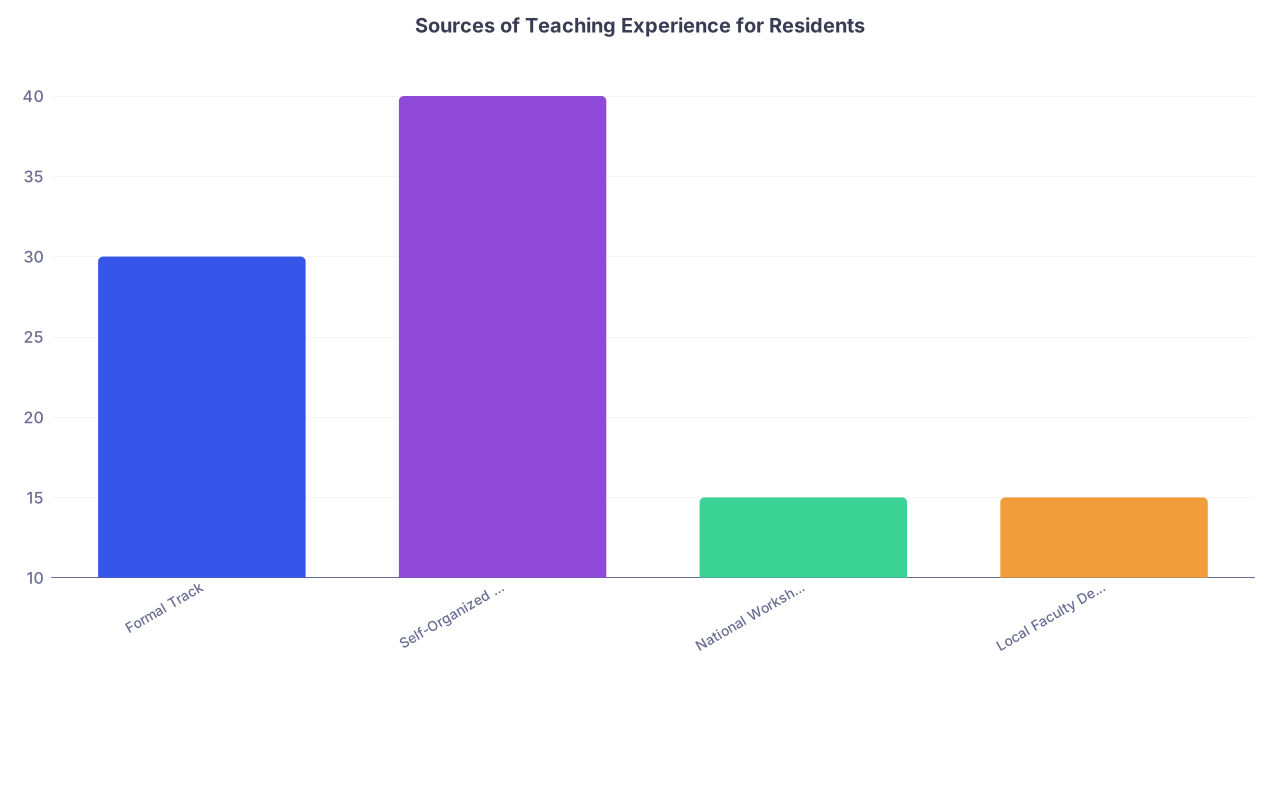
| Category | Value |
|---|---|
| Formal Track | 30 |
| Self-Organized Sessions | 40 |
| National Workshops | 15 |
| Local Faculty Development | 15 |
The Dark Thought: “What If I End Up Stuck in a Purely Clinical Job I Don’t Want?”
Here’s the nightmare scenario you’re probably playing in your head:
You finish residency/fellowship. No track. No fancy MedEd CV lines. You take a 100% clinical job at a hospital that doesn’t care about teaching, and that’s it. Game over. Dream of being a clerkship director or PD: dead.
Reality is messier and less dramatic.
A lot of people start in “mostly clinical with some teaching” roles and then:
- Pick up student teaching as a volunteer clinical preceptor
- Get involved with a local med school or PA school
- Take on small roles first: site director, small group facilitator, MMI interviewer
- Slowly shift their time toward education over a few years
The real “stuck” feeling usually comes from fatigue and loss of momentum, not a one-time structural choice.
If you keep doing a few things:
- Protect your teaching identity (even 10–20% of your life)
- Keep a record of what you do educations-wise
- Stay connected to academic folks (conferences, interest groups, mentors)
You’re not stuck. You’re just taking the longer, more winding road.
And yes, it’s scarier. But you’re not alone in that.
Quick Reality Check: Are You Doing Enough Right Now?
If you’re spiraling, use this as a brutal self-audit. Today, not in theory:
- Am I doing any recurring, planned teaching?
- Do I have any saved evidence of my teaching? (slides, schedule, evals)
- Have I attended at least one education-related workshop or course this year?
- Do I have one person who knows I want a MedEd career and believes me?
- Am I working on—or at least sketching out—one small education project?
If the answer is “no” across the board, you’re not doomed. You’re just at the starting line. That’s fixable.
If the answer is “yes” to even 2–3 of those, you’re already more of an educator than you think. The work now is packaging and growing it.
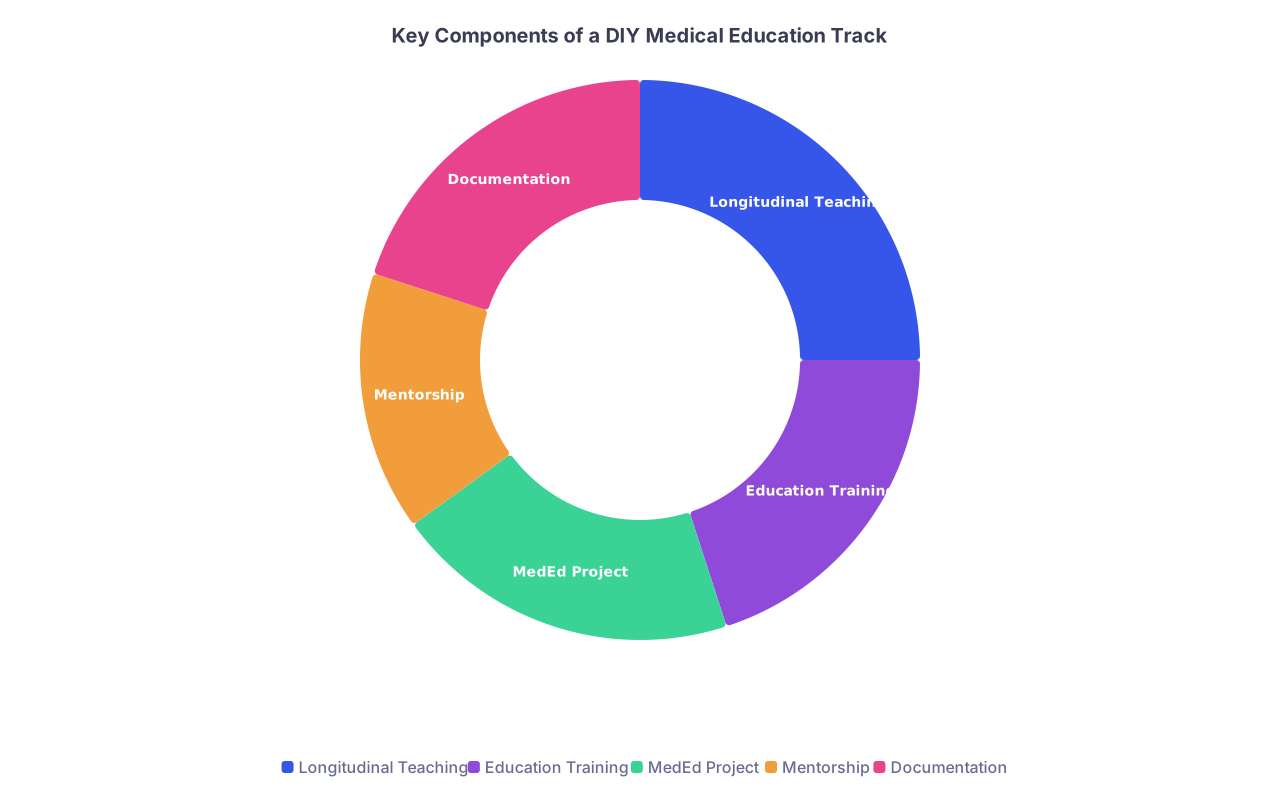
| Category | Value |
|---|---|
| Longitudinal Teaching | 25 |
| Education Training | 20 |
| MedEd Project | 20 |
| Mentorship | 15 |
| Documentation | 20 |
Visualizing the Path Forward (So Your Brain Stops Screaming)
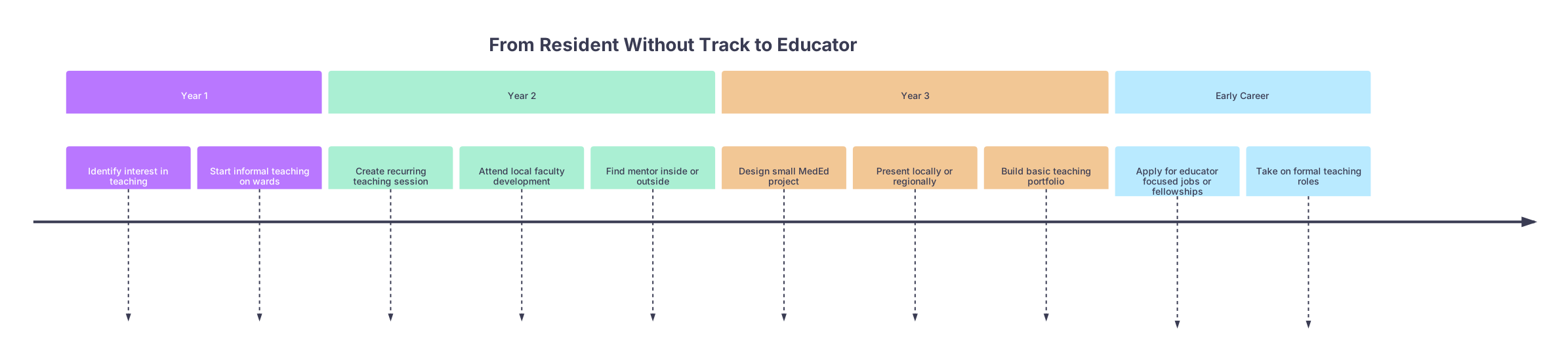
And yes, this timeline can compress or stretch depending on where you are. The point is: there is a path, even without a formal track carved out for you.
FAQs (The Stuff You’re Probably Still Worried About)
1. Do I need a formal clinician-educator track to get an academic job?
No. It helps in the sense that it structures things for you, but many academic faculty never had a formal track. What you need are outputs: documented teaching, some training in education, at least one project, and strong letters that frame you as an educator. How you got there matters less than the fact that you did.
2. Will programs or fellowships look down on me because my residency had no education track?
They’ll look down on you if your application looks like you did nothing about your interest in teaching. If you can clearly say, “My program had no track, so I built my own experiences this way…” and you have concrete examples to back it up, most people will be impressed by your initiative, not bothered by your program’s limitations.
3. Is it “cheating” to make my casual teaching sound more formal on my CV?
No—as long as you’re honest. You’re not inflating hours or inventing roles. You’re just using the language the academic world uses to describe real activities. If you led a weekly case discussion, that is indeed “facilitating case-based learning in a small-group setting.” Precision isn’t cheating; it’s clarity.
4. How big does a MedEd project have to be to “count”?
Smaller than you think. A simple curriculum tweak with 10–20 learners and a short pre/post survey is enough to be a poster or short presentation. What matters is: you thought about a learning problem, designed an intervention, evaluated something about it, and shared the results. That’s the skeleton of education scholarship.
5. What if I’m already PGY-3 (or later) and I’ve done almost nothing formal?
You’re not out of time, but you do need to move now. Pick one teaching activity you can formalize and repeat, attend at least one education workshop in the next few months, and sketch a very small project you can finish quickly (even if it’s just describing and evaluating a single session). Document everything. Then, be honest in your narrative: “I discovered this interest later, but I’ve moved fast to build skills and projects.”
6. Should I delay a job or fellowship to do an extra year in a formal MedEd fellowship or track?
If you’re truly committed to a heavy education career—future PD, clerkship director, major curriculum leader—a dedicated MedEd fellowship or a Master’s can be very helpful. But it’s not mandatory for everyone. If you already have solid teaching experiences and a project or two, you can often get an educator-leaning job and grow from there. I’d only delay if:
- You want intensive MedEd training, and
- You realistically can’t get that level of support in a job you’re considering.
Bottom line:
You’re not stuck clinically just because your program doesn’t hand you a formal education track.
If you:
- intentionally structure and document your teaching,
- seek out mentorship and basic education training, and
- complete at least one small MedEd project you can present,
you’ll walk out not as “the resident from the program with no track,” but as “the person who clearly built themselves into an educator anyway.”