
The way most clinicians write notes today is broken. Not just inefficient. Dangerous, legally fragile, and clinically useless.
You feel it every day: 20 clicks to find anything real. Pages of cloned history. Paragraphs of nonsense dropped in “for compliance.” And then you still get messages from coders, risk, and quality saying your documentation is “insufficient.”
Let me be blunt: note bloat is not a personal failing. It is a system problem. But if you wait for the system to fix it, you will drown. You need a personal, team-level, and tech-level strategy.
This guide is that strategy.
1. The Reality Check: What “Lean, Defensible” Actually Means
Stop chasing the fantasy that you can satisfy everyone with one note. You cannot. So you prioritize.
A “lean, defensible” note has three non‑negotiables:
Clinically usable
- Another competent clinician can:
- Understand why the patient is here.
- See what you thought was going on.
- Know what you did and why.
- Know what needs to happen next.
- Another competent clinician can:
Legally defensible
- If your note is projected in a courtroom 3 years from now:
- Your decision-making looks rational and anchored in the data available that day.
- Risk discussions and key informed consent elements are visible.
- Dangerous alternatives you did not pursue are explicitly addressed when relevant.
- If your note is projected in a courtroom 3 years from now:
Billing/compliance aligned without dominating the note
- Enough detail to support the billed level of service.
- Key quality and regulatory elements embedded once, not scattered and repeated.
If something in your note does not serve at least one of those three, it is a candidate for deletion or automation.
2. Why Your Notes Are Bloated (And Who Is Actually Driving It)
You are not typing 4-page notes because you love prose. You are reacting to pressure from several directions.
| Driver | Typical Pressure | Core Fix Strategy |
|---|---|---|
| Billing/Coding | Maximize complexity, justify level | Explicit MDM, smart templates |
| Compliance/Risk | Check every box, cover every policy | Standard phrases, targeted macros |
| EHR Design | Default templates, autopop, copy-forward | Custom “skeletal” templates, pruning |
| Culture/Training | Longer = better, “defensive” copy/paste | Local standards, role modeling |
| Personal Risk Aversion | “If it is not documented, I am screwed” | Decision trees, problem-based structure |
You are up against:
- Billing/Coding: Requests like “please add more detail to support high-complexity MDM.” Which magically becomes a half‑page “assessment” paragraph no one will read.
- Compliance: Pop‑ups. Mandatory fields. “You must document Fall Risk, PHQ‑9, tobacco status, flu shot, VTE prophylaxis…” Every encounter.
- EHR defaults: Templates that were never designed; they just accumulated. “Smart” features that vomit labs, vitals, and scanned notes into your progress note.
- Residency habits: You learned that a long note impressed attendings. That is over now. Attendings might have skimmed; judges do not.
- Fear: If there is a bad outcome, you want to be able to say, “See? I thought of that.” So you paste in full normal neuro exams and 15-point ROS for a sprained ankle.
You cannot fix billing, compliance, and EHR design overnight. But you can adopt a structure and workflow that bends all of them around a lean core.
3. The Core Fix: Problem-Oriented, Decision-Focused Notes
The fastest way to cut note size by 30–50 percent without losing defensibility is to move to:
- Problem-oriented structure
- Decision-focused language
- Aggressive data summarization
3.1 Use a strict problem-based Assessment & Plan
No more narrative blobs labeled “Assessment/Plan” with 6 problems buried in one paragraph.
Every significant active issue gets its own heading, with a short, structured mini‑note under it.
Example structure:
- Problem name, acuity, and status
- “Sepsis secondary to pneumonia – improving”
- Key reasoning / differential
- Data that changed your mind or confirms your thinking
- Explicit plan
- Risk/safety net language (if relevant)
For a hospitalized patient:
Assessment & Plan
Sepsis secondary to right lower lobe pneumonia – improving
- Reasoning: Met SIRS on admission (T 38.9, HR 118, WBC 15.2) with focal RLL consolidation on CXR, no abdominal, urinary, or skin source.
- Data: Blood cultures negative to date x 48h, lactate down from 3.5 to 1.2, WBC trending down.
- Plan: Continue ceftriaxone + azithromycin (day 3/5), switch to PO tomorrow if afebrile and tolerating diet. Repeat CBC in am.
- Risk: Counseled spouse that if respiratory status worsens overnight, patient may need transfer to higher level of care.
Hypertension – chronic, suboptimally controlled
- Reasoning: Home BP reportedly 150s/90s; admission BP 148/92. Currently on amlodipine 10 mg.
- Plan: Add lisinopril 10 mg daily, follow BMP in 1–2 days. Outpatient follow‑up with PCP within 2–4 weeks after discharge.
Notice what is not there: full ROS, complete PE, daily lab lists. Those belong in separate EHR sections, not text.
3.2 Make your HPI a decision story, not a transcript
HPI should explain why today matters and what changed your decision‑making.
Bad HPI (bloated, useless):
Patient is a 58-year-old male with a past medical history significant for hypertension, hyperlipidemia, and prediabetes who presents today with chest pain. The chest pain began yesterday afternoon while he was watching television and was described as sharp in nature. He states the pain is located in the left side of his chest and does not radiate. The pain is associated with some mild shortness of breath. He denies nausea, vomiting, diaphoresis, dizziness, syncope…
Lean, defensible HPI:
58M with HTN, HLD, prediabetes here for new chest pain x 24h. Sharp, left‑sided, non‑radiating, non‑exertional, worse with deep breath and palpation, no SOB, N/V, diaphoresis, or syncope. No prior similar episodes. No recent travel, immobilization, or calf pain. Strong family history CAD (father MI at 52). No personal cardiac history.
What changed?
- You used negatives selectively: only those that shape risk (classic ischemic features, PE/DVT risk).
- You compressed social and family history to what matters.
- You avoided retyping things that live in Past Medical / Meds unless they directly affect today’s decision.
3.3 Explicitly document “why not” for dangerous alternatives
Defensibility hinges on differential diagnosis handling. That does not mean listing 15 conditions; it means showing you considered and reasonably excluded the scary ones.
For that chest pain patient:
Discussed possibility of ACS, PE, aortic pathology. Low suspicion for PE (PERC negative), no tearing pain, unequal BPs, or neurologic symptoms to suggest dissection. Troponins x2 negative, ECG unchanged from prior. Shared decision-making discussion: risk of missed ACS is low but not zero; patient elected admission for observation and stress testing tomorrow.
This is arguably the most legally protective paragraph in the note. And it is three sentences.
4. Take a Chainsaw to Auto‑Import and Copy-Forward
If your EHR note contains 2 pages of vitals, labs, imaging, and previous notes, that is not documentation. That is a data dump with your signature on it.
4.1 Autopop is not your friend
Disable or radically trim:
- Auto-imported lab tables
- Full vitals flowsheet dumps
- “All prior notes” sections
- Entire imaging reports pasted into the note body
Keep these rules:
- Reference data, do not replicate it.
- “Worsening Cr 1.0 → 1.6 over 24h” is enough. The full BMP is in the lab tab.
- “CXR: RLL infiltrate, no effusion (see report)” replaces a 12-line pasted report.
- Only bring in numbers that change decisions.
- Troponin trend? Yes.
- Daily CMP when nothing changed? No.
4.2 Copy-forward with intent, not laziness
Copy-forward is where good clinicians incriminate themselves.
Once you copy yesterday’s note, you own it. If it says “abdomen soft, nontender” every day and post-op day 3 the patient actually complained of pain, your repeated copied normal exam looks worse than a short, accurate, changed exam.
Use this discipline:
Copy-forward only structural skeletons, not raw text blobs.
- Problem headings, yes.
- Yesterday’s entire A/P paragraph, no.
If you copy-forward text, use a deliberate “edit pass” pattern:
- Start each copied problem with a symbol until updated: e.g., prefix with “✏️” or “EDIT:” while you work, then remove once reviewed. (Some systems allow custom tags; use them.)
- Or, more realistically: train yourself to delete and retype key sentences rather than “tune” them.
Never copy-forward ROS and full exam.
- Build short, click-based templates for common normal exams instead.
- Then add free text only where something changed.
5. Build a Personal Documentation Playbook
You cannot “remember” to do all this at 5:45 pm after 18 patients and 12 inbox messages. You need a playbook: small, reusable assets and rules.
5.1 Core templates you should have
Forget the 20-page organizational templates. You need 5–8 skeletal templates that you actually use.
For example:
- New outpatient consult
- Established outpatient follow-up
- ED initial eval
- ED re-eval / brief note
- Inpatient H&P
- Inpatient daily progress note
- Discharge summary
- Telehealth visit
Each template should have:
- Minimal HPI prompts:
- “Onset / course / associated symptoms / what changed.”
- Problem-based A/P skeleton:
- “Problem #1 –
Reasoning:
Key data:
Plan:
Risk / follow‑up:”
- “Problem #1 –
- Key compliance phrases baked in once:
- For telehealth: “Visit conducted via secure video; patient consented to telehealth; patient located in [state].”
- For discharge: “Medication reconciliation completed; patient/caregiver verbalized understanding of changes and follow‑up plan.”
You are not filling out a novel. You are filling out a framework and then adding the 10–20 percent that is actually new.
5.2 Phrase libraries for high‑risk areas
Build a small set of standard, precise phrases for things that blow up in court:
- Informed consent
- Capacity and refusal
- Return precautions and safety netting
- Shared decision-making
Examples (modify to your practice and institution):
Informed consent (procedure)
Discussed indication, alternatives (including no procedure), and risks including bleeding, infection, damage to surrounding structures, and need for further intervention. Patient (or surrogate) voiced understanding and agreed to proceed. Questions answered.
Capacity / leaving AMA
Patient demonstrates capacity: understands diagnosis, recommended treatment, risks of refusal (including worsening illness, disability, or death), and alternatives. Patient chooses to leave against medical advice. Discussed return precautions and advised immediate return or ED evaluation if symptoms worsen or new symptoms develop.
Safety netting (common ED/urgent scenarios)
Reviewed worrisome symptoms that should prompt immediate ED return, including worsening pain, fever, vomiting, chest pain, shortness of breath, or new neurologic deficits. Patient/caregiver repeated back key points.
You can store these as:
- Smartphrases / dot phrases
- Text expander snippets (if allowed)
- EHR macros
6. Align With Billing and Compliance Without Letting Them Run the Note
You cannot ignore coders and compliance teams. You also cannot let them dictate style to the point your notes become unreadable.
Your job is to translate their checklists into short, clear clinical statements.
6.1 Make MDM explicit in a few sentences
For evaluation and management (E/M) levels, coders care about:
- Number and complexity of problems
- Amount/complexity of data reviewed
- Risk of complications / morbidity / mortality
Coders love long-winded paragraphs because they can mine them for MDM elements. You can give them what they need in 3–5 targeted sentences.
Example (complex outpatient visit):
MDM: Evaluating new severe headache with red flag features (sudden onset, age >50) and concern for SAH vs mass vs vascular lesion. Reviewed prior CT head (last month) and today’s non‑contrast head CT. Ordered and independently interpreted CT angiogram brain. Discussed case with neurology. High risk due to potential for neurologic deterioration and need for urgent intervention.
That one paragraph checks most MDM boxes.
6.2 Turn compliance into one‑line elements, not full paragraphs
Instead of paragraphs like:
Tobacco use counseling was provided. The risks of ongoing tobacco use were discussed in detail including cardiovascular disease, lung cancer, and COPD. Patient was encouraged to quit and resources were offered…
Use a compact, standardized line:
Tobacco: current smoker ~1 ppd x 20 yrs. Brief counseling provided; patient not ready to quit, offered quitline and follow‑up.
You still hit:
- Status
- Counseling done
- Resources offered
Same with depression screening, fall risk, VTE prophylaxis, etc. These can often be:
- Checkboxes in structured fields (preferable)
- One‑line bullets in the note
6.3 Have 1–2 structured discussions with your coders
Sit down (virtually or in person) with a coder who works your charts. Ask them directly:
- “Show me one of my notes that is borderline for level 4 and what you wish was there.”
- “What 2–3 sentences would have tipped this to level 4/5?”
Then build those patterns into your templates.
You will find that coders often want:
- Explicit mention of chronic conditions affecting care:
- “DM2 and CKD stage 3 increase risk for contrast; chose non‑contrast imaging.”
- Clear statements of independent interpretation:
- “I independently reviewed CXR and agree with radiologist’s impression of no acute process.”
- Statements of discussion with other clinicians:
- “Discussed case with cardiology; consensus on outpatient stress testing.”
Once you know the target, you can hit it quickly, without padding.
7. Use Technology Intentionally: Voice, Ambient Scribes, AI Help
Technology can either make note bloat worse or become your way out. Depends on how you use it.
7.1 Voice recognition and ambient scribing
If you add dictation or ambient scribing and do not change your habits, you will simply produce longer bloated notes faster.
The rule:
- Use tech to capture nuance, not volume.
Good use:
- Free dictation for the reasoning paragraph under each problem.
- Ambient scribe to generate a draft that you then cut down to your lean template.
Bad use:
- Dictating every lab value and vital sign.
- Letting ambient scribe autopop an entire conversational transcript into the note body.
Always:
- Start from your skeletal template.
- Add only the few dictated sentences that express your thinking or risk discussions.
7.2 AI summarization and drafting (within policy)
Many systems now include:
- Note suggestions
- Summarization of prior notes
- Draft note creation from chart data
You want to:
Use AI to gather, not to bloat.
- Let it pull relevant data from the chart.
- But you control what gets pasted into your final note.
Always rewrite key reasoning in your voice.
- The riskiest thing you can do is sign auto‑generated generic text describing your decision-making you did not actually think.
Use it as a second brain for structure, not content.
- E.g., have it propose a problem list for today based on orders and diagnoses.
- Then you write the A/P under each.
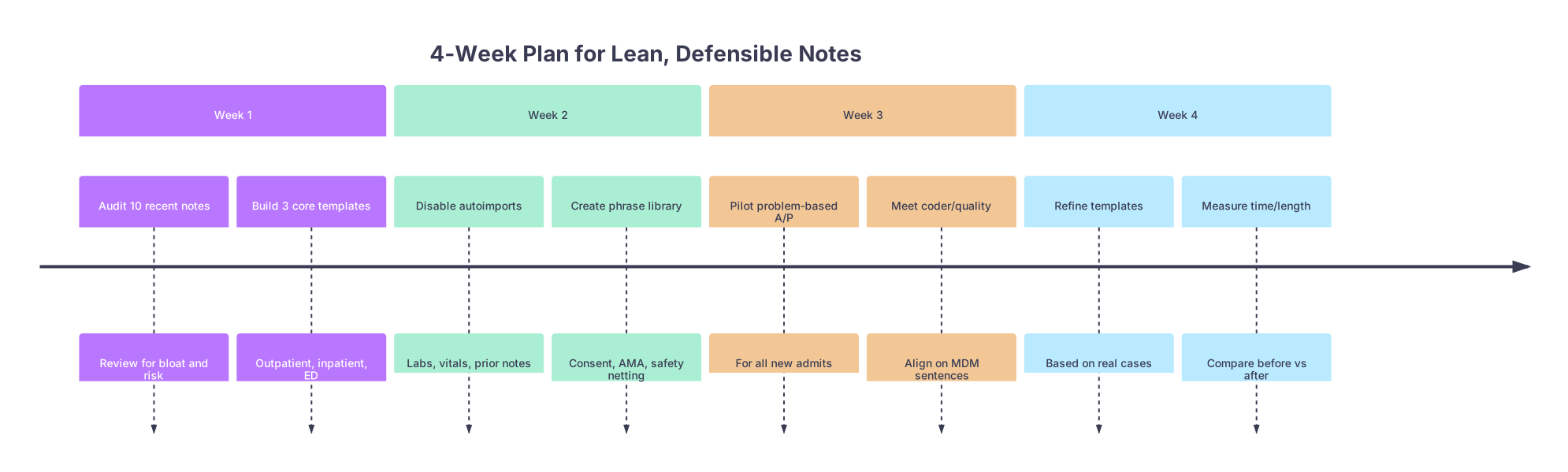
8. Implementing Change: A 4-Week Personal Plan
You do not fix documentation habits in a day. But you can radically change them in a month if you are deliberate.
| Period | Event |
|---|---|
| Week 1 - Audit 10 recent notes | Review for bloat and risk |
| Week 1 - Build 3 core templates | Outpatient, inpatient, ED |
| Week 2 - Disable autoimports | Labs, vitals, prior notes |
| Week 2 - Create phrase library | Consent, AMA, safety netting |
| Week 3 - Pilot problem-based A/P | For all new admits |
| Week 3 - Meet coder/quality | Align on MDM sentences |
| Week 4 - Refine templates | Based on real cases |
| Week 4 - Measure time/length | Compare before vs after |
Week 1: Baseline and brutal self‑audit
- Pull 10 of your recent notes (mixed encounter types).
- For each note, mark:
- Green: Clinical decisions and risk language.
- Yellow: Billing/compliance content.
- Red: Autopop garbage, pasted data, redundant history.
You will see the ratio. Aim to cut red by half.
Then:
- Draft 2–3 skeletal templates you will actually use next week.
Week 2: Turn off the firehose
Disable or slim down:
- Automatic import of vitals tables
- Lab result blocks
- Full imaging and prior note text
Build:
- 6–8 smartphrases for consent, AMA, capacity, safety netting, telehealth language.
Force yourself to reference data rather than paste it.
Week 3: Go all‑in on problem-based A/P
For all new admits and complex outpatient visits:
- Use problem headings with reasoning → data → plan → risk.
- Time yourself. It feels slower the first 5–10 uses, then speeds up sharply.
Meet briefly with a coder or compliance person:
- Show them one of your new notes.
- Ask exactly what is missing for their purposes; tweak 2–3 standard sentences.
Week 4: Refine and measure
- Compare:
- Average note length before vs after.
- Your subjective “mental load” writing notes (it will feel different).
- Tweak templates:
- Add prompts where you repeatedly forget something important.
- Remove sections you never use.
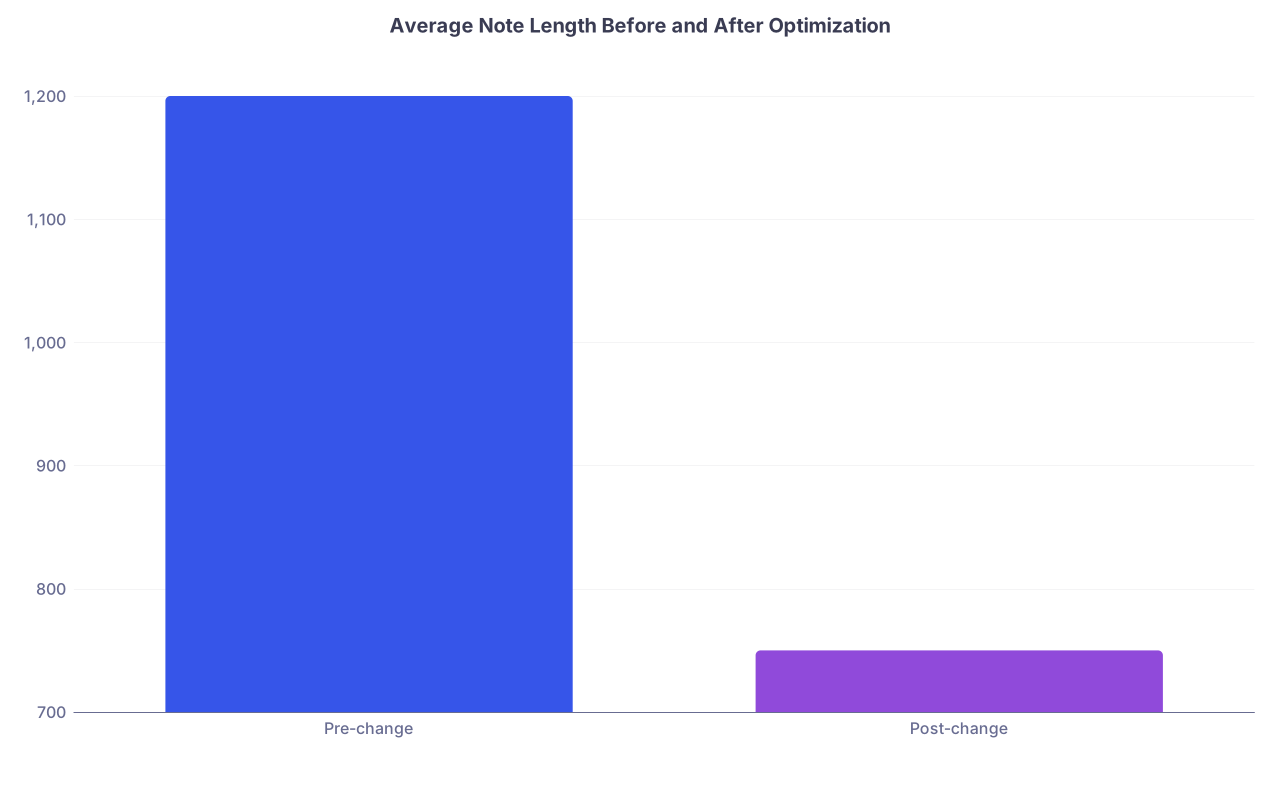
If you want hard numbers, track for 1 week:
| Category | Value |
|---|---|
| Pre-change | 1200 |
| Post-change | 750 |
Not exact, but I have seen 30–50 percent reductions in note length without loss of defensibility, and often with better legal positioning.
9. Avoiding Common Pitfalls When You Go Lean
When clinicians try to “go lean,” they often swing too far or in the wrong way.
Here is how not to sabotage yourself:
Do not strip out risk language.
- Short does not mean vague. Your key differential and “why not” for serious diagnoses must be there.
Do not rely on structured fields alone.
- Checkboxes help billing and registries. They do not tell your story. Always include a short free‑text reasoning paragraph under serious problems.
Do not ignore handoffs.
- Your colleagues read: “What is happening, what are we watching for, what will get this patient out of the hospital?” Give them that in 3–5 lines at top of A/P.
Do not make each note a standalone novel.
- The chart is the full story. Your daily notes are chapters. Reference prior information instead of restating it.
10. What This Looks Like in Practice: A Before/After Snapshot
To make this concrete, take a common scenario: 72‑year‑old hospitalized with CHF exacerbation and pneumonia, day 3.
Bloated note fragments (what I see too often):
- HPI repeats admission story in full.
- ROS: 10‑point “all negative except above.”
- Physical exam: Complete multi‑system exam identical to yesterday.
- Labs: Full CBC, CMP, Mg, Phos, BNP for last 3 days pasted in.
- Imaging: Full echo report pasted.
Lean, defensible progress note:
Subjective
Breathing improved; now comfortable at rest, mild dyspnea with walking to bathroom. No chest pain, palpitations, or near‑syncope. Eating ~50 percent of meals. No new cough or sputum.
Objective (key)
Vitals stable, O2 94 percent on 2 L. Lungs with bibasilar crackles, improved. 1+ LE edema to mid‑shin. Net –1.2 L last 24h. Cr 1.3 (from 1.1), K 4.0. CXR yesterday with improving RLL infiltrate.
Assessment & Plan
- Acute on chronic systolic HF – improving, diuresis cautious
- Reasoning: Volume status better (less edema, less dyspnea) but slight bump in Cr.
- Plan: Decrease IV furosemide to 40 mg BID, monitor I/O and daily weights, repeat BMP in am. Continue ACEi, beta‑blocker.
- Community acquired pneumonia – clinically improving
- Reasoning: Afebrile, WBC downtrending, improved oxygenation, less cough.
- Plan: Continue ceftriaxone + azithromycin (day 3/5); re‑eval for switch to PO and possible discharge in 24–48h if remains stable.
- CKD stage 3 – mild AKI risk with diuresis
- Plan: Monitor Cr and electrolytes daily, avoid nephrotoxins, encourage oral intake.
- Discharge planning
- Anticipate discharge home with home health once off IV diuretics and stable on PO regimen. PT/OT eval ordered. Daughter updated at bedside; reviewed signs of worsening HF and need to seek care.
This is maybe half the length of the bloated version and dramatically more useful to:
- The night coverage doc
- The consultant
- Future you reading this in QA or a deposition
Final Takeaways
Short notes are not risky; vague notes are. Write problem-oriented, decision-focused notes that show your reasoning and risk discussions in a few sharp sentences per problem.
Kill autopop and copy-forward dependence. Reference data instead of pasting it, and never reuse ROS/exam wholesale. Own every line you sign.
Systematize your documentation. Build lean templates, standard risk phrases, and a personal playbook, then refine it with feedback from coders and your own time/length data.