
Understanding Networking in Medicine as a DO in Pediatrics-Psychiatry
Networking in medicine is not just about collecting business cards or LinkedIn connections. It is about building a web of meaningful, long-term professional relationships that support your growth, your patients, and your career trajectory.
For a DO graduate pursuing or entering a combined Pediatrics-Psychiatry (Peds-Psych) or triple board pathway, networking is especially critical. This niche area—straddling pediatrics, psychiatry, and often child and adolescent psychiatry—tends to be a small, relationship-driven community. People know each other, talk about promising trainees, and share opportunities informally long before they’re posted.
You’re also navigating unique dynamics as a DO graduate:
- You may encounter limited slots or programs familiar with osteopathic training.
- Some faculty may not yet fully understand the strengths of osteopathic principles in behavioral health and pediatrics.
- The osteopathic residency match (and its integration with ACGME programs) means your pathway might look different from your MD peers.
In this context, strategic, authentic networking in medicine becomes more than “nice to have”—it is your leverage. It can help you:
- Navigate the DO graduate residency landscape
- Learn about combined peds psych residency and triple board programs
- Find mentors who respect and value your DO background
- Access research, leadership, and advocacy roles that might not be widely advertised
This article will guide you through a practical, step-by-step approach to medical networking as a DO graduate in Pediatrics-Psychiatry—covering conferences, mentorship, online platforms, and how to maintain these relationships during residency and beyond.
Laying the Foundation: Your Professional Identity as a DO in Peds-Psych
Before you start networking, you need clarity on who you are professionally and who you’re trying to meet. You are not “just another resident” or “a DO trying to get a job.” You are a physician-in-training at the intersection of pediatrics and psychiatry, integrating osteopathic principles with biopsychosocial care for children, adolescents, and families.
Define Your Narrative
Create a short, consistent professional story you can adapt to different settings. Think of this as your “networking elevator pitch,” but in medicine it should sound natural and patient-focused.
Example:
“I’m a DO pediatric-psychiatry trainee with a strong interest in early childhood trauma and developmental disorders. I’m particularly interested in how osteopathic principles and whole-person care can be integrated into systems-level approaches for high-risk youth.”
Or if you’re earlier in training:
“I’m a DO graduate exploring combined peds-psych pathways. I’m especially drawn to working with medically complex children with behavioral and emotional challenges, and I’m looking to learn from people who’ve built integrated careers in this space.”
Your narrative should include:
- Your training background (DO graduate, school, current PGY year)
- Your clinical interests (e.g., autism, trauma, consultation-liaison, foster care, addiction, eating disorders)
- Your career goals (e.g., academic medicine, community psychiatry, policy/advocacy, integrated care)
- A subtle nod to your osteopathic lens (e.g., whole-person, systems-focused, body-mind integration)
Prepare Your Networking Tools
Before stepping into conferences or online platforms, get some basics in place:
Updated CV and short bio
- Keep a 1-page CV handy in PDF format.
- Write a 3–4 sentence professional bio you can paste into emails, conference registrations, or speaker introductions.
Professional photo and email
- Use a clear, professional headshot (neutral background, clinic or conference attire).
- Create a professional email (e.g., firstname.lastname@institution.edu or @gmail.com).
Online presence
- LinkedIn: Simple, accurate profile with your current role, interests, and a short “About” paragraph geared toward peds-psych.
- Professional societies: Complete your member profiles (e.g., AACAP, AAP, APA, AOA, specialty sections).
- Institutional profile: If your residency has an online directory, make sure yours reflects your peds-psych and osteopathic interests.
This groundwork signals seriousness and makes it easy for new contacts to remember you and follow up.
Conference Networking: Where Peds-Psych Relationships Are Born
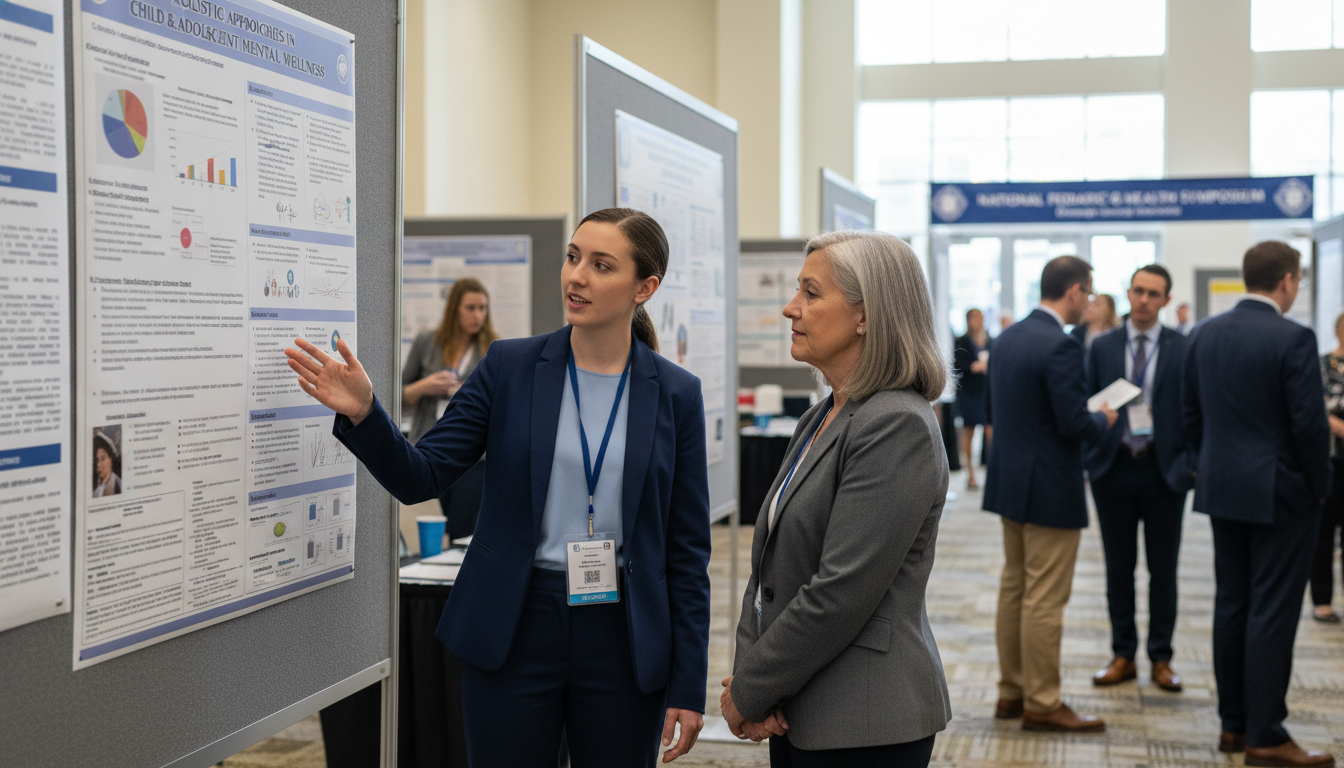
Conferences are high-yield environments for medical networking—especially in a small field like Pediatrics-Psychiatry or triple board. You have concentrated access to program directors, national leaders, researchers, and fellow trainees who may shape your career for years.
Choosing High-Yield Conferences
Prioritize meetings that bring together pediatrics, psychiatry, and child mental health:
- AAP (American Academy of Pediatrics) – Councils/sections on developmental & behavioral pediatrics, mental health, or child protection.
- AACAP (American Academy of Child and Adolescent Psychiatry) – Essential if you’re interested in child and adolescent psychiatry.
- APA (American Psychiatric Association) – Look for child & adolescent and consultation-liaison tracks.
- AOA-related or osteopathic specialty societies – For DO-specific mentorship medicine opportunities and advocacy.
- Regional or state AAP/APA/AACAP meetings – Often more approachable and less overwhelming than national meetings.
If you’re considering or already in a triple board or peds psych residency, look for sessions or interest groups specifically labeled as:
- Combined training
- Integrated pediatrics-psychiatry
- Child mental health in primary care
- Behavioral pediatrics
Pre-Conference Strategy: Who Do You Want to Meet?
Treat each conference like a targeted networking campaign.
Identify key people:
- Directors of peds-psych or triple board programs.
- Faculty publishing in your interest area (e.g., early psychosis, autism, trauma, foster care).
- Leaders of relevant committees (AAP mental health sections, AACAP committees, APA council sections).
Email 2–3 people in advance: Use a short, respectful email. For example:
Subject: DO peds-psych trainee hoping to briefly meet at [Conference]
Dear Dr. [Name],
I’m a DO graduate and current [MS4/PGY-1/PGY-2] with a strong interest in pediatrics-psychiatry and integrated child mental health care. I’ll be attending [Conference] and noticed you’re presenting on [topic].
If you have 10–15 minutes during the meeting, I would be very grateful for the chance to briefly introduce myself and ask a few questions about your work and training pathway. I’m specifically interested in [one or two specific, genuine interests].
Thank you for considering,
[Full Name], DO
[Current role, institution]
[Email, phone, LinkedIn (optional)]
Often, even if they’re busy, they’ll point you to someone else who can meet with you.
At the Conference: Practical Networking Moves
Attend smaller sessions and interest group meetings
- These are more conducive to conversation than large plenaries.
- Come with 1–2 questions prepared that show you did your homework.
Use a simple introduction template
- “Hi, I’m [Name], a DO graduate and [PGY level or med student] interested in combined pediatrics-psychiatry and child mental health integration. I’ve been following your work on [topic] and really appreciate [specific detail].”
Ask targeted, thoughtful questions Examples:
- “How did you decide between traditional and triple board training?”
- “What skills should I focus on building in residency to be competitive for child and adolescent psychiatry fellowship?”
- “How do you see DO graduates fitting into the evolving landscape of integrated peds-psych care?”
End every conversation with a clear next step
- “Would it be okay if I emailed you to ask one or two follow-up questions?”
- “Are there any residents or fellows in your program you’d recommend I connect with?”
- “Would you be open to my reaching out if I’m exploring research in this area?”
Take notes immediately after On your phone or notebook, jot down:
- Who they are / where they work
- What you discussed
- Any promised follow-up (sending CV, article, scheduling Zoom)
Post-Conference Follow-Up: Where Relationships Really Form
Within 3–5 days after the conference:
- Send a brief thank-you email:
- Mention one specific thing you appreciated from your conversation or their talk.
- If appropriate, attach your CV or a brief update you discussed (e.g., your poster, draft project idea).
- Connect on LinkedIn or professional platforms; add a short personalized message.
- If they suggested a next step (e.g., “Email me to talk about research”), follow through promptly and clearly.
By doing this consistently, your conference networking gradually evolves from one-off chats to an informal advisory circle—and sometimes formal mentorship.
Mentorship in Medicine: Building Your Peds-Psych Support Team
True mentorship medicine is more than getting advice; it’s about building long-term relationships in which someone invests in your growth, advocates for you, and helps you navigate complex choices. In peds-psych and triple board, where career paths can be non-linear, mentorship is critical.

Aim for a Mentorship Team, Not Just One Mentor
You will likely need several types of mentors:
Clinical mentors
- Pediatricians and psychiatrists who model integrated care.
- Faculty in your residency or rotation sites who understand complex pediatric mental health.
Career/trajectory mentors
- Someone who has walked a path similar to what you’re considering: combined training, child & adolescent psychiatry fellowship, or systems-level leadership.
- Could be from another institution; does not have to be DO, but DO mentors bring added perspective.
Identity and advocacy mentors
- DO physicians who’ve navigated the osteopathic residency match or integrated ACGME training.
- Faculty involved in diversity, equity, inclusion, and wellness, especially if you hold underrepresented identities.
Peer mentors
- Residents 1–2 years ahead of you.
- Other DO graduates in peds-psych or related fellowships.
How to Ask Someone to Be a Mentor
Avoid the heavy, formal “Will you be my mentor for life?” approach. Instead, start with a concrete ask and let the relationship evolve naturally.
Example email:
Dear Dr. [Name],
Thank you again for speaking with me after your [session/Grand Rounds] on [topic]. I found your path in pediatrics-psychiatry particularly relevant as a DO graduate pursuing this field.
I’m currently [your status] and would really value your perspective on [specific decision or topic, e.g., research focus, fellowship planning, balancing peds and psych training].
Would you be open to a 20–30 minute Zoom or phone conversation sometime in the next few weeks?
Thank you for considering,
[Name], DO
After a few positive interactions, you might say:
“I’ve really appreciated your guidance over the past few months. If you’re comfortable with it, I’d be grateful to think of you as a more formal mentor as I navigate the rest of my training.”
Being a Good Mentee
Strong mentors stay engaged when you:
- Show up prepared (send questions or an agenda ahead of time).
- Respect their time (30–45 minutes, end on time).
- Give updates on outcomes (e.g., “Following your advice, I joined X project—thank you.”).
- Accept feedback and follow through on commitments.
Remember: mentors also network through you. When you succeed, present, publish, or match into competitive positions, it reflects positively on them and strengthens the entire peds-psych and osteopathic community.
Digital and Day-to-Day Networking: Beyond Conferences
While conferences and formal mentorships are pivotal, your daily actions—online and in your home institution—create the fabric of professional relationships that support your career.
Leveraging Online Platforms for Medical Networking
LinkedIn
- Follow pediatric, psychiatry, and child mental health organizations.
- Connect with people you genuinely interact with (conferences, rotations, projects).
- Occasionally share:
- Conference reflections
- Publicly accessible articles on child mental health
- Brief reflections on integrated care, without violating patient privacy
X (Twitter) / Academic social media
- Many peds-psych and triple board physicians are active here.
- Follow threads on #MedTwitter, #PsychTwitter, #PedsTwitter, #MedEd, and child mental health hashtags.
- Engage respectfully with:
- Journal club discussions
- New clinical guidelines
- Advocacy for children’s mental health
Avoid posting anything that could breach confidentiality or make your program or colleagues easily identifiable in a negative light.
Society platforms
- Many professional societies (AAP, AACAP, APA) have member-only communities or listservs.
- Listen first, then occasionally ask well-framed questions or contribute resources.
Day-to-Day Networking Within Your Residency
Every rotation is an opportunity to extend your network in real life.
On-service networking
- Introduce yourself clearly to attendings: “I’m [Name], DO, a [PGY level] with a strong interest in peds-psych and child mental health.”
- Ask during lulls: “Given my interest in integrated pediatrics-psychiatry, are there any cases, clinics, or projects you’d recommend I get exposure to?”
Interdisciplinary collaboration
- Build relationships with:
- Social workers
- Psychologists
- School liaisons
- Case managers
- These professionals often know where innovative integrated care is happening and can connect you with teams or pilots.
- Build relationships with:
Institutional committees and QI projects
- Join hospital committees related to:
- Behavioral emergencies
- Pediatric safety
- Trauma-informed care
- Integrated behavioral health
- These are excellent medical networking opportunities that also show leadership and systems-level thinking.
- Join hospital committees related to:
Teaching and mentorship of juniors
- Mentor medical students or interns interested in peds or psych.
- This builds your reputation as a collaborator and educator, and your mentees may become future colleagues.
Networking as a DO: Addressing Subtle Bias or Gaps
You may occasionally encounter outdated biases about DO training, especially in academic psychiatry or pediatrics. Strategic networking can help you:
- Identify DO-friendly programs and faculty.
- Find DO mentors who’ve navigated similar dynamics successfully.
- Demonstrate your competence through:
- Strong clinical performance
- Board scores and in-training exams
- Scholarly activity
- Leadership roles
When you introduce yourself, you can subtly embed your DO background as a strength:
“As a DO, I’ve found the whole-person and systems approach particularly useful in caring for kids with complex psychosocial and medical needs.”
Over time, consistent excellence plus visible engagement in conference networking and scholarly activity reframes perceptions and opens doors.
Strategic Networking for Long-Term Career Growth in Peds-Psych
As you progress from student to resident to fellow and early attending, your networking needs will evolve. Thinking strategically can keep your efforts focused and sustainable.
Networking During the Osteopathic Residency Match and Early Training
For DO graduates still in or just beyond the matching phase:
- Use rotations and sub-internships to:
- Meet peds and psych faculty at potential residency or fellowship sites.
- Express interest early in combined pathways, peds consult-liaison, or child & adolescent psychiatry.
- Reach out to current residents and fellows:
- Ask about culture, training structure, and DO representation.
- Inquire how they built mentorship and research networks there.
Even once you’ve matched, your osteopathic residency match story can be a conversation starter and a way to connect with other DOs nationally.
Building Toward Fellowship or Early Career Roles
If you’re considering child and adolescent psychiatry fellowship, peds consult-liaison psychiatry, or a hybrid academic/community role:
Clarify your 3–5 year plan
- Academic vs community vs hybrid
- Amount of clinical work vs research vs teaching
- Focus areas (e.g., trauma systems, integrated primary care, neurodevelopment)
Identify gaps in your CV
- Limited research? Seek out a small, doable project with a peds-psych angle.
- Few leadership roles? Volunteer for a committee, quality improvement project, or trainee council.
- Little visibility? Present a poster or case at AAP, AACAP, or APA.
Network with intent
- When you meet senior faculty, frame questions around your long-term goals, not only immediate tasks.
- Ask explicitly: “Given my interest in [X], what skills and experiences would you recommend I build in the next 1–2 years?”
Giving Back: Networking as a Two-Way Street
As you advance, move from “receiver” to “connector”:
- Introduce junior trainees to mentors who fit their interests.
- Share opportunities (e.g., calls for abstracts, committees, webinars) with your peers.
- Offer to co-present or collaborate when you hear of relevant projects.
This mindset makes networking feel far less transactional and much more like building a community—especially powerful in a small, integrated field like Pediatrics-Psychiatry.
FAQs: Networking in Medicine for DO Graduates in Pediatrics-Psychiatry
1. As a DO graduate, will networking really make a difference in my peds-psych or triple board opportunities?
Yes. In a niche field like peds-psych and triple board, many roles and projects are shared through word-of-mouth or within professional circles before they ever become formal postings. Effective networking can:
- Connect you with combined program directors and faculty who understand DO training.
- Lead to research, QI, or advocacy collaborations that strengthen your application.
- Provide mentors who advocate for you in recommendation letters and informal conversations.
2. I’m introverted and feel awkward at conferences. How can I still do effective conference networking?
Structure helps. Before the conference:
- Email 2–3 people to schedule short, specific meetings.
- Pick 2–3 small-group sessions (workshops, interest groups) where interaction is expected. During the meeting:
- Use a simple introduction script, and prepare 2–3 questions in advance.
- Aim for quality over quantity—2–3 meaningful conversations are more valuable than 20 superficial ones. Afterward:
- Send brief, specific follow-up emails. Written communication often feels more comfortable and is equally important for maintaining connections.
3. How do I find mentors who specifically understand DO training and combined peds-psych careers?
Try a layered approach:
- Look for DO faculty in pediatrics, psychiatry, or child mental health at your home institution.
- Join DO-specific organizations and sections (AOA, specialty colleges) and ask about members in peds-psych or child psychiatry.
- At conferences, ask peds-psych or child psych faculty: “Do you know any DOs in this field who might be open to a brief conversation about training and career paths?” Over time, you may end up with both DO and MD mentors—each adds value from different vantage points.
4. How can I maintain networking relationships during a very busy residency?
Keep it simple and lightweight:
- Send quick updates a few times a year (“Just matched into X,” “Presented my first poster at Y,” etc.).
- When you achieve a milestone influenced by someone’s advice, send a brief thank-you note.
- If you read an article or see news relevant to a mentor’s interests, share it with 1–2 lines of commentary. Short, sincere touches are enough to keep relationships alive until you need more in-depth guidance.
By approaching networking in medicine as the long-term cultivation of authentic, mutually beneficial relationships, you can transform your path as a DO graduate in Pediatrics-Psychiatry. Your combined lens—pediatric, psychiatric, and osteopathic—gives you a powerful, integrative perspective. Strategic networking helps ensure the right people see it, support it, and help you bring it to full fruition for the benefit of the children and families you serve.