
Understanding Networking in Medicine as an IMG in Pediatrics-Psychiatry
Networking in medicine is not small talk at receptions—it is the deliberate process of building professional relationships that create opportunities, credibility, and support. For an international medical graduate (IMG) interested in pediatrics-psychiatry or a triple board pathway, networking is often the difference between being “just another ERAS application” and becoming a known, trusted colleague.
Pediatrics-psychiatry is a small, relationship-driven field. Triple board programs (Pediatrics / General Psychiatry / Child & Adolescent Psychiatry) and combined peds psych pathways have relatively few positions and tight-knit faculty communities. Program directors frequently know each other, attend the same conferences, and share impressions about applicants. Strategic medical networking therefore becomes a powerful lever for IMGs navigating this niche.
This IMG residency guide focuses on practical, step-by-step strategies to:
- Build a credible presence in pediatrics-psychiatry
- Leverage conference networking effectively
- Find and work with mentors
- Use digital tools for mentorship medicine
- Turn networking into concrete outcomes: interviews, research, and long-term career support
The Landscape: Why Networking Matters More for IMGs in Peds-Psych
As an international medical graduate, you face structural challenges:
- Limited or no US clinical experience at the start
- Smaller alumni presence in US pediatrics-psychiatry and triple board programs
- Less familiarity with US hospital culture and expectations
- Visa considerations that may make some programs cautious
In such a competitive environment, being “known” is a massive advantage. Networking helps you:
Signal Commitment to the Field
Peds psych and triple board are niche areas. When faculty repeatedly see your name on emails, posters, interest group lists, or at events, they recognize sustained interest rather than a last-minute choice.Access Hidden Opportunities
Many opportunities—short clinical observerships, informal research roles, quality improvement projects—never appear on websites. They are shared via word of mouth or forwarded to “someone who might be a good fit.”Gain Advocates and Sponsors
A mentor or senior colleague who emails a program director or writes a detailed letter that says, “I know this IMG personally; they are excellent” is often more impactful than any single exam score.Understand the Culture of Combined Training
Pediatrics-psychiatry and triple board require a particular mindset: flexibility, resilience, and comfort with complexity. Conversations with residents and faculty help you understand whether the field truly fits you—and help you speak about it convincingly in interviews.
Example: Two IMGs, Same Scores, Different Outcomes
- IMG A: Strong scores, but no network. Applies broadly to pediatrics, psychiatry, and triple board with generic personal statements.
- IMG B: Similar scores, but:
- Presented a poster at a child psychiatry conference
- Attended a virtual triple board open house and asked thoughtful questions
- Did an observership with a child and adolescent psychiatrist
- Has a mentor who sends an email to one program director
IMG B is far more likely to receive triple board interviews. The difference is not only merit—it is visibility and trust built through networking.
Core Principles of Medical Networking for IMGs
Before going into specific tactics, adopt these core principles that make networking effective—and comfortable.
1. Think Long-Term, Not Transactional
People in medicine can tell when a connection is purely about extracting something (“Can you write me a letter?” “Can you sponsor my visa?”). Instead:
- Focus on learning and contributing
- Ask: “How can I add value?”—e.g., helping with data entry, literature reviews, or translation for patient materials
- View relationships as investments across your entire career, not just the match cycle
2. Be Specific About Your Interests
“Interested in pediatrics and psychiatry” is vague. Instead, be concrete:
- “I’m interested in how early childhood trauma affects neurodevelopment and emotional regulation.”
- “I’d like to work with medically complex children who have overlapping developmental and psychiatric conditions.”
Specificity shows you have thought deeply—and makes it easier for mentors to connect you to the right people or projects.
3. Professionalism Is Your Brand
Every interaction—an email, a Zoom call, a LinkedIn message—is part of your professional “brand.” For IMGs, this is especially important because some faculty may have limited experience working with international graduates.
Your networking should consistently reflect:
- Clear, grammatically correct communication
- Respect for time (short emails, reasonable follow-ups)
- Reliability (meet deadlines, show up on time, respond promptly)
4. Quality Over Quantity
A few strong relationships are more helpful than dozens of superficial contacts. One pediatric psychiatrist who knows you well and is willing to support you is better than 50 business cards or LinkedIn connections you never interact with again.
Building Your Network from Scratch as an IMG
You do not need to be in the US yet to start networking in medicine. You can begin while still abroad and deepen connections when you arrive.

Step 1: Map the Ecosystem of Pediatrics-Psychiatry and Triple Board
To network well, you must know the community you’re entering.
Focus on these groups and organizations:
Triple Board Programs
- Review each program’s website
- Note program directors, associate program directors, and core faculty
- Look at resident profiles—many are involved in advocacy, research, or global mental health
Child and Adolescent Psychiatry Organizations
- American Academy of Child and Adolescent Psychiatry (AACAP)
- Local or regional child psychiatry societies
Pediatrics Organizations
- American Academy of Pediatrics (AAP), especially the Sections on Developmental and Behavioral Pediatrics, and the Council on Children with Disabilities
Create a simple spreadsheet of:
- Names and roles
- Areas of interest (e.g., autism, trauma, adolescent medicine, early childhood)
- Email addresses or social media/LinkedIn profiles
- Any commonalities with you (e.g., international background, languages, global health focus)
This becomes your targeted networking roadmap, not a random contact list.
Step 2: Use Digital Platforms Strategically
Digital presence is crucial for IMGs who may not yet have physical access to US programs.
Build a clear, concise profile:
- Headline: “International Medical Graduate | Pediatrics & Child Psychiatry Aspirant | Interested in Triple Board Training”
- About section: 3–4 sentences summarizing:
- Your medical school
- Your interest in pediatrics-psychiatry
- Any relevant research, advocacy, or clinical experiences
- Experience: List major roles; emphasize anything with children, mental health, or community work
Follow and connect with:
- Triple board programs and key faculty
- Pediatric and child psychiatry interest groups
- Alumni from your medical school who matched into pediatrics or psychiatry
When sending a connection request:
“Dear Dr. X,
I am an international medical graduate with strong interest in pediatrics-psychiatry and triple board training. I enjoyed your recent article on [topic]. I’d be grateful to connect and learn from your work.
Sincerely, [Name]”
X (Twitter) / Academic Social Media
Many child psychiatrists and pediatricians are active on X posting about:
- Child mental health
- Neurodevelopment
- Advocacy and policy
Engage by:
- Following relevant physicians
- Respectfully commenting on threads
- Sharing conference content or publications (with professional tone)
Step 3: Join Formal Mentorship and Interest Programs
Look specifically for mentorship medicine initiatives that support IMGs and early-career trainees:
- AACAP mentoring programs or trainee membership
- AAP section membership (often discounted for trainees or medical students)
- Institutional global health or mental health interest groups (if you have any US academic contact)
Even if you are still abroad, many are open to international participants, especially post-pandemic with increased virtual access.
Step 4: Craft Professional Emails That Get Responses
Well-written emails are a core networking skill—especially for IMGs.
Example cold email to a pediatric psychiatrist with research in your area:
Subject: IMG interested in pediatrics-psychiatry and your work on [topic]
Dear Dr. [Last Name],
My name is [Name], an international medical graduate from [Country/Medical School] with a strong interest in pediatrics-psychiatry and combined training programs such as triple board.
I recently read your article on [briefly mention 1–2 key points] and was particularly interested in [connect to your experience or interest]. I hope to develop a career working with children who have both medical and psychiatric needs.
I know you are very busy, but if you have 15–20 minutes for a brief Zoom or phone conversation, I would be grateful for any advice you might share about building a career in this field as an IMG.
Thank you for considering my request.
Sincerely,
[Full Name]
[Country / Current role]
[LinkedIn profile link (optional)]
Notice this email:
- Shows you did your homework
- Is respectful of time
- Does not immediately ask for research or observerships
- Opens the door to a relationship
If there is no reply after 10–14 days, a single polite follow-up is reasonable.
Making the Most of Conference Networking
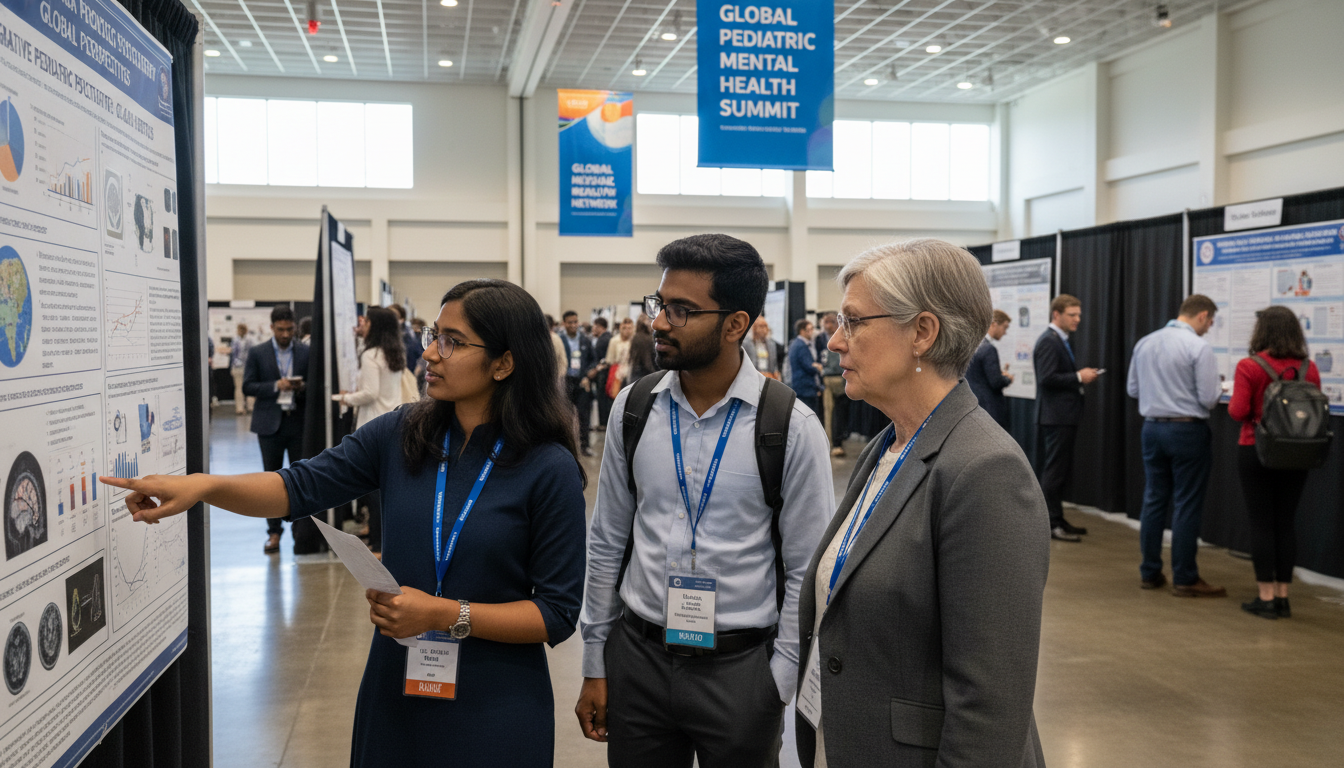
Conference networking is where your IMG residency guide becomes real-world action. Conferences are one of the fastest ways to enter the pediatrics-psychiatry community.
Choosing the Right Conferences
Prioritize events that align with your goals and budget:
- AACAP Annual Meeting – Core for child psychiatry; strong trainee programming, mentoring sessions, and poster opportunities.
- AAP National Conference & Exhibition – Especially valuable if you are also considering categorical pediatrics.
- Regional child psychiatry or combined training symposia where triple board program leaders may present.
Check for:
- Reduced fees or scholarships for students/IMGs
- Virtual or hybrid options (valuable if you’re abroad)
- Trainee networking events or “speed mentoring” sessions
Before the Conference: Strategic Preparation
Review the Program in Advance
- Mark all sessions involving:
- Triple board or combined training
- Pediatric consultation-liaison psychiatry
- Autism, neurodevelopment, early childhood, or trauma
- Note speakers you want to meet.
- Mark all sessions involving:
Reach Out Beforehand (If Possible)
- Email 2–4 faculty you’d like to meet, using a short version of the sample email:
- Mention you’ll be attending the same conference
- Ask if they might have 10 minutes during a break to say hello
- Even if they decline, they may recognize your name later.
- Email 2–4 faculty you’d like to meet, using a short version of the sample email:
Prepare Your “Micro-Introduction” (30–45 seconds)
Have a clear, confident way to introduce yourself when you meet someone new:“Hello, my name is [Name]. I’m an international medical graduate from [Country] with a strong interest in combined pediatrics and psychiatry training. I’m particularly interested in [one specific area, e.g., early childhood trauma or autism]. I’m exploring pathways such as triple board and would love to learn more about your work in [their field].”
During the Conference: How to Approach People
Poster Sessions
- These are ideal for conference networking—faculty and residents are often more relaxed and open to conversation.
- If you find a poster related to peds psych or child psychiatry:
- Read it briefly
- Ask 1–2 thoughtful questions
- Share a brief comment about a related experience from your context
Approaching Triple Board Faculty
If a session includes triple board faculty or residents:- Attend and sit nearer the front if possible
- Ask one well-prepared, concise question during Q&A
- After the session, introduce yourself:
- Reference your question or their comment
- Ask whether their program has open houses or ways for IMGs to learn more
Meeting Residents
Current residents are often more approachable and can give candid insights. Ask:- “How did you decide on triple board vs separate training?”
- “What do you wish you had known as a medical student or IMG interested in this field?”
Keep interactions brief unless they invite a longer conversation.
After the Conference: Follow-Up That Builds Relationships
Within 3–5 days, email people you met:
Subject: Thank you for speaking with me at [Conference]
Dear Dr. [Last Name],
It was a pleasure meeting you at [Conference] after your session on [topic]. I especially appreciated your insights about [specific point].
As an international medical graduate interested in pediatrics-psychiatry and triple board training, your advice about [repeat 1–2 key suggestions] was very helpful.
I hope to stay in touch and will keep you updated on my progress.
Sincerely,
[Name]
Save these emails and notes in your networking spreadsheet. Over time, you will see a pattern of connections and potential mentors emerging.
Mentorship Medicine: Finding and Working with Mentors in Peds-Psych
Mentorship is the backbone of effective networking in medicine, especially in small, relationship-focused fields like pediatrics-psychiatry.
Types of Mentors You Should Seek
Career Mentor (Peds-Psych or Child Psychiatry)
- Helps you clarify whether triple board or other combined training is right for you
- Advises on strategy: which programs to target, how to structure your CV
Research Mentor
- Helps you get involved in scholarly work: case reports, chart reviews, QI projects
- Guides you through authorship, abstracts, and submissions
Process Mentor (IMG/Residency Logistics)
- Preferably an IMG who has already matched
- Helps with ERAS, interviews, visas, and cultural adaptation
One person may fill more than one role, but it is rare for a single mentor to cover everything.
How to Be an Excellent Mentee (So Mentors Want to Help You)
Be Prepared: When you meet, have an agenda:
- Current situation (briefly)
- Your goals for the next 6–12 months
- 3–4 specific questions
Act on Advice: If they suggest:
- “Read this article,”
- “Look at this program,”
- “Email this colleague,”
do it—and let them know you did.
Respect Boundaries:
- Be clear that you understand their time is limited
- Don’t repeatedly ask for favors without showing initiative or progress
Offer Your Strengths:
You may bring:- Fluency in another language
- Knowledge of certain conditions more prevalent in your region
- Enthusiasm for data collection or statistics
When appropriate, volunteer to help with manageable tasks.
Turning Mentorship into Opportunities (Organically)
Over time, if you consistently show initiative and reliability, mentors may:
- Invite you to join small research projects
- Introduce you to triple board or child psychiatry program directors
- Offer to write letters highlighting your persistence, cross-cultural skills, and maturity
You do not need to “ask for opportunities” directly every time. Instead, ask:
“If there are any small tasks I could assist you with on your ongoing projects, I’d be eager to help and learn.”
This opens the door while showing respect and humility.
Converting Networking into a Strong Residency Application
All this effort must ultimately help you build a convincing application for peds psych residency, triple board programs, or related paths.
Demonstrating Commitment to Pediatrics-Psychiatry
Use your networking experiences to shape a clear narrative:
- US or home-country clinical experiences with children and adolescents
- Any exposure to developmental-behavioral pediatrics or child psychiatry clinics
- Conference posters or presentations
- Mentorship relationships and what you learned from them
In personal statements and interviews, reference:
- Specific conversations with mentors or faculty (without name-dropping excessively)
- How conference networking or mentorship confirmed your interest in combined training
- Concrete examples: “During AACAP 2024, I attended a session on [topic], which clarified for me that I want to work at the interface of complex medical illness and child mental health…”
Program Signaling and Communication
Networking helps you prioritize programs:
- Triple board vs categorical pediatrics vs categorical psychiatry with later child fellowship
- Programs with stronger IMG support or history of training IMGs
- Institutions aligned with your research or advocacy interests
You can then:
- Attend specific program open houses (often shared on X, program websites, or via email lists)
- Ask better questions during Q&A that show you understand the field and their program’s strengths
- Write tailored paragraphs in your personal statement or supplemental essays
Maintaining Your Network During and After Matching
Whether or not you match into a triple board or peds psych path on your first attempt, your network remains invaluable:
- Mentors can help you develop a re-application plan if needed
- Colleagues may connect you with research or fellowships
- Later in your career, you may collaborate on projects, guidelines, or advocacy
Think of networking not as a “match strategy” but as building your professional community in pediatrics-psychiatry for decades to come.
FAQs: Networking in Medicine for IMGs in Pediatrics-Psychiatry
1. I am still in my home country and have never been to a US conference. How can I start networking now?
You can begin digitally:
- Join AACAP and AAP as a student or international member if possible
- Attend virtual sessions, webinars, and open houses
- Connect with peds psych and child psychiatry faculty on LinkedIn or X
- Email potential mentors respectfully with clear interests and questions
Start small: 3–5 carefully chosen contacts rather than mass emails. Demonstrate follow-through and curiosity.
2. As an IMG, do I need research to be competitive for triple board programs?
Research is not absolutely mandatory, but:
- It significantly strengthens your application in such a small, selective field
- It gives you natural reasons to network (e.g., presenting a poster, contacting authors)
- Even modest projects (case reports, QI, chart reviews) are valuable if related to children’s mental health or complex pediatric conditions
Networking is often how you find these research opportunities, so the two go hand-in-hand.
3. How can I avoid seeming too pushy when following up with faculty I’ve emailed or met at conferences?
General guidelines:
- Wait 10–14 days after the first email before a single, brief follow-up
- Keep follow-ups to 3–4 sentences, politely acknowledging their busy schedule
- If there is still no reply, accept that and move on—do not send repeated reminders
- For people you met at a conference, one thank-you email is appropriate; if they respond positively, you can occasionally update them on important milestones
Remember: not every contact will turn into a relationship, and that’s normal.
4. I am interested in both pediatrics and psychiatry but unsure about triple board. How do I talk about this in networking conversations?
Be honest and open:
- Emphasize that you are exploring how best to integrate your dual interests
- Say: “I’m trying to understand whether triple board, categorical pediatrics with strong behavioral exposure, or psychiatry with child fellowship would be the best fit.”
- Ask mentors and residents:
- “What factors influenced your choice of pathway?”
- “What kinds of students do you think thrive in triple board specifically?”
Faculty respect thoughtful exploration. Networking is partly about clarifying your path—not pretending you already have all the answers.
By approaching networking in medicine as an international medical graduate with intention, humility, and persistence, you can turn the small, interconnected world of pediatrics-psychiatry into your greatest asset rather than your biggest barrier. Your unique background, global perspectives, and commitment to children’s mental health are strengths. Strategic networking helps the right people recognize them—and helps you step into a career where those strengths can flourish.