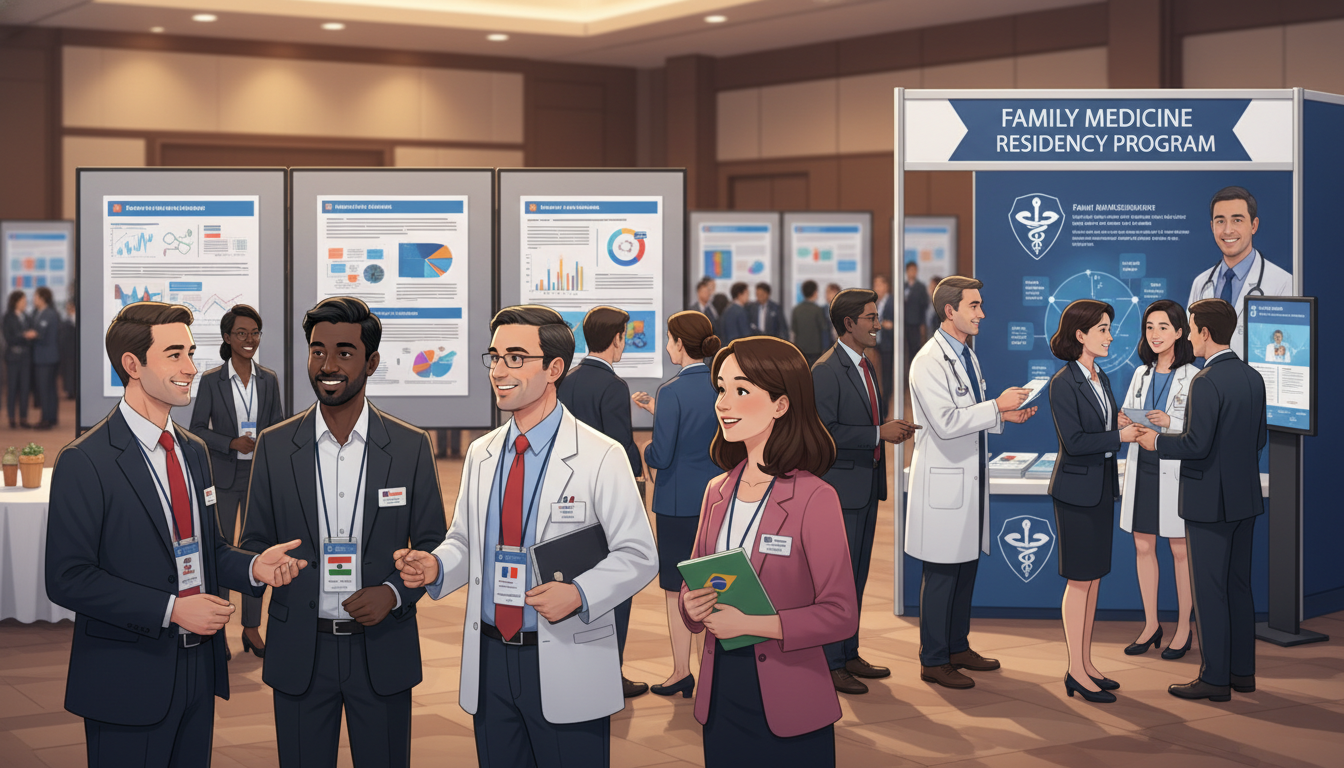
Why Networking Matters for the MD Graduate in Medicine-Psychiatry
As an MD graduate preparing for or entering a med psych residency, you sit at the intersection of two worlds: internal medicine and psychiatry. This dual identity opens unique doors—but it also means more people to know, more departments to navigate, and more systems to understand. Strategic networking in medicine is how you turn that complexity into opportunity.
Whether you trained at an allopathic medical school and are navigating the allopathic medical school match, or you are already in a medicine psychiatry combined program, your professional connections will shape:
- Where you match or transfer
- What research and QI projects you can join
- Who advocates for you when fellowship or job opportunities arise
- How effectively you care for complex, medically and psychiatrically ill patients
Networking is not about being extroverted or “selling yourself.” It is about building genuine, professional relationships that allow you to learn, contribute, and be remembered.
This article focuses on pragmatic, step-by-step strategies tailored to MD graduates in medicine-psychiatry who want to build a meaningful professional network—locally, nationally, in-person, and online.
Understanding the Networking Landscape in Medicine-Psychiatry
Networking as a medicine-psychiatry trainee has several distinctive features compared with categorical internal medicine or psychiatry alone.
You Belong to (At Least) Three Communities
Internal Medicine community
- Department of Medicine, hospitalist groups, subspecialty services (e.g., cardiology, ID, pulmonary/critical care).
- Conferences like ACP (American College of Physicians), SHM (Society of Hospital Medicine).
Psychiatry community
- Department of Psychiatry, consultation-liaison services, inpatient psych, outpatient clinics.
- Conferences like APA (American Psychiatric Association), ACLP (Academy of Consultation-Liaison Psychiatry).
Integrated / Med Psych / Collaborative Care community
- Med psych residency programs, combined medicine psychiatry clubs, consultation-liaison psychiatrists, behavioral health integration teams.
- Niche conferences and sections within broader organizations focusing on integrated care.
Your networking strategy should deliberately touch all three, because your career will likely bridge them.
The Unique Value Proposition of a Med Psych Resident
To network effectively, you need to clearly understand (and communicate) what makes you unique:
- You speak both “medicine” and “psychiatry” fluently.
- You are comfortable managing complex medical patients with significant psychiatric comorbidities (and vice versa).
- You can serve as a bridge between siloed teams in the hospital.
- You are well-positioned for roles in C-L psychiatry, integrated primary care, collaborative care, psychosomatic medicine, or leadership in behavioral health integration.
A concise way to frame this when meeting new people:
“I’m in a medicine-psychiatry combined residency. I’m especially interested in [e.g., integrated care for patients with severe mental illness and chronic medical conditions]. I love working at the interface of internal medicine and psychiatry, especially where systems often struggle.”
This “elevator pitch” is a powerful networking tool—more on that shortly.
Foundations of Effective Networking: Mindset, Goals, and Professional Brand
Adopt the Right Networking Mindset
Approach networking as:
- Curiosity-driven: “I want to learn about what you do and how you think.”
- Service-oriented: “How can I help or contribute, even in a small way?”
- Long-term: “This is a relationship, not a transaction.”
You are not just finding people who can help you now; you are building a professional community that will follow you for decades.
Define Your Early Networking Goals
As an MD graduate in or entering a med psych residency, focus on short-term, realistic goals:
Clinical exposure and mentorship
- Identify 2–3 attendings in each area (medicine, psychiatry, med psych) whose careers interest you.
- Ask to observe their clinics, join rounds, or discuss career paths.
Research and scholarly work
- Get involved in at least one project related to integrated medicine-psychiatry, C-L, addiction, primary care psychiatry, or medically complex psychiatric populations.
- Aim for a poster or abstract at a relevant conference each year.
Alignment with future fellowship or career
- If you’re considering C-L fellowship, addiction medicine, geriatrics, or hospital medicine, connect with leaders in those areas early.
Write down 3–5 specific networking goals. For example:
- “Meet at least two C-L psychiatrists and two hospitalists who regularly work with psych patients.”
- “Present at a national conference within the next 18 months.”
- “Find a long-term mentor in integrated care models.”
Build a Clear, Consistent Professional Brand
Your “brand” is the coherent story other professionals tell about you when you’re not in the room. For a medicine-psychiatry combined resident, a strong brand might include:
- Clinical identity: “The person who is calm and effective with medically and psychiatrically complex patients.”
- Intellectual identity: “Interested in health systems, integrated care, and improving transitions between medicine and psychiatry.”
- Behavioral identity: “Reliable, inquisitive, easy to work with, follows up, and lifts others.”
Practical steps:
- Create a short, 2–3 sentence bio you can reuse in emails, introductions, and conference registrations.
- Align your CV, LinkedIn (if you use it), and any online bios with that narrative.
- Be intentional about the projects you choose—do they reinforce your med psych identity?
Everyday Networking in Your Med Psych Residency Program
Networking does not only happen at conferences. Much of your most valuable medical networking happens day-to-day with people you already see.
On the Wards: Turning Routine Clinical Work into Networking
As a med psych resident, you will rotate on medicine floors, psychiatry units, and C-L services. Each rotation is a networking opportunity.
Internal Medicine Rotations
Key people:
- Hospitalists
- Subspecialists (cardiology, endocrinology, infectious disease)
- Chief residents
- Case managers and social workers
Tactics:
Ask thoughtful integration questions:
“For patients with severe mental illness and CHF, what barriers do you see in keeping them out of the hospital? I’m interested in integrated care models that might help.”Volunteer small contributions:
- Offer to give a short talk on managing antipsychotics in medically ill patients.
- Help develop a simple order set or checklist that improves coordination with psychiatry.
Follow up:
- After working with an attending you admire, send a brief thank-you email:
- Mention a specific teaching point you found useful.
- Ask if you can reach out in the future with career questions.
- After working with an attending you admire, send a brief thank-you email:
This kind of respectful follow-up is the foundation of mentorship medicine: you signal seriousness and appreciation.
Psychiatry and C-L Rotations
Key people:
- C-L psychiatrists
- Inpatient and outpatient psychiatrists
- Psychologists, social workers, case managers
Tactics:
Express your med psych identity clearly:
“Given my background in internal medicine, I’m particularly interested in the medical complexity side of our psychiatric patients. Are there any QI or research projects in that area I could help with?”
Ask about their professional journeys:
- “How did you decide between C-L fellowship, addiction, or staying general?”
- “What would you do differently if you were training now?”
Offer to help synthesize cases that highlight med-psych integration:
- Create a brief case series presentation for residents.
- Propose a morbidity and mortality (M&M) conference focusing on interface failures between medicine and psychiatry.
Building Relationships with Program Leadership
As a med psych resident, you often have two sets of leadership: medicine and psychiatry. Additionally, you may have a dedicated med psych program director.
Practical tips:
Schedule a yearly career check-in with each PD or associate PD.
Come prepared:
- Updated CV
- List of interests and potential fellowship or career paths
- Concrete questions: “What professional societies should I join?” “Who else should I meet?”
Ask for targeted introductions:
- “Is there someone in hospital leadership working on behavioral health integration you recommend I meet?”
- “Are there alumni of our med psych residency I should talk with about career options?”
Leadership often knows where opportunities and hidden jobs are; staying on their radar is critical.

Conference and Professional Society Networking: Where Med Psych Shines
Conferences and professional organizations are where your role as a medicine-psychiatry physician really stands out. You are inherently multidisciplinary; leverage that.
Choosing Where to Show Up
As an MD graduate in a med psych residency, prioritize:
General Internal Medicine / Hospital Medicine conferences
- American College of Physicians (ACP)
- Society of Hospital Medicine (SHM)
- Society of General Internal Medicine (SGIM)
Psychiatry conferences
- American Psychiatric Association (APA)
- Local/state psychiatric societies
Consultation-Liaison / Integrated Care conferences
- Academy of Consultation-Liaison Psychiatry (ACLP)
- Collaborative Care / Integrated Behavioral Health meetings
- Any med psych-specific gatherings or sections
Aim for at least one national conference every 1–2 years and local/regional events annually.
Preparing a Strong Professional Presence
Before attending:
Update your CV and create a one-page academic summary (selected experiences, interests, and ongoing work).
Prepare a 30-second introduction tailored to medicine-psychiatry:
“I’m an MD graduate in a medicine-psychiatry combined residency, currently PGY-2. I’m especially interested in improving care transitions for patients with severe mental illness and chronic medical conditions—particularly around hospital discharge planning and outpatient follow-up.”
Set 2–3 conference goals:
- “Meet at least three faculty who work in C-L psychiatry or integrated care.”
- “Identify one potential mentor or collaborator for a future project.”
- “Attend all med psych or C-L related sessions and take notes on emerging trends.”
Tactics for Effective Conference Networking
1. Use Sessions as Conversation Starters
After a talk that resonates with your med psych interests:
- Approach the speaker at the podium or during a break.
- Introduce yourself succinctly:
- “Thank you for your talk on integrated care for patients with serious mental illness. I’m a med psych resident at [institution].”
- Ask one specific question or share a brief reflection.
- Close with:
- “Would it be alright if I emailed you to ask a bit more about how you built your program?”
- Then actually email within a week, referencing the conversation.
2. Poster Sessions: Low-Pressure Networking
If you are presenting:
- Stand at your poster during peak times.
- Start with: “Hi, I’m [Name], a medicine-psychiatry resident. This work came out of our experience with [clinical scenario].”
- Ask others: “What has your institution tried for similar patients?”
If you’re visiting:
- Prioritize posters related to:
- C-L psychiatry
- Integrated care
- Substance use in medically complex patients
- Somatic symptom and related disorders
- Introduce yourself as a med psych resident; this often sparks genuine interest.
3. Attend Special Interest Groups and Socials
Many organizations have:
- C-L psychiatry sections
- Integrated care working groups
- Early-career or trainee meetups
Show up, introduce yourself to group leaders, and sign up for mailing lists or committees. Long-term committee work is one of the most powerful forms of medical networking.
Following Up after Conferences
Within 1 week of returning:
- Send brief, personalized emails to:
- Faculty you spoke with
- Residents or fellows you connected with
- Anyone who expressed interest in your work or career path
Email template:
Subject: Great to meet you at [Conference] – Med Psych Trainee
Dear Dr. [Last Name],
It was a pleasure meeting you after your talk on [topic] at [Conference]. I especially appreciated your points about [specific detail].
As I mentioned, I’m an MD graduate in a medicine-psychiatry combined residency at [institution], interested in [brief interests]. If you’re open to it, I’d love to schedule a brief call sometime in the next month to learn more about how you developed your [program/role/research focus].
Thank you again for your time and insights,
[Your Name, Degree]
[Med Psych Resident, PGY-X]
[Institution]
The professionalism of your follow-up matters as much as the conversation itself.

Mentorship in Medicine-Psychiatry: Building Your Personal Board of Advisors
For a dual-trained physician, mentorship is both more complex and more important. You need guidance across multiple domains.
Types of Mentors You Need
Consider building a “mentorship team” rather than searching for a single perfect mentor:
Career trajectory mentors
- One from internal medicine
- One from psychiatry or C-L
- Ideally one who specifically understands medicine-psychiatry combined training
Skills mentors
- Research mentor (for methods, publishing, grants)
- QI/leadership mentor (for systems change, projects)
Near-peer mentors
- Senior med psych residents or recent graduates
- Fellows in C-L, addiction, or related areas
Personal/professional development mentors
- Someone who helps you with burnout, boundary-setting, and career sustainability—this might be a faculty member known for wellness or resident advocacy.
How to Approach Potential Mentors
- Start with people you have already worked with clinically or on projects.
- Ask for a brief meeting (20–30 minutes), not a long-term commitment initially.
- Be clear but flexible:
- “I’m looking for guidance as I think about shaping a career at the interface of medicine and psychiatry.”
- “I admire how you’ve built your role as a C-L psychiatrist/hospitalist with strong psych interests and would love to hear about your path.”
During the meeting:
- Share your background succinctly (med school, MD graduate, current med psych residency).
- Articulate your evolving interests (it’s okay if they’re not fully formed).
- Ask:
- “What do you wish you had known at my stage?”
- “What professional societies or networking opportunities do you recommend for someone in med psych?”
- “Are there others you think I should talk with?”
If the chemistry is good, you can later say:
“I’ve really appreciated your advice; would you be comfortable if I considered you a mentor going forward and reached out a few times a year?”
Maintaining Mentorship Relationships
Send periodic updates (2–3 times per year):
- New rotations
- Projects, posters, publications
- Emerging questions about career direction
Be reliable:
- Show up prepared to meetings.
- Follow through on commitments (e.g., sending draft abstracts, data).
Strong mentorship medicine relationships grow from consistency and respect, not from intensity or frequency alone.
Digital and Informal Networking: Making Technology Work for You
Utilizing Online Platforms Strategically
As an MD graduate in med psych, you can leverage:
LinkedIn
- Keep a concise, professional profile.
- Join groups related to integrated care, C-L psychiatry, and internal medicine.
- Connect with people you’ve met at conferences or on rotations (attach a brief personalized note).
Professional Organization Listservs and Online Communities
- APA, ACLP, ACP, and others often have listservs or forums.
- Even lurking and reading discussions can help you learn who the leaders are and what problems are being discussed nationally.
Institutional Tools
- Internal faculty directories: search keywords like “consultation-liaison psychiatry,” “integrated care,” “collaborative care,” “med psych.”
- Recorded grand rounds or lectures: follow up with speakers.
Informal Networking: Small Gestures That Add Up
Your network also grows through simple, everyday acts:
Showing up consistently to:
- Department grand rounds (both medicine and psychiatry)
- C-L or med psych case conferences
- Journal clubs and resident teaching sessions
Asking your attendings:
- “Would it be okay if I emailed you with a question about career planning later on?”
- “Do you know any med psych graduates I might talk with about their career paths?”
Remembering and using names:
- Nurses, social workers, case managers, and coordinators all see different aspects of the system.
- They can be invaluable allies in both patient care and career navigation.
Common Pitfalls in Networking for Med Psych Trainees—and How to Avoid Them
1. Being Too Vague about Your Interests
Fix this by choosing provisional interests even if they might evolve:
- “I’m especially interested in C-L psychiatry and integrated care for medical inpatients with severe mental illness.”
- “I’m drawn to primary care-based psychiatry and collaborative care models.”
People can’t help you if they don’t know what you might want.
2. Only Networking within One Department
Remember: your value is at the intersection. If you only network in medicine or only in psychiatry, you undercut your unique training.
Create a simple tracking sheet:
- Medicine mentors/contacts
- Psychiatry mentors/contacts
- Integrated / C-L / med psych contacts
Aim for at least one active relationship in each column.
3. Treating Networking as Opportunistic Rather Than Reciprocal
Even as a trainee, you can give:
- Offer to co-present a talk.
- Share relevant articles or resources.
- Help with data collection or chart reviews.
- Connect people with each other when appropriate.
A generous approach builds a reputation that will serve you far beyond residency.
4. Neglecting Well-Being and Boundaries
Over-networking—saying yes to everything—can lead to burnout. You are in a demanding medicine-psychiatry combined program.
Use these filters:
- Does this opportunity align with my emerging professional brand?
- Will this relationship likely support my future goals?
- Do I realistically have the time and bandwidth?
It is acceptable—and often wise—to say:
“Thank you so much for thinking of me. I’m at capacity right now with clinical duties and one major project, so I’m not able to take on another commitment, but I really appreciate the opportunity.”
Putting It All Together: A Simple 6-Month Networking Plan
To make this concrete, here is a sample 6-month plan for an MD graduate starting or in the early years of a med psych residency:
Month 1–2
- Draft a 2–3 sentence professional identity statement.
- Meet with your med psych program director to discuss career interests.
- Identify 1–2 medicine attendings and 1–2 psychiatry attendings whose careers interest you; schedule brief meetings.
Month 3–4
- Choose one small scholarly project (case series, QI, brief review) in an integrated care area.
- Join at least one professional society (e.g., APA, ACP, ACLP) and subscribe to relevant sections or listservs.
- Attend at least one interdisciplinary conference or case meeting per month (e.g., C-L rounds, shared case discussions).
Month 5–6
- Submit an abstract to a local or national conference.
- Reach out to one potential external mentor you met at a conference or via a mutual connection.
- Update your CV, LinkedIn, and personal bio to reflect your med psych identity and new activities.
Repeat and refine this cycle annually, gradually building a robust, authentic network across internal medicine, psychiatry, and the integrated care space.
FAQs: Networking in Medicine for MD Graduates in Medicine-Psychiatry
1. I’m introverted and dislike “small talk.” Can I still be an effective networker in medicine?
Yes. Many excellent physicians and researchers are introverted. Focus on small, meaningful conversations rather than working a room. Prepare 2–3 questions you can ask anyone (e.g., “What kind of patients do you most enjoy working with?” “How did you find your current role?”). Aim to build a few deeper connections instead of many superficial ones.
2. How early in my med psych residency should I start thinking about networking and mentorship?
Start during your first year, but keep expectations modest. Initially, just aim to identify people whose clinical style or career path you admire. Ask for brief meetings and be curious. As you move into PGY-2 and beyond, gradually formalize mentorship relationships and expand your conference and research activities.
3. Which conferences are most valuable for a medicine-psychiatry combined resident?
At minimum, try to attend:
- A broad medicine meeting (e.g., ACP, SGIM, SHM)
- A broad psychiatry meeting (e.g., APA)
- At least one C-L / integrated care-focused meeting (e.g., ACLP) during residency
This mix exposes you to your dual identity and to leaders who can specifically guide a med psych career.
4. How can networking help if I’m worried about the allopathic medical school match or future fellowships?
Networking cannot replace a strong application, but it can:
- Help you understand what specific programs value.
- Connect you with residents or fellows who can offer honest insights and advice.
- Lead to research or scholarly work that strengthens your profile.
- Ensure that when selection committees see your name, they can associate it with positive experiences and strong recommendations.
Deliberate, thoughtful networking in medicine is one of the highest-yield investments you can make as an MD graduate in medicine-psychiatry. Your dual training makes you uniquely positioned to connect people, ideas, and systems—start practicing that skill early, and your professional network will become one of your greatest assets throughout residency and beyond.