Understanding Networking in Medicine as a US Citizen IMG in Cardiothoracic Surgery
Networking in medicine is not just “meeting people”—it is the process of building genuine professional relationships that lead to information, opportunities, advocacy, and long-term mentorship. For a US citizen IMG interested in cardiothoracic surgery residency, strategic networking can be the difference between being an unknown name in a stack of applications and being a recognizable, trusted candidate that faculty actively support.
Cardiothoracic surgery is a small, competitive field with relatively few residency spots and a tight-knit community. Most program directors know each other; many faculty trained together or collaborate on multicenter trials. In such an environment, who knows you and what they think of you can heavily influence your trajectory—especially if you are an American studying abroad and lack the built-in visibility that comes from a US medical school.
This article will walk you through:
- How networking works specifically in cardiothoracic surgery
- What unique challenges and advantages you have as a US citizen IMG
- Practical, step-by-step networking strategies
- How to use conferences, social media, and mentorship in medicine
- How to keep relationships going long-term, not just during application season
Throughout, the focus will remain clear: how to use networking in medicine to support your path to cardiothoracic surgery residency and heart surgery training in the US.
The Unique Position of the US Citizen IMG in Cardiothoracic Surgery
As a US citizen IMG (US citizen who completes medical school outside the US), you occupy a very specific niche:
- You are eligible for US residency without visa sponsorship, which removes a major barrier that some IMGs face.
- You may, however, lack a strong home institution presence in the US cardiothoracic surgery community.
- You often have limited in-person access to US-based mentors, departments, and research infrastructure.
Recognizing this early helps you build a strategy for networking that compensates for structural gaps and leverages your strengths.
Challenges You Need to Overcome
Lack of a “home” US CT surgery department
Most integrated cardiothoracic surgery (I-6) applicants from US schools are backed by their home programs. Routine interactions, research projects, and hallway conversations with CT faculty help them develop advocates who can speak to their qualities. As an American studying abroad, you often lack this built-in platform.Limited early exposure to US heart surgery training
You might not scrub into complex cardiac or thoracic operations as early or as consistently as students at major US academic centers. That can make it harder to show commitment and understanding of the field.Bias and unfamiliarity
Even as a US citizen IMG, your medical school may be less well-known to program directors. Some may question the rigor of your training or your readiness for a demanding specialty like cardiothoracic surgery.Fewer organic networking opportunities
You may not be routinely invited to national meetings, departmental events, or research groups that US students tap into early.
Advantages You May Not Realize You Have
No visa barriers
For many programs, the logistics and institutional hurdles around sponsoring visas can be a major obstacle to recruiting non-US citizens. Being a US citizen IMG removes that barrier entirely and can make you more attractive compared to non-citizen IMGs with similar metrics.Built-in narrative of resilience and adaptability
Choosing to study medicine abroad as an American often involves navigating new systems, cultures, and languages. If framed well, this experience signals maturity, flexibility, and initiative—highly valued traits in a rigorous specialty.Potential for broader clinical perspective
International training environments may expose you to different disease profiles, resource settings, or approaches to patient care, enriching your clinical judgment and empathy.A smaller but powerful network—if you build it intentionally
Instead of inheriting a network, you will be consciously building one. This often leads to more deliberate relationships, particularly in medical networking and mentorship medicine, where both you and your mentors are very intentional about the collaboration.
The takeaway: you start with some structural disadvantages, but also with distinct assets. Networking is how you transform those assets into visible strengths in the cardiothoracic surgery community.

Building a Core Foundation: Mentorship, Visibility, and Personal Brand
Before conference networking or social media outreach can be effective, you need a solid foundation. For an aspiring cardiothoracic surgeon, that means three things: mentors, visibility, and a clear personal brand.
1. Securing Strong Mentorship in Medicine
Mentorship medicine is the backbone of networking in surgery. In a small field like cardiothoracic, a few well-placed mentors can change your trajectory.
You should aim for at least three types of mentors:
Clinical/Technical Mentor (in cardiothoracic or closely related field)
- Ideally a cardiothoracic surgeon, thoracic surgeon, or cardiac surgeon.
- Helps you understand the specialty, case complexity, decision-making, and lifestyle.
- Can vouch for your technical potential and commitment to heart surgery training.
Research Mentor
- Can be in cardiothoracic surgery, cardiology, pulmonary/critical care, anesthesia, or outcomes research.
- Guides you through projects, abstracts, and manuscripts that build your academic profile.
- Important for producing tangible outputs (publications, presentations) that demonstrate your value.
Career/Process Mentor
- May be a faculty member, senior resident, or fellow who understands the US residency system, especially competitive fields.
- Help with strategy: when to take Step exams, how to choose electives, where to apply, how to position yourself as a US citizen IMG in a highly selective field.
How to Find Mentors as a US Citizen IMG
- At your international school: Identify surgeons with US connections, visiting professors, or alumni who matched into surgery or cardiothoracic surgery residency programs.
- Through US clinical electives: During visiting clerkships or sub-internships in the US, be proactive. Ask attending physicians if you can discuss your career goals over a brief, scheduled meeting.
- Via conferences: Introduce yourself after a talk by someone whose work you admire; follow up via email and ask if they would be open to continued guidance.
- Through alumni networks: Many American studying abroad programs have alumni data. Request introductions to graduates in cardiothoracic or any surgical specialty.
When you approach a potential mentor, be specific and respectful of their time:
“I am a US citizen IMG very interested in cardiothoracic surgery, currently in my [X] year at [school]. I admire your work in [area]. Would you be open to a brief 15–20 minute conversation about career planning and how I might best prepare for cardiothoracic surgery residency?”
2. Increasing Your Visibility in the Cardiothoracic Community
Networking in medicine isn’t only about who you know—it’s also about who knows you.
To increase visibility:
- Get your name on projects: Even if you start with chart reviews or case reports, this puts your name into PubMed searches and conference abstracts.
- Submit to relevant journals and meetings: Aim for cardiothoracic surgery journals and meetings (AATS, STS, ESTS, local CT societies), but also general surgery and cardiology meetings if more accessible.
- Contribute meaningfully: Be the student who follows through, hits deadlines, and adds value. People remember reliable collaborators.
3. Crafting a Clear Personal Brand
You don’t need a marketing campaign, but you do need a coherent story:
- Who are you?
- Why cardiothoracic surgery?
- What have you done to explore and commit to the field?
- What is your differentiator as a US citizen IMG?
Example personal brand themes:
- “I’m an American studying abroad who has built a solid record in outcomes research in valvular heart disease, with multiple presentations at national cardiothoracic and cardiology conferences.”
- “I’m a US citizen IMG with global health and congenital heart surgery experience, focusing on improving cardiac surgery outcomes in resource-limited settings.”
Your networking efforts—emails, conversations, presentations, and social media presence—should all align with this narrative.
Mastering Conference and In-Person Networking in Cardiothoracic Surgery
Conferences are one of the most powerful venues for medical networking—especially for someone without a home US program. They concentrate faculty, fellows, residents, and program directors in one place, and you have a reason to be there: academic engagement.
Choosing the Right Conferences
For cardiothoracic surgery residency and heart surgery training, prioritize:
- AATS (American Association for Thoracic Surgery)
- STS (Society of Thoracic Surgeons)
- ACS Clinical Congress (American College of Surgeons) – includes CT sessions
- Regional CT surgery or thoracic surgery meetings
- Specialty-focused meetings (congenital heart surgery, aortic surgery, lung cancer, ECMO, etc.)
If budget is limited, consider:
- Attending virtually when offered, which still allows for Q&A and limited networking.
- Applying for student or IMG travel scholarships often offered by CT societies.
- Prioritizing the meeting where your abstract is accepted—that gives you a natural anchor for conference networking.
Before the Conference: Strategic Preparation
Study the program
- Identify sessions on integrated cardiothoracic surgery residency, education, and training pathways.
- Note faculty and programs you’re especially interested in, particularly PDs, APDs, and influential researchers.
Reach out in advance
For 2–5 people you really want to meet (e.g., potential mentors or PDs), send a short email:“I’ll be attending STS this year and will be at your session on [topic]. I’m a US citizen IMG very interested in cardiothoracic surgery residency. If you’re available for a brief introduction during the meeting, I’d be grateful for the chance to say hello.”
Prepare your self-introduction
A tight 20–30 second summary:- Who you are (name, school, US citizen IMG)
- Training stage
- Interest in cardiothoracic surgery and specific subareas (e.g., aortic, congenital, thoracic oncology)
- A relevant project or experience
Example:
“I’m Alex Johnson, a US citizen IMG in my final year at [school]. I’m very interested in cardiothoracic surgery, particularly outcomes in aortic surgery. I’ve been working on a project examining postoperative complications after valve-sparing root replacement.”
Bring business cards and have a professional email signature
Even simple cards with your name, degree, school, email, and LinkedIn or professional website link help people remember you.
During the Conference: Executing High-Yield Networking
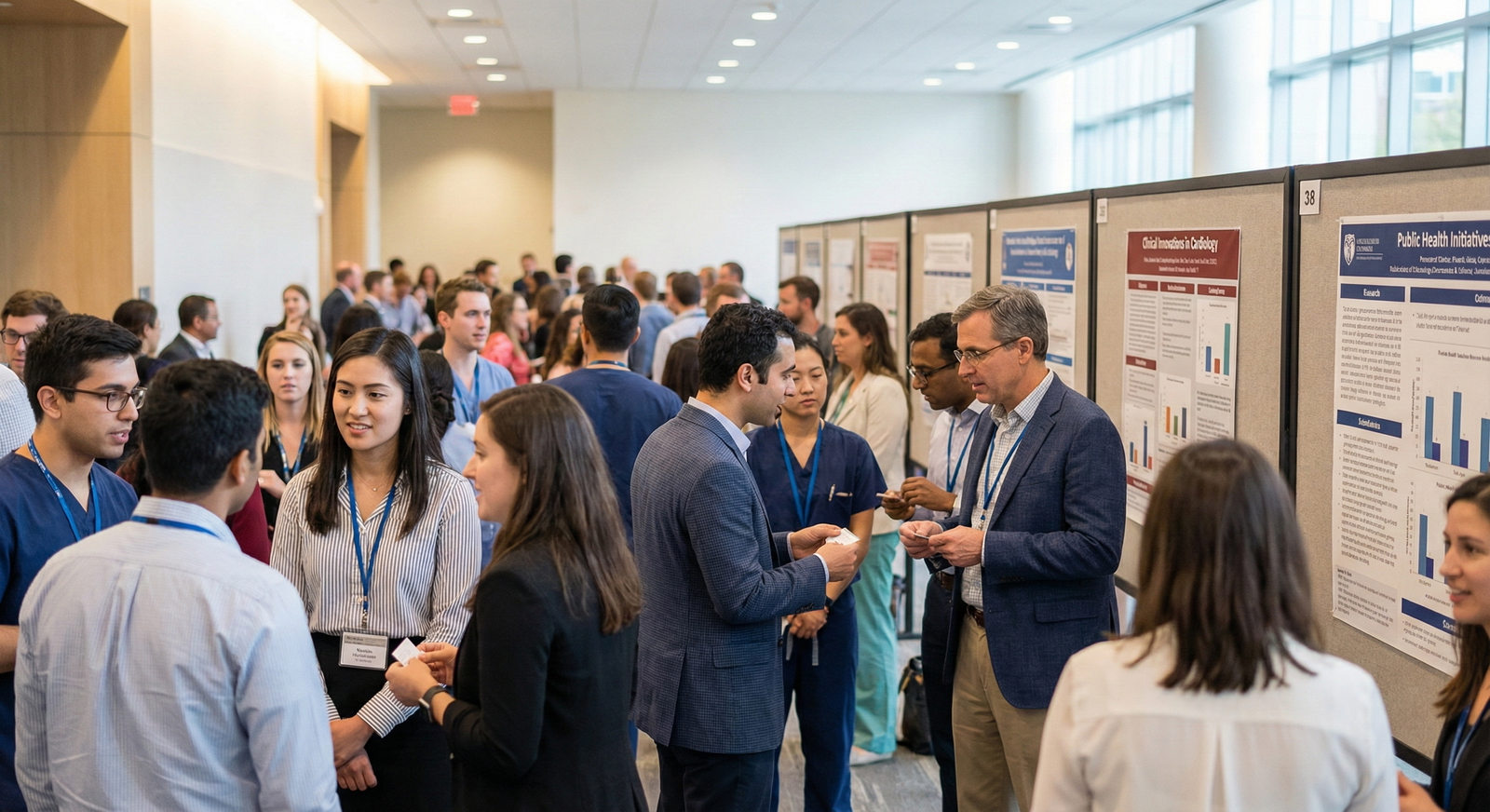
Attend small-group sessions and poster presentations
These are easier for introductions than massive plenaries. Presenters are typically more available after their talk or poster.Ask thoughtful questions at sessions
Prepare one or two questions ahead of time. When you ask a brief, insightful question, you become memorable. Later you can say:“I really appreciated your answer to my question about [topic] during the session. Could I follow up on that briefly?”
Use the “hallway rule”
If you attend a talk that genuinely interests you, try to introduce yourself to that speaker afterward. Simple, direct, respectful:“Dr. Smith, my name is [Name]. I’m a US citizen IMG very interested in cardiothoracic surgery. I appreciated your talk on [topic]. Would you have a moment for a quick question?”
Join social and trainee events
Many societies host:- Resident and medical student receptions
- Diversity and inclusion gatherings
- Women in surgery events
- Early-career networking breakfasts
These are ideal for low-pressure medical networking among trainees and approachable faculty.
Be present, not transactional
Avoid immediately asking for letters or positions. Focus on learning, curiosity, and building rapport. Opportunities tend to emerge naturally from good conversations over time.
After the Conference: The Follow-Up That Builds Real Relationships
Many students miss the most important step: follow-up.
Within 3–7 days:
- Send a short thank-you email or LinkedIn message to people you spoke with.
- Reference something specific you discussed or appreciated.
- If appropriate, propose a next step (e.g., a brief Zoom meeting, sharing your CV, asking about research involvement).
Example:
“Thank you again for taking the time to speak with me after your session at AATS. I learned a great deal from your perspective on integrating outcomes research into heart surgery training. I’d be grateful for any feedback you might have on how an American studying abroad could position themselves for CT surgery residency, and would be happy to share my CV if useful.”
Consistent, respectful follow-up is where conference networking transforms into mentorship and collaboration.

Leveraging Digital Networking: Email, Social Media, and Virtual Opportunities
For US citizen IMGs, digital networking is often the primary bridge to the US cardiothoracic surgery community. Done right, it can be remarkably powerful.
Email Outreach That Gets Responses
When reaching out by email:
Use a clear subject line
- “US citizen IMG interested in cardiothoracic surgery – brief question”
- “Prospective applicant seeking guidance in CT surgery (US citizen IMG)”
Keep the email concise (≤ 200 words)
Include:- Who you are (US citizen IMG, school, year)
- Why you’re writing to them specifically (their work, program, talk)
- A clear, low-barrier request (15–20 minute call, brief advice, possibility of future research involvement)
Attach or link your CV only if requested, or if clearly appropriate
You can say:“If helpful, I’d be happy to share my CV for context.”
Be patient and respectful
Many surgeons have heavy clinical schedules. If no response after 10–14 days, a single polite follow-up is appropriate. If still nothing, move on.
Using Social Media for Medical Networking
Platforms like X (Twitter), LinkedIn, and (to a lesser extent) Instagram and Bluesky have become important channels in academic surgery.
Ways to use them strategically:
- Follow key cardiothoracic surgery accounts: Societies (AATS, STS), journals, major programs, and individual faculty.
- Engage professionally: Like, retweet/share, or comment thoughtfully on posts about heart surgery training, research papers, and educational threads.
- Share your academic work: Presentations, accepted abstracts, publications, and carefully anonymized case reflections.
- Show your interest without oversharing: Avoid emotional venting about exams, complaints about programs, or unprofessional humor.
You’re not trying to go viral; you’re aiming to become a recognizable, thoughtful voice in the CT surgery education and trainee community.
Virtual Events and Online Mentorship Programs
Look out for:
- Resident and fellow panels about cardiothoracic surgery residency
- Webinars and virtual open houses for integrated CT and general surgery programs with strong CT tracks
- Formal mentorship initiatives from CT societies, often matching students with residents or faculty (some specifically welcome IMGs or international graduates)
When you attend a webinar:
- Ask at least one thoughtful question if Q&A is available.
- Later, send a brief note to the moderator or speaker referencing the event.
Example:
“I attended your webinar on pathways into cardiothoracic surgery for medical students and appreciated your advice about early research involvement. As a US citizen IMG, I’m especially interested in….”
Digital networking is particularly potent for American students studying abroad because it levels geographic barriers and helps you build continuity of contact before you can physically rotate in the US.
Turning Connections into Concrete Opportunities
Networking matters most when it leads to tangible steps forward: research, clinical exposure, letters of recommendation, and sponsorship during the application process.
Research Opportunities in Cardiothoracic Surgery
Research is one of the best ways to keep yourself present in a mentor’s mind and embed yourself in the CT surgery community.
You can:
- Join retrospective database studies (STS, institutional databases)
- Work on case reports or small series with CT or cardiac surgery departments
- Contribute to systematic reviews or meta-analyses on CT topics
- Assist with quality improvement or outcomes projects in ICU, stepdown, or OR settings
As a US citizen IMG abroad, you may:
- Collaborate remotely with a US mentor via shared databases and virtual meetings.
- Contribute data from your international institution (if IRB and data-sharing rules are followed).
- Lead the writing / data analysis if you cannot be onsite.
Clear, consistent communication and on-time work build trust quickly.
US Clinical Experiences and Away Rotations
For cardiothoracic surgery, in-person performance is critical. Networking can help you secure:
- Sub-internships in general surgery at institutions with strong CT programs
- Elective rotations in cardiothoracic surgery, cardiovascular ICU, or thoracic surgery
- Observerships in CT surgery if hands-on electives aren’t available
How networking helps here:
- Faculty or residents you’ve met may invite you to rotate or suggest how to apply.
- Mentors can send a personal note to program coordinators or rotation directors supporting your elective request.
- Your reputation as reliable and motivated makes it easier for programs to take a chance on you.
During these rotations, you must:
- Show up early, stay late, and be proactive but not intrusive.
- Demonstrate humility, curiosity, and a strong work ethic.
- Get to know residents—they often advocate for applicants behind the scenes.
Letters of Recommendation and Sponsorship
High-quality letters are crucial, especially for a competitive field like cardiothoracic surgery residency.
Your networking-derived mentors can:
- Write strong, specific letters that highlight your character, work ethic, and commitment to CT surgery.
- Personally communicate with program directors or selection committees.
- Include you in program or departmental conversations when application season arrives.
To maximize letter quality:
- Work closely with the letter-writer over time (research, clinical work, or both).
- Provide them with your CV, personal statement draft, and a summary of your work with them.
- Ask for a “strong letter of recommendation” and give them an easy option to decline if they can’t provide that.
Maintaining and Growing Your Network Over Time
Networking in medicine is about relationships, not one-off transactions. For a long training path like cardiothoracic surgery, this matters even more.
Principles for Long-Term Relationship Building
Provide value, even as a student
- Meet deadlines, do thorough literature searches, help draft sections of manuscripts.
- Share relevant articles or resources with your mentors or co-authors.
Communicate periodically, not just when you need something
- Share updates: new publications, exams completed, upcoming electives.
- Congratulate mentors or residents when you see their accomplishments online.
Be honest and realistic
If your plans change, or if you’re struggling academically or personally, trusted mentors can only help if you’re candid with them. Integrity builds trust.Diversify your network
- Faculty in CT surgery and related fields (cardiology, pulm/crit, anesthesiology)
- Residents and fellows, especially those who were IMGs or non-traditional applicants
- Peers who share your interest—these may be future colleagues, co-fellows, or faculty.
Over years, this network can support not only your cardiothoracic residency application but also fellowship choices, job searches, and research collaborations.
FAQs: Networking in Medicine for US Citizen IMG in Cardiothoracic Surgery
1. As a US citizen IMG, when should I start networking if I’m interested in cardiothoracic surgery?
Ideally, start by your second or third year of medical school (or equivalent) when you’ve confirmed a strong interest in surgery. Begin locally with mentors at your own institution, then expand to digital networking, conferences, and US-based contacts over time. If you’re later in training, start now—there is always time to build relationships, but earlier is better for accumulating research, mentorship, and clinical exposure.
2. How important is it to have cardiothoracic-specific research for residency in this field?
While any high-quality research is valuable, cardiothoracic-specific work clearly signals commitment to the specialty and helps you connect with the CT community. That said, meaningful projects in cardiac surgery-adjacent fields (cardiology, pulmonary, ICU, vascular, anesthesia) can also be beneficial, especially if they involve outcomes relevant to heart surgery training (e.g., post-op complications, ECMO, heart failure). Networking can often help you pivot into more CT-focused projects over time.
3. What if I can’t afford to travel to major US conferences as a student abroad?
Use a layered approach:
- Attend virtual sessions and webinars from AATS, STS, ACS, and other societies.
- Apply aggressively for student or IMG travel grants when you have an accepted abstract.
- Prioritize one high-yield meeting where you can present your work and connect with multiple potential mentors/programs.
- Supplement conference networking with consistent email and social media engagement, which is low-cost but can still be very high-yield.
4. How do I avoid coming across as pushy or transactional when networking?
Focus on curiosity and contribution rather than immediately asking for letters or positions. Ask about others’ work, training paths, and advice. Offer to help on projects instead of directly asking for research spots (“If there are any ongoing projects where a motivated student could help with data collection or literature review, I’d be grateful to contribute.”). Follow up with genuine appreciation and periodic updates. Over time, people will naturally want to support you because they know you, trust you, and have seen your work ethic.
By combining focused mentorship, strategic use of conferences and digital platforms, and a long-term relationship mindset, you can overcome the structural challenges of being a US citizen IMG and become a recognized, competitive candidate for cardiothoracic surgery residency and heart surgery training in the United States.