Why Networking Matters Even More for US Citizen IMGs in Clinical Informatics
For a US citizen IMG (American studying abroad) interested in clinical informatics, networking in medicine isn’t optional—it’s vital infrastructure for your entire career. You are positioning yourself at the intersection of medicine, data, and technology, in a field where key opportunities often circulate through trusted connections long before they ever appear on a website.
Compared with US MD seniors, US citizen IMGs face additional hurdles: less embedded access to US-based mentors, fewer organic introductions to informatics leaders, and less visibility to program directors. Strong, strategic medical networking is one of the most effective ways to close that gap.
In clinical informatics specifically, networking opens doors to:
- Electives and observerships with informatics-active departments
- Health IT training opportunities and quality improvement projects
- Research collaboration in AI, EHR usability, and digital health
- Early introductions to clinical informatics fellowship directors
- Roles with vendors, health systems, and start‑ups at the interface of medicine and technology
The good news: informatics is a relatively small, collaborative community, and US citizen IMGs who show up consistently, communicate clearly, and deliver on their commitments can stand out quickly.
This article breaks down how to network effectively, step‑by‑step, as an American studying abroad who wants a career in clinical informatics—from pre‑residency through fellowship and beyond.
Understanding the Clinical Informatics Landscape as a US Citizen IMG
Before you network, you need a clear mental map of what—and whom—you are networking toward.
Key Stakeholders in Clinical Informatics
Target your outreach deliberately to people who actually live in the clinical informatics ecosystem:
1. Academic clinical informaticians
- Physicians with dual roles: clinical practice plus informatics (EHR optimization, data governance, decision support, AI oversight).
- Typically found in departments of internal medicine, pediatrics, EM, pathology, or anesthesia.
- Often affiliated with centers for biomedical informatics or health systems’ IT divisions.
2. Clinical informatics fellowship leadership
- Program directors and associate program directors of ACGME-accredited fellowships.
- Faculty who sit on selection committees and shape training pathways.
- Key decision‑makers for your future fellowship application.
3. Health IT and analytics professionals
- CMIOs, CNIOs, and directors of clinical decision support.
- Data scientists and analysts working with EHR data.
- Product managers and implementation leads at EHR vendors and digital health companies.
4. Physician champions and super‑users
- Clinicians who lead EHR rollouts, quality improvement projects, or data‑driven initiatives.
- Not always formally titled “informatics,” but influential and well‑connected locally.
5. Professional organizations and affinity groups
- AMIA (American Medical Informatics Association)
- HIMSS (Healthcare Information and Management Systems Society)
- Specialty societies’ informatics sections (e.g., ACEP, ACP, AAP)
- Regional groups: local AMIA chapters, hospital‑based informatics committees
Your medical networking strategy should focus on becoming visible, useful, and memorable within these circles.
Unique Position of US Citizen IMGs
Being a US citizen IMG brings both challenges and advantages:
Challenges
- Limited spontaneous exposure to US clinical informatics leaders during med school.
- Fewer informal introductions from US‑based deans or advisors.
- Possible skepticism about technical or research exposure depending on your overseas curriculum.
Advantages
- No visa barriers for US training or employment—critical for fellowship and industry roles.
- International clinical perspective—useful for global health IT design and implementation.
- Often more flexible and adaptable from working in multiple healthcare systems.
Your networking should intentionally highlight your advantages (global perspective, flexibility, technical curiosity) while building evidence to reassure programs and employers about clinical and informatics readiness.

Building Your Network: Foundations Before and During Residency
Step 1: Clarify Your Clinical Informatics Story
Before initiating outreach, shape a concise narrative about who you are and where you’re going. This will guide your conversations and emails.
Include three components:
Origin – What sparked your interest?
- Example: “While rotating in [country], I saw how documentation burden and fragmented EHR systems directly impacted patient safety. That pushed me toward clinical informatics.”
Evidence – What have you done so far?
- Courses (Coursera, edX, AMIA 10x10, data science basics)
- Projects (small QI projects with data, EHR optimization, Excel/SQL/R-based review)
- Involvement in telemedicine, registries, or digital health initiatives
Direction – Where are you heading?
- Pursue internal medicine or pediatrics residency with informatics focus
- Target a clinical informatics fellowship
- Long‑term goal: practice clinically and lead in health IT, AI governance, or digital quality
Write a 3–4 sentence version and a 1–2 sentence “elevator pitch” you can use in emails, introductions, and networking conversations.
Step 2: Create a Professional Digital Presence
As an American studying abroad, your digital footprint is often the first and strongest impression US-based mentors see.
LinkedIn Essentials
- Professional headshot, neutral background.
- Headline: “US citizen IMG | Aspiring Clinical Informatician | [Intended Specialty]”
- About section (3–5 short paragraphs):
- Your clinical background (school, expected year of graduation).
- Your specific informatics interests (e.g., clinical decision support, population health analytics, EHR usability, AI governance).
- Any coursework or projects demonstrating genuine engagement with health IT training.
- Experience: Include rotations, research, QI, and relevant technical work (e.g., data analytics internship).
- Skills: “Clinical Informatics,” “Health IT,” “EHR Optimization,” “Data Analysis,” “SQL,” “Python” (only if truthful).
Google Scholar / ORCID / GitHub (optional but valuable)
- If involved in research: maintain a clean Google Scholar profile.
- If you code or work with data: a GitHub with small, documented projects (e.g., de‑identified EHR simulations, data visualization notebooks) reinforces seriousness.
Step 3: Start Networking While Still Abroad
You don’t have to wait until you set foot in a US residency program.
Leverage your status as a learner – People are often more generous with students than with job seekers.
Actionable Tactics:
Cold Emailing Informaticians at Target Institutions
Look up CMIOs, clinical informatics faculty, or fellows at hospitals where you might pursue electives or residency.Sample email structure:
- Subject: “US citizen IMG interested in clinical informatics – brief advice?”
- 1st paragraph: Who you are (US citizen IMG at [school], expected grad year, target specialty).
- 2nd paragraph: Specific, relevant interest in their work (cite a paper, a local project, or their public talk).
- 3rd paragraph: Clear, modest ask (“Would you have 15–20 minutes for a brief Zoom to get your perspective on training pathways or small ways I could begin contributing remotely?”).
- Close with gratitude, CV attached or LinkedIn link.
Online Clinical Informatics Seminars and Webinars
- Many AMIA, HIMSS, and academic centers host free or low‑cost webinars.
- Show up live, ask one thoughtful question, and connect with the speaker afterward on LinkedIn.
Join Online Communities
- AMIA student membership (often discounted; ask about IMG options).
- Slack or Discord groups for medical AI, health IT, and informatics (some are public or by request).
- Follow clinical informatics leaders on X (Twitter), LinkedIn, and YouTube.
Make a simple spreadsheet: name, role, institution, date of first contact, last contact, notes, and follow‑up date. Treat your network like a longitudinal panel of relationships, not single‑transaction encounters.
Mastering Conference and Event Networking in Clinical Informatics
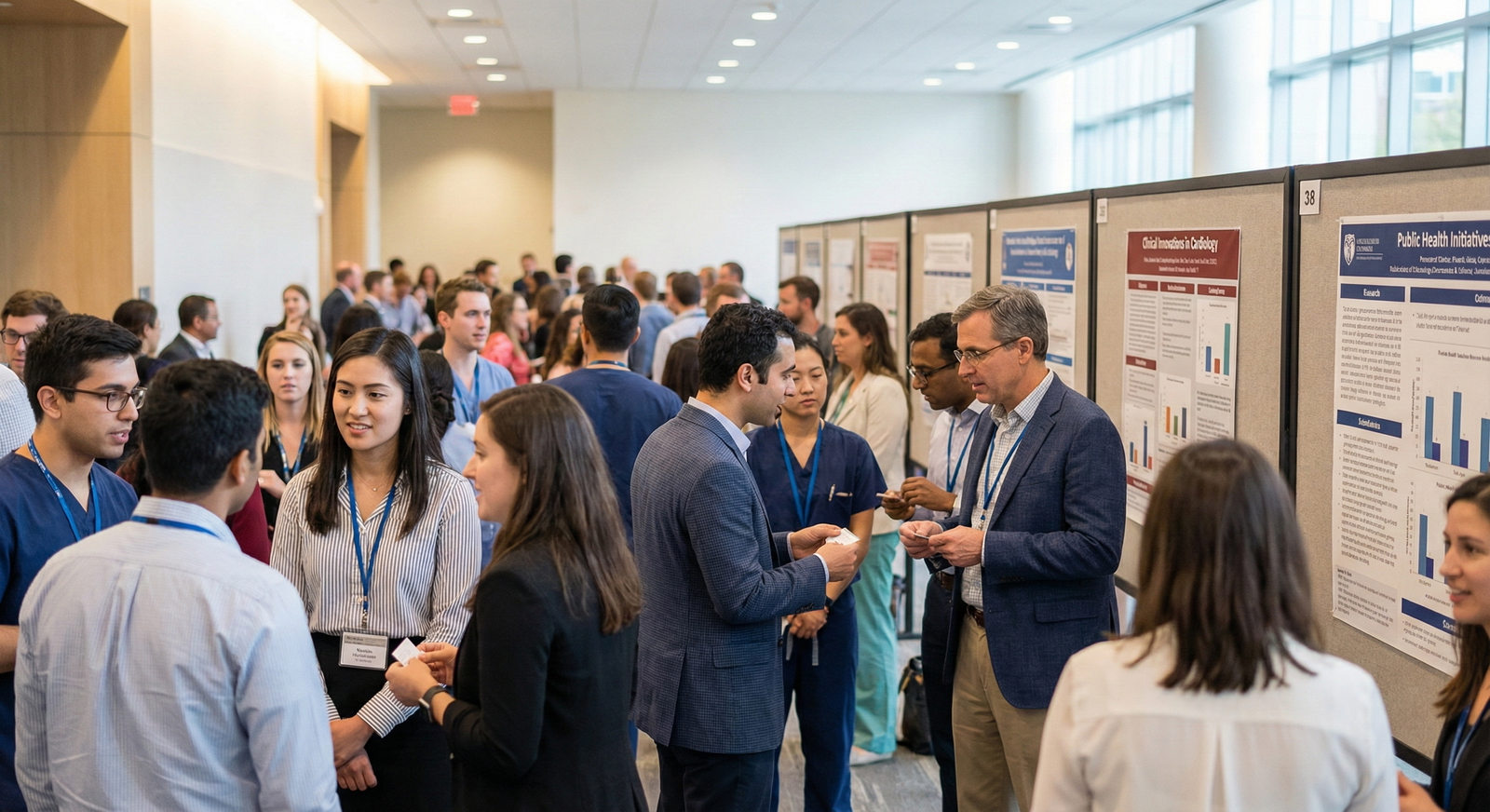
Conference networking is where your career in clinical informatics can accelerate dramatically, especially as a US citizen IMG.
Which Meetings to Target
Clinical informatics–heavy conferences:
- AMIA Annual Symposium – Flagship event in biomedical and clinical informatics.
- AMIA Clinical Informatics Conference (CIC) – More applied, clinical and operational focus.
- HIMSS Global Health Conference & Exhibition – Broader health IT, industry presence, networking with vendors.
- Specialty conferences with informatics tracks (e.g., radiology AI meetings, digital health summits).
Pre‑Conference Strategy
1. Define 3–5 Goals
Examples:
- Meet at least three clinical informatics fellows and two fellowship directors.
- Identify one potential mentor for longitudinal guidance.
- Learn how residents at specific programs balance clinical work and informatics projects.
- Explore health IT training resources and real-world project ideas.
2. Book Meetings Before You Arrive
- Scan the speaker list and program.
- Email 5–10 key people 2–3 weeks beforehand:
- Brief introduction (2–3 lines).
- Specific reason you find their work interesting.
- Ask if they’d be open to a 10–15 minute coffee chat during the conference.
3. Prepare Your Materials
- Updated, one-page CV or resume highlighting informatics experiences.
- Simple personal business card with your name, “US citizen IMG – Aspiring Clinical Informatician,” email, LinkedIn.
- A short portfolio or one‑pager (optional) summarizing 1–3 informatics/QI projects.
On‑Site: How to Actually Network
1. Attend Small Group Sessions and Tutorials
- Workshops, panels, and small oral sessions are easier for direct engagement than huge plenaries.
- Ask one succinct question in each relevant session; then approach the speaker at the end:
- “Thank you, your point about [X] helped clarify [Y] for me. I’m a US citizen IMG planning on pursuing clinical informatics—could I briefly connect with you on LinkedIn and maybe follow up with one or two questions later?”
2. Use Conference Networking Tools
- Conference apps and Slack channels often have “New to informatics” or “Student/trainee” threads.
- Post an introduction stating you’re a US citizen IMG, your school, your informatics interests, and that you’re eager to meet other trainees and mentors.
3. Practice Effective Conference Networking Etiquette
- Be concise: experiential “micro‑stories” (30–60 seconds) instead of long monologues.
- Ask more than you talk: “How did you first get into clinical informatics?” is a great opener.
- Respect time: if someone seems rushed, ask if there’s a better time for a 10–15 minute follow‑up.
4. Capture and Act on Follow‑Ups Quickly
- Each night, jot down who you met and what you talked about.
- Within 48 hours after the conference, send personalized thank‑you messages:
- Reference something specific from your conversation.
- Suggest one simple next step (“Would you be open to my emailing you a brief proposal for a small analysis related to X?”).
This is where conference networking turns into enduring mentorship medicine and collaboration.

Turning Contacts into Mentors, Projects, and Clinical Informatics Fellowships
Collecting business cards is not networking; building mutual, value‑adding relationships is.
Developing Mentorship in Medicine for Informatics
Aim for a small portfolio of mentors rather than just one:
- Career mentor – Helps you navigate overall trajectory (specialty choice, residency, fellowship).
- Skill mentor – Guides technical development (data science, EHR build, analytics).
- Sponsoring mentor – Uses their reputation and network to recommend you for projects, positions, and clinical informatics fellowship interviews.
How to nurture these relationships:
Be prepared for each interaction
- Send an agenda in advance for planned meetings: 3–5 bullet points.
- Update them on progress since your last meeting.
Make it easy for them to help you
- Draft the email they might send to introduce you to a colleague.
- Provide a brief paragraph describing you and your interests for them to forward.
Offer value back, even as a trainee
- Volunteer to help with data cleaning, literature searches, poster formatting, or meeting notes.
- Share relevant articles or resources you encounter that align with their work.
For a US citizen IMG, long‑distance mentorship (via Zoom) can be just as powerful as local mentorship if you’re consistent and reliable.
From Networking to Concrete Projects
Connections are most meaningful when they lead to outcomes:
Examples of realistic projects for a US citizen IMG:
- Literature review on best practices in sepsis alerts or medication decision support.
- Small retrospective chart review under IRB oversight, focusing on EHR utilization.
- Dashboard mockups in Power BI/Tableau for simple quality metrics (e.g., vaccine uptake, readmission rates).
- Workflow mapping and usability assessment of a telemedicine platform or EHR module.
How to propose a project:
- Briefly restate your interests and current skill level.
- Suggest a narrow, low‑risk project aligned with your mentor’s ongoing work.
- Ask: “Does this align with any ongoing initiatives where I could plug in as a student?”
- Emphasize that you understand IRB and data security requirements and are comfortable doing early work that doesn’t require PHI.
Positioning Yourself for a Clinical Informatics Fellowship
As you move into residency, your networking needs to align more explicitly with fellowship goals.
Networking with Clinical Informatics Fellowship Programs
Early in residency, identify 8–12 fellowships that fit your interests (academic vs. community, heavy analytics vs. operations, AI vs. LHS).
Reach out to current fellows for informal chats:
- Ask about their day‑to‑day work, program culture, and how they built their portfolio.
- Ask what they wish they had done differently as residents.
Attend virtual open houses and information sessions when available.
If possible, spend elective time (even 2–4 weeks) with a clinical informatics team at your home or affiliated institution.
Building a Fellowship‑Ready Portfolio Through Networking
- Cumulative output to aim for by PGY2–3:
- 2–3 informatics/QI projects with clear outcomes.
- 1–2 posters or abstracts at AMIA/HIMSS or specialty informatics meetings.
- At least one peer‑reviewed publication (helpful but not mandatory).
- Visible involvement in informatics committees or workgroups at your hospital.
Your network—mentors, collaborators, conference contacts—becomes the ecosystem that supports and validates your clinical informatics fellowship application.
Practical Networking Scripts and Pitfalls to Avoid
Sample Scripts You Can Adapt
Initial LinkedIn message to a clinical informatics fellow:
Hi Dr. [Name],
I’m a US citizen IMG in my final year at [School], planning to apply for [specialty] residency with the goal of pursuing a clinical informatics fellowship. I saw your work on [topic/project] at [institution] and found your path especially relevant.
If you’re open to it, I’d really value 15–20 minutes sometime this month to hear how you navigated informatics training during residency and any advice you might have for someone starting from outside the US system.
Thank you for considering,
[Your Name]
Email to a potential research or QI mentor in informatics:
Dear Dr. [Name],
My name is [Your Name], a US citizen IMG at [School] graduating in [Year], interested in [intended specialty] and ultimately a clinical informatics fellowship. I’ve been following your work on [brief detail], particularly your [paper/talk] about [specific aspect].
I’m eager to gain more hands‑on experience in clinical informatics and health IT training. I have prior experience with [relevant skills, e.g., basic SQL, R, or Excel‑based data analysis], and I’m comfortable working independently with guidance.
If you have any ongoing projects where an extra pair of hands could be useful—even for literature reviews, data cleaning, or basic analytics—I’d be grateful for the opportunity to contribute remotely or during an elective.
I’ve attached my CV and am happy to adapt to your team’s needs.
Sincerely,
[Your Name]
[LinkedIn URL]
Networking during a conference coffee break:
“Hi, I’m [Name]. I’m a US citizen IMG from [School], and I’m very interested in clinical informatics, especially [specific area]. I really appreciated your comments about [X] in the panel. How did you first get involved in informatics at your institution?”
Common Networking Mistakes (and How to Avoid Them)
Being vague about your interests
- Fix: Choose 1–2 focus areas to highlight (e.g., clinical decision support, population health, AI in imaging), even if you’re still exploring.
Asking for jobs or positions too early
- Fix: Initially ask for advice, reading suggestions, or small project opportunities, not jobs.
Inconsistent follow‑up
- Fix: Maintain a simple contact log and set calendar reminders. Follow up at reasonable intervals (6–8 weeks), especially when you have updates.
Overselling technical skills
- Fix: Be honest. It is much better to say “I’m learning Python and comfortable with guided analyses” than to claim senior‑level skills.
Neglecting peers
- Fix: Network horizontally with co‑students, other US citizen IMGs, residents, and fellows. Your peers today are collaborators and recommenders tomorrow.
FAQs: Networking in Medicine for US Citizen IMGs in Clinical Informatics
1. I’m an American studying abroad with no access to a formal informatics department. How can I still build a strong network?
Focus on virtual and national-level engagement. Join AMIA as a student, attend webinars, and cold‑email informatics faculty at US institutions you’re targeting for electives or residency. Ask to sit in on virtual lab meetings, quality improvement huddles, or weekly informatics rounds. Demonstrate commitment through online coursework, small remote projects, and consistent communication. Over time, a small set of remote mentors can be just as powerful as a local department.
2. How early should I start networking if I want a clinical informatics fellowship?
Start as soon as you have a genuine interest—this can be late in medical school or early in residency. For a typical timeline:
- Med school (or early PGY1): general exploration, online courses, initial contacts.
- PGY1–PGY2: deeper involvement in projects, conference networking, relationship-building with mentors.
- PGY2–PGY3: focused outreach to fellowship programs, targeted mentorship, and portfolio polishing.
Clinical informatics is competitive but still relatively small; multi‑year relationships with mentors can strongly differentiate you.
3. Does being a US citizen IMG hurt my chances for clinical informatics fellowship?
Programs vary, but being a US citizen is a significant advantage because you avoid visa constraints. The “IMG” label can raise questions about your exposure to US clinical systems and informatics, which is where strong networking and demonstrable work become critical. If you can show:
- Solid clinical training through a good residency,
- A clear informatics narrative and projects,
- Strong letters from respected informaticians,
then your IMG status becomes far less important than your actual contributions.
4. How do I balance residency workload with networking, research, and informatics projects?
Treat networking and informatics like longitudinal electives, not side‑hobbies. Strategies include:
- Carving out 1–2 protected evenings per week for emails, reading, and short Zoom meetings.
- Using lighter rotations or ambulatory blocks to push projects forward.
- Choosing projects that align with your clinical environment (e.g., EHR order set optimization on your own service).
- Being honest with mentors about your schedule and setting realistic timelines.
Consistency over time—small steps every week—matters more than intense bursts followed by long silence.
Effective networking in medicine for a US citizen IMG aiming at clinical informatics is about deliberate relationship-building, authentic curiosity, and reliable follow‑through. By combining thoughtful outreach, strategic conference networking, sustained mentorship medicine, and tangible project work, you can move from “American studying abroad with an interest in informatics” to a well‑connected, fellowship‑ready physician at the leading edge of health IT and digital care.