Networking in medicine is one of the most powerful levers you have to shape your career, and this is especially true in a relatively small, rapidly evolving field like medical genetics. Whether you are planning a medical genetics residency, already in training, or building an early career, thoughtful networking can dramatically impact your opportunities, your mentorship, and even your satisfaction in practice.
Below is a comprehensive, practical guide tailored specifically to networking in medical genetics, with a focus on the residency and early-career phases.
Why Networking Matters So Much in Medical Genetics
Medical genetics is a small specialty with outsized influence. Because the community is comparatively tight-knit, your professional relationships can have a greater impact than in larger fields.
Unique features of medical genetics that amplify networking
Small specialty, small world
- Many leaders know each other personally.
- A single strong connection (e.g., a program director or society leader) can open doors across multiple institutions.
- Word-of-mouth and reputation travel quickly—positively and negatively.
Interdisciplinary by design
- You routinely interact with:
- Pediatricians
- Internists
- Oncologists
- Neurologists
- Obstetricians/MFMs
- Laboratory geneticists
- Genetic counselors
- Effective networking means building relationships across these disciplines, not just within “pure” medical genetics.
- You routinely interact with:
Rapidly changing science
- Genomic technologies, variant interpretation standards, and gene therapies are evolving quickly.
- Staying current often depends on who you know—collaborators, mentors, and peers who share new resources, protocols, and research directions before they appear in textbooks.
Highly centralized training pathways
- There are relatively few medical genetics residency programs compared with other specialties.
- Many opportunities (fellowships, funded projects, committee roles) are concentrated at major academic centers.
- Strategic networking can help you access these limited opportunities and stand out in the genetics match.
How networking directly affects your career
Genetics match outcomes
- Insight from insiders can help you understand the “personality” of each program and tailor your application.
- A faculty advocate can significantly boost your ranking and visibility within a program.
Research and academic advancement
- Co-authorships, case series, or participation in a multicenter project often start with a conference conversation or an introduction email.
- Being known as “reliable and collaborative” can lead to invitations to join grants and publications.
Fellowships and specialized training
- Networking helps you understand niche pathways (e.g., biochemical genetics, cancer genetics, prenatal genetics, pharmacogenomics).
- Fellows and recent graduates can give you real talk about each program beyond what’s on the website.
Career resilience and satisfaction
- Networks provide:
- Emotional support
- Career advice during transitions
- Back-channel information about jobs and institutional cultures
- In a relatively small field, your network can help you find your place and prevent professional isolation.
- Networks provide:
Core Principles of Effective Networking in Medicine
Networking in medicine often gets misunderstood as self-promotion or superficial socializing. In practice, strong medical networking is about building genuine, mutually beneficial professional relationships.
Principle 1: Focus on service and curiosity, not self-promotion
Approach each interaction with:
- “How can I learn from this person?”
- “How can I be useful in return?”
Instead of leading with your CV, lead with:
- Thoughtful questions about their work
- Offers to help with tasks appropriate for your level (data collection, literature reviews, quality improvement projects)
Principle 2: Be consistent and visible
You don’t need to be everywhere, but you do need to be:
- Present in a few key spaces:
- Genetics conferences
- Institutional genetics seminars
- Genetics-related interest groups and committees
- Seen repeatedly:
- Asking smart questions at talks
- Participating in projects and actually delivering
Consistency builds your reputation much more than one impressive conversation.
Principle 3: Follow through, every time
The fastest way to build trust in a small field:
- Respond to emails reliably.
- Deliver work by (or before) the deadline.
- If you can’t complete something, communicate early and honestly.
Being seen as dependable is one of the strongest forms of professional capital in medicine.
Principle 4: Prioritize depth over breadth
In a small specialty like medical genetics, it’s more powerful to have:
- 5–10 strong, long-term relationships
- than 200 superficial LinkedIn connections.
Think:
- A couple of mentors
- A few collaborators
- Several peer colleagues you grow with over time
Building Your Network Before and During the Medical Genetics Residency
Whether you’re a medical student, resident considering a switch, or already in a medical genetics residency, you can apply a structured approach.

For medical students interested in medical genetics
1. Start at your home institution
Identify genetics faculty
- Look up:
- Division of Medical Genetics
- Clinical Genomics Service
- Genetics and Metabolism
- Include:
- Clinical geneticists (MD/DO)
- PhD laboratory geneticists
- Genetic counselors
- Look up:
Request a brief meeting (15–20 minutes)
Example email:
Subject: Medical student interested in medical genetics – request for brief meeting
Dear Dr. [Name],
I am a [MS2/MS3] at [School] with a strong interest in medical genetics and am exploring this as a potential career path. I would be very grateful for 15–20 minutes of your time to hear about your career path and any suggestions you have for getting more exposure to medical genetics at our institution.
I am available [provide 3–4 time windows], but I am happy to work around your schedule.
Thank you for considering this,
[Your Name]
Shadow in clinic
- Genetics clinics are ideal networking environments:
- Slow enough to teach
- Multi-disciplinary (genetic counselor + attending)
- Show up early, dress professionally, and volunteer small tasks:
- Drafting pedigrees
- Looking up preliminary literature
- Preparing family information sheets
- Genetics clinics are ideal networking environments:
2. Seek project and research opportunities
Offer to help with:
- Case reports on interesting variants or syndromes
- Chart reviews (e.g., diagnostic yield of panels or exomes)
- Quality improvement around genetic testing workflows
Strategies:
- Ask directly: “Are there any small projects where a motivated student could be helpful?”
- Be honest about your time constraints and meet all agreed timelines.
These experiences grow your skills and also deepen connections that can later support you in the genetics match.
3. Attend genetics-related talks and journal clubs
- Genetics grand rounds, variant review meetings, and journal clubs are prime networking venues.
- Ways to stand out:
- Read the paper in advance.
- Prepare one or two specific questions.
- Afterward, thank the presenter and connect briefly:
- “I appreciated how you explained [X]. Are there any review articles you’d recommend on this topic?”
For residents planning or in a medical genetics residency
Residents can leverage three main networking arenas: within your program, across your institution, and nationally.
1. Within your medical genetics residency program
Build strong relationships with:
- Program director (PD) and associate PDs
- Core faculty in pediatrics, IM, oncology, neurology, MFM, and others who frequently consult genetics
- Genetic counselors and lab directors
Showcase reliability:
- Be known as the resident who:
- Returns consults promptly
- Communicates clearly with referring teams
- Documents accurately, including pedigrees and test rationales
- Treats genetic counselors and staff with respect
- Be known as the resident who:
Seek small leadership roles:
- Organizing a genetics teaching series for residents
- Leading a journal club
- Helping coordinate a case conference
These visible contributions stand out to faculty and can later influence fellowship and job recommendations.
2. Networking across your institution
Use every rotation and committee as a chance to build lasting connections:
Rotations in pediatrics, oncology, neurology, etc.
- Introduce yourself as: “I’m a medical genetics resident with interest in [X area].”
- Offer to assist with:
- Complex genetic test interpretations
- Family counseling sessions (with supervision)
- After outstanding collaborative cases, follow up with an email like:
- “I appreciated working with you on [patient]. If you have other cases where genetics might help, I’d be happy to be involved.”
Hospital committees and initiatives
- Join:
- Genomics implementation working groups
- Ethics committees that discuss genetic issues
- Quality improvement teams focused on testing utilization or turnaround times
- Join:
These are natural environments for high-value medical networking with leaders who make institutional decisions.
3. National-level networking as a resident
This is where conference networking and society involvement become central.
Mastering Conference Networking in Medical Genetics
Medical genetics conferences are high-yield environments for building and strengthening your professional network. Think of them as dense “relationship accelerators.”

Key genetics and genomics conferences to consider
- American College of Medical Genetics and Genomics (ACMG) Annual Clinical Genetics Meeting
- Central for clinical geneticists, genetic counselors, and lab professionals.
- American Society of Human Genetics (ASHG) Annual Meeting
- Larger, more research-oriented, excellent for exposure to cutting-edge genomics.
- Specialty meetings:
- Genetic metabolic societies, cancer genetics, prenatal diagnosis groups
- Regional ACMG or ASHG-associated meetings.
Before the conference: Strategic preparation
Define your goals
- Examples:
- Learn about 3–4 programs before applying to medical genetics residency.
- Identify a potential mentor in cancer genetics.
- Explore interests in variant interpretation or genomic medicine implementation.
- Examples:
Review the program in advance
- Highlight:
- Sessions directly tied to your interest (e.g., pharmacogenomics, metabolic genetics, neurogenetics).
- “Meet the Expert” sessions.
- Trainee or early-career networking events.
- Highlight:
Contact people ahead of time
Reach out to:
- Program directors
- Faculty whose work you’ve read
- Residents or fellows at programs you’re considering
Sample email:
Dear Dr. [Name],
I am a [PGY-2 pediatrics resident / medical student] interested in pursuing a career in medical genetics, particularly in [area]. I have been following your work on [briefly mention a paper, talk, or initiative].
I will be attending [Conference] this year and wondered if you might have 10–15 minutes for a brief conversation about your work and any advice you might have for someone considering a career in this area. I am happy to meet whenever is convenient for you.
Thank you for your time and consideration,
[Your Name]
Prepare a concise self-introduction (“elevator pitch”)
- 20–30 seconds:
- Who you are (training level, institution)
- Your specific interests within medical genetics
- A line about what you’re exploring (research, residency, fellowship)
Example:
“I’m a PGY-2 in pediatrics at [Institution], planning to apply for medical genetics residency. I’m particularly interested in neurogenetics and how we can integrate exome sequencing earlier for children with unexplained developmental delay. I’m trying to learn more about training pathways that combine strong clinical exposure with genomic research.”
- 20–30 seconds:
During the conference: Tactics to build real connections
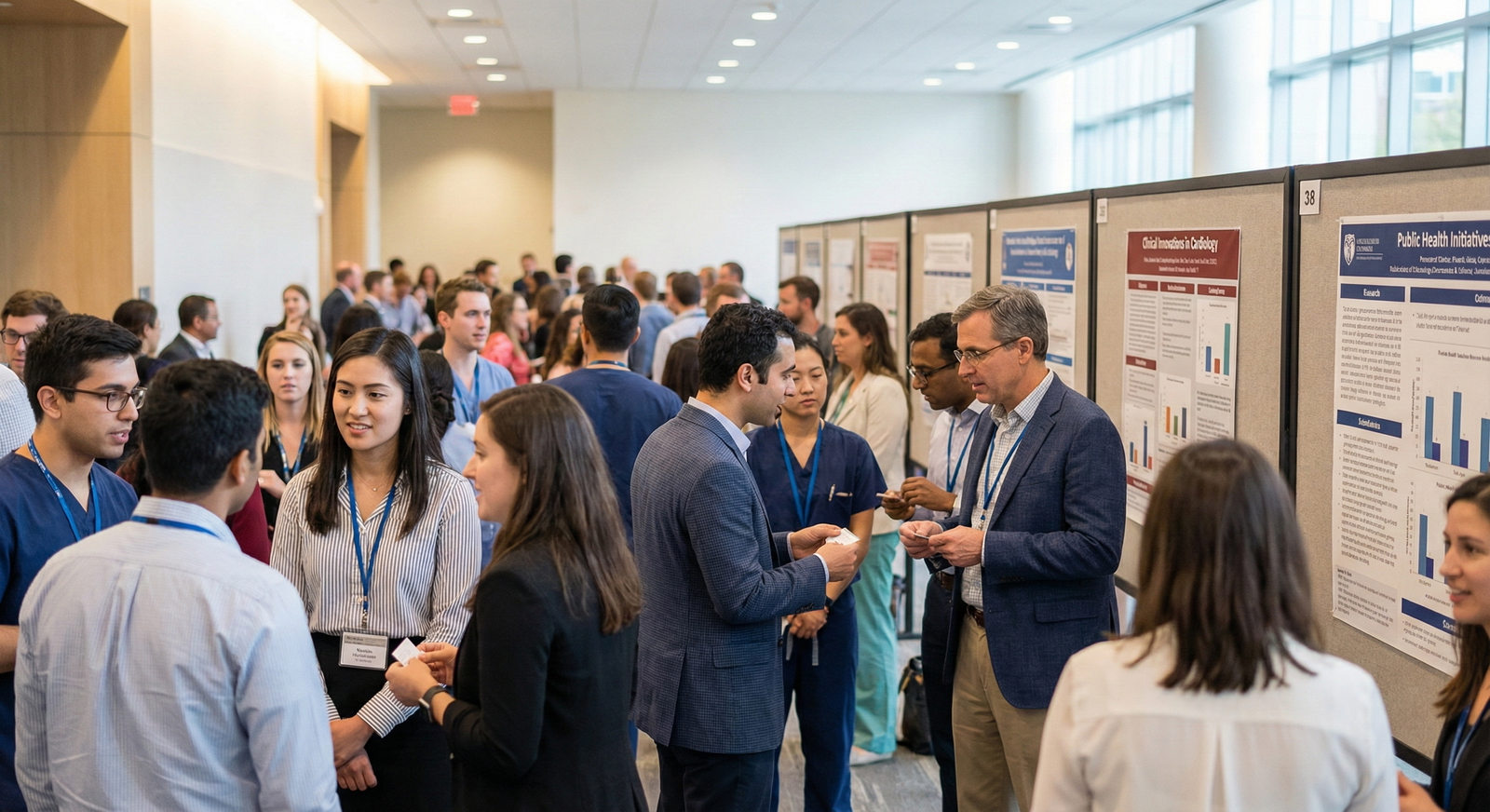
Make the most of poster sessions
- Approach posters relevant to your interests.
- Ask specific, respectful questions:
- “How do you see this assay being incorporated into routine clinical workflows?”
- “What surprised you most about your results?”
- If the presenter is a resident or fellow:
- Ask about their training path and program.
- Exchange contact information if the conversation is substantive.
Attend trainee-focused events
- Many conferences have:
- Trainee mixers
- Mentoring lunches
- “Meet the Professor” sessions
- Your goals:
- Speak with at least 3–5 people.
- Ask about their trajectory and what they wish they’d known earlier.
- Follow up later (email or LinkedIn) with a short thank-you and reminder of your conversation.
- Many conferences have:
Ask about the “unwritten rules”
- For those who’ve been through the genetics match, ask:
- “What surprised you about applying to medical genetics?”
- “What do you think distinguishes programs beyond what you see on paper?”
- “What do strong applicants in this field typically have in common?”
- For those who’ve been through the genetics match, ask:
Use social media thoughtfully
- Platforms like X (Twitter) and LinkedIn can extend conference networking:
- Follow genetics societies and leaders.
- Share 1–2 key takeaways from talks you attend (while respecting confidentiality and abstract policies).
- Don’t overshare or post patient-identifying details. Stay professional.
- Platforms like X (Twitter) and LinkedIn can extend conference networking:
After the conference: Converting contacts into relationships
Send timely follow-up messages
- Within 3–7 days:
- Thank them for their time.
- Mention one specific point you found useful.
- If appropriate, ask to stay in touch or propose a call later in the year.
- Within 3–7 days:
Connect with a purpose
- Examples:
- Share an article related to what you discussed.
- Update them when you present related work or submit an application.
- Ask 1–2 specific questions, not a long, open-ended request.
- Examples:
Track your contacts
- Maintain a simple spreadsheet:
- Name, role, institution
- How you met
- Topics you discussed
- Date and details of last contact
- This helps you follow up genuinely over time, especially during application cycles.
- Maintain a simple spreadsheet:
Mentorship in Medicine: Building a Genetics-Specific Mentorship Network
Networking and mentorship medicine are tightly connected, but not identical. Networking opens doors; mentorship helps you walk through them effectively.
Types of mentors you should aim to have
In medical genetics, a “mentorship board” is usually more realistic and effective than one “perfect” mentor.
Career mentor (big-picture trajectory)
- Helps you:
- Decide on pathways (e.g., pediatric vs combined internal medicine–genetics)
- Understand the landscape of academic vs non-academic genetics
- Identify growth opportunities (fellowships, leadership roles)
- Helps you:
Research mentor
- Guides you in:
- Project development
- Manuscript writing
- Abstract preparation and conference submissions
- Often your PI or project leader.
- Guides you in:
Skills/technical mentor
- Helps you:
- Deepen expertise in specific areas (variant interpretation, metabolic workup, genomics informatics)
- Could be:
- A lab director
- A bioinformatician
- An experienced genetic counselor
- Helps you:
Peer mentor
- Someone slightly ahead of you:
- Senior resident
- Fellow
- Early faculty
- Provides:
- Application tips
- Honest insight into training environments
- Emotional support
- Someone slightly ahead of you:
How to cultivate mentoring relationships
Start informally
- Ask for advice on a specific decision:
- “Should I prioritize this project or that one?”
- “Would you recommend a combined pediatrics–genetics track for someone with my interests?”
- Ask for advice on a specific decision:
Observe alignment
- Is this mentor:
- Respectful of your interests and boundaries?
- Supportive of your values and life circumstances?
- Reliable in responding and following through?
- Is this mentor:
Formalize when appropriate
- After several positive interactions:
- “I’ve found your guidance extremely helpful. Would you be open to serving as a more formal mentor as I navigate the genetics match and early residency decisions?”
- After several positive interactions:
Be a good mentee
- Come prepared to meetings with:
- An agenda
- Progress updates
- Specific questions
- Follow through on their suggestions or explain why you’ve chosen differently.
- Come prepared to meetings with:
Digital and Day-to-Day Networking Strategies in Medical Genetics
Not all networking happens at conferences or formal meetings. Everyday interactions and digital presence also matter.
Online presence and professional identity
LinkedIn
- Keep your profile updated:
- Training level and institution
- Interests: “Medical genetics and genomics, neurogenetics, cancer genetics,” etc.
- Connect with:
- Faculty you’ve worked with
- Peers you meet at conferences
- Occasionally share:
- Abstract acceptances (without patient details)
- Participation in panels or talks
- Commentary on newly published genetics guidelines
- Keep your profile updated:
Professional email habits
- Use a clear, respectful tone.
- Include a simple signature:
- Name, degree(s)
- Current position and institution
- Professional email
Institutional platforms
- Internal listservs or channels for:
- Genetics journal clubs
- Case discussions
- Laboratory updates
- Participate constructively, not excessively.
- Internal listservs or channels for:
Everyday “micro-networking” on the wards and in clinic
Be known for a specific value-add
- Example identities:
- “The resident who is great at explaining genetic testing options to families.”
- “The person who always helps clarify variant interpretation in tumor boards.”
- When colleagues know your strengths, they refer cases and opportunities your way.
- Example identities:
Respect and collaborate with non-physician professionals
- Genetic counselors, nurses, pharmacists, and lab technologists are central in medical genetics.
- Strong relationships here:
- Improve patient care
- Generate project ideas
- Build a reputation as a collaborative clinician
Turn challenging cases into networking opportunities
- After a complex case:
- Thank all collaborators.
- Propose a case conference or short write-up.
- This may lead to cross-departmental quality improvement projects or publications.
- After a complex case:
Common Pitfalls and How to Avoid Them
Even well-intentioned networking can go wrong. Being aware of common mistakes helps you stay grounded and professional.
Pitfall 1: Networking only when you need something
- Solution:
- Nurture relationships consistently.
- Share useful articles, congratulate on promotions or paper acceptances.
- Be available to help those who helped you.
Pitfall 2: Overextending yourself
- Solution:
- Only agree to as many projects as you can reliably complete.
- Learn to say:
- “I’m honored you thought of me. My plate is full right now, but I’d like to stay informed about future opportunities.”
Pitfall 3: Treating networking as transactional
- Solution:
- Approach people as humans, not checkboxes.
- Have conversations about:
- Their career path
- What they enjoy or find challenging
- Let mutual respect grow over time.
Pitfall 4: Being overly self-critical or silent
- Solution:
- Prepare 1–2 questions or comments for each event.
- Practice introducing yourself briefly and clearly.
- Accept that feeling awkward is normal at first; it improves with practice.
FAQs about Networking in Medical Genetics
1. Do I need research to network effectively and succeed in the genetics match?
No, you don’t need an extensive research portfolio to build a strong network or match successfully into medical genetics residency. Research is helpful, but many relationships start from:
- Shadowing and clinical involvement
- Participation in journal clubs and case conferences
- Helping with small quality improvement projects or case reports
What matters most is showing genuine interest, reliability, and a willingness to learn. If research opportunities do arise, they can strengthen your application and help you connect with additional mentors—but they are not the only route.
2. How early should I start networking if I’m considering medical genetics?
Ideally, start as soon as you are seriously considering medical genetics:
- Medical students: MS2–MS3 is common, but even MS1 exploration is valuable.
- Residents in other specialties: As soon as you begin to lean toward genetics, seek local mentors and national exposure (e.g., ACMG).
Early networking gives you time to:
- Explore whether the specialty truly fits you.
- Build longitudinal relationships that can write strong letters.
- Identify programs where you will thrive.
3. I’m introverted and find conference networking intimidating. What should I do?
You can still network effectively as an introvert by:
- Setting small, realistic goals:
- “I will have meaningful conversations with 2–3 people per day.”
- Preparing in advance:
- Drafting questions and your self-introduction
- Scheduling 1:1 meetings ahead of time (often easier than big receptions)
- Using structured formats:
- Mentoring lunches
- Small-group workshops
- Following up via email afterward, where you might feel more comfortable expressing yourself fully.
You don’t have to “work the room” to build strong, lasting relationships.
4. How do I maintain relationships once I start residency and get busy?
Residency is demanding, but small, periodic efforts go a long way:
- Send brief updates to mentors every 3–6 months.
- Share major milestones:
- “I started my medical genetics residency at [Institution].”
- “Our abstract on [topic] was accepted to ACMG.”
- Ask occasional, focused questions rather than constant requests.
- When possible, meet mentors at conferences you both attend.
Consistency, not frequency, is what keeps your network alive.
Networking in medicine, especially in a specialized field like medical genetics, is not about collecting business cards—it’s about building a professional community. By approaching networking with curiosity, service, and authenticity, you can create a robust support system that enriches your career, enhances patient care, and opens doors you may not even know exist yet.