Understanding Networking in Medicine as a DO Med-Peds Graduate
As a DO graduate entering Medicine-Pediatrics (Med-Peds), networking in medicine is not just a “nice to have”—it is a strategic skill that directly influences your osteopathic residency match success, fellowship opportunities, job searches, and long-term career satisfaction. For Med-Peds physicians, who straddle two specialties, effective medical networking is especially powerful: you are building relationships in both internal medicine and pediatrics, across inpatient and outpatient settings, and often in academic, community, and public health spaces.
Networking in medicine for a DO graduate in Med-Peds has a few unique dimensions:
- You are navigating perceptions about osteopathic training while proving your clinical strengths.
- You live in two professional worlds (medicine and pediatrics) and need visibility in both.
- Your career options are broad—hospitalist, primary care, subspecialty, academic medicine, leadership—and mentorship medicine can help you choose a path deliberately.
This article walks through a structured, practical approach to networking for DO Med-Peds residents and recent graduates, with a special focus on conference networking, mentorship, and leveraging the osteopathic residency match experience into robust professional relationships.
Why Networking Matters More for DO Med-Peds Physicians
Networking is often misunderstood as superficial self-promotion. In medicine, it is better defined as purposeful, reciprocal relationship-building that advances patient care, professional development, and career growth.
For a DO graduate in Med-Peds, networking matters for several specific reasons:
1. Overcoming Visibility Gaps as a DO Graduate
Although the osteopathic residency match is increasingly integrated with the allopathic system, DO graduates may still face:
- Less representation in some academic programs or subspecialties
- Fewer “built-in” alumni networks in certain institutions
- Misconceptions about osteopathic training from those unfamiliar with it
Networking gives you:
- Face time with decision-makers in both medicine and pediatrics
- Opportunities to showcase your skills and professionalism beyond your CV
- A way to correct misconceptions through competence, collegiality, and real interactions
2. Building a Dual-Discipline Identity
As a Med-Peds physician, you function in two communities:
- Internal medicine: hospitalists, subspecialists, primary care, academic internists
- Pediatrics: general pediatricians, pediatric hospitalists, pediatric subspecialists
Without intentional networking, it’s easy for your identity to dilute across both. Strategic relationships help you:
- Find Mentors in both medicine and pediatrics
- Craft a cohesive personal brand (“I’m a DO Med-Peds physician focused on transitions of care for medically complex adolescents.”)
- Gain access to Med-Peds–specific opportunities, like combined fellowship pathways, transitions clinics, or quality improvement projects spanning both age ranges
3. Unlocking Non-Linear Career Paths
Med-Peds physicians often:
- Combine inpatient and outpatient roles
- Work in community settings with academic collaborations
- Engage in advocacy, global health, public health, or medical education
These roles are often not posted widely. They are discovered through:
- Word-of-mouth from faculty you’ve impressed
- Recommendations from mentors across departments
- Networking at conferences and within special-interest groups
In other words, networking increases your access to the “hidden job market” in medicine.

Core Networking Skills for DO Med-Peds Residents
To make medical networking effective rather than awkward, break it into concrete, learnable skills.
Clarifying Your Emerging Professional Identity
You don’t need a fully defined career plan, but you do need a working narrative. This helps others remember you and connect you with opportunities.
Create a 3–4 sentence “professional snapshot” that includes:
Who you are
- “I’m a DO Med-Peds resident at [Institution].”
What you’re interested in
- “I’m particularly interested in complex care and transitions from pediatric to adult services.”
What you’re working on now
- “I’m currently involved in a QI project on improving handoffs for young adults with cystic fibrosis.”
Where you want to grow
- “I’m exploring careers that combine clinical work with quality improvement and medical education.”
Practice saying this naturally so it doesn’t sound rehearsed. This simple structure makes you memorable and directs potential mentors toward how they can help.
Mastering the Art of the Brief Introduction
Whether at a conference, on rounds, or in a hallway, most networking starts with 30–90 seconds of conversation. A reliable pattern:
Introduce yourself and your training level
- “Hi, I’m Dr. [Last Name], a second-year DO Med-Peds resident at [Program].”
Connect to context
- “I attended your talk on adolescent diabetes management—really appreciated your data on transition clinics.”
Offer a specific comment or question
- “I’m curious how you adapted your model in smaller community settings.”
End with a light ask (if the conversation goes well)
- “Would you mind if I emailed you to learn more about how you set up your clinic?”
This structure prevents you from rambling and shows respect for the other person’s time.
Listening More Than You Talk
Effective networking in medicine is less about selling yourself and more about active listening:
- Ask: “What projects are you most excited about right now?”
- Listen for mentorship and collaboration opportunities, such as:
- “We’re trying to expand this into adult clinics.”
- “We need help with data collection or QI workflows.”
- Reflect back: “It sounds like one challenge is coordinating between pediatric and adult sites—Med-Peds residents might be well suited to that.”
You’re signaling that you understand their work and how you might add value.
Documenting and Following Up
Networking is only as good as your follow-up:
- Keep a simple contact tracker (spreadsheet or note app):
- Name, role, institution
- Where you met
- Topics discussed
- Next step & date
- Send a brief email within 48–72 hours:
- “Thank you for taking the time to speak after your session on [topic]. I really appreciated your insights on [specific point]. I’d love to follow up about [potential next step] if you think that could be helpful.”
This transforms a one-off conversation into an ongoing relationship.
Leveraging Conferences: Strategic Medical Networking for DO Med-Peds Physicians
Conference networking is one of the highest-yield ways to build your professional network quickly—if you do it intentionally. This is especially relevant for the osteopathic residency match and beyond: national visibility can balance any initial disadvantages of coming from a smaller or less well-known DO program.
Choosing the Right Conferences
As a DO Med-Peds resident or early graduate, prioritize:
Med-Peds–Specific Meetings
- The National Med-Peds Residents’ Association (NMPRA) conferences or events
- American Academy of Pediatrics (AAP) Section on Med-Peds
- Med-Peds special interest groups within broader organizations
Core Specialty Conferences
- Internal medicine: ACP, SHM (hospital medicine), SGIM, SCCM (if ICU interested)
- Pediatrics: AAP National Conference, PAS, pediatric hospital medicine meetings
Osteopathic-Focused Meetings
- ACOI, ACOFP, or other osteopathic specialty organizations that align with your interests
You don’t need to attend every meeting. Aim for 1–2 key conferences per year, with a clear plan.
Arriving with a Networking Plan
Before the conference:
- Review the program
- Highlight talks in Med-Peds, transitions of care, complex chronic disease, primary care innovation, or education.
- Identify 5–10 people you want to connect with
- Med-Peds program directors
- Leaders in areas you care about (hospital medicine, complex care, adolescent medicine, global health, etc.)
- Send 3–5 short pre-conference emails, such as:
“I’ll be at [Conference] and noticed you’re presenting on [topic]. As a DO Med-Peds resident interested in [related area], I’d be grateful for 10–15 minutes to ask a few questions about your work if you have any availability during the meeting.”
Not everyone will respond; even 1–2 meetings can be transformative.
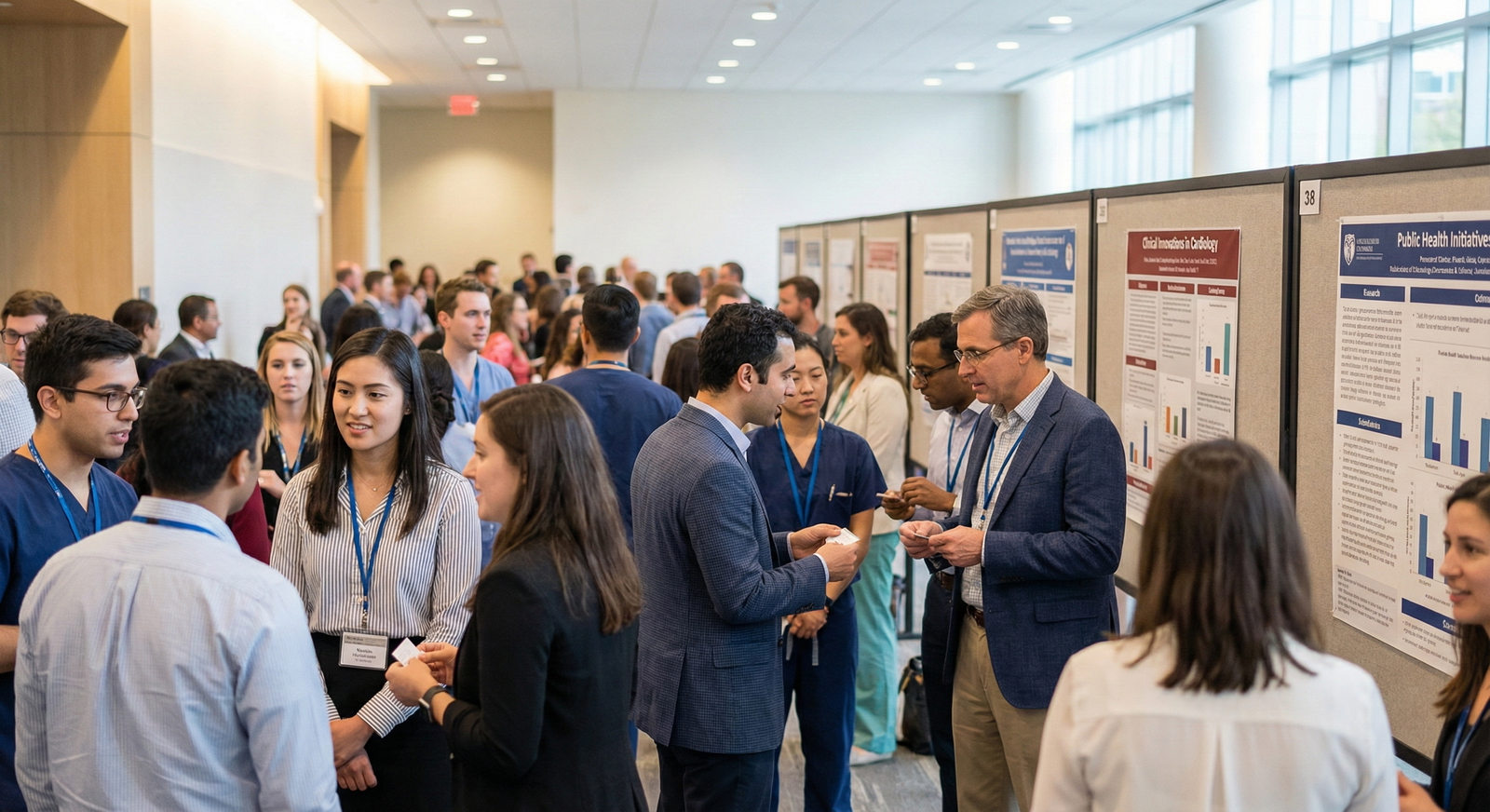
Making the Most of Poster Sessions and Social Events
Poster sessions are built-in, low-pressure networking spaces:
When you are presenting:
- Prepare a 1-minute and 3-minute summary of your project.
- End with “Where we’re heading next is…” to invite feedback.
- Have a simple way to share contact info (QR code on your poster linking to email or LinkedIn).
When you are visiting others:
- Ask presenters: “What have you learned from this project that surprised you?”
- If their work overlaps with Med-Peds, transitions, or QI, mention your Med-Peds background and how it might connect:
- “I see a lot of these challenges in my Med-Peds continuity clinic—especially as kids age out of pediatrics.”
Social events (receptions, section meetings, resident meet-ups) are similarly valuable:
- Go in with two goals:
- Meet 3 new people in Med-Peds or your interest area
- Re-connect with 2 people you know from prior rotations, email exchanges, or interviews
Presenting as a DO Graduate Without Apology
At conferences you may find yourself surrounded by MD-trained colleagues. You do not need to justify your DO background. Instead:
- State it matter-of-factly:
- “I’m a DO Med-Peds resident at [Program].”
- Highlight your unique strengths when appropriate:
- Longitudinal exposure to holistic/whole-person care
- Often strong communication and primary care emphasis
- Additional training in OMM, even if you don’t use it heavily
If someone asks, “What made you choose a DO school?” keep your answer positive and brief, then pivot back to your current work and interests.

Building Mentorship and Sponsorship in Medicine-Pediatrics
Mentorship in medicine is one of the most powerful outcomes of effective networking. For DO Med-Peds residents, intentional mentorship medicine can close gaps in access, advocacy, and visibility.
Understanding Roles: Mentor, Sponsor, and Coach
- Mentor
- Provides advice, perspective, and feedback
- Helps you think through career decisions and challenges
- Sponsor
- Uses their influence to open doors for you
- Nominates you for committees, speaking roles, or jobs
- Coach
- Focuses on specific skills (presenting, writing, time management, negotiation)
You may have a single person who fills more than one role, but expect to build a “personal board of directors” rather than relying on one ideal mentor.
Finding Mentors in Both Medicine and Pediatrics
You will likely need:
- At least one internist mentor (e.g., hospitalist, primary care, academic internist)
- At least one pediatric mentor (e.g., general peds, subspecialist, complex care)
- Ideally one Med-Peds–trained mentor, even if only virtual or at a distance
Where to look:
- Within your Med-Peds program: PD, APD, or core faculty
- Rotations where you connected well with an attending
- Institutional committees (QI, DEI, education)
- NMPRA or AAP/ACP Med-Peds sections
- Osteopathic organizations with Med-Peds members or dual-boarded physicians
Approaching a Potential Mentor
When approaching someone for mentorship:
Start with a single, clearly defined ask
- “Would you be open to a 20-minute conversation about career paths that combine Med-Peds and hospital medicine?”
After 1–2 meetings, clarify what you are seeking:
- “I’ve really appreciated your perspective. Would you be open to meeting a few times a year as I navigate decisions around fellowship and early career planning?”
Set expectations:
- Frequency (e.g., 2–4 times per year)
- Preferred mode (in-person, Zoom, email)
- What you will bring to the table (agendas, updates, questions)
Respect their time by staying prepared and following through.
Nurturing Long-Term Mentoring Relationships
To keep mentorship relationships strong:
Send periodic updates:
- “I matched into a Med-Peds residency—thank you again for your support during the osteopathic residency match process.”
- “Our QI project on transitions of care was accepted for a poster presentation.”
Ask for feedback and act on it
- If they suggest a reading, conference, or contact, follow through and report back.
Offer value where you can
- Volunteer to help with data entry, manuscript edits, resident teaching sessions, or curricula they are developing.
Over time, mentors may evolve into sponsors, advocating for you in rooms you aren’t yet in.
Practical Networking Strategies in Everyday Residency Life
Not all networking happens at conferences. Much of your most impactful medical networking occurs in the hospital, clinics, and your own institution.
On the Wards and in Clinic
Use daily interactions as networking opportunities—quietly and professionally:
- Be consistently reliable
- Show up prepared, do your notes, anticipate patient needs. Reputations travel quickly.
- Ask thoughtful clinical questions
- “In this 19-year-old with sickle cell, how do you think about transitioning from pediatric-focused to adult-focused pain plans?”
- Express interest when appropriate
- “I really enjoyed this rotation. I’m interested in Med-Peds hospital medicine—would you be open to meeting briefly about your career path?”
Faculty notice learners who are prepared, curious, and professional; these are often the people they later support with letters, introductions, or job leads.
Cross-Department Visibility
Because you are Med-Peds, you can:
- Join QI or education committees that span both departments
- Propose or join projects that explicitly address:
- Transitions of care (e.g., congenital heart disease, sickle cell disease, cystic fibrosis)
- Young adults with chronic childhood-onset conditions
- Health systems issues across pediatric and adult care
When you participate actively, you become known as the Med-Peds DO resident who gets things done—a powerful brand.
Digital Networking: Email, LinkedIn, and Professional Platforms
Digital medical networking can be high-yield, especially across institutions:
- Email etiquette
- Clear subject lines: “Med-Peds DO Resident Interested in Transitions Clinic – Request for Brief Meeting”
- Concise, respectful body: who you are, why you’re reaching out, specific ask, gratitude
- LinkedIn
- Keep a professional profile with your Med-Peds training, interests, and major projects.
- Connect with people after meeting them: “Great to meet you at [Conference/Meeting]; I enjoyed our conversation about [topic].”
- Professional societies’ online communities
- Participate in Med-Peds listservs, AAP/ACP forums, or osteopathic organization discussion boards.
- Ask focused questions and share resources you’ve found helpful.
Transitioning from Residency to Early Career
In late residency, networking becomes central to your job or fellowship search:
- Tell mentors and trusted faculty 6–12 months before graduation what you’re looking for:
- “I’m seeking a Med-Peds hospitalist role in the Midwest with opportunities for QI and teaching.”
- Ask specifically:
- “Are there colleagues you recommend I talk with?”
- “Would you be comfortable introducing me to [X group] at [Y institution]?”
- When interviewing, continue networking:
- Meet with current Med-Peds or dual-trained physicians if possible.
- Ask: “How has your Med-Peds background been leveraged here—and where do you see gaps Med-Peds could help fill?”
Open-ended yet targeted questions help you assess the culture and opportunities at each site.
Frequently Asked Questions (FAQ)
1. As a DO graduate, do I need to network differently than my MD colleagues?
You don’t need a completely different strategy, but intentionality matters more. Because DO graduates may have less automatic visibility in some academic and subspecialty spaces, networking helps you:
- Demonstrate your capabilities directly
- Connect with mentors who understand and value your osteopathic background
- Access national opportunities that go beyond your local institution
Lean into your strengths—holistic care, communication skills, and a dual-discipline Med-Peds identity—rather than trying to “blend in.”
2. How early in residency should I start networking?
Start immediately, but keep it low-pressure:
- PGY-1: Focus on building a strong reputation on rotations and identifying 1–2 potential mentors in each department.
- PGY-2: Start attending at least one regional/national conference and presenting small projects (posters, workshops).
- PGY-3/4: Solidify mentorship/sponsorship relationships and use them to explore fellowships, hospitalist roles, or combined positions.
Networking is cumulative; small, consistent efforts over years matter more than short-term bursts.
3. What if I’m introverted or feel awkward “selling myself”?
Think of networking as relationship-building around shared interests, not self-promotion. Strategies that can help:
- Prepare 2–3 open-ended questions you can use in most situations.
- Focus on learning: “What are you currently working on that you’re excited about?”
- Set small, achievable goals: introduce yourself to two new people at each meeting; send one follow-up email per week.
You don’t need to be the most outgoing person in the room; you just need to be thoughtful, prepared, and genuine.
4. How can networking help specifically with Medicine-Pediatrics match and career transitions?
During the medicine pediatrics match process (and later job/fellowship transitions), networking can:
- Give you insight into program cultures and priorities
- Help you obtain strong letters from mentors who know you well
- Alert you to less-visible positions—such as Med-Peds hospitalist roles, transitions clinics, or combined fellowships
For DO applicants and graduates, networking complements your formal application by putting a real, three-dimensional person behind the ERAS file or job application.
Intentional, authentic networking is one of the highest-yield investments you can make as a DO Med-Peds physician. By combining conference networking, everyday professional interactions, and deliberate mentorship in medicine, you can build a robust support system that opens doors, sustains your motivation, and ultimately improves the care you provide across the lifespan.