Why Networking Matters So Much for the DO Graduate
As a DO graduate entering residency or early practice, your clinical skills are essential—but they’re not enough on their own. In today’s competitive environment, medical networking is one of the most powerful tools you have to:
- Strengthen your osteopathic residency match or fellowship prospects
- Open doors to jobs in both ACGME and osteopathic-focused settings
- Find mentors who understand the unique DO journey
- Build collaborations for research, quality improvement, and teaching
- Navigate career transitions and geographic moves
Unlike a one-time activity, networking in medicine is an ongoing, strategic process of building genuine professional relationships. For DO graduates, it can also help counter persistent misconceptions, highlight your strengths in whole-person care, and showcase your osteopathic training to the broader medical community.
This article focuses on practical, actionable strategies tailored specifically for DO graduates, from late medical school through early residency and beyond.
Laying the Foundation: Your Professional Identity as a DO
Before you dive into events and LinkedIn, you need a clear sense of who you are professionally and what you bring as a DO graduate.
1. Clarify Your Short- and Medium-Term Goals
Your networking strategy should align with your goals. Consider:
- Are you aiming for a specific specialty or subspecialty?
- Are you still pivoting after the osteopathic residency match and exploring options?
- Are you leaning toward academic medicine, community practice, or hospital employment?
- Do you hope to incorporate OMM/OMT into your eventual practice?
Write down 2–3 clear goals for the next 2–5 years. Examples:
- “Secure a PGY-1 spot in internal medicine in the Northeast within 12 months.”
- “Develop a mentorship connection in sports medicine who can guide me toward fellowship.”
- “Build a network in my home state to return there after residency.”
These goals will help you choose which people, organizations, and events to invest your time in.
2. Define and Own Your DO Value Proposition
As a DO graduate, you offer distinct strengths:
- Training in osteopathic principles and whole-person care
- Comfort with manual therapies and OMT (if you maintain and market that skill)
- A culture that emphasizes communication, empathy, and teamwork
When networking, be ready with a concise self-introduction that integrates your DO identity naturally:
“I’m a recent DO graduate from [School], interested in internal medicine with a strong focus on whole-person care. I enjoy integrating osteopathic principles into managing chronic disease.”
This helps peers and faculty remember you as both a physician and an osteopathic clinician—not “just another applicant.”

Building Your Core Networking Toolkit
You’ll be more effective at medical networking if your professional presence and materials are polished and aligned.
1. Create a Strong, Updated CV
Your CV is often your first impression. For a DO graduate, make sure it clearly reflects your osteopathic background:
Key components:
- Education (with “Doctor of Osteopathic Medicine” clearly stated)
- USMLE/COMLEX scores (if relevant and comfortable sharing)
- Clinical rotations and any osteopathic-focused experiences
- Research, QI projects, case reports, and posters
- Leadership roles (especially in SOMA, AOA, SIGs, or school organizations)
- Teaching, tutoring, peer-mentoring experiences
- Volunteer and community outreach, especially osteopathic or holistic-care projects
Bring a few printed copies to conferences, interviews, and meetings. Have a clean PDF version ready to email quickly after any promising interaction.
2. Professional Email and Signature
Use a simple, professional email address—ideally your institutional email or a variation of your name.
Create an email signature such as:
Jane Smith, DO
PGY-1, Internal Medicine Resident
[Institution Name]
Email | Phone | LinkedIn URL
If you’re between positions (e.g., SOAP, waiting for a new contract):
Jane Smith, DO
DO Graduate, Class of 2025
Interested in: Internal Medicine / Primary Care
Email | Phone | LinkedIn URL
That last line subtly reminds recipients what you’re looking for.
3. Optimize Your LinkedIn and Online Presence
LinkedIn is a powerful tool for medical networking and mentorship in medicine, especially across institutions and regions.
Profile basics:
- Professional headshot (simple background, business attire or clinic-appropriate clothing)
- Headline: “Internal Medicine DO Resident at [Institution]” or “Recent DO Graduate Seeking [Specialty] Opportunities”
- About section: 2–3 short paragraphs about your background, DO training, interests, and goals
- Experience: Rotations, research, teaching, leadership roles
- Skills: Add “Osteopathic Manipulative Treatment (OMT)” if applicable, plus communication, teaching, quality improvement, research methods
Join LinkedIn groups for:
- Your specialty of interest
- DO alumni networks
- Local/state medical societies
- Osteopathic associations
4. Prepare Your “Networking Toolkit”
Before conferences, interviews, or virtual events, prepare:
- Elevator pitch (30–60 seconds) about who you are and what you’re looking for
- 3–5 talking points or questions you can use to start conversations
- A concise way to describe your DO background that educates without sounding defensive
- A small stack of professional business cards (optional but often helpful at in-person events)
Example elevator pitch tailored for a DO graduate:
“I’m Alex, a recent DO graduate from [School]. I’m very interested in academic family medicine, particularly in underserved care. During medical school, I led our student-run clinic and worked on a QI project for diabetes management. I’m hoping to learn more about how your program or department supports residents who want to teach and stay involved in community outreach.”
Strategic Networking During the Osteopathic Residency Match and Beyond
For many DO graduates, the intensity of networking peaks around the residency application and match cycle—but it remains vital throughout residency and early career.
1. Networking as a DO During the Match Process
Whether you are in the main match, the osteopathic residency match, or navigating SOAP, networking can:
- Get your name in front of program directors and coordinators
- Provide insider insights into program culture and fit
- Identify programs that are particularly supportive of DO trainees
Tactics:
- Reach out (politely, briefly) to residents or alumni from your school who matched at programs of interest.
- Ask your faculty mentors to send a short email of support to programs where you’re especially interested.
- Attend virtual Q&A sessions hosted by programs and ask thoughtful, professional questions.
Example outreach email to a DO resident at a target program:
Subject: DO Grad Interested in [Program Name] – Quick Question
Dear Dr. [Last Name],
My name is [Your Name], and I am a DO graduate from [School], currently applying to [Specialty] programs. I came across your profile and saw that you are a DO resident at [Program Name].
If you have 10–15 minutes sometime in the next couple of weeks, I would be grateful to ask a few questions about your experience as a DO there and any advice you might have for applicants with my background.
I understand you’re very busy, so I completely understand if your schedule doesn’t allow. Either way, thank you for your time and all you do for your patients and program.
Best regards,
[Your Name], DO
[Grad Year] | [School]
Email | LinkedIn
2. Network Within Your Own Institution
Once you begin residency, your primary network is your home institution—it’s where many of your most impactful mentors, sponsors, and recommenders will come from.
Focus on:
- Getting to know upper-year residents and chiefs
- Meeting faculty beyond your immediate team (e.g., attendings on other services, subspecialists you’re interested in)
- Introducing yourself to program leadership in an authentic, not self-promotional way
- Volunteering for resident committees, QI projects, and teaching sessions
You don’t need to impress everyone; instead, look for 3–5 people who might be key allies for your development.
3. Be Visible for the Right Reasons
During residency, your “networking reputation” is built on:
- Being reliable: showing up on time, doing your part, helping teammates
- Being teachable: receptive to feedback, eager to learn
- Communicating in a professional, respectful manner—even under stress
- Demonstrating your osteopathic perspective with humility and clarity when relevant (e.g., explaining OMT indications to a curious attending)
This daily conduct is often more powerful than any single conversation.
Mastering Conference and Event Networking as a DO
Conference networking can feel overwhelming, especially the first few times. With preparation and a clear plan, it becomes one of the most efficient ways to expand your network nationally.
1. Choose Events Strategically
As a DO graduate, consider:
- Your specialty’s major national conferences (e.g., ACP, AAFP, ACEP, etc.)
- Osteopathic-specific conferences (e.g., AOA, specialty-specific AOA-affiliated meetings)
- Regional and state society meetings
- Interest-focused events (sports medicine, integrative medicine, hospital medicine, etc.)
Aim for 1–2 meaningful conferences per year, depending on schedule and finances.
2. Prepare Before You Go
At least 1–2 weeks before the event:
- Review the agenda and mark sessions and workshops that align with your goals.
- Identify faculty or speakers you’d like to meet.
- Reach out to 1–3 people in advance (brief messages) to say you’re looking forward to their session and would value a chance to say hello afterward.
Bring:
- Your updated CV and business cards
- A small notebook or notes app for names and follow-up points
- A clear idea of what you’re hoping to walk away with (e.g., “2–3 potential mentors in cardiology,” “ideas for QI projects,” or “information on DO-friendly fellowships”)
3. Practical Conference Networking Techniques
At talks and workshops:
- Sit toward the front when possible—this makes it easier to approach the speaker afterward.
- Ask one relevant, concise question if there’s Q&A.
- After the session, introduce yourself:
“Thank you for your talk, Dr. [Name]. I’m [Your Name], a DO resident/graduate interested in [topic]. I really appreciated your points about [specific detail]. If you don’t mind, I’d love to connect briefly by email or LinkedIn to ask one or two follow-up questions about [topic].”
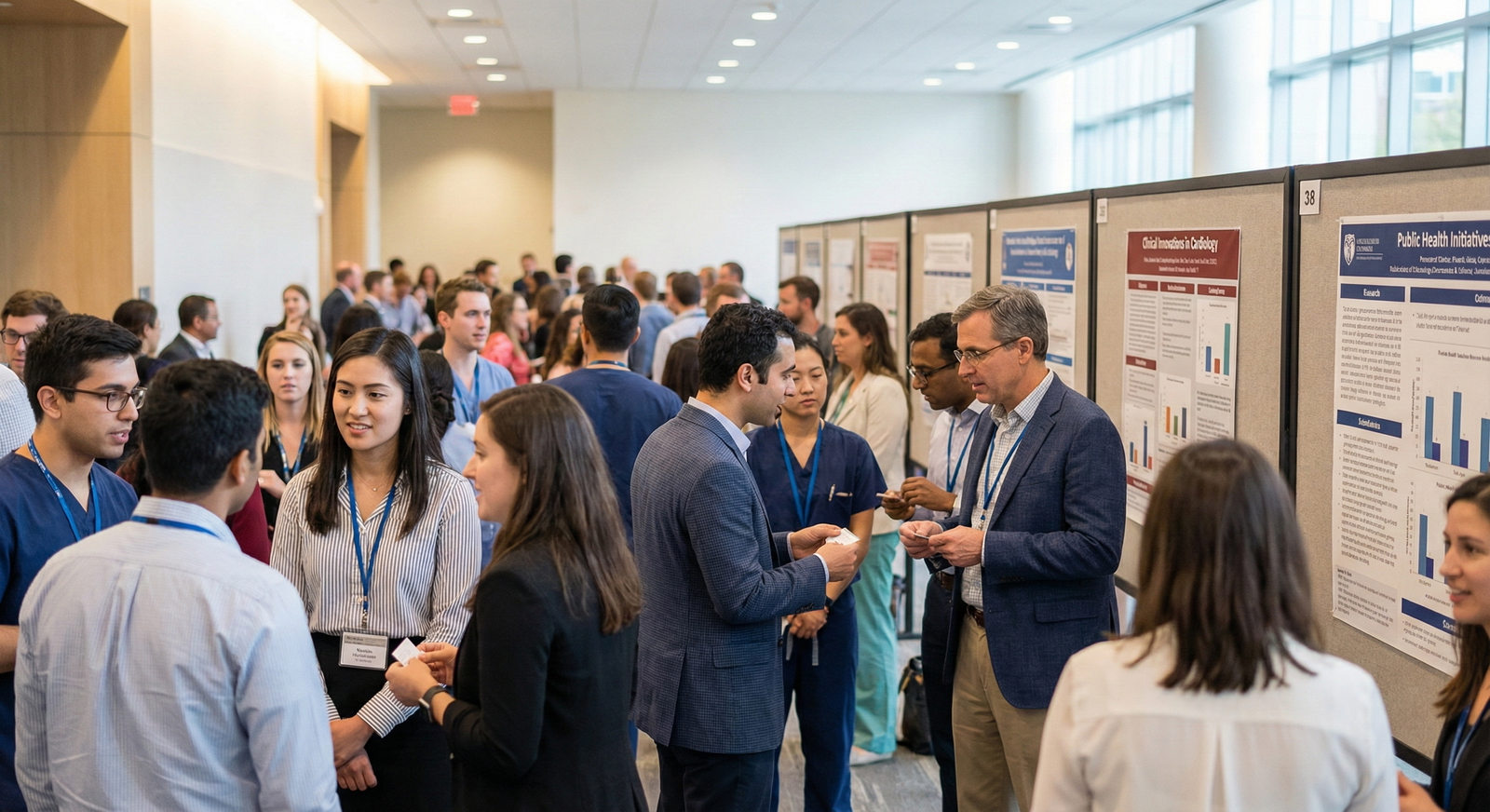
At poster sessions:
- Visit posters in your interest area; engage the presenters.
- If you share a DO background, mention it:
“I’m also a DO graduate and interested in [field]. How did you get involved in research at your institution?”
At receptions and social events:
- Aim to speak with a few new people rather than staying only with friends.
- Use simple openers:
- “What brought you to this conference?”
- “What field are you in?”
- “Have you been to this meeting before?”
- If you discover a shared interest, ask:
“Would you be open to connecting on LinkedIn or exchanging emails? I’d love to follow up on [topic].”
4. Follow-Up: Where the Real Networking Happens
Most people don’t follow up; this is where you can stand out.
Within 3–5 days after the conference:
Send a short, tailored email or LinkedIn message:
“Dr. [Name], it was a pleasure meeting you at [Conference] after your session on [topic]. I appreciated your insights on [specific point]. As a DO resident interested in [field], I’d value any advice you have on early-career steps. Thank you again for your time.”
Offer something in return, even if small:
- Sharing an article or guideline relevant to what you discussed
- Volunteering to help on a small project (e.g., literature review)
Over time, a few of these connections may evolve into mentorship relationships or collaborative partnerships.
Finding and Cultivating Mentorship in Medicine as a DO
Mentorship medicine is particularly crucial for DO graduates. A good mentor can help you:
- Strategize around the osteopathic residency match or fellowship
- Navigate any DO-related bias you encounter
- Identify ways to highlight your osteopathic training as an asset
- Build an academic portfolio and long-term career vision
1. Identify Different Types of Mentors
You don’t need one perfect mentor. Aim for a “mentorship board” with varied strengths:
- Clinical mentor: Guides your growth as a physician in a specific field
- Career mentor: Helps with long-term planning, job search, networking
- Research/academic mentor: Supports projects, publications, and presentations
- Peer mentor: A near-peer (PGY-2, PGY-3, recent graduate) who remembers what you’re going through
- Osteopathic identity mentor: A DO who’s a few years ahead, who can help you maintain and market your osteopathic skills
These roles may overlap, but thinking this way helps you fill gaps.
2. How to Ask for Mentorship (Without Making It Awkward)
Instead of starting with, “Will you be my mentor?” begin with smaller, concrete asks:
“Would you be open to a 20-minute meeting sometime this month so I could get your advice on [specific topic] as a DO resident?”
If the conversation goes well and you click:
“I’ve really appreciated your perspective. If you’d be comfortable with it, I’d love to stay in touch and occasionally ask for your guidance as I navigate [field/career decision].”
This lets a mentorship relationship form organically, based on mutual respect and shared interests.
3. Being a Good Mentee
You’ll attract and retain stronger mentors if you:
- Show up prepared with specific questions
- Respect their time (end on time, keep emails concise)
- Follow through on their advice when reasonable—and report back on outcomes
- Own your decisions; mentorship is guidance, not outsourcing your career
Example follow-up to show you value the mentorship:
“Thank you again for your advice about reaching out to DO graduates in [field]. I emailed two people you suggested and already had a helpful call with one of them. Your guidance made a big difference.”
Leveraging Digital and Local Networks as a DO Graduate
Not all networking is in-person. For many DO graduates, especially those in smaller programs or remote locations, digital and local networking are essential.
1. Online Communities and Social Media
Used wisely, platforms such as LinkedIn, Twitter/X, and specialty forums can amplify your network.
Tips:
- Follow leaders in your specialty and active DO physicians.
- Share articles with brief, thoughtful comments (avoid controversial or unprofessional content).
- Highlight your posters, publications, and presentations in a low-key way:
“Honored to present our QI project on [topic] at [Conference]. Grateful to my team and mentors for their support.”
Avoid oversharing personal frustrations, gossip about programs, or anything you wouldn’t want a future PD to see.
2. Local Medical Societies and Hospital Committees
Local and state medical societies often welcome early-career physicians and DO graduates:
- Join your state’s osteopathic association and/or medical society.
- Attend dinners, CME events, or town halls—ideal places for conference networking at a smaller scale.
- Volunteer for young physician sections or advocacy committees.
Within your hospital, consider:
- Resident wellness or education committees
- Quality and safety councils
- Diversity, equity, and inclusion initiatives
These venues put you in contact with leaders outside your department, which can lead to unexpected opportunities.
3. Alumni and DO-Specific Networks
Tap into:
- Your DO school’s alumni association
- Regional DO graduate groups on LinkedIn or Facebook (vet quality and professionalism first)
- AOA, specialty-specific osteopathic organizations, and their mentoring programs
A shared DO background often makes it easier to start a conversation:
“I’m a DO graduate from [School], now training in [location]. I’d love to hear about your path as a DO in [field] and any advice you might have.”
Common Pitfalls and How to Avoid Them
Even well-intentioned DO graduates can undermine their networking efforts with avoidable missteps.
1. Being Too Transactional
People sense when you only reach out to get something (a letter, a spot, an introduction).
Fix: Aim to build authentic, long-term relationships. Be curious about the other person’s work and path. Offer help where you can, even as a trainee (e.g., assistance on a project, sharing relevant literature).
2. Over-Apologizing for Being a DO
You never need to apologize for your degree. If someone seems unfamiliar with DO training, view it as an opportunity to educate, not defend.
Example response:
“Yes, I’m a DO graduate. Our training is fully accredited and includes the same core medical curriculum and clinical rotations as MD programs, plus additional hours in OMT and a strong emphasis on whole-person care.”
State facts calmly and confidently.
3. Neglecting Follow-Up
Many promising conversations die for lack of follow-up.
Fix: After every conference or meaningful encounter, write down names and 1–2 details. Block 30–60 minutes the next week to send tailored messages.
4. Overcommitting
As a DO resident or new graduate, time and energy are limited. It’s easy to say “yes” to every committee, project, or invitation and then feel overwhelmed.
Fix: Choose opportunities aligned with your goals. It’s better to do a few things well than ten things superficially.
FAQs: Networking in Medicine for DO Graduates
1. How early should I start networking as a DO student or graduate?
Ideally, start in late medical school—during clinical rotations and early conferences. However, it’s never too late. If you’re already a DO graduate or in residency, begin now with your current institution, local societies, and online platforms. Focus first on existing contacts (faculty, preceptors, classmates) before expanding outward.
2. What if I’m introverted and find conference networking overwhelming?
You don’t need to “work the room.” Instead, set small, realistic goals: have 2–3 meaningful conversations per day, or speak briefly with one speaker after a session. Prepare a few open-ended questions in advance and practice a simple self-introduction. Quality matters far more than quantity.
3. Is it okay to ask for a letter of recommendation from someone I met through networking?
Yes—but only after you’ve built a real working relationship (e.g., they’ve supervised you clinically or on a project). A mentor who knows your work is far more valuable than a “big name” who barely remembers you. When you ask, be specific about the purpose, provide your CV and personal statement, and give ample time.
4. How can I maintain my OMT skills and osteopathic identity while networking in predominantly MD environments?
Seek out DO mentors locally or online, attend osteopathic-focused workshops, and volunteer to demonstrate OMT when appropriate (e.g., resident lectures, skill sessions). In conversations, integrate OMT as a strength and tool in your toolkit, not as your only defining trait. Networking with both DO and MD colleagues will help you position yourself as a well-rounded physician who brings valuable osteopathic skills to patient care.
For a DO graduate navigating residency life and its challenges, networking in medicine is not optional—it’s a core professional skill. By clarifying your goals, building a strong professional presence, engaging thoughtfully at conferences and in your institution, and cultivating mentorship, you can create a robust, supportive network that will serve you throughout your career.