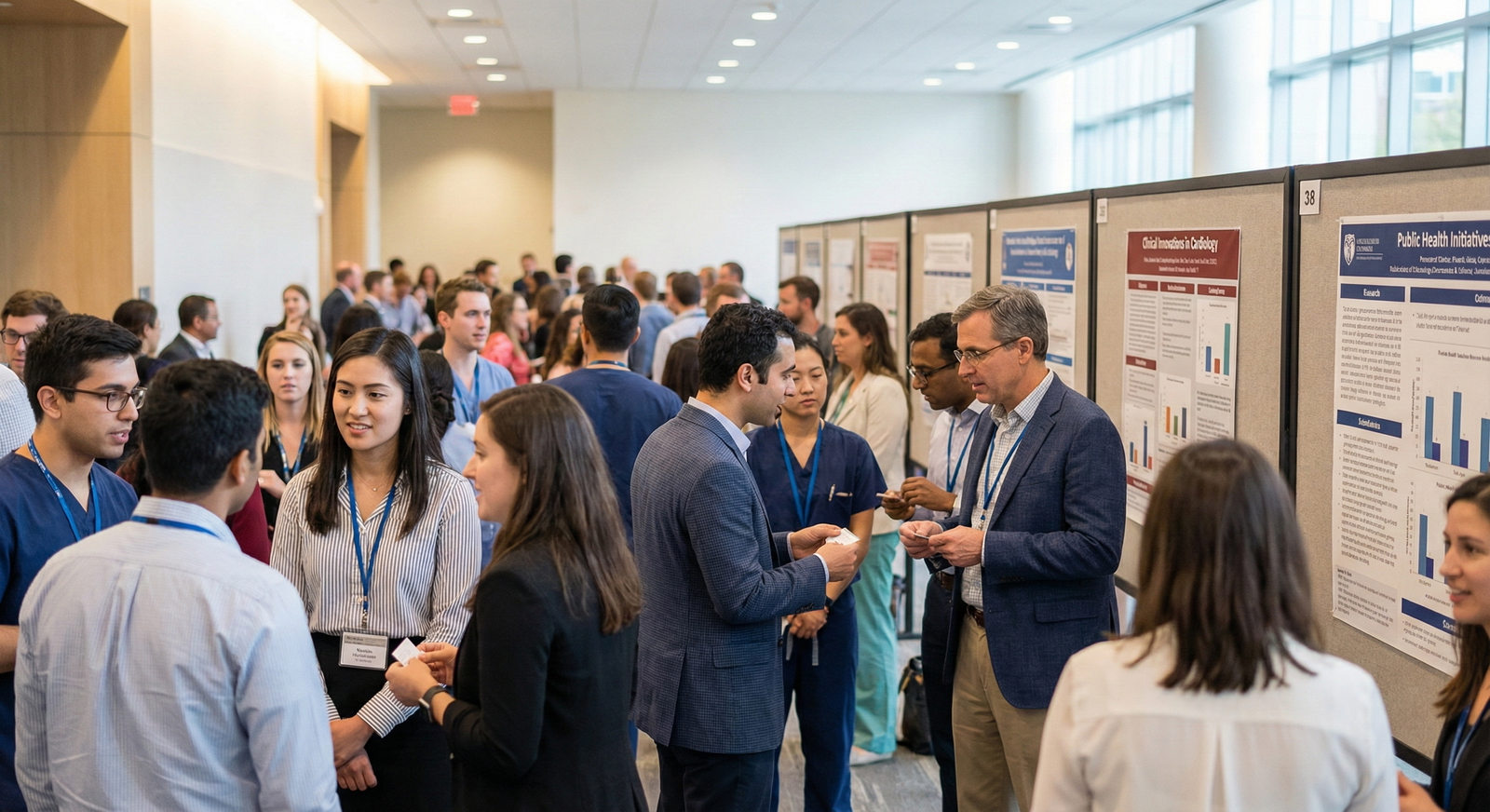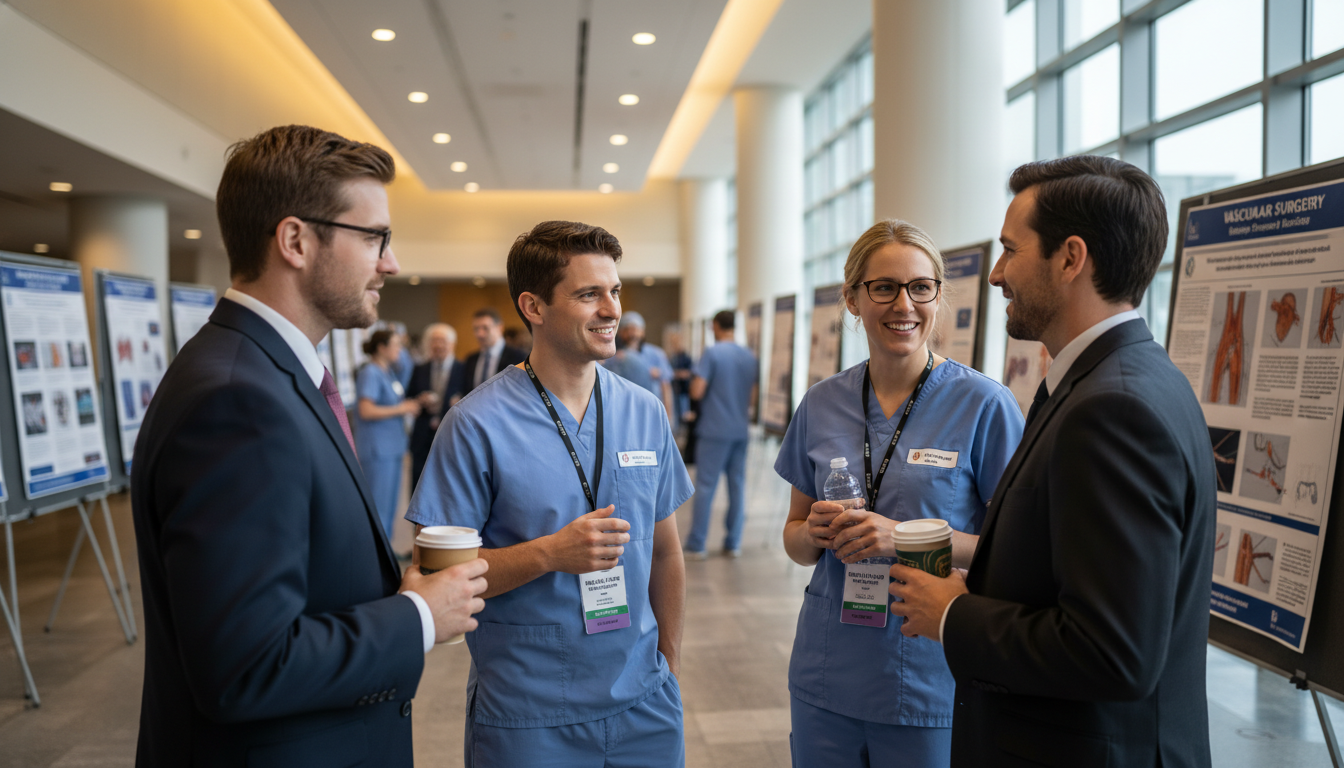
Networking in medicine is not a soft, optional skill—it is a core professional competency, especially in a highly specialized field like vascular surgery. Whether you are targeting an integrated vascular program, applying to fellowship after general surgery, or already in vascular surgery residency, your network will influence your training opportunities, research productivity, letters of recommendation, and eventually your job offers.
This guide focuses on what networking really looks like in vascular surgery, how to build authentic relationships at every stage of training, and how to leverage medical networking strategically without feeling transactional or insincere.
Why Networking Matters So Much in Vascular Surgery
Vascular surgery is a relatively small, highly connected specialty. That reality makes networking in medicine particularly important here.
A small world with long memories
Compared with internal medicine or general surgery, the vascular community is small:
- Fewer residency positions (especially integrated vascular program spots)
- Fewer fellowship programs
- A tight community of academic and private practice groups
Program directors, division chiefs, and faculty routinely know each other through:
- Conferences and national societies
- Multicenter research collaborations
- Training lineages (who trained where, and with whom)
This means:
- Your mentors might personally know the PD of the program you are applying to.
- A strong recommendation can carry unusually high weight.
- A poor reputation can spread quickly.
Networking is about signal, not spin
In vascular surgery, networking is not about “selling yourself” or being loud in a room. It is about:
- Making your interests and goals visible
- Demonstrating reliability, curiosity, and professionalism
- Building a track record of collaboration and follow‑through
- Giving people enough data points to trust you
In a specialty where patients are complex, decisions are high‑stakes, and outcomes are heavily scrutinized, people hire colleagues, not résumés. Networking helps you become visible as the kind of colleague others want on their team.
Where networking shows its impact
For a vascular surgery–bound trainee, networking can directly translate into:
Opportunities for early exposure
Shadowing in the OR, joining a vascular clinic, or attending vascular conferences as a student.Research and scholarly work
Multi-institutional studies, QI projects, database work, and case series often arise from networks, not cold emails alone.Stronger, more targeted letters
Faculty who truly know you can write specific, high-impact letters that match your vascular surgery story.Interview invitations and rank list support
A phone call or email from a trusted colleague can move an application from the “maybe” pile to the interview list.Early career positions
Many vascular jobs (especially desirable hybrid academic/private opportunities) are filled by word-of-mouth and informal networking.
Foundations of Effective Medical Networking in Vascular Surgery
Before diving into conferences and social media, you need the right mindset and core behaviors.
1. Focus on relationships, not transactions
The most respected vascular surgeons tend to:
- Follow up on commitments
- Support juniors without expectation of return
- Invest in mentees over years, not weeks
Approach networking with the same long-view mindset:
- Don’t ask, “How can this person help my application tomorrow?”
- Ask, “Is this someone I want to learn from and collaborate with over the next decade?”
You are building a professional community that will shape your entire career, not just your match.
2. Be reliably excellent in small things
Your reputation is built on repeated small encounters, such as:
- Responding promptly and professionally to emails
- Showing up on time for clinics, conferences, and meetings
- Completing IRB tasks or data abstraction you volunteered for, on schedule
- Proofreading abstracts before submission
When vascular surgeons notice that you consistently do the small things well, they extrapolate that you will handle bigger responsibilities the same way—OR cases, independent call, complex patients. That trust is what makes people invest in you.
3. Develop a clear, evolving narrative
Program directors and faculty are more likely to remember you if they understand your story. For vascular surgery, this might include:
- What drew you to vascular surgery (e.g., endovascular innovation, limb salvage, complex open aortic work, longitudinal patient care)
- Specific interests (e.g., CLTI, aortic pathology, dialysis access, venous disease, health disparities, outcomes research)
- How your skills align with those interests (e.g., imaging, statistics, device design, QI methodology)
You don’t need a perfectly polished “pitch,” but you should be able to articulate, in 30-60 seconds:
- Who you are
- Where you are in training
- What your vascular interests are
- What you’re hoping to learn or explore next
This makes it easier for mentors and potential collaborators to identify opportunities that fit you.
4. Build a visible professional presence
For networking in medicine today, especially in vascular surgery, visibility happens in multiple spaces:
- Locally: Your home institution’s vascular division
- Regionally: State/regional vascular societies, local research networks
- Nationally: SVS, AVF, ACS, SIR/vascular-focused sessions, and related societies
- Online: Email, institutional pages, and professional social media (especially X/Twitter and LinkedIn)
Aim to be:
- Findable: Your name shows up on institutional sites or conference programs
- Contactable: People can clearly see how to reach you
- Credible: Your scholarly and clinical interests are evident

Mentorship in Medicine: Strategic Mentors for Vascular Surgery
Mentorship medicine is especially powerful in vascular surgery because of the specialty’s size and complexity. You will likely need different types of mentors.
Types of mentors you should intentionally seek
Local vascular surgery mentor (clinical)
- Attending at your home institution
- Helps with shadowing, OR exposure, and clinical skills
- Can provide early letters and program guidance
Research mentor (possibly vascular, possibly not)
- Someone who has ongoing, publishable work
- Teaches research design, manuscript writing, and deadlines
- May be in vascular, cardiology, radiology, surgery, or outcomes research
Career mentor in vascular surgery
- Often a vascular attending with broader connections
- Guides overall strategy: integrated vs. fellowship, academic vs. private practice
- Advises on conference selection, networking, and long-term planning
Near-peer mentors
- Senior residents, vascular fellows, or recent graduates
- Provide high-yield, practical advice: how to approach a rotation, how to study, how to impress on vascular services
- Often more approachable for “small” questions
External mentor (at another institution)
- Can provide perspective outside your local culture
- Often found via conferences, research collaborations, or introductions
- Particularly valuable if your home institution has limited vascular exposure
How to approach potential mentors
Many students hesitate to “bother” faculty. In reality, most vascular surgeons enjoy mentoring motivated learners. When reaching out:
Use a concise, respectful email:
- Who you are (MS3 at X, PGY-2 at Y, etc.)
- Your interest in vascular surgery
- How you found them (saw them present at SVS, recommended by Dr. A, etc.)
- A clear, modest ask (15–20 minute Zoom to discuss career questions; possibility of joining an ongoing project; shadowing opportunity)
Attach or link supportive material:
- A 1-page CV
- Your general availability
Example email opening:
My name is [Name], an MS3 at [Institution] with a strong interest in vascular surgery, particularly limb salvage and endovascular interventions. Dr. [X] suggested I reach out to you given your work in CLTI. I’m hoping to learn more about career paths in vascular surgery and explore potential research involvement.
Then follow through: show up on time, come with a short list of questions, and send a brief thank-you email afterward.
Maintaining mentor relationships
Mentorship is sustained by ongoing, low-friction communication:
Send brief updates every few months:
- New publications or presentations
- Rotations you completed
- Upcoming application cycles
Share tangible progress:
- “That project you suggested is now submitted to JVS.”
- “I’m presenting our abstract at SVS this June.”
Ask specific questions, not “What should I do with my life?”:
- “I’m deciding between submitting this paper to JVS vs. Annals VS; what would you recommend?”
- “Would you mind reviewing my personal statement for vascular applications?”
This cadence helps mentors invest more deeply, because they can see real momentum and impact.
Conference and Society Networking: Where Vascular Surgeons Actually Meet
Conference networking is one of the most efficient ways to immerse yourself in the vascular surgery community, especially if you’re aiming for a vascular surgery residency or fellowship.
Key societies and venues include:
- SVS (Society for Vascular Surgery) – premier U.S. vascular meeting
- VAM (Vascular Annual Meeting) – flagship SVS conference
- AVF (American Venous Forum) – venous/lymphatic focus
- Regional vascular societies (e.g., Eastern, Southern, Western)
- ACS Clinical Congress – strong vascular presence
- Specialized meetings focused on endovascular techniques or aortic disease
Preparing for conference networking
Before you step onto the conference floor:
Study the program
- Identify vascular sessions that match your interests (e.g., CLTI, EVAR, carotid disease, access)
- Note speakers and moderators you’d like to meet
- Look for “young surgeon,” “resident/student” events or mentorship sessions
Know who from your institution is attending
- Ask which vascular attendings, fellows, and residents will be there
- Let them know you are attending and would value introductions
Have a few “anchors”:
- A poster or oral presentation
- A scheduled mentor meeting
- A society-sponsored trainee networking event
These built-in events give you natural touchpoints to start conversations.
How to network in real time
At the conference:
Attend talks and actually listen
- Note a specific point or question that you could later discuss with the presenter or a mentor
- Example: “I was particularly struck by your data on lesion length in CLTI. How do you think that should change everyday practice?”
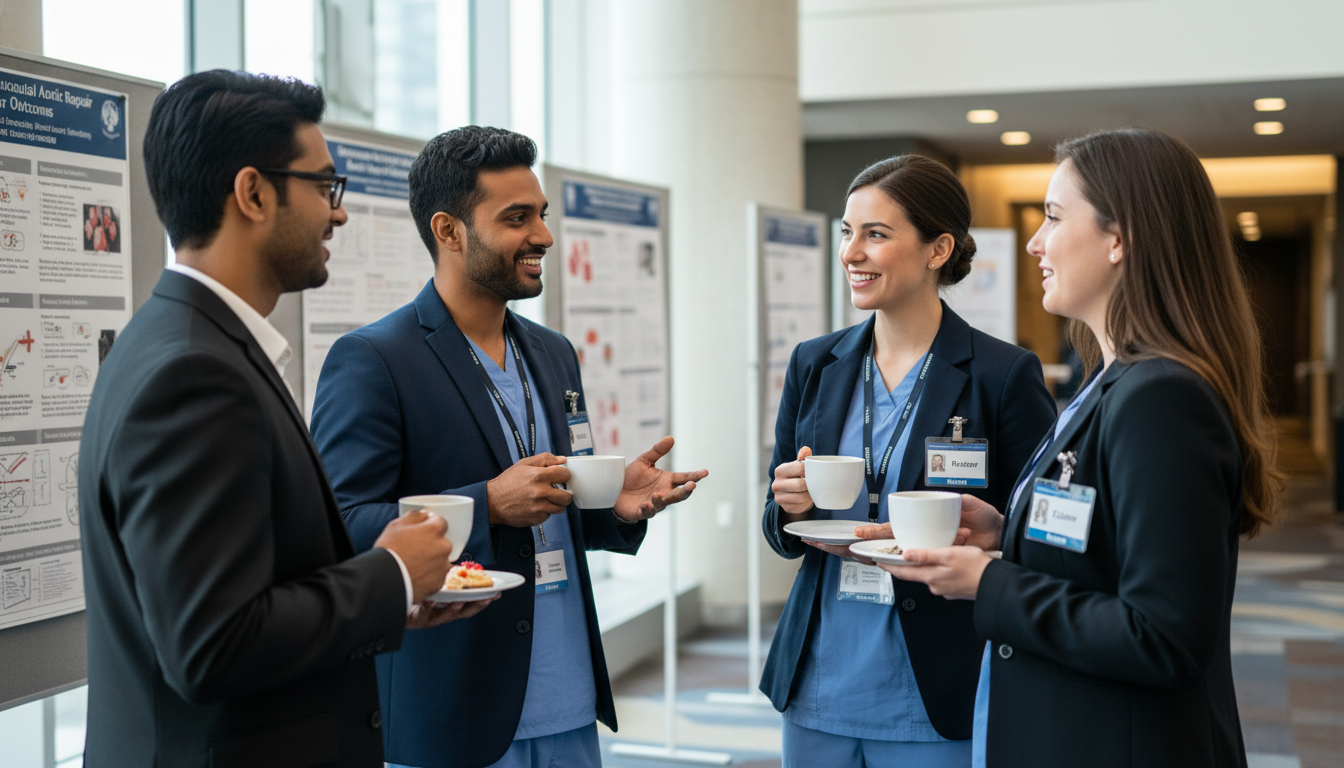
Use the poster sessions strategically
- Introduce yourself to presenters in vascular surgery topics that interest you
- Ask about how the project began and who was involved—this often reveals research networks you can join
Leverage your mentors’ networks
- Ask a local mentor: “If you’re comfortable, is there anyone you’d recommend I meet at VAM who works on [your interest]?”
- When they introduce you, be ready with a concise self-introduction and a thoughtful question.
Have a simple conversational script
- “I’m [Name], an MS3 at [Institution], very interested in vascular surgery. I’ve really enjoyed learning about [subarea]. I wanted to introduce myself and thank you for your work on [topic].”
Following up after the conference
Within 3–7 days after the meeting:
Email individuals you met:
- Briefly remind them where you met and what you discussed
- Thank them for their time or guidance
- If appropriate, ask a light next-step question (e.g., “If you ever need help with [project area], I’d be happy to contribute.”)
Update your CV:
- Add any presentations or committee roles
- Note who you connected with—these notes are invaluable when application season arrives.
Share key lessons with peers:
- This reinforces your insights and positions you as someone plugged into the vascular community.
Everyday Networking in Vascular Surgery Residency and Integrated Programs
For those in, or aiming for, an integrated vascular program or traditional route, a great deal of impactful networking happens in your daily environment.
Networking on rotations: being the resident people remember
Whether you’re a student on a vascular rotation or a junior resident:
Know the patients well
- Be the person who has all the data: imaging, labs, consult notes, prior ops
- Anticipate the next steps: “We’ll need a CT angio by this afternoon”
Engage with the “why,” not just the “what”
- Ask thoughtful, not constant, questions:
- “How did you decide between open and endovascular for this case?”
- “What factors pushed you toward bypass instead of angioplasty alone?”
- Ask thoughtful, not constant, questions:
Show progression over the rotation
- Faculty notice when your notes improve, your presentations tighten, and your understanding deepens over 2–4 weeks
- That trajectory often influences how strongly they advocate for you later
These behaviors build your clinical reputation—one of the purest forms of medical networking.
Research as a networking engine
Research in vascular surgery is not just about line items on your CV; it’s an active networking tool:
Join existing initiatives
- Large registries (e.g., VQI-based projects), QI initiatives, or institutional studies
- These often include cross-institutional teams—instant network expansion
Be the “closer”
- The person who moves a project from data collection to abstract to manuscript
- Vascular faculty remember who finishes work; they will repeatedly pull you into new opportunities
Present your work
- Presenting at VAM, AVF, or regional meetings raises your profile tremendously
- Discuss your project at your home institution’s M&M or research days—more people learn your name and interests
Online presence and medical networking
Used wisely, social media can be a powerful adjunct to in-person networking in vascular surgery:
X (Twitter)
- Follow vascular journals, societies, and thought leaders
- Share accepted abstracts, publications, and conference takeaways
- Engage respectfully in case discussions (without sharing PHI)
LinkedIn
- Good for a CV-like public profile
- Connect with mentors and conference contacts after meeting them
Professional boundaries
- Avoid case photos with identifying features or unique details
- Keep commentary professional—disagreements should be data-driven and respectful
- Remember: programs and employers see your digital footprint
Strategic Networking for the Vascular Surgery Match and Early Career
As you move closer to applying—whether to an integrated vascular program from medical school or to fellowship from general surgery—networking becomes more directed.
For medical students aiming for an integrated vascular program
Key steps:
Engage early (MS2 or early MS3)
- Identify at least one local vascular mentor
- Seek 1–2 focused research projects that can realistically produce abstracts or manuscripts by MS4
Make your interest unmistakable
- Attend vascular conferences if feasible
- Join student/resident sections of relevant societies
- Request vascular electives/sub-internships at home and, if possible, away rotations
Be intentional about away rotations
- Target programs where:
- You could realistically match
- There is a culture of teaching and mentorship
- Treat every day as both an audition and a learning opportunity—this is networking in medicine at its most high-stakes.
- Target programs where:
Leverage mentor advocacy
- Your mentors can email or call PDs to highlight your strengths
- Provide them with an updated CV and brief summary of your key contributions (papers, projects, teaching)
For general surgery residents applying to vascular fellowship
Networking is even more central at this stage:
Regional and national presence
- Present at VAM, ACS, or regional vascular meetings
- Join vascular committees or trainee groups when possible
Cultivate multiple vascular advocates
- At least:
- Your division chief or vascular program director
- Another vascular attending who knows your day-to-day work
- A research mentor (vascular if possible)
- At least:
Let your network know your timeline
- Around a year before applying:
- Inform mentors of your plans
- Ask for feedback on which programs might be a good fit
- Request early letter commitments
- Around a year before applying:
Make the most of interview days
- Treat interview dinners, pre-interview gatherings, and post-interview emails as extended networking:
- Show authentic curiosity about the program’s culture, case mix, and fellow autonomy
- Follow up with thank-you notes that reference specific conversations
- Treat interview dinners, pre-interview gatherings, and post-interview emails as extended networking:
Early career: transitioning from trainee to colleague
Once you are a vascular fellow or early attending:
Shift from mentee to collaborator
- Offer to help with multi-center trials, guideline projects, or teaching sessions
- Mentor students and residents seriously; your reputation as a teacher spreads quickly
Engage with societies beyond attendance
- Volunteer for committees (e.g., education, quality, young surgeons)
- Offer to moderate sessions, review abstracts, or help with trainee events
Network for jobs early and honestly
- Be transparent with mentors about your career goals (geography, practice type, research vs. clinical focus)
- Many vascular surgery jobs come from an email that begins, “We are looking for someone; do you have a fellow or junior colleague who might be interested?”
FAQs: Networking in Vascular Surgery and Medical Training
How early should I start networking if I’m interested in vascular surgery?
Start as soon as you have a genuine interest—often MS2 or early MS3. At that stage:
- Seek shadowing in vascular clinic or OR.
- Introduce yourself to the vascular division.
- Take on small, doable research tasks to build momentum.
You don’t need a complete CV or a perfect vision of your future; you just need curiosity and reliability.
I’m at a school with little or no vascular surgery presence. What can I do?
You can still build a vascular network:
- Reach out to vascular surgeons at nearby institutions for shadowing or case conferences.
- Attend regional or national vascular conferences, even as a student.
- Email potential external mentors whose work you’ve read or seen presented; ask about remote involvement in research projects.
- Use virtual opportunities—webinars, online journal clubs, and society events—to meet people.
I feel awkward networking at conferences. How can I make it easier?
Use structure to reduce anxiety:
- Go with a short list of 3–5 people you’d like to meet.
- Ask your mentor to introduce you to 1–2 of them.
- Prepare 2–3 simple questions about each person’s work.
- Start with group conversations (e.g., after a talk, at a poster) before initiating 1-on-1 chats.
Remember: faculty expect trainees to be a little nervous. Politeness, preparation, and genuine interest go much further than flawless delivery.
How do I avoid coming across as transactional or opportunistic?
Anchor your networking in curiosity and contribution:
- Ask about others’ work and genuinely listen.
- Offer help on projects within your skill level.
- Maintain relationships over time, not just during application season.
- Share your progress and express gratitude when mentors support you.
When you consistently show up as someone who learns, contributes, and follows through, people will see you as a valued member of the vascular surgery community—not as someone just “working the system.”
Networking in medicine, especially in vascular surgery, is not a one-time activity—it's a career-long practice. By cultivating genuine relationships, engaging in thoughtful conference networking, and leveraging mentorship medicine intentionally, you build more than a match strategy: you build a professional community that will shape and sustain your career for decades.