

It’s 11:47 pm. You’re in bed, blue light frying your eyeballs, rereading an email you sent to a program director earlier.
You thought it was fine when you hit send. Now you’re wondering if that one line — that slightly desperate “You’re my top choice” you also said to two other programs — just violated an NRMP rule you only half remember from orientation.
And now the spiral:
What if they report me?
What if NRMP bans me for Match violations?
What if I can never do residency in the US because of this one stupid email?
Let’s walk through this like someone actually living inside that anxiety. Because I’ve watched people do exactly what you’re doing right now — zoom in on one email and inflate it into “career death penalty.”
First: What Actually Gets You in Trouble With NRMP (And What Just Feels Scary)
Let me be blunt:
NRMP is not sitting in an office somewhere reading your post-interview emails. They’re not combing through your “thank you so much for having me” notes looking for a gotcha.
They get involved when:
- Someone files a formal violation report
- There’s evidence of a pattern of dishonesty or coercion
- A program or applicant refuses a Match commitment
One slightly overeager or awkward email that you now regret?
Almost never the hill your career dies on.
Here’s the part that matters: NRMP rules are mainly about commitments, contracts, and fairness, not about punishing socially anxious applicants for clumsy communication.
So let’s talk about the realistic risk: what one “bad” email can do — and what it almost certainly can’t.
What Counts as a Real NRMP Violation vs. “I Sounded Awkward”
There actually are things you can do in email that cross into NRMP territory. But they’re way more extreme than what most anxious applicants are afraid of.
Things That Can Be NRMP Violations (Email or Otherwise)
These are the “yes, they care” actions:
You back out after you match
You match to a program, then email them: “I’ve decided not to come, I got a better offer elsewhere.”
That’s a huge problem. Reneging on a Match commitment is one of the top reasons applicants end up barred from future Matches.You try to arrange a pre-Match deal in a Match-participating program
Like: “If you promise to rank me #1, I’ll withdraw from other programs” or “Can you guarantee me a spot outside the Match?” in an NRMP-participating program.
This is absolutely not allowed.You misrepresent your status in a way that materially affects the Match
Example: You email programs saying “I have already been accepted at X program but I’m still interested in you” when that’s a lie, trying to pressure them or increase your appeal.You try to manipulate another applicant’s rank list
Yes, NRMP even cares about things like: “If you rank this program lower, I’ll rank you higher at my program in return” (rare but nasty).
Things That Are Not NRMP Violations (But Can Still Hurt You)
Now the category you’re probably actually in:
- Saying “You’re my top choice” to more than one program
- Saying “I intend to rank you highly” in a generic, non-specific way
- Sending a pushy or overly frequent follow-up email
- Sounding desperate, awkward, or unpolished
- Accidentally oversharing your rank intentions (“You’ll be #2 unless X program ranks me too low”)
NRMP doesn’t police honesty in thank-you letters. They don’t punish you for being inconsistent in post-interview communication. That’s not their lane.
Programs might not like it. They might roll their eyes. They might consider you less professional.
But NRMP? They get involved when the integrity of the Match process itself is compromised — not when someone sends a cringe email.
The Big Fear: “I Told Two Programs They’re My #1. Is That an NRMP Crime?”
This one comes up constantly.
You told Program A: “You’re my top choice. I plan to rank you #1.”
A week later, after another amazing interview, you told Program B the exact same thing.
And now you’re lying in bed thinking:
“If they compare notes, will I get reported for Match violations?”
Let me be very clear:
NRMP does not have a rule that says “You must be honest in post-interview communication about your rank list.”
They explicitly say that post-interview communication is non-binding.
Is it ethical to tell multiple programs they’re your “#1”? Honestly? Questionable.
Is it sleazy? Yeah, kind of.
Is NRMP going to ban you from the Match for it? No.
Here’s what actually happens in real life if programs realize you told others the same thing:
- They may think you’re disingenuous.
- They may lower you on their rank list.
- They may ignore or discount your communication altogether.
That’s the real consequence: how programs view you, not NRMP sanctions.
What Does It Take to Get “NRMP-Banned” in Reality?
Let’s talk about what you’re actually scared of: that “barred from future Matches” phrase.
NRMP can impose sanctions that include:
- Public listing as a violator
- Being barred from the Match for 1–3 years
- In severe or repeated cases, permanent exclusion
That sounds horrifying. I know.
But those penalties usually come from stuff like:
Breaking a Match contract
You match → you don’t show up or you refuse the contract.Accepting a position outside the Match that conflicts with a Match commitment
For example, you match to a categorical program, then take a PGY-1 spot somewhere else instead.Programs and applicants making illegal side deals
“Rank me first and I promise I’ll come; if you don’t, I’ll do X.” That type of garbage.Serious misrepresentation tied directly to the Match
Like fake credentials, fake exams, fraud-level stuff.
So where does your one bad email fall on this spectrum?
Almost certainly nowhere near it.
For NRMP to even look at it:
- A program would have to be angry enough to file a formal report.
- NRMP would need clear evidence of a violation of Match policy, not just “this email annoyed me.”
- It would have to be significant enough to impact the fairness/integrity of the Match process.
“That thank you note sounded a little pushy” is not that.
The Emails That Make You Look Bad (But Not “Banned From Match” Bad)
There are emails that can hurt you — not legally, but practically.
Here’s where anxiety is actually pointing at something real: how you’re perceived.
| Email Type | NRMP Risk | Program Impression Risk |
|---|---|---|
| Simple thank you note | Very Low | Very Low |
| “You’re my top choice” (one program only) | Very Low | Low |
| “You’re my top choice” (copy-pasted to many) | Very Low | Moderate |
| Repeated “any update?” follow-ups | Very Low | Moderate |
| Aggressive or entitled emails | Very Low | High |
Examples of emails that can make programs not love you:
The daily follow-up
“Just checking in on my rank status.” sent 4 times over 3 weeks.
Programs do talk: “This applicant is…a lot.”The guilt trip
“I’ve worked so hard and really deserve a spot in your program. I hope you’ll give me a chance.”
It makes them uncomfortable. Not illegal. Just off-putting.The subtle threat
“Other programs are very interested in me, but I’d consider you if you indicate strong interest.”
This sounds manipulative. Programs hate this.
Again, none of this is NRMP-banishment territory. It’s “you might quietly slide down their rank list” territory.
What About Programs Violating NRMP Rules Over Email?
Let’s flip it, because sometimes what you’re anxious about is actually something they’re doing, not you.
Programs are not supposed to:
- Ask you how you’re going to rank them
- Ask you to reveal your rank list
- Tell you that you have a “guaranteed spot” if you rank them a certain way
- Pressure you to commit verbally before the Match
So if a PD emails you:
“Will you rank us #1? We only want applicants who commit to us first,”
that’s their problem, not yours.
Does NRMP expect you to report them? No. You can, but you’re not obligated.
Are you in trouble just for replying? No.
A safe reply looks like:
“Per NRMP policy, I understand the Match process is binding and confidential, so I’ll be submitting my rank list through NRMP. I remain very interested in your program.”
Polite. Non-committal. NRMP-safe.
Worst-Case Scenario You’re Imagining vs. The Reality
Let me lay out what your brain is doing versus what actually happens.
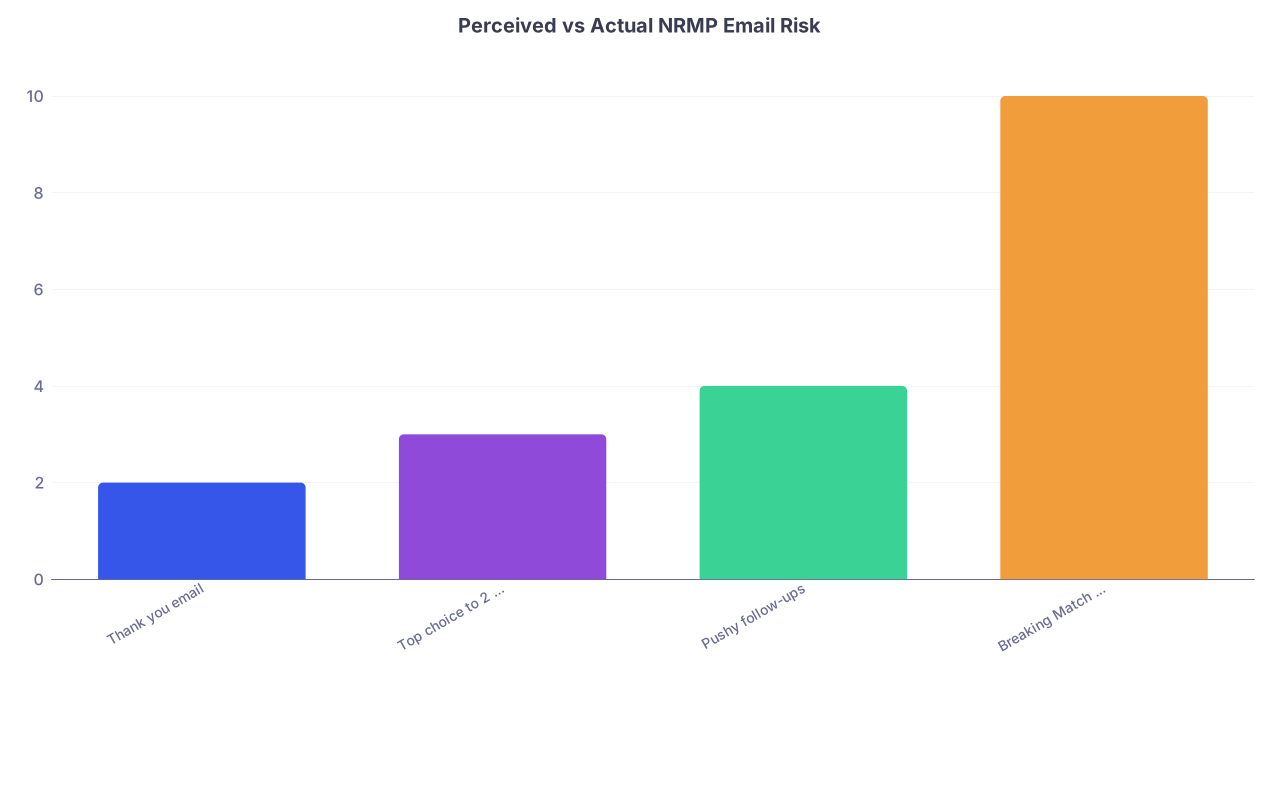
| Category | Value |
|---|---|
| Thank you email | 2 |
| Top choice to 2 programs | 3 |
| Pushy follow-ups | 4 |
| Breaking Match contract | 10 |
Scale 1–10, where 10 is “NRMP definitely cares”.
- That thank you email you rewrote 8 times? Feels like a 7. Reality: maybe a 1–2.
- Telling two programs they’re #1? Feels like a 9. Reality: maybe a 3 for ethics, 0–1 for NRMP.
- Ghosting your matched program? That’s a real 10.
The gap between perceived threat and actual NRMP risk is huge. Your anxiety fills that gap with worst-case scenarios. Programs filing formal violations over mildly awkward wording is fantasy.
How to Email Programs Without Triggering NRMP Panic (Or Getting Yourself In Trouble)
If you want to sleep better at night, use a simple mental checklist before you hit send:
Am I making a promise I might not keep?
If yes, don’t send it. Never promise “I will rank you #1” unless it’s 100% true.Am I asking them to break Match rules?
If you’re hinting at “can you guarantee I will match here?” — stop.Would I be okay if someone read this email out loud to a room of PDs?
If you’d die of secondhand embarrassment, rewrite.Is my tone respectful, brief, and professional?
Rambling, emotionally loaded, or manipulative emails age badly.
Instead of:
“Please let me know if you plan to rank me highly; I need to know where to rank you.”
Use:
“I remain very interested in your program and appreciate the opportunity to have interviewed with you.”
General principles that keep you safe:
- Don’t negotiate. This isn’t a used car lot.
- Don’t pressure.
- Don’t make conditional statements about ranking based on what they’ll do.
- Don’t lie in specific measurable ways (like fake offers or contracts).
That’s it. You don’t need Olympic-level email skills. You just need to avoid deals, threats, and outright lies.
What If I Already Sent Something Bad?
This is probably what you’re really asking.
You’ve already hit send. You can’t unsend. Your stomach is in free fall.
Ask yourself honestly:
Did I break a Match commitment?
Example: “I know I matched with you, but I’m not coming.”
If yes — that’s serious. You need to talk to your dean or GME office immediately.Did I try to create a side deal?
“If you guarantee to rank me to match, I’ll withdraw from others.”
If this happened, stop all communication like that now. Do not double down.Or… did I just sound overeager / awkward / a little dishonest?
Example: multiple “you’re my #1” emails, or weird phrasing.
This is almost always fixable by… doing nothing. Let it sit. Don’t send more panicked follow-ups trying to “fix” it.
I’ve seen applicants send panicked clarification emails like:
“Just to clarify, you’re actually in my top three, not necessarily number one.”
That makes things worse. Now you look both anxious and inconsistent.
Most of the time, the best damage control is:
- Stop sending more emails.
- Learn from it for future messages.
- Accept that at worst, one program may think you’re a bit much.
NRMP banning you? No.
The Quiet Truth: Programs Don’t Have Time to Ruin You
Programs are busy. PDs are drowning in clinical work, admin, and hundreds of applications.
Filing an NRMP violation:
- Takes time
- Requires documentation
- Is a serious step
- Often escalates beyond just “this person annoyed me”
They’re not going to go through all that because you sent a overeager thank-you or a slightly dramatic “you’re my dream program” line.
Will they remember you as “the email person” when they rank? Maybe.
Will they try to end your entire career over one clumsy message? No.
What You Can Do Tonight So You’re Not Spiraling Over Every Email
Let’s make this concrete so you can actually exhale.
Right now, do this:
- Open your email “Sent” folder.
- Pick the last 1–2 emails you sent to programs that you’re most worried about.
- For each one, ask yourself:
- Did I try to create or discuss a guarantee or deal outside the Match?
- Did I break or deny a Match commitment?
- Did I blatantly lie about contracts, offers, or status?
If the answer is no to all three, your NRMP risk from those emails is effectively zero.
Your action item for today:
Create a tiny, personal “post-interview email template” doc.
One simple thank-you template and one “continued interest” template that:
- Doesn’t mention rank positions
- Doesn’t make promises
- Doesn’t ask them about their rank list
Save it. Use that going forward. Stop freestyling emotional essays in your inbox at midnight.
And the next time your brain whispers, “What if that one bad email gets me banned from the Match?” — pull that doc up, reread your own rules, and remember:
NRMP cares about broken contracts and backroom deals.
Not about one anxious med student trying too hard to sound interested in a thank-you note.


